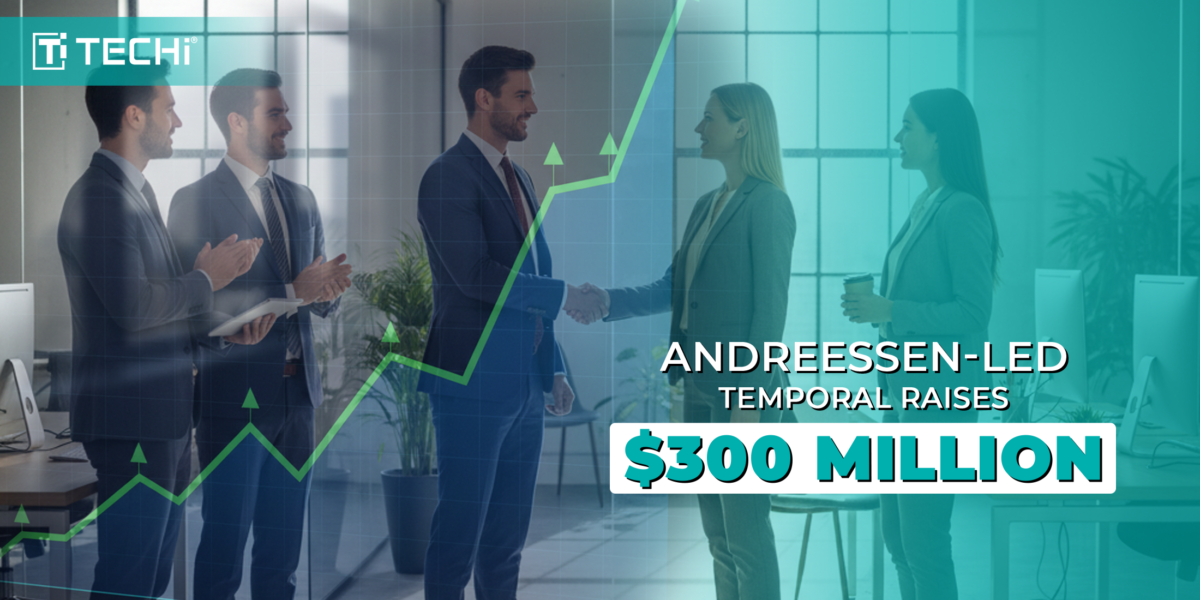
Temporal has garnered a financial edge of $300 million that has seen its valuation soar to $5 billion in one of the rounds of investment tightly headed by the venture capital firm of Andreessen Horowitz.
The valuation, which, thanks to a previous secondary trading, had increased to $2.5 billion in October, is diligently magnified here, as investors are growing more excited by AI infrastructure, in light of the increasing autonomous activity in solving muddy conditions of the real world, due to an artificially created agent.
Funding Frenzy Fuels Growth
The capital investment, which is from Lightspeed Venture Partners, Sapphire Ventures, and Sequoia Capital, is a Series D milestone of the San Francisco-based venture established in 2019.
With over 380 personnel members, the company currently caters to a client base of premium clients, such as OpenAI, Snap, Netflix, and JPMorgan Chase.
The capital-diversified investment will be spent in research and development, and sales and marketing plans that will expand its open-source sustainable execution platform that serves as a free software with a consumption-based Temporal Cloud product.
Why Reliability Rules AI Agents?
The technological strength of Temporal is to have application-resiliency capabilities through failure of a system, and not require custom remedies, and functionality frequently important with artificial-intelligence systems shifting to being more like task-executors, rather than conversational agents.
Co-founder and Chief Executive Samar Abbas said that capability is becoming more critical as AI systems move from generating responses to carrying out real-world tasks.
The stetement:
We’ve been building Temporal for over a decade now and what we are trying to solve is these core reliability problems for distributed systems.
Abbas said in an interview.
When the software moves from generating answers to executing work, the tolerance of failure basically becomes tiny.
Outlook
In the future, Temporal will be poised to dominate, as AI in the form of agents spreads into enterprise platforms, where consistency is expected to take precedence over raw processing speed. Temporal can leverage a market worth of about $5 billion coupled with a strong capitalization by leading capital firms like Andreessen Horowitz to leverage the fast-growing shift to AI-agents.
With the advent of AI systems being more and more commonly implemented within enterprises to handle real-life tasks, the issue of reliability and fault tolerance should take precedence and become indispensable.
In case of this trend continuing, the resilient and distributed workflow management that Temporal focuses on can become a building block in the infrastructure of organizations such as OpenAI and Netflix. The next stage of the firm development is likely to rely on the expansion of its cloud-based offerings and a leadership role in the infrastructure of strong AI implementation.