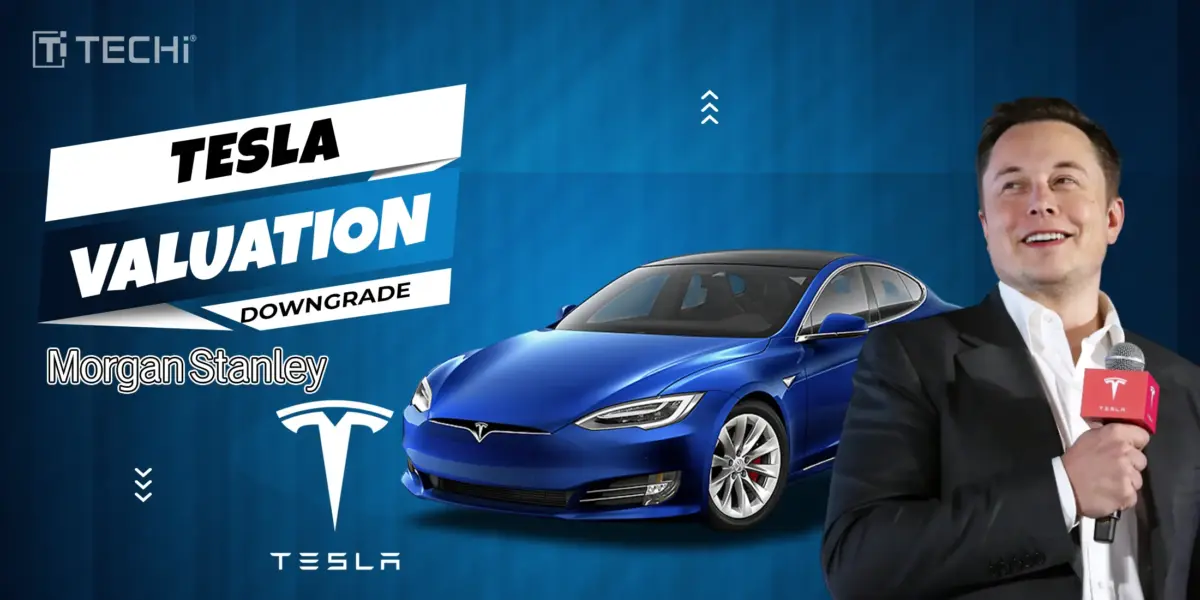
Morgan Stanley recently made headlines by downgrading Tesla’s stock, citing concerns over its overly high valuation. The company’s shift in stance reflects a growing belief that Tesla’s current market price already reflects much of its potential future growth.
The Change in Perspective
The downgrade comes after Andrew Percoco took over as the lead Tesla analyst at Morgan Stanley, replacing Adam Jonas. Percoco’s team has altered Tesla’s stock rating to “Equal-Weight,” a neutral stance, from a previously more bullish view.
At the same time, Morgan Stanley raised its price target to $425 per share, from the prior target of $410. While this suggests a slightly higher valuation, it still signals limited upside potential at the current stock price.
The adjustment follows a broader reassessment of Tesla’s future. The firm now suggests that Tesla’s stock has become overly priced, particularly due to the market already factoring in ambitious, future growth projections, including robotaxis, humanoid robots, and autonomous driving technologies.
Tesla’s Current Valuation and Market Expectations
For years, Tesla’s valuation has been tied to the narrative of becoming an AI and tech powerhouse, with some analysts pushing a “growth at any cost” mentality. However, Morgan Stanley’s recent downgrade indicates a shift in sentiment.
The firm suggests that Tesla’s AI-driven vision for the future—while promising—is not yet guaranteed at the current stock price of $440 per share. This marks a departure from the unrestrained optimism that once defined the company’s valuation.
The company’s stock has always been priced on the promise of significant software margins, but now, with the stock valued over 190x forward earnings, the market is being forced to reconsider. In comparison, companies like Toyota and GM trade at earnings multiples between 7x and 11x, while tech giants like Google are valued around 28x.
The Risks and Uncertainty in Tesla’s Future
One of the key reasons behind the downgrade is the increased uncertainty surrounding Tesla’s growth trajectory. Morgan Stanley notes that Tesla has already seen its future projects—like robotaxis and humanoid robots—factored into the current stock price. If these projects don’t unfold as quickly or as successfully as anticipated, Tesla’s stock could face downward pressure.
Despite the cautious stance on Tesla’s overall valuation, Morgan Stanley acknowledges that Tesla remains a leader in the electric vehicle (EV) and renewable energy sectors. However, they argue that the company’s share price has risen too quickly without corresponding fundamentals to support the growth.
Tesla’s AI Future: Uncertainty and Competition
Tesla’s grand ambitions for AI and robotics remain a major focus, but Morgan Stanley’s analysts point out significant risks in these areas. The company’s humanoid robot project, Optimus, is valued at $60 per share in Morgan Stanley’s model, but the firm has applied a 50% probability discount due to the uncertainty surrounding the timeline and adoption of humanoid robots.
Tesla’s advantage in AI and production capabilities is clear, but how quickly these innovations can be brought to market remains unclear.
The firm has also reduced its projections for Tesla’s vehicle deliveries, estimating only 1.6 million vehicles by 2026, down from prior forecasts. This adjustment reflects slower-than-expected electric vehicle adoption globally and increased competition in the EV sector.
The Emerging Threat: Competitors Catching Up
While Tesla has been seen as the dominant player in the autonomous vehicle and AI space, competition is quickly heating up. Companies like Waymo, which has already launched fully driverless robotaxi operations, and EV manufacturers in China such as XPeng and BYD, are making significant strides in autonomous driving technology.
Tesla’s fleet data, once a major competitive moat, could soon lose its uniqueness as rivals scale their own autonomous solutions.
The competition in China, coupled with reduced EV tax credits in the U.S., has put pressure on Tesla’s margins. Tesla’s promise of robotaxis and full self-driving (FSD) vehicles remains, but the clarity on when and how these will materialize is still lacking.
Is Tesla’s AI Dream Still Viable?
Morgan Stanley’s analysis suggests that while Tesla’s vision for AI and robotics holds substantial long-term potential, the road to achieving these goals may not be as smooth as once anticipated. For now, the stock price is being driven by hope rather than hard results, with investors looking past current financials to the promise of future technologies.
In light of these concerns, Morgan Stanley’s analysts have lowered their valuation of Tesla’s automotive division, reflecting slower growth expectations. Despite this, they still see substantial upside potential in Tesla’s software and network services, particularly its Full Self-Driving (FSD) system. However, even the FSD remains an uncertain factor in the company’s future, with the analysts projecting higher revenue per user and adoption rates for the system.
Tesla’s Grand Narrative and the “Sanity Test”
The primary tension facing Tesla today lies in the gap between its grand narrative of becoming a tech leader in AI and robotics and the current challenges it faces as an automaker. While Tesla is a clear leader in electric vehicles and applied AI, the market is increasingly questioning whether its stock price can continue to justify its lofty valuation without proof of consistent, sustainable execution.
Morgan Stanley’s downgrade signals that the company needs to prove its vision is more than just hype. With current product lines facing challenges—such as decreasing margins in the automotive division and increased competition—Tesla now faces a “valuation test.” The market is shifting from “growth at any price” to “show me the revenue.”
Final Thoughts
In conclusion, while Tesla still holds significant long-term potential in the electric vehicle and AI spaces, the company is facing increased scrutiny as its stock price approaches a more critical juncture. Morgan Stanley’s downgrade reflects this shift in sentiment, as even the most optimistic analysts now call for a more cautious approach to Tesla’s valuation.
As Tesla moves forward, it will need to address its competition, regulatory hurdles, and the execution of its ambitious AI and robotics projects. For investors, the story of easy gains from Tesla’s AI future may be over, and the company will need to demonstrate real results—timelines, margins, and clear strategies—to justify its valuation going forward.