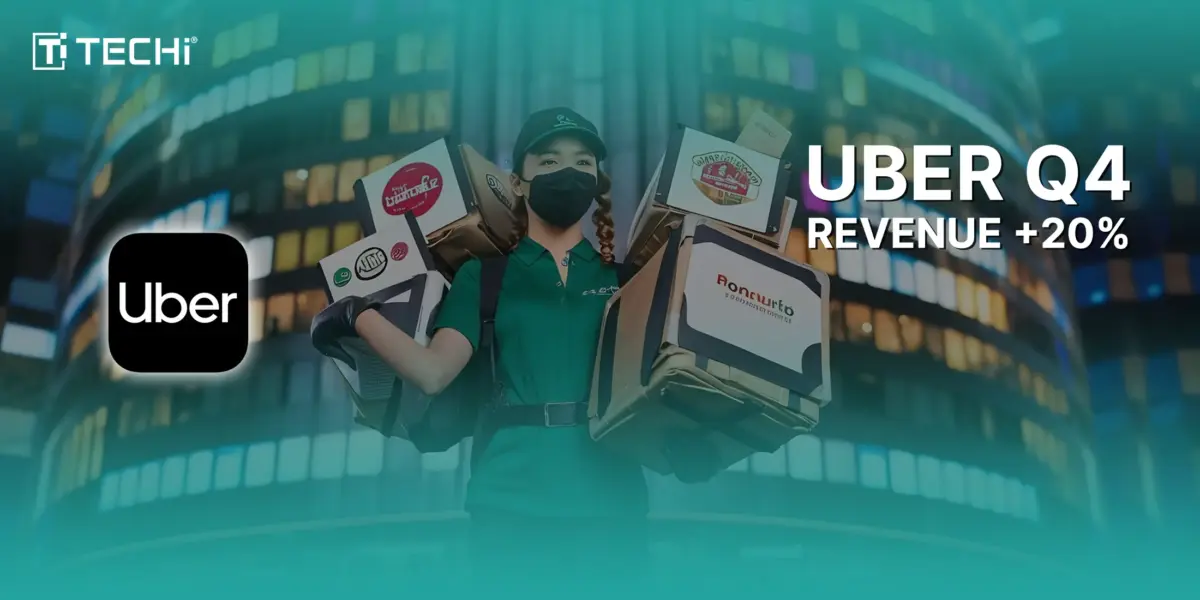
The latest earnings report from Uber presented results, which the company believed would show its five-star driver rating and its ability to handle late-night food delivery requests. The company achieved fourth-quarter revenue results, which exceeded market predictions because of its continuously growing delivery operations.
However, the stock experienced a temporary decline following the announcement of financial results, but it moved 3% upward during the earnings call when executives discussed Uber’s plans to achieve self-driving technology.
Uber’s Delivery Dominates 🔗
The quarterly revenue reached a total of $14.37 billion, which exceeded Wall Street predictions of $14.32 billion, and showed significant growth from the previous year’s $12 billion. The Food delivery services brought in more revenue than Uber’s ride-hailing business, which still serves as the company’s primary service.
Uber Eats delivery revenue reached $4.9 billion, which exceeded market estimates by 30%, showing how the service has developed from delivering restaurant food to providing grocery and essential retail items. Its mobility revenue increased by 19% to reach $8.2 billion, which almost matched market expectations.
Profits with a Few Accounting Speed Bumps 🔗
The company made a net income of $296 million during the quarter, which represented a substantial decrease from the previous year when the company reported high profit.
The drop in business activity took place because the company faced a $1.6 billion pre-tax loss, which resulted from evaluating equity investments.
The main business operations performed well, but the accounting methods created a situation that made it seem like Uber encountered some financial difficulties.
Global Desire Keeps Growing 🔗
The company achieved gross bookings of $54.1 billion, which surpassed market expectations and demonstrated strong consumer interest throughout its entire platform. The delivery operations in Europe, Middle East, and Africa experienced exceptional expansion, because the company established partnerships with OpenTable, Shopify, and various leading retail companies throughout different nations.
Uber currently operates as a logistics system, which supports all aspects of everyday activities instead of just delivering food.
Betting Big on a Driverless Future 🔗
Uber extends its operations beyond providing food and transportation services in order to develop self-driving vehicle technology. CEO Dara Khosrowshahi expressed his conviction that self-driving technology would create a market that is worth trillions of dollars.
The pilot programs tested in cities such as Atlanta and Austin demonstrated an overall increase in trips, which also benefited human drivers. Uber plans to establish autonomous ride services in 15 cities by 2026, while aiming to become the largest autonomous vehicle trip platform by 2029.
Improving Uber Ecosystem 🔗
Uber focuses on improving its technological capabilities through various initiatives. The company operates its Uber One subscription service, which boosts customer service on rides and delivery services, while it develops its advertising division as well.
Also, Uber uses ChatGPT integration through its generative AI technology to assist users in finding restaurants and services, which leads to food orders through its platform.
Bottom Line 🔗
Uber expands its capabilities through autonomous vehicles and its development of AI-based systems, but company executives work to manage public expectations. The adoption of self-driving vehicles will remain limited for several years, because of existing legal requirements and technical challenges that need to be solved.
After Uber’s Q4 earnings report, we can see that Uber has evolved into a company that provides complete transportation services, which include its current delivery services, stable mobility operations, and its upcoming technology developments.