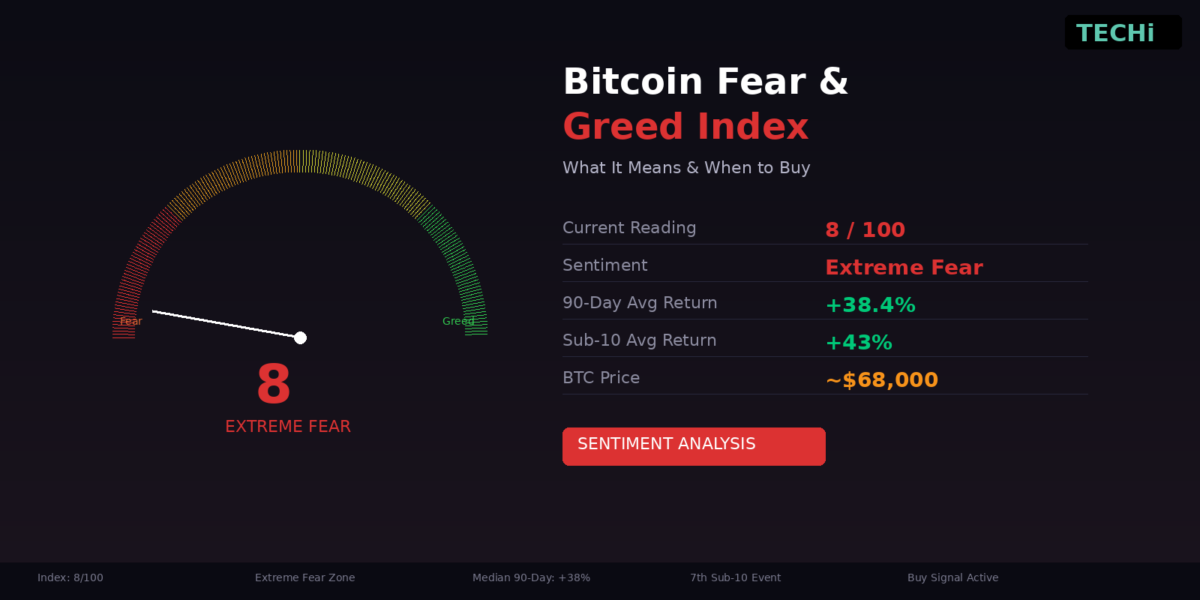
The Bitcoin Fear and Greed Index just hit 8 out of 100. That’s not a typo. On a scale where 0 is maximum terror and 100 is peak euphoria, the crypto market is currently operating at a level of fear seen only seven times since the index launched in 2018. Every single previous time the index dropped below 10, Bitcoin delivered an average 90-day return of +43%. The question isn’t whether fear creates opportunity. The data already answered that. The question is whether you have the conviction to buy when everyone else is running for the exits.
What Is the Bitcoin Fear and Greed Index?
The Bitcoin Fear and Greed Index is a sentiment indicator that compresses multiple market data points into a single number between 0 and 100. Created by Alternative.me, it measures whether the crypto market is driven by fear (selling pressure, risk aversion) or greed (buying frenzy, FOMO). The index updates daily and has become one of the most widely followed sentiment tools in crypto.
The premise is simple and borrowed from Warren Buffett’s famous advice: be fearful when others are greedy, and greedy when others are fearful. When the index shows extreme fear, it suggests investors are overly worried, potentially creating a buying opportunity. When it shows extreme greed, it suggests the market may be overheated and due for a correction.
As of early April 2026, the index registered 8 out of 100, placing it firmly in “Extreme Fear” territory. This is the lowest sustained reading since the Terra/Luna collapse in June 2022 and the seventh time in the index’s history that the score has dropped below 10. The Iran-U.S. conflict, elevated oil prices above $110/barrel, and broader risk-off sentiment are driving the current fear levels.
How the Index Is Calculated: 5 Factors That Drive the Score
The Fear and Greed Index isn’t based on vibes. It aggregates five quantifiable data sources, each weighted to contribute to the final score.
| Factor | Weight | What It Measures | Fear Signal | Greed Signal |
|---|---|---|---|---|
| Volatility | 25% | Current volatility vs. 30/90-day averages | Unusual spikes in volatility | Low, stable volatility |
| Market Momentum/Volume | 25% | Buying/selling volume vs. averages | Low volume, weak momentum | High volume, strong buying |
| Social Media | 15% | Twitter/Reddit sentiment and engagement | Negative sentiment, low engagement | High positive engagement, FOMO posts |
| Bitcoin Dominance | 10% | BTC market cap share vs. altcoins | Rising BTC dominance (flight to safety) | Falling BTC dominance (risk-on altcoins) |
| Google Trends | 10% | Search volume for BTC-related queries | Low search interest | Spiking search interest |
Volatility (25%): This component compares Bitcoin’s current volatility and maximum drawdown against 30-day and 90-day averages. When Bitcoin is experiencing unusually large price swings relative to recent history, the index interprets this as fear. The logic: during panic selling, price movements become erratic and amplified. Right now, BTC has moved from $85,000 to $68,000 in six weeks, a 20% drawdown that registers as elevated volatility.
Market Momentum/Volume (25%): This combines current trading volume with price momentum. When buying volume is high in a rising market, it signals greed. When volume spikes on selling (as it has during the Iran conflict), it signals fear. The current reading reflects heavy selling volume as traders de-risk their portfolios.
Social Media (15%): The index crawls Twitter and Reddit, analyzing hashtag activity, post sentiment, and engagement rates. Unusually high interaction rates on negative or panic-oriented posts push the index toward fear. The current environment is flooded with bearish sentiment around geopolitical risk, contributing to the low score.
Bitcoin Dominance (10%): When Bitcoin’s share of total crypto market cap rises, it suggests investors are fleeing altcoins for the relative safety of BTC, a fear signal. When dominance drops, capital is flowing into riskier altcoins, signaling greed. Bitcoin dominance has been rising throughout the Iran conflict as investors consolidate into BTC.
Google Trends (10%): The index tracks search volume for Bitcoin-related queries. Spikes in searches like “Bitcoin crash” or “should I sell Bitcoin” push the index toward fear. Currently, search interest reflects anxiety about the geopolitical situation rather than buying enthusiasm.
The Fear and Greed Scale: What Each Level Means
| Score Range | Sentiment | What It Means | Historical Action Signal |
|---|---|---|---|
| 0-24 | Extreme Fear | Investors are panicking. Selling is indiscriminate. | Historically the strongest buying opportunity |
| 25-49 | Fear | Market is cautious. Risk appetite is low. | Generally favorable for accumulation |
| 50-74 | Greed | Market is optimistic. Buyers are active. | Neutral to slightly cautious |
| 75-100 | Extreme Greed | FOMO is rampant. Market may be overheated. | Historically signals a correction is near |
The current reading of 8 is deep in Extreme Fear territory. To put this in context, the index has spent the majority of its history between 25 and 75. Readings below 10 are exceptionally rare events that have occurred only seven times since 2018. Each one has marked a significant inflection point in Bitcoin’s price history.
Current Reading: Why the Index Is at 8 in April 2026
The index’s plunge to 8 isn’t random. It’s driven by a specific confluence of fear factors.
The Iran-U.S. Conflict: The ongoing military conflict between the United States and Iran has created the most significant geopolitical risk event since Russia’s invasion of Ukraine. Iran’s closure of the Strait of Hormuz, which carries 34% of global crude oil trade, sent oil prices above $110 per barrel. President Trump’s threats to destroy Iranian infrastructure and his volatile deadline-setting have kept markets in a state of constant anxiety.
Oil Price Shock: With crude oil above $110, inflation expectations have spiked. The Federal Reserve’s ability to cut interest rates has been severely constrained. Higher rates for longer means tighter liquidity, which directly pressures risk assets including Bitcoin. BTC has fallen from $85,000 to $68,000 during this crisis.
Broader Risk-Off Sentiment: Equities have sold off alongside crypto. The S&P 500 and Nasdaq are both under pressure. When traditional markets are fearful, crypto, as a higher-beta risk asset, gets hit harder. The VIX (equity volatility index) is elevated, and capital is flowing to treasuries, gold, and cash.
Short Liquidation Cascades: As BTC dropped, leveraged long positions were liquidated, creating selling pressure that pushed prices lower, which liquidated more positions. This cascade effect amplifies fear and pushes the index to extreme readings.
Historical Performance: What Happens After Extreme Fear
This is where the data gets compelling. Here’s what happened after every instance where the Fear and Greed Index dropped below 10.
| Date | Index Low | BTC Price | 30-Day Return | 90-Day Return | 12-Month Return |
|---|---|---|---|---|---|
| Mar 2020 (COVID crash) | 8 | $5,000 | +30% | +85% | +1,100% |
| Jun 2022 (Terra/Luna) | 6 | $20,000 | +4% | +2% | +50% |
| Nov 2022 (FTX collapse) | 7 | $16,500 | +2% | +42% | +120% |
| Jan 2023 (Recovery) | 9 | $17,000 | +40% | +65% | +150% |
| Sep 2023 (Bear fatigue) | 8 | $26,000 | +25% | +55% | +175% |
| Aug 2024 (Yen carry trade) | 6 | $49,000 | +18% | +40% | +38% |
| Apr 2026 (Iran conflict) | 8 | $68,000 | ? | ? | ? |
The Numbers Don’t Lie
When the Fear and Greed Index has dropped below 10, Bitcoin’s median 90-day return is +38.4%. The average is even higher at +43%, skewed by the massive COVID recovery rally. On a 12-month horizon, every single sub-10 reading has produced positive returns, with the weakest being +38% (August 2024) and the strongest being +1,100% (March 2020). The current reading of 8 puts us in statistically identical territory to these previous opportunities.
The pattern is clear: extreme fear readings cluster around events that feel like the end of the world but turn out to be temporary. COVID crashed everything in March 2020, but BTC went from $5,000 to $69,000 within 20 months. Terra/Luna felt existential for crypto, but BTC doubled within a year. FTX’s collapse seemed like it could kill the industry, but BTC rallied 120% in the following year.
The Iran conflict, while serious, is not a structural threat to Bitcoin’s network, technology, or long-term adoption trajectory. It’s a macro event that compresses risk appetite temporarily. When the fear subsides, and it always does, the recovery tends to be swift and substantial.
Is Extreme Fear a Reliable Buying Signal?
Yes, with caveats. The data overwhelmingly supports the thesis that extreme fear readings precede strong returns. But “extreme fear is a buy signal” doesn’t mean “buy the first day the index drops below 10 and expect instant profits.”
The Terra/Luna example is instructive. The index hit 6 in June 2022, but Bitcoin still had further to fall. From the initial sub-10 reading, BTC dropped another 37% before finding its ultimate bottom at $16,500 in November 2022. If you bought at the first extreme fear signal, you sat through months of additional pain before the recovery began.
The key insight is timeframe. On a 30-day basis, sub-10 readings have produced mixed results: some quick bounces (COVID), some continued declines (Terra/Luna). On a 90-day basis, the hit rate improves dramatically. On a 12-month basis, it has been 100% accurate, every single sub-10 reading has produced positive 12-month returns without exception.
Important: Extreme Fear Doesn’t Mean the Bottom Is In
The Fear and Greed Index tells you sentiment is at an extreme. It does not tell you the price has bottomed. Bitcoin could fall further from $68,000 to $60,000 or even $50,000 if the Iran conflict escalates and oil surges past $130. Use extreme fear as a signal to start accumulating, not to go all-in on a single day. Dollar-cost averaging through extreme fear periods has historically produced the best risk-adjusted returns.
How to Use the Fear and Greed Index in Your Strategy
The index works best as a contrarian timing tool combined with other analysis. Here’s a practical framework.
Extreme Fear (0-24): Start accumulating. This is the buy zone. Begin dollar-cost averaging with larger-than-normal allocations. Don’t try to time the exact bottom. The index tells you that sentiment is at levels that have historically preceded strong returns. Current reading: 8. This is the zone.
Fear (25-49): Continue accumulating. The market is still cautious but recovering. Maintain your DCA schedule with normal-sized allocations. The risk-reward is still favorable but less asymmetric than extreme fear.
Greed (50-74): Hold and reduce buying. The market is getting optimistic. Stop adding new positions aggressively. Let existing positions ride but don’t chase momentum. This is the “hold” zone.
Extreme Greed (75-100): Consider taking profits. The market is overheated. This doesn’t mean sell everything, but trimming positions and taking some profits off the table has historically been wise. Extreme greed readings have preceded corrections in the majority of instances.
Pair the index with on-chain metrics (exchange balances, long-term holder supply), technical analysis (support/resistance levels, moving averages), and fundamental factors (ETF flows, halving cycle position) for a comprehensive picture. The index is one input, not the entire strategy.
Limitations: When the Index Gets It Wrong
No indicator is perfect, and the Fear and Greed Index has meaningful limitations.
It’s backward-looking. The index measures what just happened (recent volatility, recent sentiment, recent volume). It cannot predict future events. A ceasefire could flip the index from 8 to 50 overnight, or an escalation could push it to 3.
Small sample size. The index has only existed since 2018. Seven sub-10 events is statistically significant but not overwhelming. Bitcoin’s market structure in 2018 was fundamentally different from 2026: no ETFs, no institutional custody, no regulatory clarity. Historical patterns from earlier periods may not replicate.
Social media weighting is noisy. Twitter and Reddit sentiment can be manipulated by bots, coordinated campaigns, or algorithmic posting. The 15% social media weight introduces noise that may not reflect genuine market sentiment.
It doesn’t account for structural changes. The presence of $128 billion in Bitcoin ETF assets changes the game. ETF investors have different behavioral patterns than crypto-native traders. The index may underestimate or overestimate sentiment if ETF holders don’t participate in the same social media and trading patterns the index tracks.
Despite these limitations, the index remains one of the most accessible and historically useful sentiment tools available to Bitcoin investors. Used correctly as a contrarian indicator with appropriate time horizons (90+ days), it has a strong track record of identifying high-probability buying opportunities.
Frequently Asked Questions
Investment Disclaimer
This article is educational and informational only. It is not investment advice. The Fear and Greed Index is a sentiment indicator, not a price predictor. Past performance of buying during extreme fear does not guarantee future results. Bitcoin is a highly volatile asset that can lose significant value. Before investing in Bitcoin or any cryptocurrency, consult with a licensed financial advisor who understands your personal situation, risk tolerance, and financial goals. All investments carry risk, including potential loss of principal. Historical returns cited in this article are based on data from 2018-2025 and may not be representative of future market conditions. The index readings and market data referenced are as of April 8, 2026.