

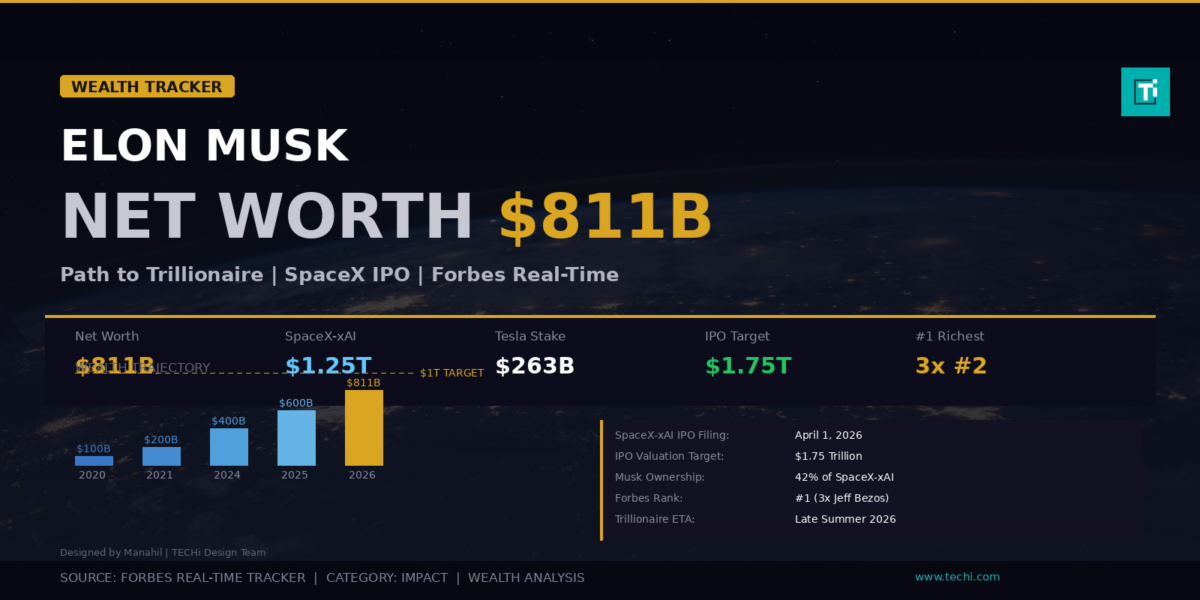
Elon Musk is not just the richest person alive. He is in a wealth category that has never existed before. At an estimated $811 billion according to the Forbes real-time tracker, Musk’s fortune exceeds the entire annual GDP of countries like Poland (~$750 billion) and Sweden (~$600 billion). He crossed $500 billion in October 2025, blew past $600 billion two months later, and hit $800 billion by February 2026 after merging SpaceX with xAI in the largest corporate combination by notional value in history (an all-stock deal between Musk-controlled entities).
The speed of this wealth accumulation has no precedent. It took Jeff Bezos over two decades to go from first-time billionaire in 1999 to $200 billion in 2020. Musk went from $500 billion to $800 billion in four months. And with SpaceX filing for a $1.75 trillion IPO that could close in late summer 2026, Musk is on track to become the world’s first trillionaire before the year is out.
Here is exactly how Musk’s fortune breaks down, what is driving it, and why the numbers may be both more impressive and more fragile than they appear.
The Wealth Breakdown: Where the $811 Billion Comes From
Musk’s net worth is concentrated in three assets. The combined SpaceX-xAI entity, Tesla stock, and X Holdings (formerly Twitter) account for virtually all of it. Everything else, Neuralink, The Boring Company, personal real estate, amounts to a rounding error at this scale.
Musk’s Asset Portfolio
| Asset | Ownership Stake | Estimated Valuation | Musk’s Share | % of Net Worth |
|---|---|---|---|---|
| SpaceX-xAI (merged) | ~42% | $1.25 Trillion | ~$525B | ~65% |
| Tesla (TSLA) | ~13% | $1.14 Trillion | ~$148B | ~18% |
| Tesla Options (2018 comp package) | 304M options at $23.33 strike | ~$115B intrinsic value | ~$115B | ~14% |
| X Holdings | ~79% | ~$12.5B (est.) | ~$10B | ~1% |
| Neuralink | Majority | $9.65B | ~$5B | <1% |
| The Boring Company | Majority | ~$7B | ~$5B | <1% |
The composition has shifted dramatically in the past year. As recently as mid-2025, Tesla accounted for roughly 60% of Musk’s wealth. Today, the SpaceX-xAI combination represents about 65%. This shift matters because SpaceX is private, meaning Musk’s dominant asset is valued by private market transactions rather than public market trading, where valuations tend to be more generous and less volatile on a day-to-day basis.
SpaceX-xAI: The $1.25 Trillion Merger That Changed Everything
On February 2, 2026, Musk merged SpaceX and xAI in an all-stock deal that valued the combined entity at $1.25 trillion. SpaceX was internally valued at $1 trillion, xAI at $250 billion. Bloomberg applies a lower valuation of approximately $1.03 trillion for the combined entity, using the $800 billion SpaceX tender offer price rather than the merger-internal figure, since no new outside capital was raised. The deal was structured as a share exchange, with each xAI share converting into 0.1433 SpaceX shares.
Musk described the rationale as building “the most ambitious, vertically-integrated innovation engine on (and off) Earth.” The practical reason was simpler: xAI was burning cash rapidly trying to compete with OpenAI and Anthropic, and SpaceX had the balance sheet and infrastructure to absorb it. The merger also enables Musk’s vision of orbital data centers, where SpaceX’s launch capabilities and Starlink’s satellite network provide the physical infrastructure for xAI’s computing needs.
SpaceX-xAI: Key Numbers
| Metric | Value |
|---|---|
| Combined Valuation | $1.25 Trillion (Feb 2026 merger) |
| IPO Filing | Confidential S-1 filed April 1, 2026 |
| Expected IPO Valuation | $1.75 Trillion |
| Expected IPO Capital Raise | $50B–$75B |
| Expected IPO Timing | Late Summer 2026 |
| Starlink Revenue (2025 est.) | ~$15B |
| Starlink Revenue (2026 est.) | $20B+ |
| Musk’s Ownership | ~42% |
If the IPO prices at $1.75 trillion, Musk’s 42% stake would be worth roughly $735 billion from this single asset alone, enough to push his total net worth past the $1 trillion mark even without any gains from Tesla. For a full breakdown of the IPO timeline, SEC filing details, and how retail investors can participate, see our deep-dive: SpaceX IPO 2026: $1.75 Trillion Valuation, SEC Filing, Timeline & How to Invest.
Tesla: The Stock That Started It All
Tesla shares closed at $352.82 on April 4, 2026, giving the company a market cap of approximately $1.14 trillion. Musk holds roughly 13% of outstanding shares, worth about $148 billion. But the more consequential piece is his 2018 compensation package: 304 million stock options with a $23.33 strike price.
The Delaware Supreme Court restored this pay package in December 2025, reversing the lower court’s Tornetta decision that had voided it. At the current stock price, those options carry an intrinsic value of approximately $115 billion ($352.82 minus $23.33, multiplied by 304 million shares). Combined with his direct equity, Musk’s total Tesla exposure is roughly $263 billion.
But Tesla’s contribution to Musk’s wealth story has shifted from growth engine to risk factor. The stock is down approximately 45% from its December 2024 peak of $479 per share. Q1 2026 profits dropped 71%. A Yale study found that Musk’s political activities cost Tesla between 1 million and 1.26 million US vehicle sales, while boosting competitors by 17% to 22%.
For a complete analysis of where TSLA may be headed, including robotaxi catalysts, Optimus timeline, and analyst price targets through 2030, see our Tesla Stock Price Prediction 2026-2030.
Tesla’s Recent Financial Trajectory
| Metric | Value |
|---|---|
| Stock Price (April 4, 2026) | $352.82 |
| Market Cap | ~$1.14 Trillion |
| All-Time High | $479.86 (Dec 2024) |
| YTD Decline | ~26% |
| Q1 2026 Profit Drop | 71% |
| Lost Sales (Yale Study) | 1.0–1.26 million vehicles |
| Public Approval of Musk (survey) | 43% favorable / 57% unfavorable |
The DOGE Factor: Politics as a Wealth Headwind
Musk’s role as head of the Department of Government Efficiency (DOGE) under President Trump has been the most polarizing chapter of his public life. While the position gave him influence over federal spending, it came at measurable cost to his core business.
Tesla stock soared to $479 by mid-December 2024 on post-election optimism, then lost 45% of its value as consumer backlash intensified. Dealerships were vandalized. European sales cratered. Surveys showed 57% of American adults holding a negative view of Musk personally. Tesla’s own earnings filings acknowledged that “political sentiment” could hurt the company.
In April 2026, Musk announced he would step back from DOGE to refocus on Tesla, reducing his government role to one or two days per week. Tesla shares rose over 5% on the news, a telling indicator that the market had been pricing in DOGE as a liability rather than an asset.
The tension at the heart of Musk’s wealth is that his political influence and his commercial value pull in opposite directions. The same visibility that gave him a seat at the White House table drove away customers who buy electric vehicles. Whether the DOGE chapter ends up as a net positive (regulatory access, government contracts) or net negative (brand damage, lost sales) will not be clear for years.
The Net Worth Milestones: A Timeline Without Precedent
| Milestone | Date | Primary Driver | Time Between Milestones |
|---|---|---|---|
| $100 Billion | August 2020 | Tesla stock surge during COVID rally | — |
| $200 Billion | September 2021 | Tesla continued momentum; S&P 500 inclusion | 13 months |
| $300 Billion | November 2021 | Tesla peak at $1.2T market cap | 2 months |
| $400 Billion | December 2024 | Tesla post-election rally; SpaceX revaluation | 37 months |
| $500 Billion | October 2025 | Tesla $479 ATH; SpaceX at $350B+ | 10 months |
| $600 Billion | Mid-December 2025 | SpaceX approaching $1T; Tesla comp restored | 2 months |
| $700 Billion | Late December 2025 | SpaceX-xAI merger announced | ~2 weeks |
| $800 Billion | February 2026 | SpaceX-xAI merged at $1.25T | ~6 weeks |
The pattern is striking. It took Musk three years to go from $300 billion to $400 billion (a period that included the Twitter acquisition, Tesla’s stock decline, and public controversies). Then it took just four months to go from $500 billion to $800 billion. The acceleration is almost entirely driven by private market revaluations of SpaceX and xAI, not public market Tesla gains.
The Path to $1 Trillion
Fortune published a headline on April 2, 2026, calling Musk the “world’s first trillionaire” based on implied SpaceX IPO valuations. That is premature. The IPO has not priced. But the math is straightforward.
Trillionaire Scenarios
| Scenario | SpaceX-xAI Value | Musk’s SpaceX Share | Tesla + Options | Other | Total |
|---|---|---|---|---|---|
| IPO at $1.75T (bull case) | $1.75T | $735B | $263B | $26B | $1.02T |
| IPO at $1.5T (base case) | $1.5T | $630B | $263B | $26B | $919B |
| IPO at $1.25T (bear case) | $1.25T | $525B | $263B | $26B | $814B |
| No IPO (current) | $1.25T | $525B | $263B | $26B | ~$811B |
If SpaceX prices at $1.75 trillion and Tesla holds current levels, Musk crosses the trillion-dollar threshold. Even at a $1.5 trillion IPO, he falls just short at roughly $919 billion, though any Tesla appreciation or Neuralink revaluation could close the gap.
The bear case is that public markets value SpaceX more conservatively than private rounds have, the IPO prices at a discount to the S-1 target, and Tesla continues to slide. In that scenario, Musk remains comfortably above $800 billion but the trillionaire milestone moves to 2027 or later.
Musk vs. the World: Wealth in Context
| Comparison | Value |
|---|---|
| Elon Musk Net Worth (Forbes) | $811B |
| #2 Larry Page (Bloomberg, April 2026) | ~$257B |
| #3 Sergey Brin (Bloomberg, April 2026) | ~$239B |
| #4 Jeff Bezos (Bloomberg, April 2026) | ~$235B |
| #5 Mark Zuckerberg (Bloomberg, April 2026) | ~$203B |
| GDP of Poland (2025) | ~$750B |
| GDP of Sweden (2025) | ~$600B |
| GDP of Saudi Arabia (2025) | ~$855B |
| Combined wealth of #2 through #5 richest | ~$934B |
Musk is not merely the richest person in the world. His fortune approaches the combined wealth of the next four wealthiest people ($934 billion), a gap that has never been this narrow at the top of the rankings. His fortune is within striking distance of Saudi Arabia’s annual GDP. This concentration of wealth in a single individual has no historical parallel in inflation-adjusted terms.
The Risks Nobody Is Pricing
SpaceX-xAI IPO execution risk. The $1.75 trillion valuation target assumes markets remain receptive to mega-cap tech IPOs. If market conditions deteriorate, the IPO could be delayed or downsized, freezing Musk’s largest asset at a private valuation that may not reflect public market pricing.
Tesla brand erosion may be structural, not cyclical. The Yale study documenting 1 million lost sales is not a temporary blip. Brand damage in the automotive industry tends to compound. Once consumers associate a brand with political controversy, recapturing them is harder than acquiring them in the first place, especially as competitors like BYD, Rivian, and legacy automakers improve their EV offerings.
Private market valuations are not liquid wealth. Roughly 65% of Musk’s fortune is in SpaceX-xAI, a private entity. He cannot sell shares freely. The IPO will create liquidity, but lock-up periods typically prevent founders from selling for 90 to 180 days after listing. Musk’s paper wealth and his available capital are two very different numbers.
Regulatory and litigation exposure. Musk faces ongoing SEC scrutiny over Tesla disclosures, FTC investigations into X (formerly Twitter), European regulatory pressure on content moderation, and potential conflicts of interest from his DOGE role. None of these are existential individually, but collectively they create an environment where a single adverse ruling could trigger a sentiment shift across his public and private holdings.
Key-man risk is the highest in corporate history. No individual has ever had an $800 billion fortune tied so directly to their personal involvement in so many companies simultaneously. Tesla, SpaceX, xAI, X, Neuralink, The Boring Company. Musk’s time is the scarcest resource in his empire, and DOGE demonstrated what happens when his attention is diverted from the core business.
For more on the best AI stocks to buy in 2026 and where xAI, Nvidia, and other players fit into the broader landscape, explore our investment guides.
What is Elon Musk’s net worth in 2026?
As of April 2026, Elon Musk’s net worth is estimated at $811 billion according to the Forbes real-time billionaire tracker. The Bloomberg Billionaires Index puts the figure lower at approximately $636 billion due to differences in how private company stakes are valued. The discrepancy stems primarily from different valuations applied to SpaceX-xAI, which represents about 65% of Musk’s fortune.
How did Elon Musk get so rich so fast?
Musk’s wealth accelerated dramatically in late 2025 and early 2026 due to three events: Tesla’s stock rally to $479 in December 2024, the Delaware Supreme Court restoring his $115 billion Tesla compensation package in December 2025, and the SpaceX-xAI merger in February 2026 that valued the combined entity at $1.25 trillion. He went from $500 billion to $800 billion in just four months.
Will Elon Musk become a trillionaire?
It depends primarily on the SpaceX IPO. If SpaceX-xAI prices at the targeted $1.75 trillion valuation in its expected late summer 2026 IPO, Musk’s 42% stake alone would be worth roughly $735 billion. Combined with his Tesla holdings (~$263 billion), that would push his total net worth past $1 trillion. If the IPO prices below $1.5 trillion or Tesla continues to decline, the trillionaire milestone likely moves to 2027.
What is the SpaceX-xAI merger?
On February 2, 2026, SpaceX absorbed xAI in an all-stock deal valuing the combined company at $1.25 trillion (SpaceX at $1T, xAI at $250B). The merger created the most valuable private company in history. Musk described the rationale as building orbital data centers and a vertically-integrated AI and space infrastructure platform. SpaceX subsequently filed a confidential S-1 for an IPO targeting a $1.75 trillion valuation.
Has DOGE hurt Elon Musk’s wealth?
Yes, measurably. Tesla stock fell roughly 45% from its December 2024 peak, with Musk himself acknowledging that DOGE backlash was hurting the stock. A Yale study found his political activities cost Tesla between 1 million and 1.26 million US vehicle sales. Consumer surveys show 57% of Americans now view Musk negatively. However, SpaceX and xAI valuations continued rising during this period, so the net impact on total wealth was partially offset by private market gains.
Disclosure: This article is for informational purposes only and does not constitute investment advice. The author and TECHi may hold positions in securities mentioned. Always conduct your own research or consult a licensed financial advisor before making investment decisions. Net worth estimates vary by source and methodology; figures cited are as of the date published and subject to change.