The iOS vs Android fight rivalry has evolved far beyond emoji battles and text bubble colors, it’s no longer just a superficial comparison. It’s about two huge digital ecosystems influencing how billions of people engage with cool technology, view content, and make buying decisions. For companies developing mobile apps, startups pursuing the next big thing or large organizations optimizing digital experiences, the decision between iOS and Android is not technical, rather it’s a strategic choice that can make or break your access, income, and relevance in the current tech-powered economy.
This in-depth guide deconstructs the most important iPhone vs. Android distinctions, examines international market tendencies, and provides critical factors for companies looking to determine where to roll out their next large mobile app. From demographics and device usage to electronic devices and app store incomes, here’s what you need to know in 2025.
iOS vs Android, Global Market Share and Reach 🔗
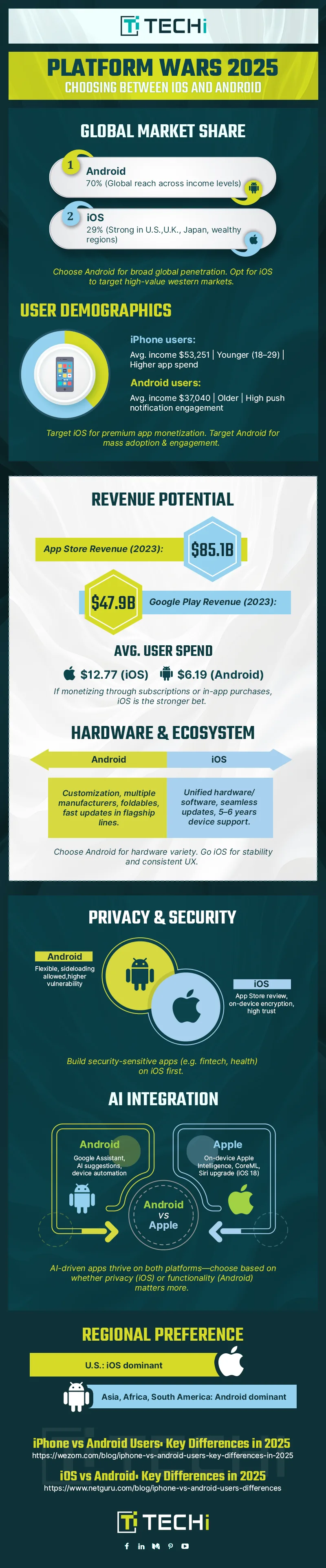
The worldwide smartphone market remains dominated by the two divas, Android and iOS. Android holds around 70% of the global market share as of late 2023, while iOS enjoys around 29%, with more grip in high-income economies such as the U.S, U.K, and Japan. Android’s strength is its diverse nature, vacant on everything from inexpensive to ultra-premium devices, it is sold globally. iOS, on the other hand, thrives in markets where people prioritize privacy, premium user experience, and a tightly integrated ecosystem of cutting-edge gadgets and tech perks.
User Demographics & its Importance 🔗
When marketing to users with new technology gadgets, cool things to order, or releasing your next app, knowing about the user persona matters. Historically, iPhone owners have tended to make more money. In a 2024 survey, iPhone owners had a mean annual income of $53,251 compared to $37,040 for Android users. iPhones reign among young users (18–29), and Android is in the lead with the older crowd.
Consumer behavior is also different. iPhone customers are more inclined to spend money on in-app purchases, cool gadgets, and best tech gifts. Android customers, on the other hand, are better at responding to push notifications and prefer apps within categories such as education, food & beverages, and affordable gadgets. Strangely enough, Android has a narrow lead in loyalty at 91% compared to iOS’s 86%. Further, iOS users feel safer and are more likely to recover their data following security incidents.
Google Play vs Apple App Store 🔗
In terms of App Availability, Google Play has 3.55 million apps, whereas the Apple App Store offers 1.6 million apps. In terms of revenue, in 2023, the App Store brought in $85.1 billion, while Google Play brought in $47.9 billion revenue. iOS users spend more per app, which is $12.77 to $6.19 on Android. If the product includes monetization by subscription or in-app purchases, such as smart accessories, electronic gadgets, or the latest cool tech, iOS customers are the more lucrative ones. Android prevails for wider distribution and penetration, particularly in developing markets.
Monetization strategies also show discrepancy. Apple takes a 30% cut from in-app purchases (a reduced 15% for smaller developers), something that has been a thorn in its side. Google takes a 30% fee but does permit third-party billing alternatives in some areas, providing a tad more flexibility.
Hardware and Software Experience 🔗
- Android’s extent of manufacturers includes Samsung, Google, OnePlus, Motorola, and others from $150 to $1,000+. iOS is limited to Apple products with strict quality control and uniformity.
- Android fans get more flexibility, widgets, themes, and customization. iOS maintains simplicity with an unchanging, grid-based UI.
- Androids typically still have physical navigation controls, while iPhones use solely gesture-based navigation. These variations influence user interaction and contentment, particularly when developing apps that need to capture user input, customization, or hardware controls such as camera control or sensors.
User Experiences 🔗
From a quick glance, iPhone and Android smartphones appear to be similar in terms of function, as both permit users to browse, text, and explore the online realm. Although, there are significant differences beneath the surface that make up the reasons why people prefer one platform over the other in 2025.
Ease of Use and Customization 🔗
Simplicity is one of the most quoted reasons why users prefer iPhones. The iOS platform is quite tidy, easy to understand, and does not need much technical knowledge. Most iPhone users love the way everything just works and is the perfect option for those who prefer a plug-and-play, frictionless experience. Android, on the other hand, is attractive to those who prefer more freedom and customization. Even though Android is more flexible with widgets, themes, and settings, it can also lead to increasing the user experience being more challenging at times. It’s like a constructor, a user can build anything they want to, but it would just take time.
System Stability and Software Updates 🔗
As for reliability, Apple has raised the bar. iOS is stable, with updates released all at the same time across all supported devices. This lack of fragmentation reduces crashes and provides a consistent experience. Android offers a more fragmented environment. Device performance and timing of updates rely heavily upon the manufacturer. Mid-range or older Android devices might be subject to lag, and many only get irregular or no OS updates after two or three years.
Interface Design and Aesthetics 🔗
Apple’s design aesthetic is one of harmony and simplicity. iOS apps tend to have a common layout and look, providing a consistent appearance and feel that brings user content, photos, text, and video to the face. Android, on the contrary, is all about experimentation. Android apps and UI are designed in a manner to accommodate different screen sizes, aspect ratios, and form factors, such as foldable phones. Google’s Material Design system, with its colorful interfaces, shadows, and animations, tends to encourage a more dynamic and playful user understanding.
Camera Performance and Features 🔗
Apple still takes the lead with a solid and easy to use camera. Without any need of manual adjustments, iPhone cameras are able to produce excellent photos and videos, particularly in portrait and selfie modes. Androids provide a broad range of camera hardware and capabilities, which includes optical zoom, macro photography, and AI-driven enhancements. The quality of photos usually hinges on the manufacturer, where top leading Android phones are generally better than the budget models.
Notifications and Interactions 🔗
Even notifications seem distinct on different platforms. iOS organizes alerts into the Notification Center and promotes minimalism. Android offers greater control to the user, where notifications can be expanded, engaged with, grouped, or can be dismissible in a quick manner. The presence of quick reply, smart actions, and built-in media controls makes Android notifications more interactive and convenient.
Security and Privacy 🔗
Apple’s closed system provides an edge in security. Apps in the App Store undergo a rigorous review process, this minimizes any sort of malware risk. The majority of iOS users rely on the platform’s security features, such as on-device encryption and Face ID. Android’s open nature allows for flexibility, but at the cost of increased vulnerability, particularly when users sideload applications from third-party websites. Although Google Play does perform security screening, it’s not as highly controlled as Apple’s.
Durability and Long-Term Support 🔗
Coming towards the software longevity, Apple again takes the top position. iPhones get iOS updates for a period of five or six years, keeping older devices running and secure. On the other hand, support on Android depends upon manufacturer, leading devices from players like Samsung and Google now get up to four years of OS updates, but budget phones tend to lose support after two or three years.
AI and Machine Learning Integration 🔗
Both platforms have bet big on AI-driven innovation, introducing features that are smarter and raised the bar for mobile experiences. Apple’s AI features include Apple Intelligence, which puts privacy first by giving out on-device Siri, which is more conversational and responsive in 2025. It also includes Core ML, which allows developers to add machine learning to apps such as cool gadgets, health monitors, and AI tools.
On the contrary, Android’s AI advantage includes strong integration with Google Assistant, predictive suggestions, automation between apps, and more support for varied hardware with integrated AI accelerators. Doesn’t matter if you’re building the next coolest tech for personal productivity or the greatest gadgets for smart homes, AI will be a foundation on both platforms.
Platform Choice by Region 🔗
Apple dominates highly in the U.S with more than 50% of active devices supported, which is supported by strong customer loyalty and a perception of high quality. Economic and cultural influences also come into play, Apple is a status symbol and design icon in the U.S. Around the world, Android triumphs in countries such as Asia, Africa, South America, and Europe because of affordability and widespread availability. Those businesses that seek to push cool tech devices or fresh hardware in international markets could gain more benefits from Android-first launches.
Smartphone Trends in 2025 🔗
The Android vs iOS battle does not seem to be slowing down anytime soon. With emerging technologies redesigning the mobile landscape, both platforms are evolving side by side, each with its own vision for the future.
Foldable Phones 🔗
Foldable phones are one of the coolest 2025 trends, and Android is out front on them. Companies such as Samsung (Galaxy Z Fold and Flip) and Google (Pixel Fold) have already commercialized foldable smartphones. Apple is holding off until the technology reaches maturity, presumably holding off its first foldable iPhone until 2026 or beyond. As foldable phones become more mass-market and price-competitive, Android may establish a firmer presence among early adopters and tech fans.
Performance and Chip Innovation 🔗
Apple’s A17 Pro chip, which came out in 2024, already beats most others when it comes to power and efficiency. The A18 Pro is upcoming and will further set the bar higher. Android phones tend to mostly depend on and use Qualcomm (Snapdragon 8 Gen 4) chips, Samsung (Exynos) chips, and Google (Tensor) chips, where each one offers enhancements and improvements in AI, power efficiency, and graphics. While Snapdragon chips look promising, Apple’s close hardware-software integration still provides better real-world performance.
AI Integration 🔗
AI is no longer a catchword, as it’s integrated into every smartphone experience. Google has been diligent in pertaining AI capabilities throughout its Pixel range, leveraging features such as Magic Eraser, Live Translate, and improved Google Assistant features. Apple, on the other hand, has been moving more cautiously. With the release of iOS 18, Apple is set to deploy robust neural processing on the device, with a focus on privacy and performance, balancing innovation with user trust.
The Right Platform of App Development for Year 2025 🔗
When making apps for higher-income earners or premium electronic gadgets, iOS comes in first. Android is an excellent fit if one works on mass-market tech gadgets or for some cool things to order at handy prices. In terms of Device ecosystem, Android provides range and affordable prices, whereas iOS would prove true on uniformity and integration into the ecosystem. Time, talent, and cost has a vital role in it as well. An iOS app takes longer to pass App Store review, but it has fewer bugs and a profitable return. Androids are generally faster in publishing, it also has a wider reach, particularly for cool tech gadgets in developing countries and emerging markets.
Alignment Between the Platforms 🔗
There isn’t an exact winner in the 2025 smartphone war. On one hand, Android has the largest market share, greatest accessibility, and most innovative form factors. iOS, on the other hand, still excels in user loyalty, profitability, and intuitive ecosystem integration. For developers, iOS presents a more profitable user base and a predictable stable setting, which is perfect for revenue generating apps, high-end electronic devices, or subscription paid services. Android, with its enormous reach and versatility, is optimal for larger markets, particularly in developing economies.
Ultimately, the success of a mobile business does not depend on the side one chooses, it is about knowing your users. It doesn’t matter whether one is creating an app, marketing the coolest gadgets, or building an app that will change how people do things, rather choosing the right platform would mean using up your audience’s habits, preferences, and devices.
Alignment is what matters the most, because if you release your app on the wrong platform first, you won’t only lose customers, you’ll lose momentum. Pick a platform wisely, code intelligently, and keep in mind that the platform war might be dualistic, but your success as a business does not have to be that way.