

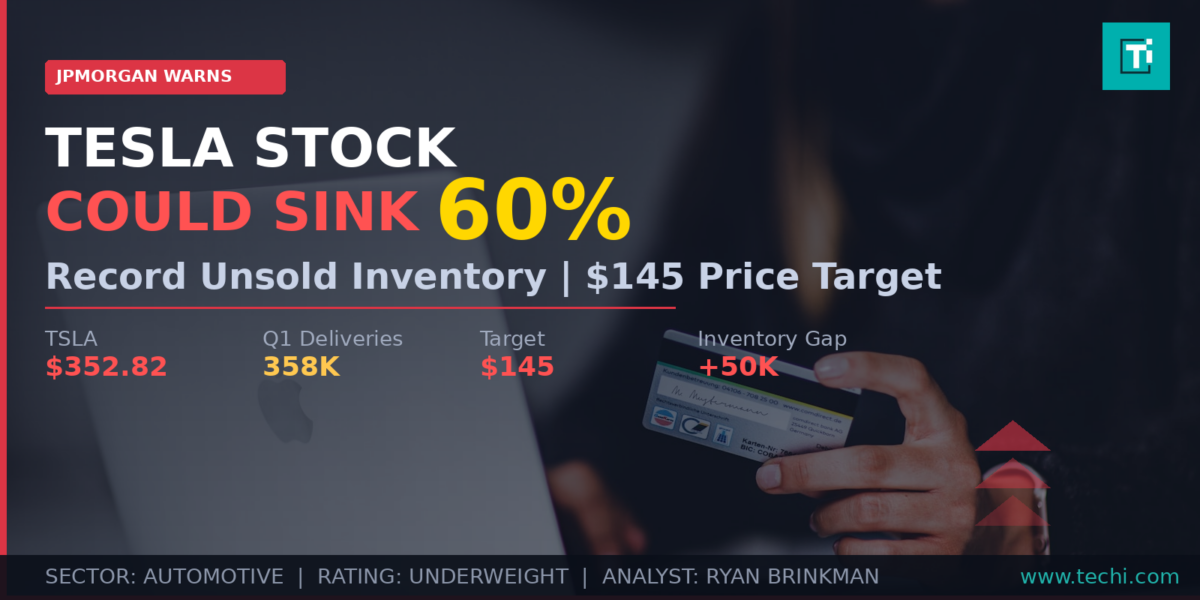
JPMorgan just doubled down on its most bearish call on Wall Street. On April 6, 2026, lead automotive analyst Ryan Brinkman reiterated his Underweight rating on Tesla (NASDAQ: TSLA) with a $145 price target — implying roughly 60% downside from the stock’s current price of $352.82. The warning comes just days after Tesla reported Q1 2026 deliveries that missed expectations and revealed the largest production-delivery gap in company history.
This isn’t a fringe opinion from a no-name shop. JPMorgan Chase is the largest bank in the United States by assets, and Brinkman has covered Tesla since 2014. His $145 target makes it the most bearish price target among major Wall Street firms, sitting more than 60% below the consensus target of approximately $394.
For investors holding TSLA — or considering buying the dip — this is a note that demands serious attention. Here’s what JPMorgan sees that the market might be missing.
What JPMorgan’s Report Actually Says
Brinkman’s April 6 research note is titled with the kind of directness that gets attention on trading desks: JPMorgan is warning that Tesla’s stock faces a potential 60% collapse from current levels. The core thesis rests on three pillars.
First, the Q1 2026 delivery numbers were bad. Tesla delivered 358,023 vehicles in the first quarter, according to the company’s official filing, missing the Bloomberg consensus of 372,000 and JPMorgan’s own estimate of 385,000. Deliveries dropped 14.4% sequentially from Q4 2025’s 418,227 vehicles, though they rose 6.3% year-over-year from a historically weak Q1 2025.
Second, the inventory buildup is reaching alarming levels. Tesla produced 408,386 vehicles in Q1 but only delivered 358,023 — a gap of 50,363 units. That’s the largest single-quarter inventory build in Tesla’s history. Almost all of the excess sits in the Model 3/Y category, where production of 394,611 outpaced deliveries of 341,893 by nearly 53,000 units. When a manufacturer builds significantly more cars than it sells, it typically signals one of two things: weakening demand or deliberate pre-positioning. JPMorgan believes it’s the former.
Third, the valuation disconnect is extreme. Even after declining roughly 20% year-to-date, Tesla trades at approximately 327 times trailing earnings based on its FY2025 GAAP EPS of $1.08, or roughly 196 times JPMorgan’s 2026 forward EPS estimate of $1.80. JPMorgan has lowered its full-year 2026 EPS estimate from $2.00 to $1.80, citing margin pressure from the inventory overhang and likely pricing actions needed to clear unsold vehicles. At $145, Brinkman is valuing Tesla at roughly 80 times his 2026 EPS estimate — still a premium multiple, but one that strips out what he views as unjustified optionality embedded in the current share price.
The Inventory Problem Is Worse Than It Looks
Let’s put Tesla’s Q1 inventory build in historical context. In prior quarters where production outpaced deliveries, the gap typically ranged from 10,000 to 25,000 units — and Tesla would correct the imbalance within one to two quarters through price cuts or regional promotions. A 50,000-unit gap is qualitatively different.
Days of inventory supply, a metric used across the auto industry to gauge demand health, has been creeping higher for Tesla throughout 2025 and into 2026. Traditional automakers like General Motors and Ford typically carry 60-80 days of supply. Tesla historically operated at 10-15 days, a testament to its build-to-order efficiency and strong demand. Current estimates suggest Tesla’s days of supply have expanded to 25-35 days globally, with significantly higher levels in specific markets.
The energy storage business provided no offset. Tesla deployed just 8.8 GWh in Q1 2026, a 38% drop from Q4 2025’s 14.2 GWh and far below the analyst consensus of 14.4 GWh. Energy storage was supposed to be the high-margin growth engine that diversified Tesla beyond automotive cyclicality. A miss of this magnitude raises questions about execution and demand timing.
Europe: Tesla’s Biggest Brand Crisis
The geographic breakdown of Tesla’s demand problem tells an even more troubling story. European registrations have been declining for 13 consecutive months, with registrations across five major markets down approximately 44% year-over-year in early 2026. Total European registrations fell from 326,000 units in 2024 to roughly 235,000 in 2025, and the 2026 trajectory suggests another significant decline.
The proximate cause is brand damage from CEO Elon Musk’s political activities. His endorsement of Germany’s far-right AfD party, support for anti-Islam activist Tommy Robinson in the UK, and his role heading the Department of Government Efficiency (DOGE) under President Trump have alienated the environmentally-conscious European buyer base that once formed Tesla’s core demographic. A Yale School of Management study found that Tesla sales would have been 67-83% higher without the negative impact of Musk’s political involvement.
Meanwhile, competition has intensified dramatically. Chinese EV giant BYD saw European registrations surge 165% year-over-year in January 2026, more than doubling its market share from 0.7% to 1.9%. Volkswagen’s ID. series, BMW’s iX lineup, and Hyundai’s IONIQ models are all gaining share in segments where Tesla once competed with minimal opposition. As our comprehensive Tesla stock analysis detailed, the company is now fighting for market share against competitors with newer products, better prices, and leadership that isn’t actively alienating customers.
The Bull Case: What JPMorgan Might Be Missing
To be fair, JPMorgan’s $145 price target is a dramatic outlier. The Wall Street consensus target sits at approximately $394, with 13 analysts rating TSLA a Buy, 11 at Hold, and 8 at Sell. Several prominent bulls have articulated reasons to dismiss the bearish thesis.
The Cybercab robotaxi is the biggest near-term catalyst. Musk confirmed at Tesla’s 2025 Annual Meeting that Cybercab manufacturing begins at Giga Texas in April 2026 using Tesla’s patented Unboxed manufacturing process. If Tesla can demonstrate a viable autonomous ride-hailing service in Austin — where 135 vehicles are already operating — the stock’s valuation framework shifts entirely from automotive multiples to a technology platform model. Morgan Stanley analyst Adam Jonas, who maintains one of the highest price targets on the Street, has argued that Tesla’s autonomous driving and AI capabilities alone justify a $400+ valuation.
Tesla’s Full Self-Driving (FSD) software continues generating high-margin recurring revenue, and the Optimus humanoid robot program represents a multi-trillion-dollar addressable market if commercialized successfully. These optionality bets are precisely what JPMorgan’s model discounts, and what Tesla bulls believe the market is paying for.
There’s also the question of cyclicality. Q1 is traditionally Tesla’s weakest delivery quarter due to production line changeovers and logistics challenges. Some of the sequential decline is seasonal rather than structural, and the company could recover meaningfully in Q2 and Q3 as new model variants ramp.
Where Does Tesla Stock Go From Here?
The honest answer is that Tesla’s stock trajectory depends almost entirely on which narrative the market ultimately endorses.
If you believe Tesla is primarily an automotive company — and should be valued accordingly — JPMorgan’s math is difficult to argue with. At $352, Tesla carries a market capitalization of approximately $1.13 trillion for a business that generated $94.8 billion in revenue and $1.08 in EPS last year. General Motors, which delivered 6.5 million vehicles globally in 2025, is valued at roughly $52 billion. Toyota, the world’s largest automaker by volume, carries a market cap of about $250 billion. The implied premium for Tesla’s AI, autonomy, and energy ambitions is enormous.
If you believe Tesla is a technology platform that happens to make cars — and that robotaxis, FSD licensing, energy storage, and Optimus will collectively generate hundreds of billions in future revenue — then $352 might actually be cheap. This is essentially the long-term Tesla stock price prediction thesis that has rewarded patient holders with roughly 1,500% returns from Tesla’s 2020 split-adjusted lows near $22.
For most investors, the practical approach is position sizing. Tesla is not a stock you put 20% of your portfolio into at any price. At current valuations, a 3-5% allocation allows participation in the upside scenarios while limiting damage if JPMorgan’s bear case materializes. Our guide on the best tech stocks to buy in 2026 provides additional context for building a diversified technology portfolio.
Key Numbers at a Glance
| Metric | Value | Context |
|---|---|---|
| Current Price | $352.82 | As of April 4, 2026 close |
| JPMorgan Target | $145.00 | ~60% downside implied |
| Consensus Target | ~$394 | ~12% upside implied |
| Q1 2026 Deliveries | 358,023 | Missed consensus of 372K |
| Q1 2026 Production | 408,386 | 50K+ excess inventory |
| FY2025 Revenue | $94.83B | Down 3% YoY |
| FY2025 EPS (GAAP) | $1.08 | Down 47% YoY |
| JPM 2026 EPS Est. | $1.80 | Lowered from $2.00 |
| YTD Performance | ~-20% | Underperforming S&P 500 |
| European Sales | -44% YoY | 13 consecutive months of decline |
What Investors Should Watch Next
Several catalysts in the coming weeks and months will determine whether JPMorgan’s bear case or the bull consensus proves correct.
Q1 2026 Earnings (late April): Tesla’s earnings call will reveal margins, inventory commentary, and management’s outlook. If gross margins compress below 15% due to pricing pressure from the inventory overhang, expect another leg down. If management demonstrates inventory normalization and reaffirms delivery guidance, the stock could rally.
Cybercab Production Launch (April 2026): The first Cybercab units rolling off the Giga Texas line would represent a tangible milestone for the autonomous driving thesis. Watch for production cadence, cost-per-unit data, and any regulatory updates from the Austin pilot program.
European Pricing Strategy: Tesla has historically used price cuts to stimulate demand in weak markets. If the company announces significant discounts in Europe, it could boost volumes but will pressure margins further — a lose-lose for bulls in the near term.
FSD v13 Rollout: The next major update to Tesla’s Full Self-Driving software could expand the addressable market for supervised autonomous driving and boost take rates, adding high-margin software revenue. Recent developments in Tesla’s AI capabilities have been covered in our Tesla stock today live tracker.
Macro Environment: With the broader market bracing for volatility in 2026, high-multiple growth stocks like Tesla face additional de-rating risk if interest rates remain elevated or recession fears intensify.
The Bottom Line
JPMorgan’s 60% downside call on Tesla is extreme, but it’s grounded in legitimate fundamental concerns: record inventory builds, declining European demand, brand damage from Musk’s political activities, and a valuation that embeds enormous expectations. The $145 price target essentially values Tesla as a premium automaker without giving credit for its AI, autonomy, or energy businesses.
Whether that’s realistic depends on your time horizon. In the next 12 months, if Tesla’s auto margins deteriorate further and Cybercab progress disappoints, a move toward $200-$250 is plausible — not JPMorgan’s $145, but painful enough. Over 3-5 years, if even a fraction of Tesla’s non-automotive bets pay off, today’s price could look like a bargain.
The market is pricing Tesla at $352 because it sees a technology company. JPMorgan is pricing it at $145 because it sees a car company with a demand problem. The truth, as usual, is somewhere in between — and that’s exactly what makes TSLA the most debated stock on Wall Street.
Why does JPMorgan think Tesla stock could drop 60%?
JPMorgan analyst Ryan Brinkman maintains a $145 price target on Tesla, implying approximately 60% downside from current levels. His bearish thesis is built on three factors: Tesla’s Q1 2026 delivery miss (358,023 vs. 372,000 consensus), a record 50,363-unit gap between production and deliveries indicating inventory buildup, and a valuation that he believes prices in too much optionality from unproven businesses like robotaxis and Optimus. JPMorgan also lowered its 2026 EPS estimate from $2.00 to $1.80, citing margin pressure from likely pricing actions needed to move unsold inventory.
What is the Wall Street consensus on Tesla stock?
As of April 2026, the Wall Street consensus on Tesla is a Hold rating based on 32 analysts, with 13 Buys, 11 Holds, and 8 Sells. The average price target is approximately $394, implying roughly 12% upside from current levels. Price targets range widely from $131 (HSBC, the most bearish major-firm target) to $600 (the most bullish target). JPMorgan’s $145 target is among the lowest on the Street, while Morgan Stanley’s Adam Jonas maintains one of the highest targets based on Tesla’s autonomous driving and AI platform potential.
How bad were Tesla’s Q1 2026 delivery numbers?
Tesla delivered 358,023 vehicles in Q1 2026, missing the Bloomberg consensus estimate of 372,000 and JPMorgan’s estimate of 385,000. While deliveries rose 6.3% year-over-year from Q1 2025’s weak 336,681 units, they fell 14.4% sequentially from Q4 2025’s 418,227 vehicles. More concerning was the production-delivery gap: Tesla produced 408,386 vehicles but only delivered 358,023, creating a 50,363-unit inventory surplus — the largest in company history. Energy storage deployments also disappointed at 8.8 GWh versus 14.4 GWh consensus.
Why are Tesla sales falling in Europe?
Tesla’s European registrations have declined for 13 consecutive months as of early 2026, with sales across five major markets down approximately 44% year-over-year. The primary driver is brand damage from CEO Elon Musk’s political activities, including his endorsement of Germany’s far-right AfD party and his role heading the Department of Government Efficiency (DOGE). A Yale School of Management study estimated that Tesla sales would have been 67-83% higher without the Musk brand impact. Simultaneously, competition from BYD, Volkswagen, BMW, and Hyundai has intensified significantly in the European EV market.
Should I sell Tesla stock after JPMorgan’s warning?
Investment decisions should be based on your individual risk tolerance, time horizon, and portfolio allocation — not a single analyst note, even from a firm as prominent as JPMorgan. The $145 target represents an extreme bear case that most analysts disagree with. However, JPMorgan’s concerns about inventory buildup, European demand weakness, and stretched valuation are legitimate. Many financial advisors suggest keeping individual stock positions at 3-5% of a diversified portfolio to limit single-stock risk. If your Tesla position has grown to represent an outsized share of your portfolio, rebalancing may be prudent regardless of any specific analyst call.
Disclaimer: This article is for informational purposes only and does not constitute investment advice. The stock prices mentioned were accurate at the time of publication but are subject to change. Always conduct your own research and consult a licensed financial advisor before making investment decisions. TECHi and its authors may hold positions in the securities discussed.