In January of last year, Meta declared that it would raise its capital expenditures from $72 billion in 2025 to $135 billion in 2026. The majority of that money will be used to grow its “Meta Superintelligence Labs” AI division.
Given that Meta employs AI algorithms on all of its primary social media platforms Facebook, Instagram, Messenger, and WhatsApp that approach is not shocking.
But for the foreseeable future, that strategy might also backfire and negatively impact its stock, which has dropped 3% so far this year.
Capital Expenditure Surge
The financial statements of 2025 are a warning as revenue increased by 22%, operating margins fell to 41%, one percentage point, but earnings per share decreased by 2%, which can be explained by a one-time tax bill, losses in Reality Lab and the expense of AI expansion.
The decline in free cash flow was 16% to $43.6 billion bringing only 2.6% on a market capitalization of 1.7 trillion as versus 3.3% last year. By purchasing more GPUs, creating custom chips, and constructing more data centers, Meta intends to boost its AI infrastructure spending, which will further lower its FCF in 2026.
Since many investors value tech companies based on their FCF yield the percentage of FCF generated for each dollar invested in the stock rather than their EPS, that decline will compress valuations.
Margins Compression Issues
It can be expected that with the introduction of higher AI spending, the profit margins will continuously squeeze down, especially considering the current cash outflows of Reality labs in virtual and augmented reality projects.
The advertising business, which accounts predominantly in revenues in the format of high-margins at Meta, will have to cover this deficit, though in recent economic downturns, corporate advertising funds have been suppressed whereby comparable declines have been recorded.
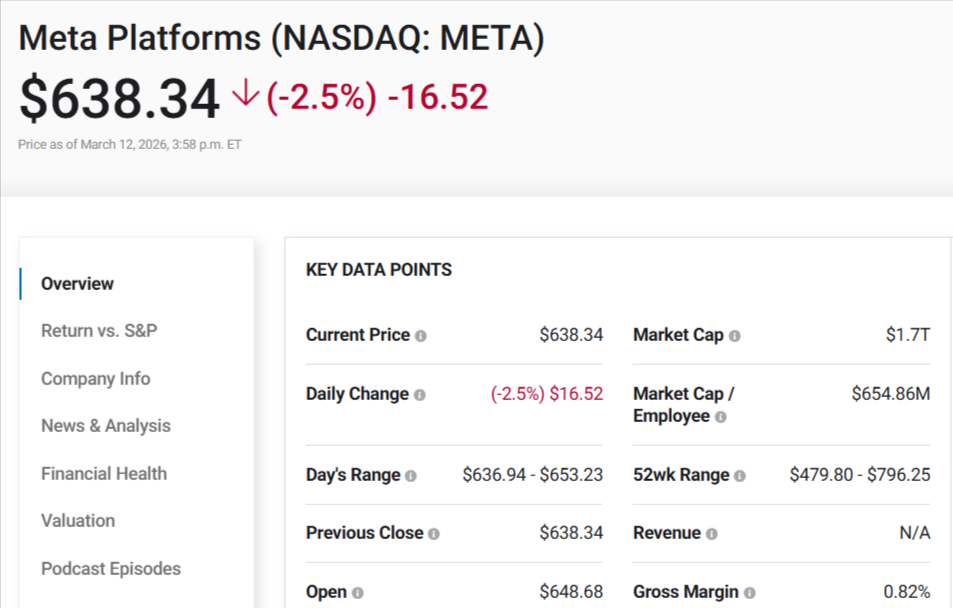
At the end of the trading day on Friday, the shares were at $638.34 which represents a drop of 2.5% beta in view of the capital allocation fear.
Strategic Outlook
The analysts are positive about the long-term growth; the stock is traded at around 19x (January) the earnings of the stock next year, which implies it is underestimated.
The identified decrease can be defined as an investment opportunity, in case AI continues to cement the advertising leadership of Meta and its ability to retain users.
However, threats are there to stay: the prolonged decline in the level of free cash flow may produce volatility in case of the inabilities to satisfy the expectations of returns.
The success of the entity will depend on the speed at which it monetizes super intelligence, otherwise, it might fail to enthuse shareholders who are focused on consistent returns.