
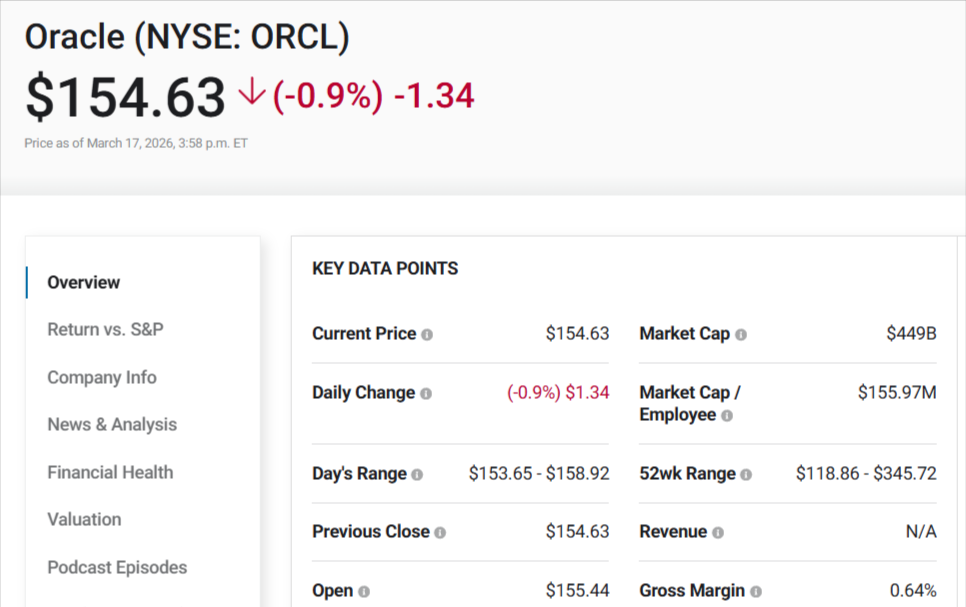
Oracle is speeding up the process of becoming a leader in the AI industry by building its data-centers at an aggressive pace, but its use of capital is concerning. On 17 March 2026, it dropped by -1.34% to $154.63, in an industry-technology downturn of only 3.3%.
Hyper growth and its Cost Implication 🔗
Oracle Cloud Infrastructure (OCI) suggests massive growth, its remaining performance obligations (RPO) reached $523 billion, a startling 438% increase from the previous year, including a $68 billion increase from the previous quarter, according to Oracle’s fiscal second quarter report, which was released in mid-December.
While overall cloud sales increased 34% to $8 billion, cloud infrastructure revenue surged 68% to $4.1 billion.
The team continued to project faster cloud growth in the future and stuck to their full-year revenue forecast of $67 billion. In fiscal 2026, which concludes in May, Oracle is anticipated to spend over $50 billion on capital expenditures more than twice as much as it did the previous year.
By fiscal 2029, the amount is expected to surpass $85 billion. The cost of that spending is mounting. According to data compiled by Bloomberg, the company reported negative free cash flow of almost $10 billion last quarter by far the worst in its history and it is predicted to be negative $7.3 billion in this report.
Its first negative free cash flow since 1990 occurred in fiscal 2025, and it is anticipated that this trend will persist at least through fiscal 2028.
Head of research at S&P Global Visible Alpha, Melissa Otto, said:
“High-growth companies are willing to take a hit in the near term” in pursuit of an outsized gain over the long-term, , but investors are looking for evidence along the way that capex is translating into return on invested capital, margin expansion, and revenue growth. When I look at balance sheets and cash positions of the hyperscalers in the space, they’re very good with the exception of Oracle,”
Investor Risks 🔗
OCI has an edge over its competitors because its databases are already installed in the data centers of Amazon, Microsoft, and Alphabet. This gives OCI a flexible multicloud value. However, due to its high level of leverage, Oracle is vulnerable to fluctuations in AI spending or client capacity agreement defaults.
The return on invested capital is nearly equal to the weighted average cost of capital, indicating that further investment will lose value if revenue growth stagnates.
Projections 🔗
The plan of Oracle depends on its possibilities to turn backlog into lasting profitability, but at the same time, the risk of debts arises in case of the decline in the interest toward AI.
It may be the high-stakes opportunity of risk-appreciative growth investors, but it may be a wait-until-there is a definitive change in cash-flow dynamics to prudent investors. A winning performance will determine survival in a volatile market.