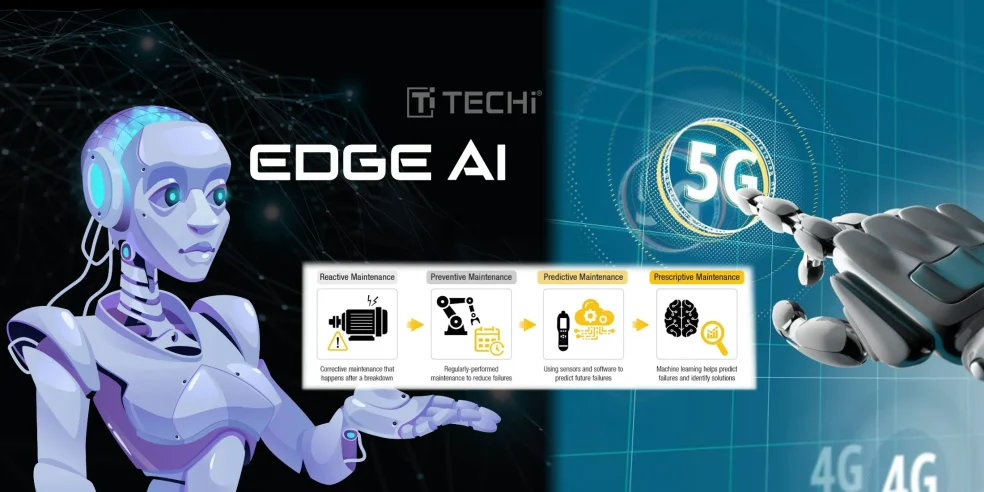
Consider yourself a manufacturer running 24/7 production, what if your machine failed, and every second after that costs you thousands to millions? Only a reaction is not enough at that time; it will consume many hours to repair, obviously, and those hours will impact your finances. Enter predictive maintenance. It’s an approach to assess what your machines are trying to convey to you.
Managing a large number of equipment can be a headache, but with new tech emerging, we have a stronger grip over the maintenance systems. As the world gets adaptive, so does this space. With Edge AI and 5G entering the field, spotting issues like bugs or breakdowns before they occur is no longer a vision; it’s becoming the new normal. In this blog, we’ll discover how Edge AI and 5G are transforming the world.
The Importance of Predictive Maintenance 🔗
Predictive maintenance is necessary because it helps to manage the equipment that can lead to destructive and costly failures. Unexpected breakdowns don’t only cause delays, they also have a negative effect on the economy. So if we rely just on the usual maintenance methods, we’ll be left behind in this booming tech universe. Advanced predictive maintenance methods detect real-time data to identify and resolve the issues before they cause you any damage. This saves your business money, time, and procedural hassles. Even the smartest and most well-engineered systems can fall short without proper maintenance so it’s better to be on the precautionary side.
To understand this concept in-depth, here’s a helpful video for you
Link : What is Predictive Maintenance? Explainer
Edge AI and 5G Combo 🔗
We all are aware that managing large operations is no walk in the park; it requires proper management and a smart system for making decisions instantly. This is where traditional systems fall short. Waiting for data to travel back and forth between servers takes up valuable time, which we don’t have. This is where Edge Ai and 5G networks become the tools.
Edge AI refers to the use of artificial intelligence locally, either on smartphones, drones, or self-driving vehicles. Whether it’s a camera on the road, a sensor on a machine, or you have to track any records, edge AI processes the data locally without sending any information to Cloud AI. So, no lag, no delays, just an instant response about what’s happening right now. This local system reduces internet usage and the need for routine checks.

Then we move to 5G, which brings higher speed, lower latency, and connects with more devices at the same time. We are talking about information being transferred in milliseconds. It has become as easy as flipping a switch.
The combination of edge AI and 5G is transforming the way network operations are conducted. Just imagine a factory where motors need to be monitored in real-time. Just a spike in temperature can disrupt the entire process and compromise the quality of products or functions. Edge AI processes on the spot, and 5G sends signals instantly, rerouting tasks, slowing the process, or even shutting down the motor to prevent damage. This completely eradicates the need to do a manual check, keep a team, or conduct any emergency protocols, just a quiet and automated response.
Milliseconds That Save Millions 🔗
A few seconds might not seem climactic to us in our daily routine, but in industries working on precision and speed, this pause can cause multiple problems. Germany’s automotive manufacturing is the most advanced industry in the world. Companies like Siemens, Bosch , Huawei OpenLab in Munich, Rexroth, and BMW have deployed edge AI and 5G into their production lines. These companies run on tight synchronization. Each sensor, each arm, and each machine runs in harmony, down to the milliseconds.
Here is an interesting video showing the use of Edge Ai and 5G in real time industrial operations.
Germany’s move toward these technologies is not about being trendy. It’s about avoiding costly downtime, reducing human error, and pushing production quality to near perfection. They’re not the only ones; across Europe and Asia, manufacturers are starting to realize that millisecond-level response isn’t merely a step-up, it’s quickly becoming the industry standard.
Real World Examples 🔗
Edge AI and 5G are not limited to industries, but their real strength is their versatility. From emergency response to renewable energy, these technologies are really changing the way machines work. Let’s examine how various sectors are utilizing this combination to streamline their daily operations.
1. Wind Turbines 🔗
Wind turbines are becoming essential in countries like Germany, Denmark, USA etc. Wind energy is critical for the national power there. So, with the help of edge-powered sensors wind speed, rotor movement, and structural strain in real-time are easily monitored. Instead of sending that data to a cloud server for review, edge AI processes it right there, on the turbine itself. For instance, Siemens Gamesa used edge computing to run autonomous turbines that can adapt real-time environmental conditions.

Also the system can respond immediately by regulating blade angles or with the pause of operation when something looks off, like even a slowed process due to overheating or a sudden blast. This kind of millisecond-level reaction not only prevents costly downtime and repairs, but it also protects the equipment. It acts as a prime tech for remote or offshore setups where service delays can stretch into days.
2. Smarter Fleet Management on the go 🔗
In connected cities such as Singapore and Amsterdam, logistics fleets are already running with edge intelligence built into the vehicles. The behavior of the driver, road conditions, and the temperature of the engine are detected in real time using these technologies. The system can instantly alert the fleet manager if it shows mechanical stress or an uneven rise in temperature.

In the Netherlands, edge-based AI goes a step even further. In Amsterdam, 5G-enabled edge computing is used to process 2 million traffic decisions daily. The system analyses in actual time to predict congestion and set traffic or reroute the traffic instantly without requiring a cloud environment.
3. Precision in Smart Manufacturing 🔗
Edge AI and 5G are playing a huge role in manufacturing hubs across South Korea, Germany, and Japan. At Hyundai’s plants in Ulsan, hundreds of robotic systems are connected with the help of private 5G and are being monitored using edge AI. When a robotic arm shows signs of strain or when temperature levels spike during welding, the system responds immediately to prevent any quality issues.

In Germany, Siemens uses edge computing to coordinate thousands of devices across factories, which helps in optimization with ongoing production. Japanese manufacturers, including Fanuc and Omron, utilise edge-powered machine vision to detect flaws such as scratches or misalignments before a product reaches the end of the production line, all without slowing down the process.
4. Smarter Grids and Utility Systems 🔗
In urban infrastructure, edge computing is actually helping cities become smarter, particularly in countries such as Singapore, Australia, and India. In Singapore, water pipes and power grids are loaded with sensors that detect pressure changes or abnormal load spikes. If any section of the grid is failing, edge AI redirects the flow before the system even realizes there’s a problem.
In rural Australia, where wildfires and blackouts are major threats, edge zero monitoring solutions act as first responders, sorting faults in milliseconds. It reduced the need for crews to manage the situation. In India, where urban energy demand is increasing, smart meters utilising edge AI and 5G are enabling cities like Pune to manage power flows more efficiently. At the same time, it detects faults early enough to prevent outages entirely.
5. Emergency Response on the Frontline 🔗
Emergency services are also aligned with the edge-powered system. The Campfire on 8 November 2018 caused unfortunate destruction, claiming 85 lives, destroying 18,000+ structures, and causing over $16 billion in damages. The fire burned so fast that early detection systems, even humans, could not respond in time but cameras noticed that the fire had engulfed the entire town.


In California, the fire department now utilizes edge devices for monitoring hazardous environments. These systems can detect gas leakage or a smoke alert and then trigger a response on the spot. In Canada, this technology is built into ambulances, helping to track vital signs and receive live medical guidance. Some European cities, such as those in Spain, are also testing edge-based crowd monitoring in public spaces. Their systems can detect abnormal movements, safety risks, or surges in real-time, which allows responders to assess an emergency, act accordingly and on time.
Also Read: The Impact of 5G Technology on Society, Environment, and Industry
Challenges 🔗
As powerful as the combo of Edge AI and 5G is, it’s not without its challenges. Like any emerging tech, there’s a catch with this pair too. But the momentum is real, and despite these hurdles, companies are already seeing value.
The setup of edge infrastructure, from smart sensors and local processors to private 5G networks, can get expensive quickly. While implementing cloud setups, the cost is less because it scales gradually. However, edge deployments often require dedicated hardware and on-site integration from day one. It is manageable for large enterprises, but for mid-sized or smaller players, it can feel like a cliff. Some are tackling this with a small start, applying edge AI to just one production line or a single use case before scaling it to other operations. Reports from manufacturers in Asia and Europe show uptime gains and maintenance savings of 20–40% after just six months of edge deployment.

Another genuine concern is data privacy. While processing data locally enhances control, it also introduces new responsibilities. Who manages the data stored on edge devices? How often is it synced? What happens if a device is compromised? Countries like Germany, with strict privacy laws, are pushing for “zero trust” edge frameworks, where each node is independently secured and data sharing is minimized. It’s a smart direction, but building those guardrails across thousands of distributed devices takes time and the right expertise.
Edge AI works best when models are trained to make fast, local decisions. But training complex models on edge devices themselves is still an evolving space. Most edge systems today rely on cloud-trained models that are pushed down to local hardware. It’s suitable for various tasks, such as detecting vibration deviation or temperature spikes. But more adaptive or learning-on-the-fly systems are still in development. Hardware manufacturers like NVIDIA and Qualcomm are already building next-gen edge chips that can handle more complex learning locally. Although edge training is not yet fully mainstream, it is headed in that direction.
Future of Edge AI and 5G 🔗
- Edge devices will get smaller. They’ll become easier to install in remote places and tight spaces without needing huge infrastructure.
- Private 5G will become more common. Businesses will start building their own networks to keep things faster and more secure.
- AI at the edge will start learning by itself. Instead of just running pre-trained models, it will adapt in real time when conditions change.
- Millisecond reactions will become standard. Systems will stop waiting and start acting instantly when something needs to be fixed or adjusted.
- Smart cities will rely on the edge for everyday tasks. Streetlights, public safety, traffic control, and even waste systems will respond instantly without cloud delays.
- Security at the edge will improve. Companies will protect devices by using encrypted data, implementing smarter updates, and AI-based threat detection.
- More industries will finally adopt this tech. Agriculture, mining, public works, and other slow-moving sectors will use edge systems to cut waste and make better decisions.
- Global standards will begin to form. With more adoption, there will be a bigger push to make all systems work together smoothly across countries and industries.
Edge AI and 5G are not just upgrades; they are a shift in how we think about speed, decision-making, and maintenance. Nowadays, industries are finally getting ahead of the problem instead of waiting for things to break. This technology is helping systems act faster than ever before, often in the blink of an eye.
Companies jumping on this tech are not just staying efficient. They are staying prepared. Of course, there are challenges. But with the pace of adoption and the progress already happening around the world, it is clear that this combo of technologies will take over the world sooner than you think.