

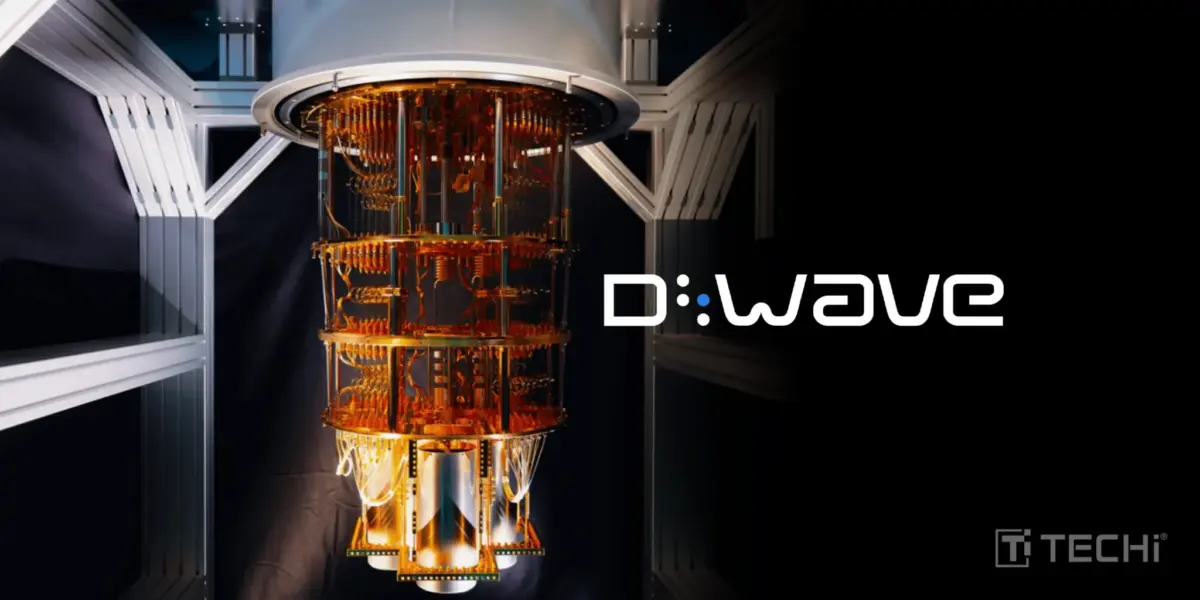
Key Takeaways
- Price QBTS closed at $14.32 on April 3, down 69% from its 52-week high of $46.75 but up 87% over the past year. Market cap sits at approximately $5.3 billion.
- Revenue Growth FY2025 revenue surged 179% to $24.6 million with 82.6% gross margins, though adjusted EBITDA losses widened to $71.8 million. Post-earnings bookings of $32.8 million in January-February 2026 signal accelerating demand.
- QCI Acquisition The $550 million acquisition of Quantum Circuits Inc. makes D-Wave the only dual-platform quantum company with both annealing and gate-model technology, addressing the biggest bear argument against the stock.
- Analyst Consensus Fourteen analysts cover QBTS with a Strong Buy consensus and a median price target of $40.00, implying roughly 179% upside from current levels. Only Zacks dissents with a $8.50 bear case.
- Key Risks Extreme valuation (215x revenue), 67% share dilution in one year, IonQ acquiring D-Wave fabrication supplier SkyWater, and the possibility that commercial quantum adoption remains years away.
Last updated: April 6, 2026 at 10:00 AM ET — Prices reflect market close on Friday, April 3, 2026.
The QCI Acquisition Changes Everything
On January 20, 2026, D-Wave completed its acquisition of Quantum Circuits Inc. (QCI) for $550 million ($300 million in stock, $250 million in cash). This deal transforms D-Wave from a quantum annealing specialist into the only dual-platform quantum computing company in the world. QCI’s technology brings something D-Wave has never had: gate-model quantum computing capability. QCI’s dual-rail qubits feature built-in erasure detection that identifies approximately 90% of errors before they propagate. The practical implication is that QCI’s architecture requires up to 10 times fewer physical qubits per logical qubit compared to competing gate-model approaches. D-Wave now controls all three core technologies needed for scaled, error-corrected superconducting gate-model systems: high-fidelity dual-rail qubits, local cryogenic control electronics, and multi-chip superconducting packaging. The company is targeting general availability of its first dual-rail gate-model system in 2026. For investors, this acquisition addresses the single biggest bear argument against D-Wave: that annealing is a technological dead end. Gate-model systems can theoretically solve any quantum-computable problem, including running Shor’s algorithm for cryptography and Grover’s algorithm for search. By owning both platforms, D-Wave hedges its technology bet while keeping its current commercial advantage in optimization. The risk is execution. Integrating a $550 million acquisition while simultaneously scaling a pre-revenue business segment demands management bandwidth that a company burning $70+ million a year in adjusted EBITDA losses can ill afford to waste.Growth Catalysts: Government Contracts and Commercial Traction
The post-earnings booking numbers tell a more compelling story than the income statement. Between January 1 and February 25, 2026, D-Wave booked $32.8 million in new business. That figure exceeds the company’s combined 2024 and 2025 bookings in less than two months.Government and Defense
D-Wave formed a dedicated U.S. Government Business Unit in December 2025, led by Jack Sears Jr. The timing coincides with growing federal interest in quantum applications for national security. In November 2025, Davidson Technologies installed an Advantage2 annealer at its Huntsville, Alabama headquarters to serve Department of Defense and aerospace customers. By January 2026, Davidson had partnered with defense tech firm Anduril to apply quantum optimization to U.S. air and missile defense planning. Government contracts in quantum computing tend to start small but scale rapidly once agencies validate the technology. The DoD’s interest in optimization for logistics, threat assessment, and resource allocation aligns precisely with D-Wave’s annealing strengths.Commercial Acceleration
Two post-earnings deals stand out. Florida Atlantic University purchased a $20 million D-Wave system, and a Fortune 100 company signed a $10 million, two-year enterprise QCaaS agreement. D-Wave reported 135+ customers across its platform in 2025, including 70+ commercial enterprises and 24+ Forbes Global 2000 companies. Usage metrics reinforce the adoption story. Advantage2 usage jumped 314% year-over-year, and the Stride hybrid solver (which integrates classical and quantum processing) saw a 114% usage increase over just six months. These aren’t pilot programs collecting dust. Enterprises are actively running workloads on D-Wave hardware.Competitive Landscape: Where QBTS Stands
The quantum computing investment landscape splits into two camps: pure-play quantum stocks and big tech incumbents. D-Wave competes differently against each. Among pure-plays, IonQ (NYSE: IONQ) leads in revenue scale with approximately $106-110 million in FY2025 guidance, roughly four times D-Wave’s haul. IonQ uses trapped-ion technology with industry-leading error rates (99.99% two-qubit gate fidelity) and distributes through AWS, Google Cloud, and Azure. Its market cap of roughly $8-9 billion reflects that revenue premium. Rigetti Computing (NASDAQ: RGTI) focuses on modular superconducting gate-based architectures, targeting a 150+ qubit system by late 2026. Rigetti’s revenue base is smaller and its technology less commercially proven, but its modular approach could scale efficiently if the engineering challenges are solved. IBM operates on a different scale entirely. Its Quantum Starling program targets fault-tolerant systems performing 20,000 times more operations than current machines. IBM’s advantage is R&D budget: it can afford to lose money on quantum for decades while revenue from its enterprise business funds research. D-Wave’s competitive moat comes down to three factors: it has the only commercially deployed quantum system that has demonstrated supremacy on a real-world problem, it now owns both annealing and gate-model technology (unique in the industry), and its annealing platform delivers measurable business value to enterprises today rather than in some nebulous future.Analyst Price Targets and Ratings
Bull Case: Why QBTS Could Outperform
The bull thesis rests on three pillars. First, D-Wave has something no competitor can claim: proven quantum supremacy on a commercially relevant problem. The 100-million-times speedup on a materials science optimization problem is not a lab curiosity. It demonstrates that quantum annealing delivers real computational advantages at enterprise scale right now. Second, the dual-platform strategy eliminates the technology risk that plagued D-Wave’s pure-annealing pitch. If gate-model computing becomes the dominant paradigm (as many physicists expect for general-purpose quantum computation), D-Wave now has a seat at that table through QCI. If annealing continues winning in optimization, D-Wave already dominates that market. Either way, D-Wave has exposure. Third, the bookings trajectory has inflected. The $32.8 million booked in January-February 2026 represents a fundamentally different growth rate than the prior two years combined. The Florida Atlantic and Fortune 100 deals suggest that enterprise buyers are moving from pilot programs to production deployments. If this pace sustains through 2026, D-Wave could report $80-100+ million in annual bookings. The $884.5 million cash position provides approximately 8-10 years of runway at current burn rates (before accounting for revenue growth), removing near-term survival risk from the equation.Bear Case: What Could Go Wrong
Is QBTS Stock a Buy?
QBTS stock occupies a strange position in the market. The company has the strongest near-term commercial argument of any pure-play quantum stock: real customers, real revenue growth, proven supremacy, and now a dual-platform moat. The booking acceleration in early 2026 suggests inflection, not stagnation. At the same time, the valuation assumes a level of growth and execution that leaves almost no margin for error. At $14.32, QBTS sits 69% below its 52-week high of $46.75. That pullback has made the entry point considerably more attractive than it was in January, but 215 times revenue is still rich for a company losing $70+ million a year. For investors with a 3-5 year horizon and tolerance for quantum-sector volatility, the current price represents a more reasonable entry than recent history has offered. The combination of the QCI acquisition, government contract momentum, the $884.5 million cash buffer, and the booking inflection creates a setup where positive surprises could meaningfully reprice the stock. Conservative investors should wait for evidence that the booking surge converts to recognized revenue in Q1-Q2 2026 earnings. If D-Wave reports a quarter with $15+ million in revenue, the narrative shifts from “promising but unproven” to “scaling commercial traction,” and the stock likely re-rates accordingly. The 14.69% short interest means any positive catalyst, an unexpected government contract, a gate-model prototype ahead of schedule, or a blowout revenue quarter, could trigger a sharp short squeeze. That cuts both ways: negative surprises with this short interest create downward momentum just as quickly. Position sizing matters more than timing here. This is a stock where being right on the thesis but wrong on the size could be equally painful as being wrong entirely. A 2-5% portfolio allocation captures the asymmetric upside without creating existential risk if quantum computing’s commercial moment takes longer than expected.What does QBTS stock represent?
QBTS is the NYSE ticker symbol for D-Wave Quantum Inc., the world’s first commercial quantum computing company. D-Wave builds and sells quantum annealing systems and, following its January 2026 acquisition of Quantum Circuits Inc., now also develops gate-model quantum computing technology. The stock went public via SPAC merger in August 2022.
How much revenue does D-Wave Quantum generate?
D-Wave reported $24.6 million in full-year 2025 revenue, a 179% increase from FY2024. Revenue comes from three streams: system sales ($16.2 million), Quantum Computing as a Service subscriptions ($5.5 million), and professional services ($2.7 million). Post-earnings bookings of $32.8 million in January-February 2026 suggest accelerating momentum.
Is D-Wave Quantum profitable?
No. D-Wave reported an adjusted EBITDA loss of $71.8 million for FY2025, which was 28% wider than the prior year’s $56.0 million loss despite revenue nearly tripling. The company holds $884.5 million in cash, providing significant runway, but profitability remains years away. Analyst consensus estimates a FY2026 EPS loss of ($0.35) per share.
What is the analyst price target for QBTS stock?
The median analyst price target for QBTS is $40.00, with a full range of $30 to $45. Fourteen analysts cover the stock: 13 rate it Buy and 1 rates it Hold. Zacks offers a contrarian bear case with a fair value estimate of $8.50. At the current price around $14, the median target implies roughly 179% upside.
How does QBTS compare to IonQ (IONQ)?
IonQ leads in revenue (approximately $106-110 million FY2025 guidance vs. D-Wave’s $24.6 million) and cloud distribution through AWS, Google Cloud, and Azure. D-Wave counters with the only proven quantum supremacy demonstration on a real-world problem, a dual-platform strategy (annealing plus gate-model), and the largest qubit count (1,200+ on Advantage2). IonQ uses trapped-ion technology while D-Wave uses superconducting systems.
What are the biggest risks of investing in QBTS stock?
Key risks include extreme valuation (over 200 times revenue), ongoing dilution (shares outstanding grew 67% in one year with more issuance expected), IonQ’s acquisition of fabrication supplier SkyWater Technology, lumpy and unpredictable revenue, widening operating losses, and the possibility that commercial quantum adoption at scale remains several years away.
What is the QCI acquisition and why does it matter?
D-Wave acquired Quantum Circuits Inc. for $550 million in January 2026, adding gate-model quantum computing to its annealing technology. This makes D-Wave the only company with both quantum computing paradigms. QCI’s dual-rail qubits require up to 10 times fewer physical qubits per logical qubit than competing approaches, potentially accelerating the path to fault-tolerant gate-model computing.
Disclaimer: This article is for informational purposes only and does not constitute investment advice. Stock investing carries risk, including potential loss of principal. Always conduct your own research and consult a licensed financial advisor before making investment decisions. TECHi may hold positions in securities mentioned in this article.