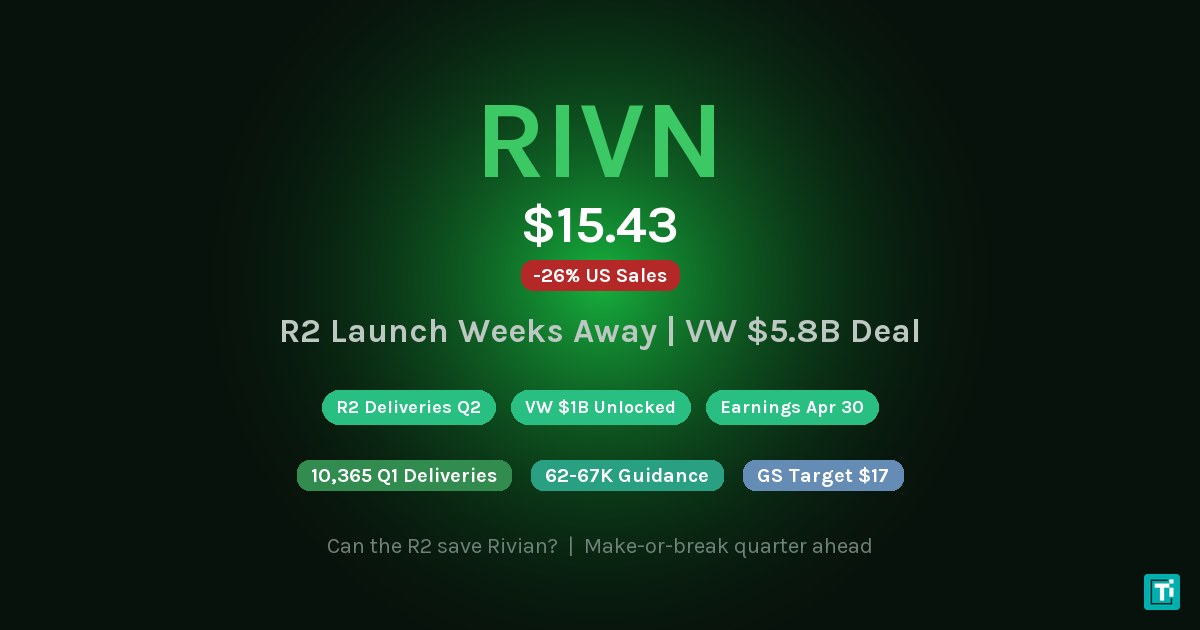
Rivian Automotive delivered 10,365 vehicles in Q1 2026 while its U.S. sales plunged 26%. The stock sits at $15.43 with a market capitalization of roughly $16.4 billion. Those two data points look contradictory until you understand what happens next: the R2, Rivian’s mass-market SUV starting under $45,000, begins customer deliveries in a matter of weeks. And Volkswagen just handed Rivian another $1 billion, bringing the joint venture total to $5.8 billion.
The next 90 days will determine whether Rivian is a future EV leader or another capital-intensive startup that never reached escape velocity. The April 30 earnings call, the R2 production ramp, and the cash burn trajectory all converge this quarter.
Key Takeaways
- RIVN closed at $15.43 on Friday, April 11, with a market cap of roughly $16.4 billion after U.S. sales plunged 26%, sending the stock down 5% on April 7.
- Q1 2026 deliveries hit 10,365 against production of 10,236, with deliveries exceeding production for the first time, while the company reaffirmed full-year guidance of 62,000-67,000 vehicles.
- R2 deliveries start in weeks with the mass-market SUV priced under $45,000 targeting the largest U.S. vehicle segment. The R2 represents an estimated $20 billion revenue opportunity at scale.
- VW unlocked another $1 billion on March 27 after completing winter testing, bringing total JV commitments to $5.8 billion with 1,500+ engineers building shared EV software for VW's 2027 models.
- April 30 earnings is make-or-break with investors watching for R2 ramp timing, cash burn rate, gross margin sustainability, and management's plan to nearly double quarterly deliveries.
Last updated: April 13, 2026 at 5:15 PM ET
Q1 2026 By the Numbers: Stable but Not Enough
Rivian produced 10,236 vehicles and delivered 10,365 in Q1 2026, according to the company’s newsroom release. The fact that deliveries exceeded production is a positive signal: the company is working through existing inventory rather than building unsold trucks.
For context, Q4 2025 saw 10,974 produced and only 9,745 delivered. The Q1 improvement in delivery efficiency matters, even if the absolute numbers remain modest.
The problem is the math against annual guidance. Rivian reaffirmed its 2026 target of 62,000 to 67,000 deliveries. After delivering 10,365 in Q1, the company needs roughly 17,000 to 19,000 deliveries per quarter for the remaining three quarters. That requires nearly doubling the current run rate, and the entire ramp depends on the R2 entering production on schedule.
The 26% US Sales Plunge in Context
Rivian’s U.S. sales declined 26% in the latest reporting period, sending the stock down 5% on April 7. The R1T pickup and R1S SUV face intensifying competition from Tesla’s refreshed lineup, Ford’s F-150 Lightning, and GM’s Hummer EV, all of which have come down in price over the past year.
The R1 platform’s pricing problem is straightforward. The R1S starts above $70,000. The R1T starts above $69,000. At those price points, Rivian competes directly with premium ICE SUVs and trucks from BMW, Mercedes, and high-trim domestic models. The addressable market at that tier is inherently limited, and the 26% decline suggests Rivian may have already saturated the early-adopter segment willing to pay premium prices for an EV truck.
This is precisely why the R2 matters so much. Every quarter the company depends solely on R1 sales is a quarter where the addressable market shrinks.
The R2: Rivian’s Make-or-Break Vehicle
The R2 midsize SUV, priced starting under $45,000, targets the single largest vehicle segment in the American market. First customer deliveries are expected in Q2 2026, meaning production ramp should begin contributing to delivery numbers within weeks.
Unlike the R1 line, which was engineered for capability and premium features, the R2 was designed from the ground up with cost discipline as the primary constraint. Rivian CEO RJ Scaringe has called the R2 the vehicle that makes Rivian a real car company, and the manufacturing architecture reflects that ambition. The new platform uses fewer components, simplified wiring, and a more efficient assembly process than the R1.
At under $45,000, the R2 enters the ring against the Tesla Model Y ($44,990), Hyundai Ioniq 5 ($43,350), and the Chevrolet Equinox EV ($33,900). That pricing places Rivian in a crowded segment, but the R2 differentiates on interior space, off-road capability, and what Rivian calls “adventure-ready” design DNA inherited from the R1 platform. Pre-order numbers have not been publicly disclosed, though DA Davidson noted in its April 1 upgrade that dealer channel checks suggest healthy early demand.
Trefis estimates the R2 opportunity at approximately $20 billion in potential revenue if Rivian can scale to 200,000+ annual units by 2028. For a company trading at $16.4 billion in total market capitalization, successful R2 execution would fundamentally re-rate the stock.
The risk is equally concentrated. Production ramps for new vehicle platforms are notoriously difficult. Tesla spent years sorting through what Elon Musk called “production hell” with the Model 3. Rivian needs a smoother launch. Any meaningful delay would undermine the 2026 delivery guidance and reignite concerns about cash burn at a time when the broader market is already punishing unprofitable growth companies.
Volkswagen’s $5.8 Billion Vote of Confidence
On March 27, Volkswagen unlocked another $1 billion for Rivian after completing winter testing of Rivian’s software and electrical architecture in VW vehicles. The total joint venture commitment now stands at $5.8 billion tied to milestone-based deliverables.
The JV employs over 1,500 engineers and focuses on deploying Rivian’s software platform across Volkswagen’s next-generation EVs. The first VW models running on Rivian’s architecture are expected in 2027.
For Rivian, the VW deal provides two critical advantages beyond cash: validation and revenue diversification. If VW successfully deploys Rivian’s software across its own lineup, Rivian effectively becomes both an automaker and a technology licensor. That dual revenue stream of vehicle sales plus software licensing is the financial model that could justify a valuation multiple well above current levels.
Automotive OEMs do not cut $1 billion milestone checks without rigorous technical evaluation. VW’s continued funding signals that the technology partnership is meeting internal benchmarks, even as Rivian’s vehicle sales struggle.
The stock rallied 6.3% on the day Rivian reaffirmed delivery guidance and the VW software deal details became public, demonstrating how sensitive RIVN is to positive catalysts amid the bearish sentiment. That single-day move nearly offset the 5% decline caused by the sales data a week earlier.
What Wall Street Is Saying About RIVN
Goldman Sachs cut its Rivian price target from $19 to $17 on April 7, citing execution risks around the R2 launch and uncertainty about Rivian’s autonomous driving roadmap. Even at the reduced target, Goldman sees roughly 10% upside from $15.43.
DA Davidson moved the other direction, upgrading Rivian from Underperform to Neutral on April 1, noting that the VW milestone payments provide sufficient cash runway and that R2 pre-order signals appear encouraging based on channel checks.
The split reflects genuine uncertainty. Bears point to the 26% sales decline, ongoing cash burn, and the execution risk inherent in launching a new platform at scale. Bulls point to the R2’s massive addressable market, VW’s continued investment, and Rivian’s brief achievement of positive gross margins in Q4 2025, a milestone that suggests the underlying manufacturing economics are improving even as headline sales disappoint.
For retail investors trying to size the opportunity, the simplest framework is this: RIVN at $15.43 prices in the R1 business and the VW cash infusions. It does not price in a successful R2 launch. If the R2 ramps on schedule and approaches 100,000 annual deliveries by 2027, the revenue trajectory alone would justify a stock price well above $20. If the R2 stumbles, the current valuation has limited downside protection given the ongoing cash burn.
The Cash Burn Question
Rivian has been burning through roughly $1.5 billion per quarter while scaling R1 production and preparing the R2 line. The VW milestone payments have been critical in extending the cash runway. Without the $5.8 billion VW commitment, Rivian’s capital position would be far more precarious.
The path to profitability runs through two milestones: sustained positive gross margins (expected to arrive with R2 volume) and operating breakeven (likely 2027 or 2028 at the earliest). Rivian achieved a brief positive gross margin in Q4 2025, a significant milestone for a company that had been losing money on every vehicle sold. Whether that margin holds through the R2 ramp, when production costs typically spike before settling into steady state, is the central financial question for the next two quarters.
What April 30 Earnings Must Deliver
Rivian’s Q1 2026 earnings call on April 30 carries outsized importance. Five specific data points will drive the stock’s direction through the summer:
R2 production ramp update: Any delays push revenue recognition and the positive gross margin thesis further out. Investors need a specific timeline for first deliveries, not just “first half of 2026.”
Cash position and burn rate: How much cash remains after the latest VW tranche? What is the quarterly burn rate, and when does management project cash flow breakeven?
Gross margin trajectory: Did Rivian sustain the positive gross margins achieved in Q4 2025, or did the mix shift back to losses?
Delivery guidance confidence: How does management plan to ramp from 10,365 quarterly to the 17,000+ needed to hit the 62,000-67,000 annual target?
VW software licensing revenue: When do technology licensing revenues begin appearing on the income statement, and what is the expected margin profile?
A strong call confirming R2 is on schedule and gross margins are holding could push RIVN toward Goldman’s $17 target quickly. A weak call revealing delays or margin deterioration risks pushing the stock below $12.
Disclaimer: This article is for informational purposes only and does not constitute investment advice. TECHi and its authors may hold positions in securities mentioned. Always conduct your own research and consult a licensed financial advisor before making investment decisions.