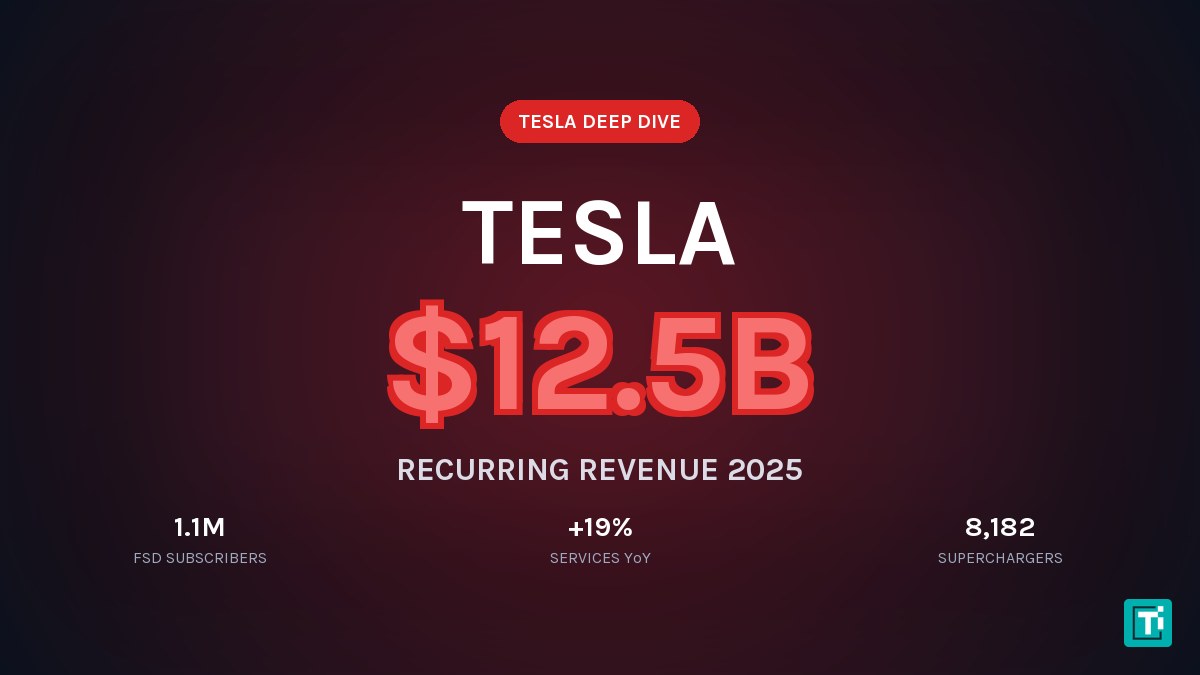
The most important number in Tesla’s 2025 annual report was not the headline. The headline was that net income fell 46 percent to $3.79 billion, and most of the financial press wrote it up as a story about an automaker losing share to BYD and watching its margins compress. That framing missed the point. Buried in the same filing, services and other revenue ran at $12.53 billion for the full year, up 19 percent year-over-year, and Tesla’s energy business hit $12.8 billion at +27 percent. Add the two together and Tesla now generates more than $25 billion of non-automotive revenue annually, growing in the high teens to high twenties, while the cars themselves are becoming the loss-leader hardware that delivers customers to a stack of monthly bills.
Key Takeaways
- Services revenue: $12.53 billion in 2025, up 19 percent year-over-year. Energy revenue added another $12.8 billion at +27 percent.
- FSD subscribers: 1.1 million active FSD users at end of 2025, including roughly 330,000 on the monthly recurring tier. Subscription-only since February 14, 2026 at $99 per month.
- Supercharger moat: 8,182 stations and 77,682 stalls. Every major North American OEM now uses the network via NACS.
- Insurance attach: 17 percent of Tesla owners in available states have opted in. Telemetry-priced premiums create a structural data moat.
- Why it matters: Net income fell 46 percent to $3.79 billion in 2025, but the recurring revenue base supports a software-style multiple expansion that the consolidated number does not capture.
Last updated: April 12, 2026. TSLA closed at $348.95 on April 10, 2026 (Polygon end-of-session aggregate). All financial figures sourced from Tesla’s Q4 2025 update and verified earnings coverage.
Reviewed by Rana Umair Aslam, ACCA (Finance Editor). This article is informational only and does not constitute investment advice.
In This Article
The Pivot Hiding in Plain Sight
For most of the past decade, the bull case on Tesla rested on a single equation: build more cars, sell them at scale, watch the margin profile inflect. That equation broke in 2025. Total revenue slipped to $94.83 billion from $97.69 billion the year before, and a 46 percent collapse in full-year net income to $3.79 billion forced even the most patient long-only desks to acknowledge that the automotive growth story was, for now, on pause. Vehicle deliveries fell. Pricing pressure from BYD and a half-dozen Chinese competitors compressed average selling prices. Regulatory credit revenue, which had been a quiet margin cushion since 2020, began to fade as competitor compliance pools narrowed.
And yet the stock did not collapse. Tesla shares closed at $348.95 on April 10, 2026, holding within a few percent of the 52-week range and pricing in a forward multiple that does not look like an automaker at all. The reason is simple. The market has begun to value Tesla on its non-automotive revenue base, and that base is now large enough, growing fast enough, and structurally recurring enough to justify a software-style multiple on a hardware-style company. The cars are still the product. They are no longer the business.
FSD Subscription: The Trojan Horse
The single most consequential change in Tesla’s commercial model arrived on February 14, 2026, when the company quietly ended one-time purchases of Full Self-Driving and moved the product to a subscription-only basis. Existing one-time buyers were grandfathered. Every new vehicle delivered after that date can only access FSD through a $99 per month subscription, with a discounted $49 per month tier for owners who had previously purchased Enhanced Autopilot. Tesla also extended an FSD transfer window for buyers who took delivery of a new vehicle by March 31, 2026, the only meaningful concession in an otherwise sharp pivot away from the historical perpetual-license model.
The arithmetic is what matters, but it has to be done carefully. Tesla disclosed at the end of 2025 that the FSD active user base had crossed 1.1 million, a figure that includes both outright purchasers from prior years (roughly 770,000 grandfathered owners contributing no monthly cash flow) and the smaller monthly subscription cohort (roughly 330,000 paying users at the time of disclosure). The recurring portion is what matters for the SaaS thesis. At a $99 monthly run-rate, the active subscriber base alone represents roughly $390 million of annual recurring revenue, before any future price increases and before any of the new vehicles delivered in 2026 are added to the count. The $390 million figure understates the long-run trajectory because the February 14 transition to subscription-only means every new vehicle delivered after that date can only convert to FSD through the monthly tier. Elon Musk has stated explicitly that the subscription price will rise as the software’s capabilities improve, which positions FSD as a SaaS product with both a unit-growth tailwind and a pricing-power tailwind layered on top. The per-subscriber lifetime value of an FSD user, assuming a five-year average ownership window and modest price escalation, comfortably exceeds the gross profit Tesla earns on the underlying vehicle. That is the crux of the recurring-revenue thesis: every car delivered is no longer a one-time transaction but the start of a multi-year billing relationship.
The strategic logic also explains why Tesla has been so unwilling to license FSD to other automakers despite repeated reports of inbound interest. Licensing the software to a third party would generate one-time revenue and an ongoing royalty, but it would forfeit the direct customer relationship and the ability to upsell adjacent services (insurance, charging, premium connectivity) into the same account. Owning the full vehicle stack is the moat. Subscriptions are how that moat gets monetized.
Supercharging: The Toll Road Tesla Already Owns
The Supercharger network is the second pillar of the recurring revenue stack, and it might be the most underappreciated asset on the entire Tesla balance sheet. As of the end of Q4 2025, Tesla operated 8,182 DC fast-charging stations and 77,682 individual stalls globally, growing the station footprint by 17.3 percent year-over-year and the stall count by 18.6 percent. The interesting story is not the absolute size. It is who is plugging into them.
Between 2023 and early 2026, every major North American automaker (Ford, General Motors, Hyundai, Kia, Genesis, Rivian, Polestar, Volvo, Mercedes, BMW, Toyota, Honda, Nissan, Stellantis) committed to adopting the North American Charging Standard (NACS) and gaining access to the Supercharger network through built-in ports starting with their 2025 model years. By the end of 2025, the practical effect was that Tesla had become the dominant fast-charging utility for the entire North American EV market, collecting per-kilowatt-hour fees from cars its competitors built. The 2025 services revenue line, which grew 19 percent, was driven primarily by paid Supercharging sessions and the rate increases Tesla pushed through on its US network as utilization climbed.
This is the cleanest example of platform economics in the entire EV transition. Tesla built the network with internal capital years before competitor demand materialized. The marginal cost of serving a non-Tesla vehicle at an existing Supercharger stall is effectively the same as serving a Tesla, which means every additional non-Tesla session is incremental gross margin against a fixed cost base that is already paid for. Industry estimates put Supercharger gross margin in the 30 to 40 percent range at current utilization, and that figure rises as the network gets more crowded with non-Tesla traffic. Unlike automotive gross margin, Supercharger margin is structurally decoupled from vehicle pricing competition.
Tesla Insurance: The Quietest Bull Case
If FSD is the obvious recurring revenue line and Supercharging is the underappreciated one, Tesla Insurance is the line that almost no sell-side model treats seriously. As of early 2026, Tesla Insurance is live in 13 US states, including Arizona, California, Colorado, Florida (added in December 2025), Illinois, Maryland, Minnesota, Nevada, Ohio, Oregon, Texas, Utah, and Virginia, with steady expansion underway. The product uses real-time telemetry from the vehicle (acceleration patterns, braking severity, lane discipline, time of day) to price premiums on a per-driver basis rather than the traditional demographic-and-history approach used by Geico, Progressive, and State Farm. Tesla also discounts premiums for owners who actively use FSD, which compounds the recurring revenue case across two product lines simultaneously.
The number that matters here is the attach rate. As last formally disclosed by Tesla management on the Q4 2022 earnings call in early 2023, 17 percent of Tesla owners in states where the product is offered had opted for Tesla Insurance. Tesla has not published an updated attach rate since, but state-by-state regulatory filings and industry tracking suggest the figure has continued to climb in line with the geographic expansion of the product. The strategic ceiling is much higher. Auto insurance is roughly a $300 billion annual market in the US alone, and the median per-vehicle premium is in the $1,500 to $2,000 range. If Tesla can scale to all 50 states over the next several years and push the attach rate into the 40 to 50 percent range that loyal customer bases support, the insurance line alone could become a multi-billion-dollar high-margin business with a captive distribution channel that no incumbent insurer can replicate.
The hidden advantage is the data feedback loop. Every Tesla on the road generates terabytes of driving telemetry that flows back to a single underwriting model, which means Tesla’s loss ratio improves with every additional policy sold, while traditional insurers depend on third-party data brokers and historical actuarial tables. Over a long enough horizon, that data advantage either becomes an unbridgeable moat or it forces Tesla to license the underwriting product to other carriers, which would be a third recurring revenue stream layered on top of the first two.
Premium Connectivity, Software Features, and the Long Tail
Beyond the three headline subscription lines, Tesla operates a long tail of smaller recurring products that collectively contribute meaningful margin. Premium Connectivity is a $9.99 monthly subscription that unlocks live traffic visualization, satellite-view maps, video streaming, and in-car internet browsing. The product is bundled free for the first eight years on most new vehicles, after which owners convert to paid subscriptions at relatively high rates because the alternative experience is meaningfully degraded. There are also a la carte software upgrades (Acceleration Boost, certain in-car gaming bundles, and other vehicle-specific feature unlocks) that operate on a one-time-purchase basis but reset with every new vehicle delivery.
None of these individual lines is large in absolute terms. The aggregate effect, however, is that Tesla earns a small but durable monthly revenue stream from essentially every active vehicle on the road, in addition to the larger FSD and Supercharging contributions. When the entire installed fleet is taken into account (Tesla had delivered roughly 8.9 million cumulative vehicles globally by the end of 2025), the recurring revenue surface area is enormous and largely independent of new-car sales. A bad delivery quarter does not immediately impair the recurring base. A great delivery quarter accelerates it.
What This Means for the Multiple
The valuation question that matters most is whether Tesla deserves a software multiple on its recurring revenue base or an automaker multiple on its consolidated revenue. The answer the market has been groping toward through 2025 and into 2026 is that the answer should be different for different parts of the company. The roughly $80 billion in automotive revenue should be valued like a global automaker (somewhere in the 0.7x to 1.2x sales range) while the roughly $25 billion in services and energy revenue should be valued like a hybrid SaaS-and-utility business (closer to 6x to 10x sales for the SaaS portion and 3x to 5x for the energy portion).
Run those numbers and the sum-of-the-parts case gets to a market cap meaningfully higher than the consolidated multiple implies. That is why the stock has held its level despite the 46 percent net income decline. It is also why every quarter that services and energy continue to compound at the current pace makes the bear case structurally harder to defend. The single biggest risk to the thesis is not vehicle sales. It is regulatory friction around FSD, an autonomous driving incident that forces a temporary feature pause, or a state-level insurance commissioner blocking Tesla Insurance expansion. Those are the variables that matter now, not unit deliveries.
The Bear Case
Three risks deserve serious weight. First, FSD subscription churn is unknown. Tesla discloses subscriber count but not retention rate, and a $99 monthly product that depends on customer perception of incremental capability gains is structurally vulnerable to cancellations if regulatory bodies push back on autonomous claims or if a single high-profile incident undermines trust. Second, Supercharger pricing is constrained by competitor build-out. As Electrify America, EVgo, and Shell Recharge expand their fast-charging footprints, Tesla’s pricing power on the network will gradually erode, even though absolute volumes keep growing. Third, the insurance unit operates in a regulated industry where state-level approval cycles can take quarters or years and where a single bad loss-ratio quarter can force premium repricing that compresses margin.
None of these risks invalidates the thesis. They modulate the trajectory. The recurring revenue base is real, the growth rates are documented, and the company has now publicly committed to the subscription-only path on its most important software product. Investors comparing Tesla to traditional automakers are missing the structural change underway. Investors comparing Tesla to NVIDIA or to a pure software platform are overpaying for a business that still ships physical hardware at thin margins. The truth sits in between, and the right valuation framework adjusts as the recurring base grows.
What to Watch Next
Three forward catalysts should drive the recurring revenue narrative through the rest of 2026. The first is the next FSD subscriber disclosure in the Q1 2026 earnings update, which will reveal whether the February 14 transition to subscription-only is accelerating or slowing net additions. The second is the Optimus Gen 3 unveil, originally planned for Q1 2026 but delayed into Q2 2026 after Musk confirmed the hardware needed final refinements. Gen 3 is the first version of the humanoid robot designed for mass production and the entry point to a category that does not yet exist on any automaker income statement. The third is incremental state approvals for Tesla Insurance, particularly in California (where regulatory approval cycles have historically been slow) and in any of the large East Coast states currently absent from the footprint.
The clearest signal that the recurring revenue thesis is working will be a quarter in which services and energy revenue together exceed automotive gross profit. That crossover is closer than most models assume. When it happens, the stock stops being a referendum on quarterly delivery numbers and becomes a referendum on subscriber growth, attach rates, and gross margin per active vehicle, the same metrics that Wall Street has spent the past fifteen years learning to value highly in software and AI infrastructure businesses. That is the multiple expansion the bull case is waiting for, and the data through Q4 2025 says it is materializing on schedule.
How much recurring revenue does Tesla actually generate?
Tesla’s services and other revenue line came in at $12.53 billion for full-year 2025, up 19 percent year-over-year, and the energy business added another $12.8 billion at +27 percent. Together that is more than $25 billion of non-automotive revenue annually. Within the services line, the largest recurring contributors are paid Supercharging, FSD subscriptions (1.1 million active users at the end of 2025, of which roughly 330,000 are on the monthly recurring tier), Tesla Insurance, and Premium Connectivity.
What changed with FSD pricing in February 2026?
On February 14, 2026, Tesla ended one-time purchases of Full Self-Driving and moved the product to a subscription-only basis. The standard rate is $99 per month, with a discounted $49 per month tier for owners who previously purchased Enhanced Autopilot. Existing FSD owners are grandfathered. The shift converts what had been a one-time hardware unlock into a perpetual recurring revenue stream tied to vehicle ownership.
How big is the Supercharger network and who uses it?
As of the end of Q4 2025, Tesla operated 8,182 Supercharger stations and 77,682 individual stalls globally, growing 17 to 19 percent year-over-year. Every major North American automaker has now committed to adopting NACS and accessing Tesla’s network, which means Tesla collects per-kilowatt-hour fees from non-Tesla EVs built by Ford, GM, Hyundai, Kia, Rivian, and others. Industry estimates put Supercharger gross margin at 30 to 40 percent and rising as utilization climbs.
How is Tesla Insurance different from traditional auto insurance?
Tesla Insurance prices premiums based on real-time vehicle telemetry rather than demographic and historical actuarial data. The product is currently available in 13 US states (including California, Florida, Texas, Illinois, Ohio, Arizona, Nevada, and Oregon) and reached a 17 percent attach rate among Tesla owners in markets where it was offered, as last formally disclosed by Tesla management on the Q4 2022 earnings call. The data feedback loop from millions of connected vehicles is the structural advantage no incumbent carrier can replicate quickly.
Why did Tesla’s profit fall 46 percent in 2025 if the recurring revenue base is growing?
The 46 percent net income decline (to $3.79 billion) was driven almost entirely by the automotive segment: lower vehicle deliveries, BYD-led pricing pressure across China and Europe, and fading regulatory credit revenue. Services and energy revenue grew double-digits in the same period, but they are still smaller than the automotive base in absolute terms. The thesis of this article is that the mix is shifting fast enough that the multiple expansion from a recurring revenue re-rating will more than offset the cyclical automotive decline over a multi-year window.
Disclaimer: This article is for informational purposes only and does not constitute investment advice. TECHi and its authors may hold positions in securities mentioned. Price data cited reflects the most recent Polygon end-of-session aggregates available at the time of writing. Always conduct your own research and consult a licensed financial advisor before making investment decisions.