When we think of the term hacker, we are reminded of men in dark hoods, who hack into your systems, disrupt everything, and remain a step above the police. They are a novel form of offending and resistance in the modern world of interconnected society. Yet, behind the dramatic headlines and mega breach of information, are true tales of real people, as well as valuable lessons.
This is the story of the 10 most notorious hackers, how they rose, what they did, where they are now, and what their legacies mean for a world that’s more connected and more vulnerable than ever.
The Roots of a Digital Revolution 🔗
Before the internet became the backbone of modern life, it was a playground for the curious and the clever. In the 1970s and 80s, the digital world was a frontier with no lawman, no rules, and endless possibilities. Early hackers weren’t always out to cause harm. Many were just kids with a skill for taking things apart, kids who saw a phone line or a computer terminal as a puzzle waiting to be solved.
But as technology grew, so did the stakes. The line between curiosity and crime blurred. Some hackers became heroes, others villains, and a few became legends.
1. Kevin Mitnick 🔗
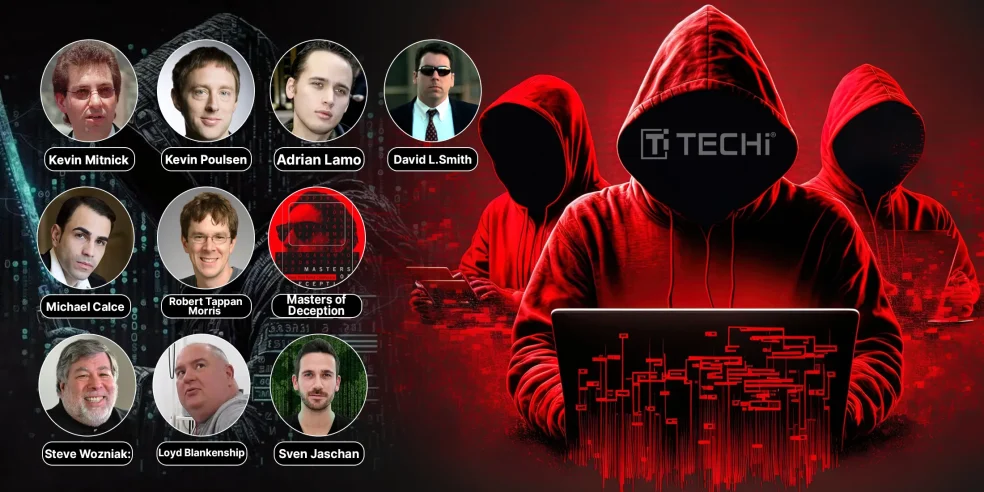
Let’s start with Kevin Mitnick, the man who turned hacking into high drama. Born in Los Angeles in 1963, Mitnick was a magician before he was a hacker. He loved tricks, deception of hand, and the art of misdirection. By his teens, he discovered a new kind of magic: social engineering. He could talk his way past phone operators, security guards, and eventually, digital gatekeepers. Mitnick’s exploits in the late 1980s and early 1990s read like a Hollywood script. He broke into the networks of Motorola, Nokia, and Fujitsu, swiping source code and leaving digital footprints that drove the FBI mad. For years, he was the most wanted computer criminal in America. His 1995 arrest was a media circus, and his five-year prison sentence set a new precedent for cybercrime.
But here is the twist: after prison, Mitnick reinvented himself. He became a best-selling author and founded his own security consultancy, teaching companies how to defend against hacking. Until his death in 2023, he was a sought-after speaker and a champion for ethical hacking. His story is a reminder that the line between outlaw and expert is razor-thin. In fact, the same techniques of social engineering that Mitnick perfected remain incredibly effective today.
As of 2025, social engineering tactics like phishing remain the top cause of cyber breaches, responsible for over 85% of incidents. According to the 2024 Verizon DBIR, the human element is contained in 68% of breaches. Of those, the Comcast Business Cybersecurity Threat Report says 80-95% are initiated by a phishing attack, and the total volume of phishing attacks has skyrocketed by 4,151% since the advent of ChatGPT in 2022, according to SlashNext. At an estimated $4.88M per phishing breach, social engineers are making billions by being better at making people click than we are at understanding what makes them tick.
2. Kevin Poulsen 🔗
Kevin Poulsen, known as “Dark Dante,” had a thing for phones. Born in 1965, he was obsessed with the hidden pathways of the telephone system. His most famous trick? In 1990, he took over all the phone lines to a Los Angeles radio station, guaranteeing himself the winning call in a contest for a Porsche 944 S2. He also broke into police databases, landing him a spot on “Unsolved Mysteries.”
After a two-year game of cat and mouse, Poulsen was caught and served time. But like Mitnick, he found redemption. Today, he is an investigative journalist at The Wall Street Journal, exposing online predators and fighting for digital rights as a senior editor at Wired. His journey proves that hackers can become the watchdogs of the very world they once disrupted. His other projects include being author of the book KingPin and working with the late Aaron Swartz to design and develop SecureDrop, an open-source software platform for secure communication between journalists and sources, now used at dozens of news organizations.
3. Adrian Lamo 🔗
Adrian Lamo’s life was anything but ordinary. Born in 1981, he spent much of his youth couch-surfing or living on the streets, using public libraries and cafes as his digital base. Lamo’s targets included Microsoft, Yahoo, and most famously, The New York Times. He would get into networks using public Wi-Fi, exposing gaps in corporate security.
However, Lamo’s most controversial act came in 2010, when he reported Chelsea Manning for leaking classified documents to WikiLeaks. Some called him a hero, others a traitor. Lamo died in 2018, but his story is a powerful reminder that hackers often operate in moral gray areas. In fact, insider threats and ethical dilemmas are more common than ever in 2025. According to security professionals, insufficient employee training and awareness is the largest perceived driver of insider threat activity.
4. Steve Wozniak 🔗
Before Apple was a household name, Steve Wozniak was just a kid with an aptitude for mischief. Born in 1950, he and Steve Jobs built “blue boxes,” the devices that tricked phone systems into making free long-distance calls. For Wozniak, hacking was about curiosity and creativity, not crime. That same spirit led him to co-found Apple and change the world of personal computing.
Steve Wozniak aka “The Woz” learned about phreaking from the 1971 Esquire article “Secrets of the Little Blue Box” by Ron Rosenbaum. Halfway through the article, Woz called his friend, Steve Jobs, and read it to him.
Wozniak’s story is proof that hacking isn’t always about breaking things. Sometimes, it’s about building something better.
5. Loyd Blankenship 🔗
Loyd Blankenship, known as “The Mentor,” was a guiding force in the 1980s hacker group Legion of Doom. After his arrest in 1986, he penned “The Hacker Manifesto,” a poetic defense of hacking as a quest for knowledge rather than malicious activity. His words became a uniting cry for generations of hackers, even making their way into the trendy classic film Hackers.
Blankenship’s “The Hacker Manifesto,” written after his arrest, became a seminal text in hacker culture. Transitioning from hacking, Blankenship became a successful writer and designer for popular video games like Cyberpunk. He continues contributing to technology and society with his writings on computer security and contributions to educational programming.
Blankenship’s legacy is more philosophical than technical. He showed that hacking is as much about ideas as it is about code.
6. Michael Calce 🔗
In 2000, a 15-year-old Michael Calce, better known as “Mafiaboy,” brought the internet to its knees. His denial-of-service attacks took down Yahoo!, eBay, Amazon, and CNN, exposing just how fragile the web really was. The fallout was massive as President Bill Clinton convened the first White House cybersecurity summit, and Calce was arrested after bragging in chat rooms.
Today, Calce runs a cybersecurity firm and is a global advocate for digital safety. His book, Mafiaboy: How I Cracked the Internet and Why It’s Still Broken, is a staple in cybersecurity courses. His actions still persist, as in the first quarter of 2025, Cloudflare blocked 20.5 million DDoS attacks. That represents a 358% year-over-year (YoY) increase and a 198% quarter-over-quarter (QoQ) increase.
7. Robert Tappan Morris 🔗
In 1988, Robert Tappan Morris, a Cornell grad student, unleashed the first worm to spread across the internet. His goal? To measure the size of the web. The result? Chaos. The Morris Worm infected over 6,000 computers and caused millions in damages. Morris was convicted under the new Computer Fraud and Abuse Act but received probation and a fine.
Today, Morris is a respected computer scientist and co-founder of Y Combinator, a startup accelerator. His early mistake led to the creation of the Computer Emergency Response Team (CERT), a cornerstone of modern cyber defense.
8. Masters of Deception 🔗
The Masters of Deception (MOD) were a collective of elite hackers in the late 1980s and early 1990s. Their specialty? Phone phreaking—manipulating the nation’s phone networks. Their most infamous act was the 1992 attack on AT&T, which forced telecom companies to rethink their security from the ground up. MOD’s exploits are chronicled in books and documentaries, capturing the transition from analog to digital hacking. Their story is a reminder that every era has its outlaws and its lessons.
In 1992, five members of MOD were indicted in federal court following a major nationwide investigation by a joint FBI/Secret Service task force. Within the next six months (in 1993), all five pleaded guilty and received probation or prison sentences.
9. David L. Smith 🔗
In 1999, David L. Smith released the Melissa virus, which spread like wildfire via email and caused over $80 million in damages. The virus exploited Microsoft Word macros and tricked users into opening infected documents. Smith was sentenced to jail, but the Melissa virus changed how organizations approached email security forever. Today, phishing and ransomware attacks are direct descendants of Smith’s original blueprint. A fact underscored by the FBI’s Internet Crime Complaint Center (IC3) receiving over 300,000 phishing reports in 2025—more than any other cybercrime category.
10. Sven Jaschan 🔗
German teenager Sven Jaschan wrote the Sasser and Netsky worms in 2004, infecting millions of computers and causing global chaos. Jaschan received a suspended sentence and was later hired by a security firm, a classic case of turning a black hat into a white one. In 2025, worms and self-propagating malware are still major threats, especially with the explosion of IoT devices. In Q1 2025, Kaspersky products blocked more than 629 million attacks that originated from various online resources.
Also Read: Hackers Have 19 Billion Passwords, See If Yours Is One of Them
Cybercrime and the World Today 🔗
According to Cybersecurity Ventures, global cybercrime costs are expected to hit $11.5 trillion annually by the end of 2025, nearly double what they were just four years ago. Ransomware, phishing, and supply chain attacks are more sophisticated than ever. Recent incidents like the Salesforce breach and massive password leaks demonstrate that the threats these hackers pioneered remain relevant today.
Here are some numbers that tell the story:
| Category | 2025 Data/Trend |
| Human Element in Data Breaches | – Verizon’s 2025 Data Breach Investigations Report finds the human element was involved in about 60% of breaches in 2024 and 2025, including phishing, social engineering, credential misuse, and errors. – Mimecast’s State of Human Risk 2025 report claims up to 95% of breaches are caused by human error, which includes insider threats, credential misuse, and accidental mistakes. – According to IBM, phishing specifically accounted for 16% of all breaches in 2025, making it the third most common attack vector after credential misuse (22%) and vulnerability exploitation (20%). |
| Ransomware Attack Trends | – Check Point and TechRepublic report a 126% increase in ransomware attacks in Q1 2025 compared to the same period in 2024. – Bluefire Redteam reports a 35% increase in ransomware attacks in Q1 2025 over the previous quarter, and a 55.5% year-over-year increase in the number of active ransomware groups. |
| Average Cost of a Data Breach | – IBM and Deuglo both cite an average cost of $5.3 million for 2025, up from $4.88 million in 2024. |
| Prevalence of Significant Cyber Incidents | – The World Economic Forum’s Global Cybersecurity Outlook 2025 finds 72% of organizations report a rise in cyber risks, and over 70% have experienced at least one significant incident annually. – Deuglo reports that 93% of organizations experienced at least one breach in the past year. |
The lessons from these notorious hackers are more relevant than ever. The threats have evolved, but the core vulnerabilities—human error, poor security hygiene, and lack of awareness—are still the same.
What We Can Learn from Them 🔗
So, what do these stories teach us? First, that curiosity drives innovation. Many hackers started out wanting to learn, not to harm. Second, ethics matter; the line between right and wrong in the digital world is often blurry. Third, that redemption is possible—some of the world’s most notorious hackers now protect the very systems they once breached. And finally, that vigilance is the key: cyber threats are always evolving, and the only way to keep up is to keep learning. For comprehensive guidance, consider reading our guide to the best cybersecurity books.
Looking Forward 🔗
The future of hacking is both exciting and terrifying. Artificial intelligence is now used by both attackers and defenders, automating everything from phishing to threat detection. Quantum computing could break today’s encryption, while blockchain offers new ways to secure transactions.
What’s next?
Expect more sophisticated, automated attacks targeting critical infrastructure. Encryption as we know it may become obsolete within the next decade. And the demand for ethical hackers is at an all-time high, with salaries rising 18% year-over-year. But the most important lesson is:
Technology alone can’t secure cyberspace. The stories of these 10 hackers remind us that curiosity, creativity, and ethics are just as important as firewalls and code.
Also Read: Unveiling the Hidden Costs of Innovation
Frequently Asked Questions 🔗
1. Who is considered the most notorious hacker ever? 🔗
Most experts point to Kevin Mitnick, whose exploits and high-profile pursuit by the FBI made him a household name.
2. How did Michael Calce’s attacks change the world? 🔗
His 2000 attacks exposed the internet’s vulnerabilities, leading to a global reckoning on cybersecurity and inspiring new laws and technologies.
3. Are any of these hackers still active in the field? 🔗
Yes. Kevin Poulsen is an investigative journalist, Michael Calce runs a cybersecurity firm, and Robert Tappan Morris is a respected academic and entrepreneur.
4. What’s the biggest cyber threat in 2025? 🔗
Ransomware and AI-powered phishing attacks are the top threats, with damages projected to exceed $11.5 trillion globally this year.
5. How do hackers hide? 🔗
Encrypting their communication and data allows hackers to prevent others from intercepting and reading their messages. Encrypting data before it leaks is also a way for hackers to get around your security tools, which are designed to detect signs of corporate data leaving your organization.