AI technology in the world is mainly controlled by the big companies from the U.S, but the next major growth area is China, in which Alibaba will be playing a major role. After going through a tough phase of regulatory challenges and strong competition, the company has slowly but surely regained its position in the market.
The company’s financial report for the quarter ending September 2025 indicated that the cloud revenue of the company increased by 34% compared to the previous year, and revenue from AI-related cloud services also increased.
It can be said that this was not just a one-time increase, rather it was the clearest proof till now that Alibaba is transforming itself from an online retail innovator to a complete AI industry player. For those investors who want to take the risk of investing in the long run in China’s AI boom, Alibaba will be, among the major choices, the most attractive, and the least recognized opportunity in the market.
Alibaba Cloud 🔗
AI, as a technology, is not feasible without having powerful computing, and when it comes to China, Alibaba Cloud has been the infrastructure that is the chiefly preferred one for that purpose. Any model, no matter if it is being trained, deployed, or fine-tuned, will need cloud storage, and currently, Alibaba is very much involved in capturing this demand on a large scale.
Its cloud division is expanding at a pace that is far superior to the company’s other segments, not because of the temporary excitement but due to the companies systematically integrating it into their operations. Artificial intelligence technology is being implemented by banks, manufacturers, retailers, logistics networks, and public sector agencies in China, and Alibaba is in the middle of this revolution, doing the role of a facilitator. This means that the more the AI technology spreads in China, the more vital Alibaba Cloud will be.
Full-Stack AI Approach With Strength 🔗
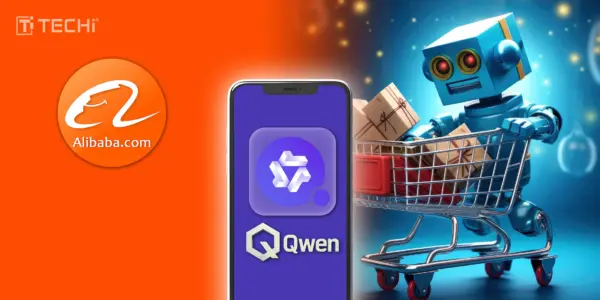
In contrast to companies providing stand-alone AI solutions, Alibaba has developed a vertically integrated ecosystem that will make it hard for the competitors to dethrone it in the long run. At the top of the ecosystem is its Qwen large language model which is used in the customer service automation, productivity applications, and creative tools.
Over the top of that is Alibaba Cloud, which is the main source of the computing power that is required for the training and deployment of those models. Additionally, there is still the company’s development of domestic AI chips, which is a bold but vital step in cutting off dependence on U.S hardware. Such a multi-layered approach equates to the western tech powerhouses and makes Alibaba the closest and biggest competitor to AWS, Azure, and Google Cloud, all in one company.
Artificial Intelligence in the Largest Digital Ecosystem of China 🔗
Alibaba owns a giant digital ecosystem that no one can compete with, because it can be present in every way and can also immediately deploy AI on a large scale. Its online selling platforms are using AI to make search and recommendations smarter. Cainiao Logistics takes advantage of AI in the analysis and planning of delivery and warehouse automation.
DingTalk has incorporated the use of AI tools in the enterprise workflows. The more applications there are, the more data is generated, and the better the AI models become, which leads to the improvement of the ecosystem. Only a handful of companies worldwide can boast of such a closed-loop advantage.
Bottom Line 🔗
Alibaba does not feel the need to promote itself as an AI stock; instead, it is laying down the infrastructure, models, and ecosystem of sorts that could easily turn out to be the backbone of the Chinese AI economy. The process of transformation has been very real, it is gaining momentum, and is of highly strategic nature.
For investors who are ready to look beyond U.S markets and want to take part in a diversified exposure to global AI growth, Alibaba presents an attractive combo, where scale, technology depth, and an ecosystem is ready for long-term monetization. In a worldwide AI contest dominated by the usual Western rivals, Alibaba is the silent competitor who has the potential to be a game-changer and a beneficiary of China’s next decade of innovation.