

Alibaba stock jumped by almost 4.8%, as the news circulated that China had licensed the import of Nvidia H200 AI chips in the current quarter which further fueled the frenzy among the technology investors about the Chinese AI rejuvenation.
Stock Surge Details
The boost was the largest daily percentage gain Alibaba has recorded since November as Hong Kong-traded shares surged up to 4.8 % on the promise of access to Hopper-generation chips capable of six times the performance of the limited H20 produced by Nvidia.
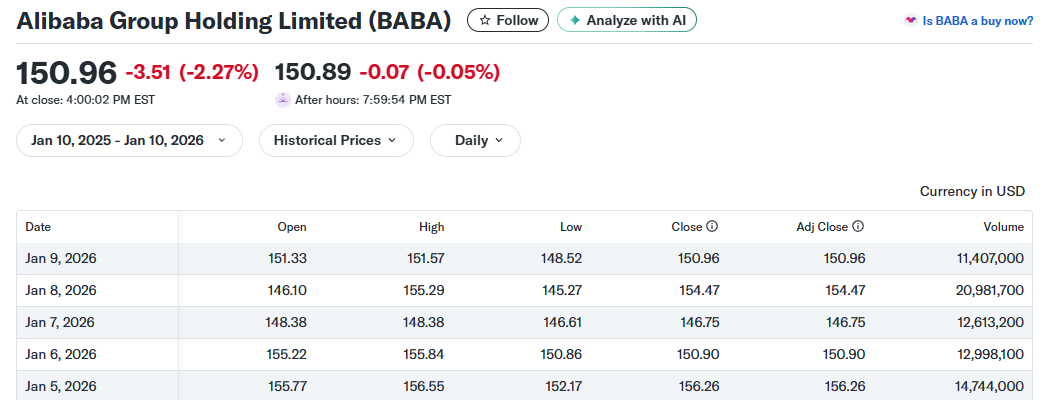
On 9 January, Alibaba fell slightly to $150.95 in its NYSE close, which indicated price profit-taking.
By 10 January, BABA was trading close to its pre-market level at about $151.57 and is still 20% below its position in October, even though there is still pressure on e-commerce.
China’s Chip Shift
The approval by Beijing is in line with approval conferred on or by the Trump administration, which allowed partial commercial imports with on-condition terms of the required up-front payments and domestic chip quotas.
Nvidia is demanding full upfront payment from Chinese customers for its H200 artificial intelligence chips as it navigates the uncertainty of whether Beijing will approve shipments, according to Reuters.
As a result, the demand has soared: Chinese companies have already placed more than 2 million H200s orders, which is more than the stock in the inventory of Nvidia, with 700,000 on hand; Alibaba and ByteDance both target it at 200,000+ units to improve the models that are competing with those of OpenAI.
AI Boost Ahead
Alibaba, the most active AI spender, has registered a 34% growth in cloud revenue in the previous quarter. Most importantly, H200s may hasten its development, thus bridging the technology gap in the United States even with local efforts against self-sufficiency.
However, there are still risks, such as the final mandate of Beijing, military limitations, and the shift of Nvidia towards Blackwell that may limit volume.
In the case of Alibaba and its cloud desires, this development will provide the key to the essential computing capabilities in 2026 and further.
Disclaimer
This article is for informational purposes only and does not constitute financial, investment, tax, or legal advice. Market data, tax rules, and prices can change after the article date. TECHi and its authors may hold positions in securities or digital assets mentioned. Always conduct your own research and consult a licensed financial, tax, or legal professional before making decisions.
About the Author

Warisha Rashid writes about the intersection of corporate strategy, venture capital, and macro for TECHi — why certain acquisitions close when the Fed pivots, why a Series C prices at a markdown, and how capital rotation reshapes competitive positioning. She reads PitchBook, CB Insights, and S&P Capital IQ filings alongside the earnings commentary most coverage ignores. Her work focuses on M&A rationale, startup unit economics, and the policy signals that move private markets before they show up in public ones.