


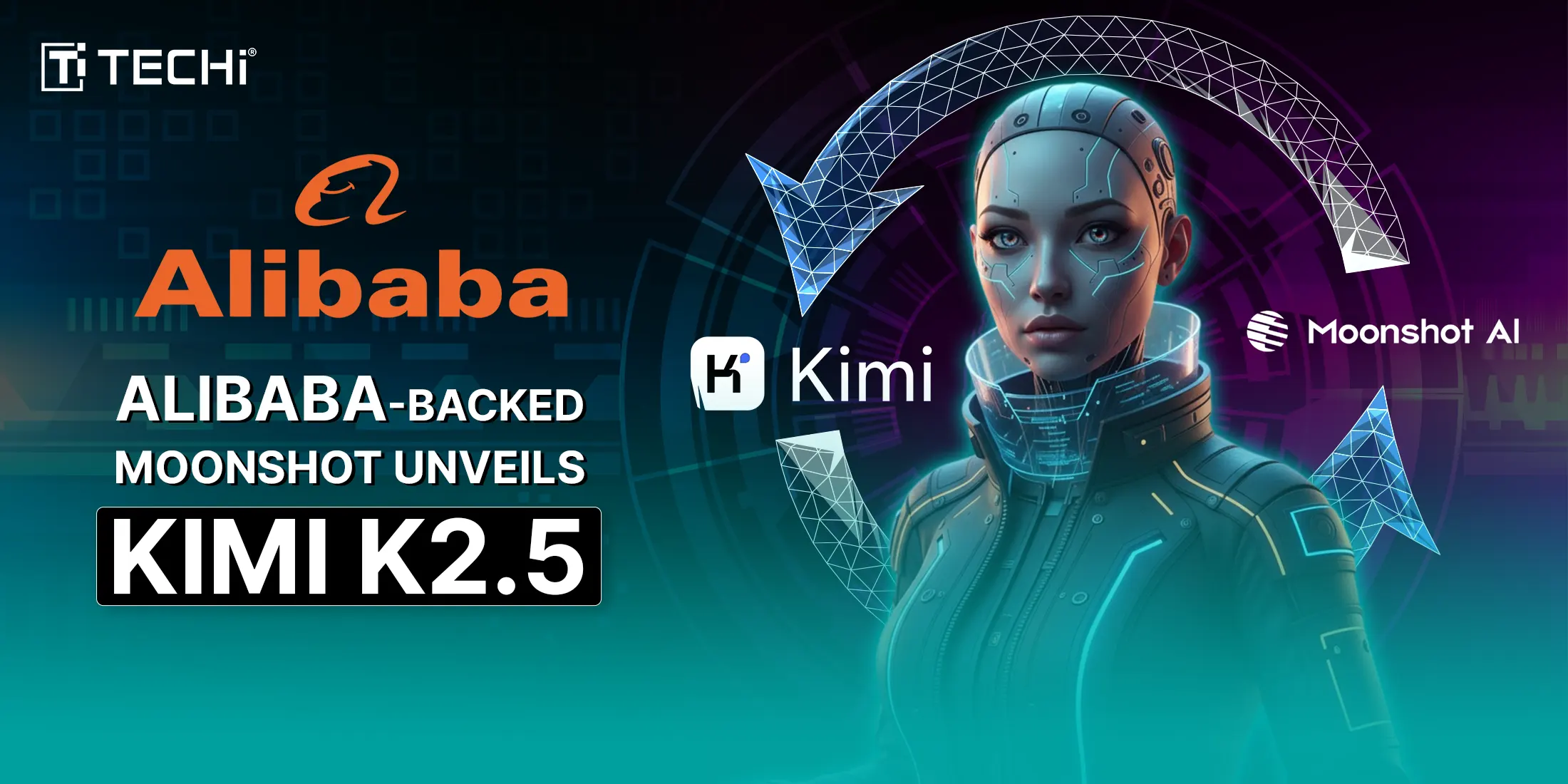
Alibaba-invested Moonshot AI has introduced text, image, and video multimodal large-language models, Kimi K2.5, which can be run in a single native architecture, a first according to the company. The organization claims that K2.5 has state-of-the-art code, agent-based system, and general reasoning with an API compatible with the OpenAI specification which ensures a much lower switching cost to developers when using U.S. platforms.
In addition, Moonshot has added an “Agent Cluster” capability, which allows K2.5 to instantiate several specialized "avatars" and run them in parallel on multifaceted tasks; the company asserts that it can be deployed to have potentially tenfold or hundredfold improvements in real world processes.
The model enables the thinking and non-thinking modes hence balancing latency and depth of reasoning to enterprise applications.
Strategic Boost for Alibaba
In competition with Tencent, Baidu, and ByteDance, Alibaba, which has its shares listed in Hong Kong (9988) which co-traded on 26 January at a price of around HK$169.50, is also using Moonshot to strengthen its domestic AI stack.
JPMorgan Chase & Co. has increased its price target for Hong Kong shares of Alibaba Group Holding Ltd. by nearly 45%, making it the highest target among analysts that Bloomberg tracks. The revised goal of HK$240 ($30.85) per share by the end of 2026 suggests a 36% increase from Tuesday's close.
According to analysts led by Alex Yao, the valuation of Alibaba at twelve times the bank's fiscal 2028 earnings estimate "offers significant room for" upside, citing an improved cloud-revenue outlook and growing synergy between its AI and e-commerce operations.
A manager of an AI fund based in Shanghai wrote that competitive advantage in China is going to form around vertically-oriented AI products built on powerful local models, not just because of the scale of the raw models; multimodal systems like Kimi K2.5 are essentially suited to use in retail, manufacturing and in the public sphere.
China’s AI Push and Outlook
The China AI Large Language Model Market is projected to reach 19.17 billion by 2033, growing at a compound annual growth rate (CAGR) of 13.77% from 2026 to 2033 from its 2025 valuation of 8.84 billion.
Rising demand, continuous technological advancement, and the growing range of applications across numerous industries are the main drivers of this strong growth. Beijing wants AI to grow into a $100 billion industry by 2030 and add over $1 trillion to other industries enabled by the push of Beijing towards self-sustenance in semiconductors, infrastructure, and base models.
In that regard, the open-source status of Kimi K2.5 and open-style interface of OpenAI present Alibaba and Moonshot with a viable avenue to establish a portion of the Chinese developer base interested in alternative, scalable, and compliant versions of Western models.
Disclaimer
This article is for informational purposes only and does not constitute financial, investment, tax, or legal advice. Market data, tax rules, and prices can change after the article date. TECHi and its authors may hold positions in securities or digital assets mentioned. Always conduct your own research and consult a licensed financial, tax, or legal professional before making decisions.
About the Author

Ali Sher maintains TECHi's daily word-puzzle coverage — Wordle, Connections, Strands, Quordle, Hurdle, and Pips. He verifies each day's official answer against the New York Times and Merriam-Webster sources before the page goes live, writes the progressively revealed hints, and curates the yesterday-answer archives readers actually reference. His work prioritizes accuracy: puzzle pages lose trust the moment a single wrong answer ships.


Comments