

Table of Contents
Bitcoin traded at $70,928 on April 9, 2026 — roughly two years out from its next halving event, estimated for March–April 2028 at block 1,050,000. For investors studying Bitcoin halving 2028 price prediction models, this mid-cycle window deserves serious attention. Every previous halving has preceded a major rally, and the accumulation phase happening right now has historically offered the best risk-adjusted entry points in crypto.
The 2024 halving cut block rewards from 6.25 BTC to 3.125 BTC. The 2028 event will slash them again to just 1.5625 BTC per block — shrinking new daily supply to roughly 225 BTC. With spot Bitcoin ETFs now managing over 1.3 million BTC and institutional demand accelerating, the supply-demand imbalance heading into 2028 could dwarf anything the market has seen before.
This analysis breaks down exactly where Bitcoin sits in its four-year cycle, what historical pre-halving price action tells us, and how the 2024–2028 cycle differs from every one before it.
Last updated: April 9, 2026 at 7:30 PM ET
Bitcoin Halving History: A Pattern of Explosive Returns
Bitcoin’s protocol enforces a halving every 210,000 blocks — approximately every four years. Each halving reduces the mining reward by 50%, creating a predictable supply shock. The pattern is simple: less new BTC entering circulation while demand remains constant or grows.
Here’s what happened after each halving event:
| Halving | Date | Reward Change | Price at Halving | Peak Price (Next 18 Mo.) | Return |
|---|---|---|---|---|---|
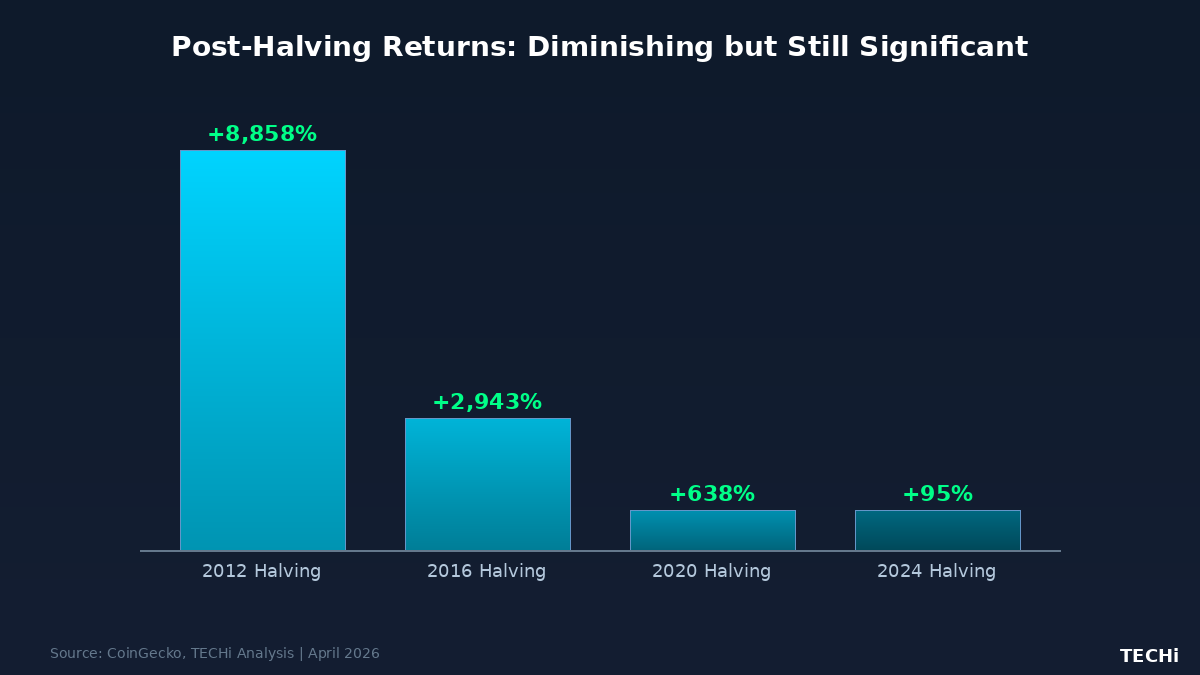
| 1st | Nov 28, 2012 | 50 → 25 BTC | $12 | $1,075 (Nov 2013) | +8,858% |
| 2nd | Jul 9, 2016 | 25 → 12.5 BTC | $650 | $19,783 (Dec 2017) | +2,943% |
| 3rd | May 11, 2020 | 12.5 → 6.25 BTC | $8,727 | $69,000 (Nov 2021) | +690% |
| 4th | Apr 20, 2024 | 6.25 → 3.125 BTC | $64,968 | $126,500 (Oct 2025) | +95% |
| 5th | ~Mar–Apr 2028 | 3.125 → 1.5625 BTC | TBD | TBD | TBD |
The diminishing returns trend is clear — each cycle delivers a smaller percentage gain. But even the “weakest” cycle (2024) produced a new all-time high above $126,000 within 18 months of the halving. The question isn’t whether the 2028 halving will matter. It’s how much of the move you capture by positioning early.
Where Does Bitcoin Sit in the Current Halving Cycle?
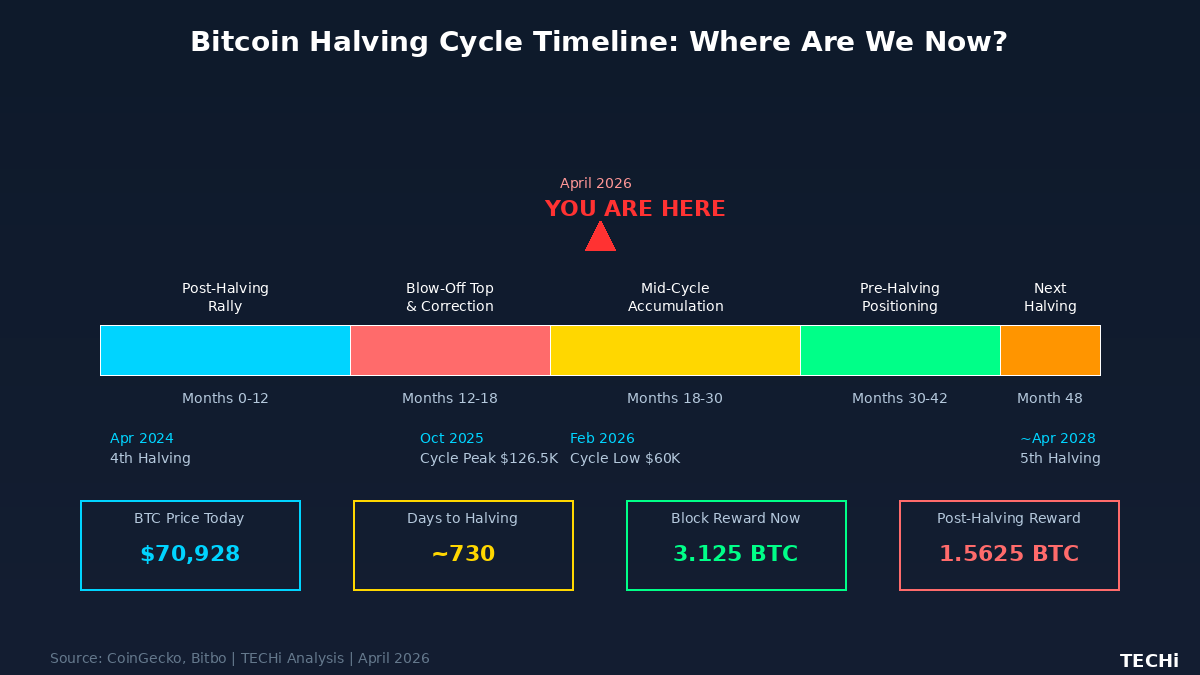
As of April 2026, Bitcoin is approximately 24 months post-halving — deep into the mid-cycle phase. Previous cycles show a consistent pattern: an initial post-halving rally (months 1–12), a blow-off top and correction (months 12–18), and then an extended accumulation phase (months 18–30) before pre-halving positioning begins.
Bitcoin hit its cycle high of roughly $126,500 in October 2025, then corrected sharply — dropping to $60,001 by February 6, 2026 (a 52% drawdown). The current price around $70,900 represents a partial recovery from that low, but still sits 44% below the cycle peak.
This drawdown-and-recovery pattern mirrors previous cycles almost exactly. After the 2017 peak, BTC spent all of 2018 and much of 2019 in accumulation before the 2020 halving ignited the next bull run. After the 2021 peak, BTC consolidated through 2022–2023 before the 2024 halving kicked off the current cycle. If you’re reading our Bitcoin Fear and Greed Index analysis, the sentiment indicators right now look remarkably similar to those mid-cycle accumulation periods.
The Pre-Halving Accumulation Phase: Where Smart Money Enters
Historical data shows that the 12–18 months before a halving event represent the optimal entry window. Dollar-cost averaging into BTC during this period has outperformed every other timing strategy across all four previous cycles.
Here’s the pre-halving price performance measured from approximately 24 months before each halving to the halving date:
| Cycle | Price ~24 Mo. Before Halving | Price at Halving | Pre-Halving Gain |
|---|---|---|---|
| 2016 Halving | ~$600 (Jul 2014) | $650 | +8% |
| 2020 Halving | ~$7,500 (May 2018) | $8,727 | +16% |
| 2024 Halving | ~$39,000 (Apr 2022) | $64,968 | +67% |
| 2028 Halving | $70,928 (Apr 2026) | ? | ? |
The pre-halving window shows significant variance — the 2016 cycle was nearly flat across 24 months, while the 2024 cycle delivered a +67% gain as ETF approvals supercharged demand. The more compelling pattern emerges when measuring from cycle lows to halving dates: investors who accumulated during the deepest corrections preceding each halving captured the largest returns. With BTC currently sitting 44% below its $126,500 cycle high, the current mid-cycle correction may represent a similar accumulation opportunity.
The Diminishing Returns Debate: Is the Halving Effect Fading?
Critics of the halving thesis argue that each cycle delivers smaller returns because the supply reduction becomes proportionally less significant. The 2012 halving cut daily new supply by 3,600 BTC. The 2028 halving will cut it by only ~225 BTC. When the total circulating supply exceeds 19.8 million BTC, does removing 225 coins per day still move the needle?
The data supports both sides. Post-halving returns have declined from 8,858% (2012) to 690% (2020) to 95% (2024). But there’s a counter-argument the bears miss: demand has scaled faster than the supply reduction has shrunk. Spot Bitcoin ETFs alone absorbed over $65 billion in net inflows since launching in January 2024, according to Bitbo’s ETF tracker. BlackRock’s iShares Bitcoin Trust (IBIT) now manages approximately $54 billion in AUM — making it one of the most successful ETF launches in history.
The halving effect isn’t fading. The demand side is amplifying it in ways that previous cycles never experienced.
Institutional Demand: The Variable That Breaks the Old Playbook
Previous halving cycles were driven primarily by retail speculation. The 2024–2028 cycle is fundamentally different. As of March 2026, U.S. spot Bitcoin ETFs collectively hold nearly 1.3 million BTC — worth approximately $92 billion at current prices — almost double their holdings from two years ago, per data from BlackRock’s IBIT fund page.
This creates a structural demand floor that didn’t exist in prior cycles. ETF investors tend to be longer-term holders — financial advisors allocating 1–5% of client portfolios, pension funds testing digital asset exposure, and family offices building positions. They don’t panic-sell on 20% drawdowns the way retail traders do.
On April 6, 2026, U.S. spot Bitcoin ETFs recorded $471 million in single-day net inflows — the highest in six weeks — signaling renewed institutional buying even as BTC hovered near $68,000. This persistent bid creates a market structure where the pre-halving accumulation phase could look very different from previous cycles: shallower drawdowns, faster recoveries, and a higher price floor heading into the 2028 halving.
For investors already tracking how geopolitical events impact Bitcoin’s path to $100K, institutional flows are the variable that matters most in this cycle.
Hash Rate and Network Security: Miners Are Betting Big on 2028
Bitcoin’s hash rate tells a story that price alone doesn’t. Despite BTC trading 44% below its all-time high, the network hash rate hit 1.1 zettahash per second (ZH/s) in October 2025 — a record that was briefly surpassed in January 2026 before weather-related curtailment forced temporary shutdowns across U.S. mining operations.
Mining difficulty climbed to 144.4 trillion in February 2026, marking a 15% jump — the largest single increase since China’s 2021 mining ban, according to CoinWarz difficulty data. Miners are pouring capital into next-generation ASIC hardware and expanding capacity because they expect BTC prices to be significantly higher by the time the 2028 halving cuts their revenue in half again.
Public mining companies like Marathon Digital (MARA), Riot Platforms (RIOT), and CleanSpark (CLSK) have all announced capacity expansion plans targeting 2027–2028 readiness. Their capital expenditure decisions are a leading indicator: miners don’t invest billions in infrastructure if they expect sub-$100K Bitcoin.
Stock-to-Flow Model: What PlanB’s Framework Says About 2028
The stock-to-flow (S2F) model, created by pseudonymous analyst PlanB, uses Bitcoin’s scarcity ratio (existing supply divided by new annual production) to project price. After the 2028 halving, Bitcoin’s S2F ratio will roughly double — approaching gold’s scarcity level.
PlanB’s model projects a $500,000 average cycle price for the 2024–2028 period, with potential peaks above $1 million post-2028. However, the model’s accuracy has deteriorated in recent cycles — Bitcoin has consistently traded below S2F projections since 2022.
Ethereum co-founder Vitalik Buterin publicly criticized the model, and several quantitative analysts have noted its statistical flaws. The S2F should be treated as one data point among many — not a price guarantee. What it does correctly capture is the directional impact of programmatic supply reduction on a fixed-supply asset with growing demand.
Bitcoin Price Predictions for the 2028 Halving
Analyst predictions for BTC at the 2028 halving span a wide range, reflecting genuine uncertainty about macro conditions, regulation, and adoption rates:
| Analyst / Source | 2028 Price Target | Basis |
|---|---|---|
| Pav Hundal (Swyftx) | $120,000+ | 100% gain from current levels |
| Henrik Andersson (Apollo Crypto) | $200,000 | Pre-halving cycle peak |
| Historical Diminishing Returns Model | $303,600 | 360% rally from halving low |
| PlanB (Stock-to-Flow) | $500,000–$1,000,000 | S2F scarcity model |
| Institutional Consensus Range | $200,000–$350,000 | ETF demand + supply shock |
The most conservative estimate (Swyftx’s Hundal at $120K) still represents a 69% gain from current prices. The institutional consensus range of $200K–$350K implies that buying BTC in the current $70K zone could deliver 3x–5x returns over the next two years — even accounting for diminishing cycle performance. For broader context on how major tech investments are positioning ahead of these moves, see our analysis of Cathie Wood’s ARK Invest strategy.
Is Bitcoin’s Four-Year Cycle Broken?
The 2024 cycle’s relatively modest 95% post-halving return (compared to 690% in 2020) has fueled debate about whether the four-year cycle still holds. Several factors complicate the picture.
First, BTC hit its cycle high ($126,500) just 18 months after the 2024 halving — faster than previous cycles, which typically peaked 12–18 months post-halving. This acceleration suggests institutional capital compresses the cycle rather than eliminating it.
Second, the correction from $126,500 to $60,001 (a 52% drop) is actually in line with previous mid-cycle drawdowns: BTC fell 54% from $64K to $29K in 2022, and 84% from $19.7K to $3.2K in 2018. The pattern persists — only the magnitude is evolving.
Third, macro correlation has increased. Bitcoin now trades more like a risk asset — sensitive to trade wars, interest rate expectations, and geopolitical events like the Iran crisis. This external influence may distort the cycle’s clean four-year rhythm without eliminating the underlying supply-driven mechanics.
The cycle isn’t broken. But it’s maturing — becoming more nuanced, more macro-influenced, and less prone to the 10x–100x swings of early Bitcoin history.
On-Chain Signals: What Whale Wallets Are Doing Right Now
On-chain data shows that long-term holders (wallets holding BTC for 155+ days) are in distribution mode — selling into the recovery from the February lows. This is typical mid-cycle behavior: long-term holders who accumulated during the 2022–2023 bear market are taking profits.
Meanwhile, exchange reserves continue declining — BTC is flowing off exchanges into cold storage and ETF custody. This supply squeeze happens gradually, then accelerates as the halving approaches. By mid-2027, when halving anticipation starts building in earnest, the combination of reduced exchange supply and growing ETF demand could create the tightest supply conditions in Bitcoin’s history.
Watching these on-chain metrics alongside sentiment tools like the Fear and Greed Index gives a more complete picture of where accumulation opportunities sit in the current cycle.
How to Position for the 2028 Bitcoin Halving
Based on historical patterns and current market structure, there are three scenarios investors should consider:
Scenario 1 — Continued Accumulation ($60K–$80K range, Q2–Q4 2026): BTC consolidates through 2026, offering the longest DCA window. This mirrors the 2019 pre-halving accumulation zone. Investors who dollar-cost averaged through 2019 captured the full 2020–2021 bull run.
Scenario 2 — Early Breakout ($100K+ by late 2026): Institutional ETF demand compresses the cycle timeline, pulling forward the pre-halving rally. This scenario sees BTC re-testing its $126K high before year-end 2026, with the 2028 halving potentially driving prices toward $200K–$300K.
Scenario 3 — Macro Disruption (Below $50K): A global recession, aggressive Fed tightening, or major regulatory crackdown pushes BTC below $50K. While painful short-term, previous macro-driven crashes (March 2020 COVID crash to approximately $3,800, June 2022 Luna/3AC collapse to $17K) created the best buying opportunities of their respective cycles.
Across all three scenarios, the data points the same direction: the two years before a halving have historically been the optimal accumulation window. The strategy isn’t timing the bottom — it’s being positioned before the supply shock hits.
Risks That Could Derail the 2028 Halving Thesis
No analysis is complete without acknowledging what could go wrong:
Regulatory risk remains the biggest wildcard. While the Trump administration has been broadly pro-crypto (establishing a Bitcoin strategic reserve and rolling back SEC enforcement), a policy reversal or adverse legislation in another major market (EU’s MiCA framework tightening, China’s continued prohibition expanding to Hong Kong) could suppress institutional flows.
ETF outflow risk is underappreciated. If a prolonged BTC bear market triggers sustained ETF redemptions, the same institutional mechanism that provided a demand floor becomes a selling accelerant. The crypto market has never experienced forced institutional liquidation at this scale.
Mining centralization is another concern. As block rewards shrink to 1.5625 BTC, smaller miners get squeezed out. If hash rate concentrates among a handful of large operators, it introduces systemic risk to network decentralization — potentially undermining Bitcoin’s core value proposition. Investors watching NVIDIA’s stock performance know that hardware consolidation trends affect the entire mining ecosystem.
The Bottom Line: Two Years to Position
Bitcoin’s halving cycle has produced four consecutive supply shocks followed by price rallies spanning 95% to 8,858%. The 2028 halving at block 1,050,000 will cut the block reward to 1.5625 BTC — the lowest in Bitcoin’s history — while institutional demand via ETFs provides a structural bid that no previous cycle had.
At $70,928 today, BTC sits in the mid-cycle accumulation zone with approximately two years until the next halving. Whether you’re a long-term holder adding to positions or a new investor building initial exposure, the historical data is unambiguous: buying during the pre-halving accumulation phase and holding through the post-halving expansion has been the single most reliable strategy in Bitcoin’s 17-year existence.
The numbers don’t guarantee anything. But every four years, the same pattern repeats — and the clock is already ticking toward 2028.
Frequently Asked Questions
When is the next Bitcoin halving in 2028?
The next Bitcoin halving is estimated to occur between March and April 2028 at block 1,050,000. The exact date depends on average block times, with most estimates centering on March 26 to April 23, 2028.
What will Bitcoin’s block reward be after the 2028 halving?
The block reward will drop from 3.125 BTC to 1.5625 BTC per block. This means miners will produce approximately 225 new BTC per day, down from the current 450 BTC daily output.
How much could Bitcoin be worth at the 2028 halving?
Analyst predictions range from $120,000 (conservative) to $500,000+ (stock-to-flow model). The institutional consensus falls between $200,000 and $350,000, based on historical diminishing returns patterns combined with growing ETF demand.
Does Bitcoin always go up after a halving?
Bitcoin has set a new all-time high within 18 months of every halving event in its history (2012, 2016, 2020, 2024). However, past performance doesn’t guarantee future results, and the magnitude of post-halving gains has decreased with each cycle.
What is the best strategy for investing before the Bitcoin halving?
Dollar-cost averaging (DCA) during the 12–24 months before a halving has historically provided the best risk-adjusted returns. This approach avoids the risk of mistiming the market while ensuring exposure before the post-halving supply shock takes effect.
How many Bitcoin halvings are left?
Bitcoin will undergo approximately 29 more halvings before all 21 million BTC are mined, which is projected to occur around the year 2140. The 2028 event will be the fifth halving in Bitcoin’s history.
Disclaimer: This article is for informational purposes only and does not constitute financial, investment, or trading advice. TECHi.com and its authors are not licensed financial advisors. Cryptocurrency and stock markets are highly volatile — you can lose your entire investment. Always conduct your own research (DYOR) and consult a qualified financial advisor before making any investment decisions. Past performance does not guarantee future results.