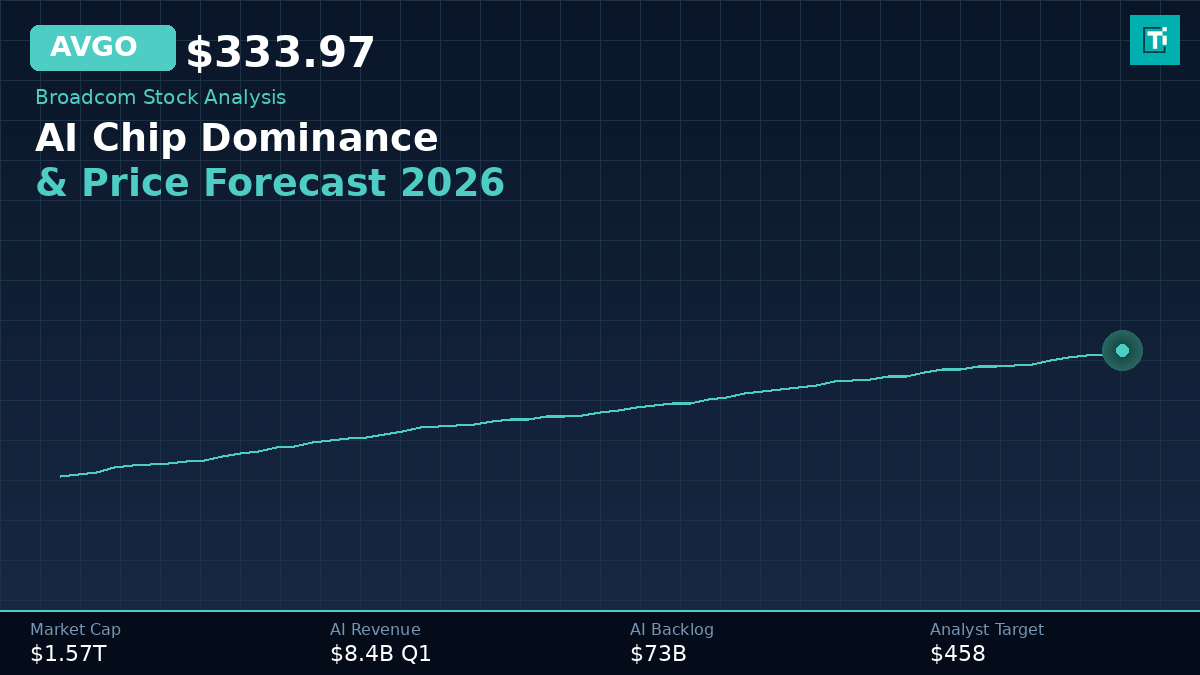
Broadcom designs the custom AI chips that power Google’s data centers, Meta’s training clusters, and an expanding roster of hyperscalers that collectively spend over $200 billion annually on AI infrastructure. At $333.97 per share, the stock trades at roughly 27 times forward earnings, making it the cheapest mega-cap exposure to the AI buildout. Q1 FY2026 AI revenue hit $8.4 billion, up 106% year over year, and the company sits on a $73 billion AI-specific order backlog. Yet most investors still think of Broadcom as a networking chip company.
The Business: Two Engines Driving a $1.57 Trillion Company
Broadcom operates two distinct but increasingly intertwined business segments. The Semiconductor Solutions division, which generates approximately 65% of total revenue, builds custom AI accelerators (XPUs), networking switches for AI data centers, broadband infrastructure, and wireless connectivity chips. The Infrastructure Software division, at roughly 35% of revenue, is anchored by the $69 billion VMware acquisition completed in November 2023.
The semiconductor side is where the AI story lives. Broadcom’s custom ASIC design services are used by the world’s largest technology companies to build proprietary AI chips. Google’s Tensor Processing Units (TPUs) rely on Broadcom’s interconnect IP and design expertise. Meta’s MTIA (Meta Training and Inference Accelerator) chips follow the same playbook. More recently, both OpenAI and Anthropic have reportedly emerged as Broadcom customers, signaling that the custom silicon opportunity extends well beyond the original hyperscaler base.
On the networking side, Broadcom’s Memory Fabric and Ethernet switching ASICs connect GPU and custom chip clusters inside AI data centers. Every large-scale AI training run requires thousands of chips communicating at extreme bandwidth; Broadcom supplies the plumbing. This dual position, designing both the compute chips and the networking fabric, gives the company a structural advantage that pure-play GPU makers cannot replicate.
The AI Revenue Story: $8.4 Billion and Accelerating
Broadcom reported $8.4 billion in AI-specific revenue for Q1 FY2026 (the quarter ending February 2, 2026), representing a 106% increase from the prior year. CEO Hock Tan’s Q2 guidance implies AI revenue approaching $10.7 billion, which would mark a near-30% sequential jump. For the full fiscal year 2026, analysts at Mizuho project AI revenue reaching $40.4 billion, up roughly 92% from FY2025.
| Metric | Q1 FY2026 | Q1 FY2025 | YoY Change |
|---|---|---|---|
| AI Revenue | $8.4B | $4.1B | +106% |
| Total Revenue | $19.3B | $14.9B | +29% |
| Q2 Revenue Guidance | $22.0B | Consensus: $21.7B | |
| AI Backlog | $73B | Multi-year committed orders | |
The custom ASIC opportunity breaks down into two categories. First, Broadcom designs the actual compute chips: application-specific processors optimized for AI training and inference workloads. Google’s TPUs represent the largest single contract, with HSBC estimating that TPU-related shipments account for approximately 78% of Broadcom’s ASIC revenue. Second, networking ASICs and optical interconnects that link these custom chips into massive clusters. Both categories are growing simultaneously.
Hock Tan has stated that Broadcom has “line of sight” to AI chip revenue exceeding $100 billion by 2027. That figure may sound aggressive, but the math works when you consider that Broadcom’s addressable market, defined as the total custom silicon and networking spend by hyperscalers, is projected at $60 billion to $90 billion by 2027, according to the company’s own investor day projections. Add Meta’s stated goal of scaling to multiple gigawatts of AI compute capacity by 2027, and the demand curve becomes clearer.
VMware: The Cash Machine Nobody Talks About
Wall Street’s fixation on Broadcom’s AI narrative has overshadowed what might be the most successful enterprise software acquisition of the decade. The VMware integration, now 18 months post-close, has exceeded every margin target Broadcom set during the deal process. The subscription transition is effectively complete: more than 300,000 enterprise customers have migrated from perpetual licenses to recurring subscription contracts, providing the kind of revenue visibility that software investors pay premium multiples for.
Operating margins from the Infrastructure Software segment have expanded meaningfully as Broadcom applies its standard playbook of cutting redundant product lines, consolidating sales teams, and focusing R&D on the highest-margin offerings. VMware Private AI Foundation deserves particular attention. This product allows enterprise customers to run AI workloads on VMware’s virtualization infrastructure, which means Broadcom captures revenue on both sides of the AI equation: the custom silicon in the data center and the software layer that manages those workloads.
The cross-sell opportunity remains largely untapped. VMware’s 300,000+ enterprise customers represent a captive audience for Broadcom’s security, observability, and infrastructure management tools. Each dollar of incremental software revenue drops to the bottom line at margins north of 70%, making the Infrastructure Software segment a reliable cash generation engine that funds the semiconductor R&D investment needed to stay ahead in custom AI chip design. For investors tracking AI stocks that could outperform in 2026, the VMware synergy story adds a margin-expansion catalyst that pure semiconductor plays lack.
Financial Deep Dive
| Metric | FY2026E | FY2025 | Change |
|---|---|---|---|
| Total Revenue | ~$85B | $63.9B | +33% |
| AI Revenue | ~$40.4B | ~$21B | +92% |
| Adjusted EBITDA Margin | ~68% | ~67% | Expanding |
| Free Cash Flow | ~$30B+ | ~$26.9B | +12% |
| Dividend Yield | ~0.83% | ~1.0% | Growing payout |
| Forward P/E | ~27x | vs. NVDA ~32x, AMD ~28x | |
| Market Cap | $1.49T | 3rd largest chip company | |
Broadcom’s financial profile combines high-growth AI revenue with the stability of a mature enterprise software business. The blended operating margin, approaching 65% on an adjusted basis, reflects both the inherent leverage in semiconductor design (where incremental units carry near-zero marginal cost) and the subscription economics of VMware’s enterprise base.
Free cash flow conversion is among the best in the semiconductor industry. At roughly $27 billion annually, Broadcom generates more free cash flow than AMD’s entire revenue base. This cash funds a growing dividend (currently yielding approximately 0.83% at the current ~$314 share price), share buybacks, and the R&D investment required to maintain design leadership in custom AI accelerators.
The balance sheet carries debt from the VMware acquisition, but Broadcom has a long track record of deleveraging quickly after large deals. Interest coverage remains comfortable, and the company has stated its intention to reach investment-grade leverage ratios within its standard post-acquisition timeline. Compared to companies like Qualcomm, which trades near multi-year lows despite record auto revenue, Broadcom commands a premium valuation, but the AI growth trajectory justifies the spread.
Broadcom vs Nvidia vs AMD: The AI Chip Hierarchy
The AI semiconductor market is not a winner-take-all contest. Nvidia, Broadcom, and AMD occupy distinct positions in the ecosystem, and understanding those positions is essential for investors deciding where to allocate capital.
| Company | Stock Price | AI Revenue (TTM Est.) | AI Market Position | Forward P/E |
|---|---|---|---|---|
| Nvidia (NVDA) | $177.64 | $100B+ | GPU training/inference dominant | ~32x |
| Broadcom (AVGO) | $333.97 | ~$30B+ | Custom ASIC + networking | ~27x |
| AMD (AMD) | $220.18 | ~$8-10B | GPU alternative (MI300X/MI400) | ~28x |
Nvidia wins when customers buy standardized, off-the-shelf GPUs. Its CUDA software ecosystem creates switching costs that keep enterprise customers locked in for training workloads. Broadcom wins when customers decide to design their own chips, which increasingly is the direction hyperscalers are moving. Google, Meta, Amazon, and Microsoft all have internal chip programs, and Broadcom is the design partner for the majority of them. AMD occupies the middle ground, offering GPU alternatives at competitive price points for inference workloads.
The critical insight for investors: these markets are growing simultaneously. The total addressable market for AI compute is expanding faster than any single company can absorb. Nvidia’s dominance in training GPUs does not preclude Broadcom’s growth in custom ASICs, just as recent Nvidia insider selling worth $3.3 billion does not necessarily signal bearishness about the broader AI chip market. Both can compound at 30%+ revenue growth rates for the foreseeable future because the underlying demand, driven by frontier AI model scaling, shows no signs of plateauing.
Analyst Consensus and Price Target
Wall Street consensus on Broadcom is overwhelmingly bullish. Of approximately 50 analysts covering the stock, 48 rate it a Buy or Strong Buy. The median 12-month price target sits at $458, implying roughly 37% upside from the current $333.97 share price. The range spans from $335 on the low end to $630 at the high end, reflecting the wide distribution of outcomes depending on AI revenue trajectory assumptions.
The most recent upgrades have come from firms with strong semiconductor coverage. Morgan Stanley raised its target citing the custom ASIC backlog durability. Bank of America reiterated Buy on VMware margin expansion. Goldman Sachs added AVGO to its conviction list, noting the company’s unique positioning at the intersection of custom compute and networking for AI workloads.
The bear case among the small minority of Hold-rated analysts centers on valuation. At 27x forward earnings, Broadcom is not cheap in absolute terms, even if it represents a discount to Nvidia’s 32x multiple. The counterargument: Broadcom’s earnings growth rate, projected at 30%+ for the next two fiscal years, makes the PEG ratio (price-to-earnings-growth) attractively below 1.0, which historically signals undervaluation for high-growth technology stocks.
Bull Case / Bear Case
The probability-weighted outcome favors the bulls. Broadcom’s $73 billion backlog provides multi-year visibility, the VMware recurring revenue base provides downside protection, and the company’s entrenched position in custom AI silicon would require years for competitors to challenge. The bear case requires multiple negative catalysts hitting simultaneously, while the bull case only requires the current trajectory to continue.
How to Invest in Broadcom
Direct stock purchase remains the most straightforward approach. At $333.97 per share, AVGO is accessible to most retail investors, particularly through brokerages that offer fractional shares. The stock trades on the NASDAQ under ticker AVGO with average daily volume of approximately 12 million shares, providing ample liquidity for positions of any size.
For investors seeking diversified semiconductor exposure, several ETFs hold significant AVGO positions. The VanEck Semiconductor ETF (SMH) and iShares Semiconductor ETF (SOXX) both include Broadcom among their top holdings. These funds spread risk across the chip ecosystem while still providing meaningful exposure to Broadcom’s AI growth story.
Income-oriented investors can consider covered call strategies on AVGO shares. The stock’s elevated implied volatility, driven by AI-related sentiment, means options premiums are rich. Selling monthly covered calls 10-15% out of the money can generate 2-3% in additional monthly income while maintaining upside participation through most analyst price target ranges. This strategy pairs particularly well with the existing 1.0% dividend yield, creating a total yield approaching 3-4% annualized before any capital appreciation.
Disclaimer: This article is for informational purposes only and does not constitute investment advice, a recommendation, or a solicitation to buy or sell any securities. The stock prices mentioned were accurate at the time of publication but are subject to change. Always conduct your own research and consult a licensed financial advisor before making investment decisions. TECHi and its authors may hold positions in the securities discussed.
Is Broadcom stock a good buy in 2026?
Broadcom has a Strong Buy consensus from 48 of 50 Wall Street analysts with a median price target of $458, implying 37% upside from current levels. The company’s AI revenue grew 106% year over year in Q1 FY2026, it holds a $73 billion AI backlog, and it trades at roughly 27x forward earnings, a discount to Nvidia. However, semiconductor stocks carry inherent cyclical risk, and past performance does not guarantee future returns.
What does Broadcom do in AI?
Broadcom designs custom AI accelerator chips (called XPUs or ASICs) for major technology companies including Google, Meta, OpenAI, and Anthropic. It also builds the networking switches and optical interconnects that link AI chip clusters inside data centers. This dual position in both compute and networking makes Broadcom a critical infrastructure provider for AI training and inference workloads.
How does Broadcom compare to Nvidia?
Nvidia dominates the market for standardized AI training GPUs, while Broadcom leads in custom-designed AI chips built specifically for individual hyperscalers. Nvidia trades at approximately 32x forward earnings with over $100 billion in AI revenue, while Broadcom trades at about 27x with rapidly growing AI revenue that hit $8.4 billion in Q1 FY2026. Both companies benefit from the expanding AI infrastructure market and are not directly competing for the same customers in most cases.
Does Broadcom pay a dividend?
Yes. Broadcom pays a quarterly dividend yielding approximately 1.0% at current prices. The company has a history of consistent dividend increases, supported by over $25 billion in annual free cash flow. For investors seeking AI exposure with income, Broadcom is one of the few mega-cap AI stocks that offers a meaningful dividend.
What is Broadcom’s AI revenue backlog?
Broadcom reported a $73 billion AI-specific order backlog as of Q1 FY2026. This backlog represents committed multi-year orders from hyperscaler customers for custom AI chips and networking equipment. CEO Hock Tan has stated the company has line of sight to exceeding $100 billion in AI revenue by 2027, supported by this backlog and expanding customer relationships.