

For months, the biggest question hanging over Ethereum ETF staking wasn’t whether it would happen but when. On March 17, 2026, the SEC and CFTC answered that question with a joint interpretive release that classified staking rewards as non-securities across 16 digital commodities — ETH chief among them. ETH traded at $2,184 on April 9, 2026, with a market cap near $263 billion, still digesting the implications.
This ruling didn’t just remove a regulatory barrier. It opened the door to something Bitcoin ETFs structurally cannot offer: yield. A spot Bitcoin ETF holds BTC passively. A staked Ethereum ETF earns 3.1–3.3% annualized just by participating in network validation. For pension funds, endowments, and wealth managers who think in terms of risk-adjusted returns, that distinction matters more than most retail investors realize. The early movers — Grayscale and BlackRock — are already live. The rest of the industry is racing to catch up, and the SEC’s evolving crypto policy under Chair Paul Atkins has made that race considerably shorter.
How ETH Staking Works Inside an ETF
Ethereum shifted from Proof-of-Work to Proof-of-Stake in September 2022. Validators lock 32 ETH as collateral, propose and attest to blocks, and earn rewards — new ETH issuance plus transaction fees plus MEV tips.
Inside an ETF wrapper, the mechanics look different from solo staking:
- The fund custodian (Coinbase Prime for BlackRock, for example) stakes 70–95% of the fund’s ETH across multiple institutional validators.
- A liquidity sleeve of 5–30% stays unstaked to handle daily creations and redemptions without hitting the exit queue.
- Rewards flow to shareholders after the fund manager takes a service fee. BlackRock’s ETHB passes through roughly 82% of gross staking rewards to investors.
- Slashing risk — where validators lose staked ETH for misbehavior or downtime — is mitigated through diversified validator selection. ETHB uses Coinbase Prime, Figment, Galaxy Digital, and Attestant as validators.
The net result for an investor holding ETHB: exposure to ETH price movement plus an estimated 1.9–2.2% net annual yield after fees. Not transformative on its own, but compounded over years inside a tax-advantaged account, it changes the math for institutional crypto adoption meaningfully.
Timeline: From Staking Ban to Full Approval
The road from “no staking allowed” to “staking is live” took 20 months. Here’s how it unfolded:
| Date | Event | Significance |
|---|---|---|
| Jul 22–23, 2024 | SEC approves 8 spot ETH ETFs | Staking explicitly stripped from all filings |
| Mar 10, 2025 | Cboe files 19b-4 for Fidelity FETH staking | First formal staking amendment request |
| May 2025 | SEC staff: protocol staking ≠ securities offering | Regulatory thaw begins |
| Oct 6, 2025 | Grayscale ETHE & ETH enable staking | First U.S. ETFs to stake |
| Dec 8, 2025 | BlackRock files S-1 for separate ETHB product | Chose new fund over amending ETHA |
| Jan 2, 2026 | Commissioner Crenshaw departs SEC | All-Republican commission |
| Jan 6, 2026 | Grayscale distributes first staking payout ($9.4M) | Proof of concept for yield distribution |
| Jan 7, 2026 | Morgan Stanley files Ethereum Trust S-1 with staking | First major U.S. bank ETH filing |
| Mar 12, 2026 | BlackRock ETHB launches on Nasdaq | $107M seed, $15.5M first-day volume |
| Mar 17, 2026 | SEC/CFTC joint interpretive release | Staking declared non-securities across 16 assets |
That March 17 ruling was the capstone. SEC Chair Paul Atkins framed it plainly: protocol staking, mining, airdrops, and token wrapping of non-security crypto assets do not trigger Securities Act registration. No ambiguity. No temporary no-action letters. A binding interpretation.
Who’s Live and Who’s Still Waiting
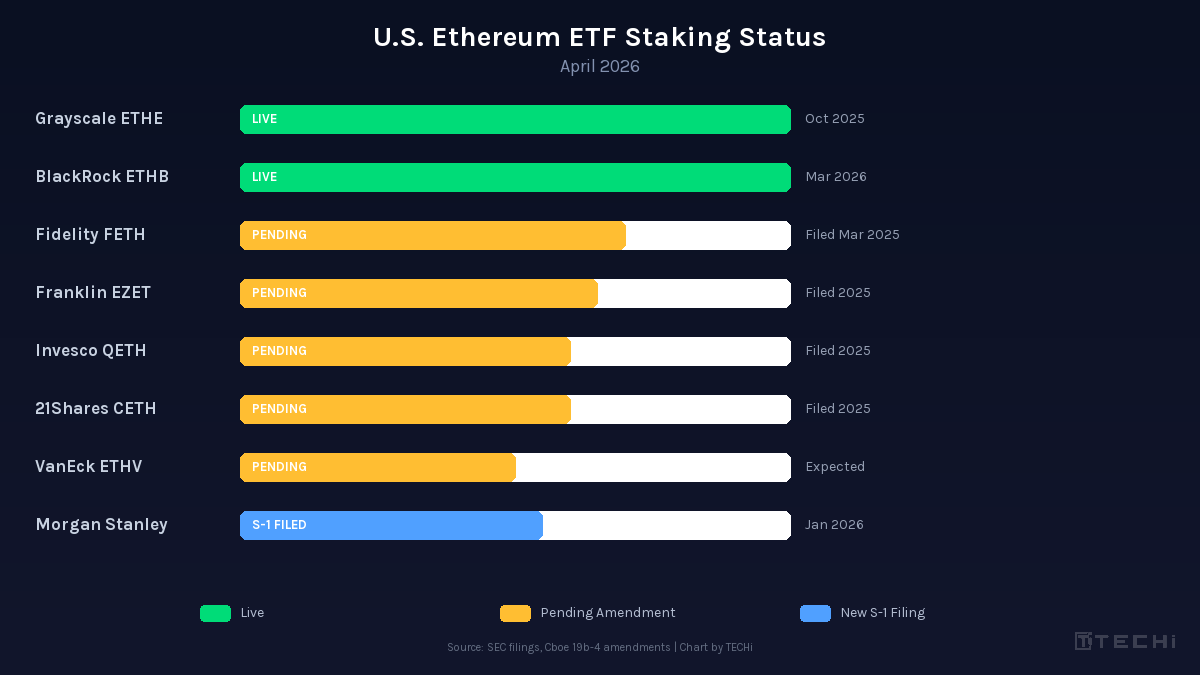
Two funds are already staking. Several more are in the pipeline:
| Issuer | Ticker | Status | Notes |
|---|---|---|---|
| Grayscale | ETHE | Live since Oct 2025 | Renamed Jan 5, 2026; first payout $9.4M |
| BlackRock | ETHB | Live since Mar 2026 | $107M seed; 82% reward pass-through |
| Fidelity | FETH | Pending amendment | Filed via Cboe Mar 2025, delayed Sep 2025 |
| Franklin Templeton | EZET | Pending amendment | Filed 2025, delayed |
| Invesco Galaxy | QETH | Pending amendment | Filed 2025 |
| 21Shares | CETH | Pending amendment | Filed 2025 |
| VanEck | ETHV | Pending amendment | Expected filing |
| Morgan Stanley | TBD | S-1 under review | Filed Jan 7, 2026; staking from launch |
The pending amendments should move faster now. The March 17 interpretive release eliminated the core legal question that caused delays in September 2025. Fidelity and Franklin Templeton could receive approval within weeks, not months.
Morgan Stanley’s filing deserves separate attention. This is the first time a major U.S. bank has filed for a spot crypto ETF under its own brand — not a brokerage referral to BlackRock, but a Morgan Stanley product competing head-to-head with iShares. The S-1 filing on SEC EDGAR includes staking as a feature from day one.
Why Staking Yields Make ETH ETFs Structurally Different From Bitcoin ETFs
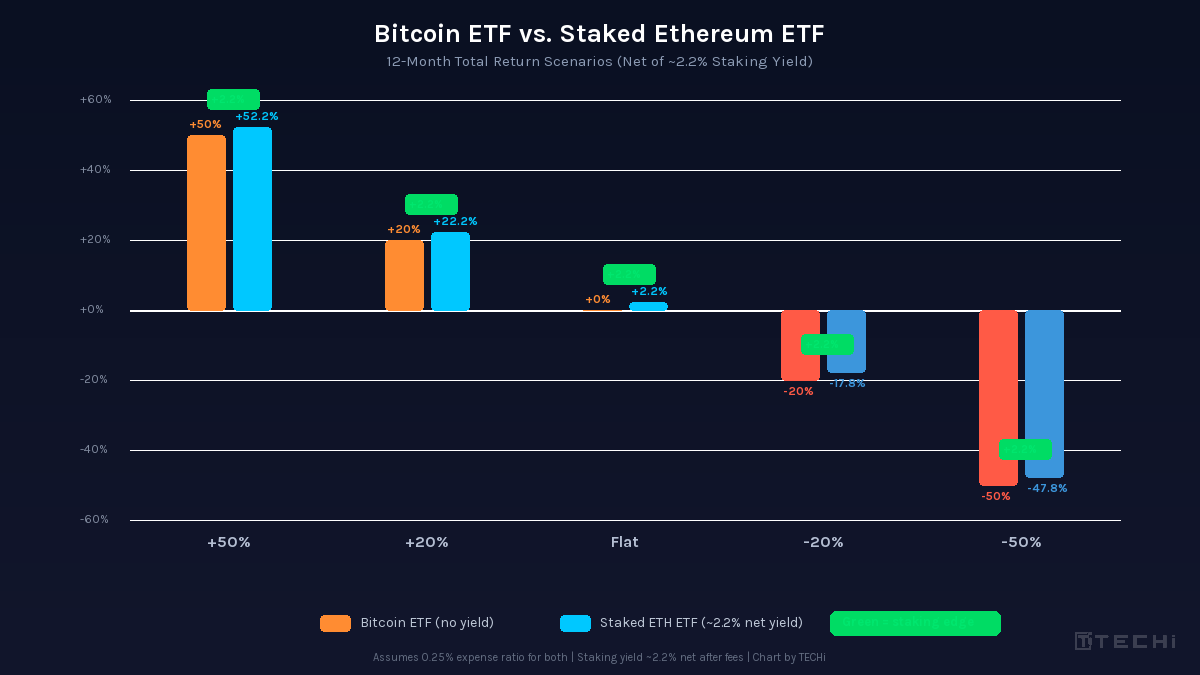
Bitcoin ETFs hold BTC. That’s it. Price goes up, you profit. Price goes down, you lose. There’s no yield, no dividend, no coupon. The only return is capital appreciation.
Staked ETH ETFs earn yield regardless of price direction. At 3.1–3.3% gross APR, even a flat ETH price year delivers positive returns after fees. For allocators comparing a Bitcoin ETF to a staked Ethereum ETF on a risk-adjusted basis, the staking yield acts like a built-in buffer.
This is the same dynamic that separates dividend stocks from growth stocks. Both can appreciate, but one generates cash flow while you wait. Pension funds, insurance portfolios, and crypto-focused portfolio strategies that require yield generation now have a regulated on-ramp.
The comparison gets sharper when you look at total return. If ETH stays flat for 12 months, a staked ETF investor nets roughly 1.9–2.2% after fees. A Bitcoin ETF investor nets zero minus the expense ratio. Over a full market cycle, that compounding gap widens significantly.
Can Ethereum ETF Staking Trigger a Supply Squeeze?
About 35.86 million ETH — 28.9% of the total supply — is currently locked in staking contracts. ETF inflows into staked products would add institutional demand on top of existing validator participation.
Consider the math. Total Ethereum ETF inflows hit $12.94 billion in 2025. If staking amendments get approved across all pending funds and institutional interest picks up, new ETH purchases for staking could absorb millions of additional ETH from the open market.
Every ETH staked through an ETF is ETH that can’t be sold immediately. The exit queue for unstaking takes days to weeks. That creates a structural supply reduction that doesn’t exist with Bitcoin ETFs, where the custodian can liquidate holdings at market speed.
Whether this triggers a price squeeze depends on the pace of inflows. But the mechanism is real, and it’s why analysts tracking Ethereum’s 2026 outlook have started building staking-adjusted supply models.
The Political Tailwind: An All-Republican SEC
Commissioner Caroline Crenshaw — the lone Democrat and the most vocal opponent of crypto-friendly rulemaking — departed the SEC on January 2, 2026. Her criticisms were pointed. She called the May 2025 staking guidance “another example of the SEC’s ‘fake it till we make it’ approach to crypto.”
Her departure left an all-Republican commission for the first time in the SEC’s modern history. Chair Paul Atkins, who replaced Gary Gensler, has treated crypto regulation as a priority — not for enforcement, but for clarification. The crypto working group established under the Trump administration has accelerated rulemaking that spent years in limbo.
The March 17 joint release with the CFTC was the direct result. Without bipartisan friction at the commission level, staff recommendations move to final action faster. For Ethereum ETF staking specifically, this means the remaining pending amendments face a smoother approval path than at any point since the original spot ETF filings.
What the Grayscale Payout Proved
On January 6, 2026, Grayscale distributed $9.4 million in staking rewards to ETHE shareholders. It covered the staking period from October 6 through December 31, 2025 — less than three months.
That payout was proof of concept. A U.S.-regulated ETF collected staking rewards, handled the tax reporting, and distributed cash to shareholders through normal brokerage channels. No DeFi wallets. No seed phrases. No validator management. Just a deposit in a brokerage account like any dividend payment.
For the advisor managing $50 million across 200 client accounts, that simplicity matters more than the yield percentage. The operational barrier to staking — which kept most institutional capital on the sidelines — evaporated.
Grayscale renamed ETHE to the “Grayscale Ethereum Staking ETF” on January 5, 2026, a signal that staking is now the product’s core value proposition, not a bolt-on feature.
How BlackRock’s ETHB Changes the Competitive Landscape
BlackRock chose not to add staking to its existing ETHA fund. Instead, it filed a separate S-1 for ETHB — the iShares Staked Ethereum Trust ETF — and launched it on March 12, 2026 with $107 million in seed capital.
The strategy is deliberate. ETHA remains a pure spot ETH exposure product. ETHB targets investors who want yield. Two products, two mandates, one underlying asset. This mirrors how BlackRock offers both accumulation and income versions of its equity ETFs.
ETHB’s fee structure passes 82% of gross staking rewards to investors. The remaining 18% covers validator operations, custody, and BlackRock’s margin. At a 3.2% gross yield, that translates to roughly 2.6% gross to investors minus the fund’s expense ratio.
First-day trading volume hit $15.5 million — modest by Bitcoin ETF standards but significant for a product that launched during a period of declining ETH prices.
Risks That Could Derail the Staking ETF Thesis
No thesis survives without stress-testing. Several risks remain:
Slashing events. If a validator used by an ETF custodian gets slashed, the fund’s NAV takes a direct hit. Diversified validator selection reduces but doesn’t eliminate this risk. A coordinated attack or major client bug affecting Coinbase Prime validators would hit both ETHA and ETHB.
Regulatory reversal. The March 17 interpretive release is binding, but a future administration could revisit it. Legislative codification through Congress would be more durable than agency interpretation.
Liquidity mismatches. If a staked ETF faces heavy redemptions during a market crash, the liquidity sleeve may prove insufficient. The exit queue for unstaking ETH can extend during periods of high validator churn, creating a gap between redemption requests and available cash.
Yield compression. As more ETH gets staked — through ETFs and otherwise — the network’s base reward rate declines. The current 3.1–3.3% could compress toward 2% or lower if staking participation rises significantly.
Tax complexity. Staking rewards are taxable income in most jurisdictions. ETF investors will receive 1099s reflecting distributed yields, adding tax complexity that passive Bitcoin ETF holders avoid.
What the SEC’s Approval of In-Kind Redemptions Means for Staked ETFs
The SEC’s earlier approval of in-kind creation and redemption mechanisms for crypto ETFs has a specific benefit for staked products. In-kind processes allow authorized participants to deliver ETH directly to the fund rather than requiring cash settlement.
For staked ETFs, this means new creations can be processed without the fund needing to buy ETH on the open market, stake it, and wait for activation. The AP delivers ETH, the custodian stakes it, and the fund issues new shares. The liquidity friction drops meaningfully compared to cash-create models.
This is a technical detail that rarely makes headlines, but it directly impacts tracking error, spread costs, and the fund’s ability to maintain tight NAV alignment — all factors that institutional allocators scrutinize before committing capital.
What Comes Next: The April 2026 Decision Window
The remaining staking amendments from Fidelity, Franklin Templeton, Invesco, 21Shares, and VanEck are expected to clear their final review windows in Q2 2026. The legal foundation is set. The precedent — two funds already live — is established.
If all pending amendments get approved, every major spot ETH ETF will offer staking by mid-2026. At that point, a non-staked Ethereum ETF becomes a strictly inferior product — same exposure, no yield. Capital would logically migrate toward staked versions, accelerating the supply dynamics discussed earlier.
Morgan Stanley’s entry adds another dimension. When the largest U.S. wealth manager by client assets offers its own staked ETH product through its advisor network, the distribution reach extends well beyond crypto-native investors. The $6.5 trillion sitting in Morgan Stanley’s wealth management accounts represents a potential allocation pipeline that dwarfs current ETH ETF AUM.
The Bitcoin price prediction community has spent years modeling ETF flow impacts. Ethereum’s staking dynamic adds a variable that Bitcoin doesn’t have — and the market hasn’t fully priced it in.
Frequently Asked Questions
What is Ethereum ETF staking?
Ethereum ETF staking is when a spot Ethereum exchange-traded fund locks a portion of its ETH holdings in the Ethereum network’s Proof-of-Stake validation system to earn staking rewards. The fund then passes most of those rewards to shareholders as yield, similar to a dividend. Grayscale’s ETHE and BlackRock’s ETHB are the two U.S. ETFs currently doing this.
Is ETH staking inside an ETF considered a security?
No. The SEC and CFTC’s joint interpretive release on March 17, 2026 explicitly stated that protocol staking of non-security digital commodities — including ETH — does not trigger Securities Act registration requirements. This applies to solo staking, custodial staking, and liquid staking models.
How much yield can you earn from a staked Ethereum ETF?
The Ethereum network pays approximately 3.1–3.3% gross APR to validators. After ETF management fees and custodial costs, investors in funds like BlackRock’s ETHB can expect a net yield of roughly 1.9–2.6% annually. Exact returns vary based on network conditions and the fund’s fee structure.
Which Ethereum ETFs currently support staking?
As of April 2026, two U.S. Ethereum ETFs support staking: Grayscale’s Ethereum Staking ETF (ETHE, live since October 2025) and BlackRock’s iShares Staked Ethereum Trust ETF (ETHB, live since March 2026). Fidelity, Franklin Templeton, Invesco, 21Shares, and VanEck have pending staking amendments.
What are the risks of staking ETH through an ETF?
Key risks include slashing (where validators lose staked ETH for misbehavior), liquidity mismatches during heavy redemptions due to unstaking exit queues, yield compression as more ETH gets staked network-wide, and tax complexity from staking reward distributions. Diversified validator selection and liquidity sleeves mitigate some of these risks.
How is a staked Ethereum ETF different from a Bitcoin ETF?
A Bitcoin ETF provides pure price exposure with no yield — returns depend entirely on BTC appreciation. A staked Ethereum ETF earns 3.1–3.3% gross annual yield from network validation on top of ETH price movement. This makes staked ETH ETFs structurally more similar to dividend-paying equities, giving institutional allocators a yield component that Bitcoin funds cannot match.
Disclaimer: This article is for informational purposes only and does not constitute financial, investment, or trading advice. TECHi.com and its authors are not licensed financial advisors. Cryptocurrency and stock markets are highly volatile — you can lose your entire investment. Always conduct your own research (DYOR) and consult a qualified financial advisor before making any investment decisions. Past performance does not guarantee future results.