

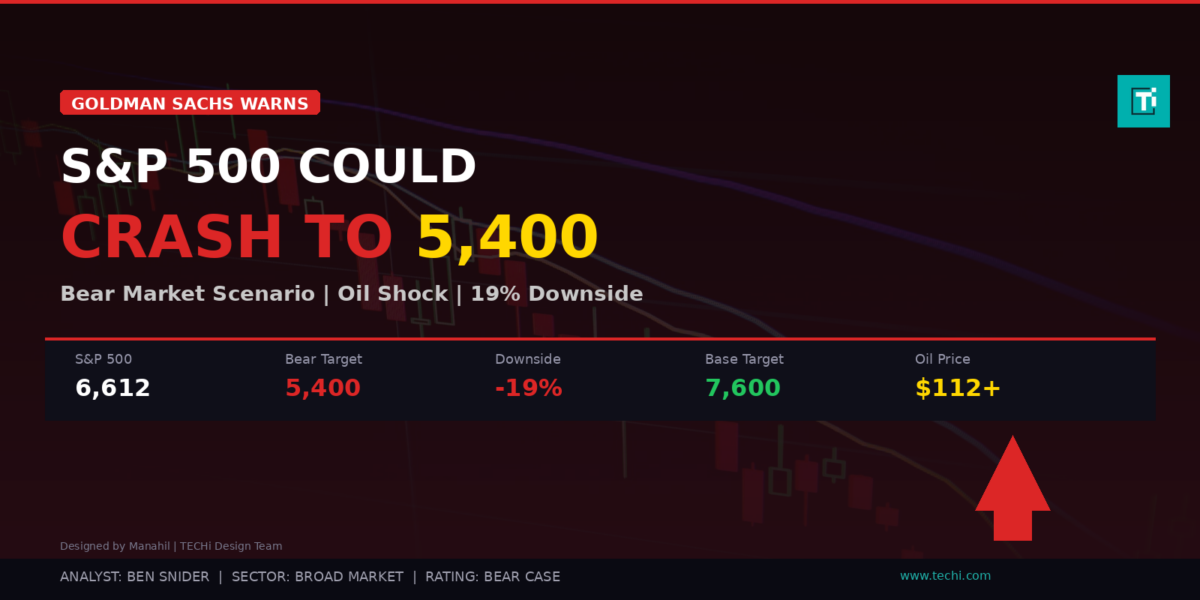
Goldman Sachs has put a number on the nightmare scenario. In a March 16 research note that continues to dominate institutional positioning three weeks later, Chief U.S. Equity Strategist Ben Snider warned that a severe oil supply shock from the ongoing Iran conflict could drag the S&P 500 down to 5,400, roughly 18% below current levels and into bear market territory from its January 2026 closing high of 6,979 (intraday ATH: 7,002).
The warning lands at a moment when markets are already on edge. Oil prices have surged past $112 per barrel after the closure of the Strait of Hormuz, the International Energy Agency has called it the largest supply disruption in the history of global oil markets, and Goldman’s own recession probability model now sits at 25%. Meanwhile, prediction markets on Polymarket are pricing in a coin-flip 50% chance of a formal recession by year-end.
But here’s what makes this note different from the usual Wall Street doom-and-gloom: Goldman isn’t abandoning its bullish base case. The same team that issued the 5,400 bear warning simultaneously reiterated a year-end target of 7,600, a 15% rally from here. That’s a 2,200-point spread between Goldman’s best and worst case scenarios, and understanding which one materializes could be the difference between a portfolio-defining gain and a devastating loss.
Goldman’s Bear Case: The Math Behind 5,400
Ben Snider’s bear scenario isn’t a vague hand-wave about “things could get bad.” It’s a structured valuation framework with specific triggers, and every institutional investor on Wall Street is running the same numbers right now.
The model starts with oil. If crude prices sustain above $150 per barrel for an extended period (a scenario Goldman considers plausible if the Strait of Hormuz remains closed through Q3), the inflationary impulse would force the Federal Reserve to pause or even reverse its rate-cutting cycle. That’s the critical mechanism: higher energy costs feeding into core inflation, killing the rate-cut narrative that has supported equity multiples throughout 2025 and into 2026.
Under this scenario, Goldman projects the S&P 500’s forward price-to-earnings ratio would compress from its current level of roughly 21-22x to between 16x and 19x. At 16x forward earnings, which reflects a severe stagflationary environment — you get the 5,400 target. For context, the S&P 500 hasn’t traded at 16x forward earnings since the October 2022 market bottom, when the Fed was aggressively hiking rates and the market was pricing in recession.
The earnings side of the equation deteriorates simultaneously. Goldman’s bear case assumes S&P 500 EPS growth decelerates to low single digits as corporate margins get squeezed by energy costs, supply chain disruptions, and reduced consumer spending power. That’s a sharp departure from the 12% earnings growth Goldman is forecasting in its base case.
The Oil Shock: Largest Supply Disruption in History
The geopolitical backdrop driving Goldman’s bear case isn’t hypothetical — it’s happening right now. The U.S. Energy Information Administration confirmed that the Strait of Hormuz closure has removed approximately 17 million barrels per day of crude oil transit capacity from the global market, out of roughly 20 million barrels per day of total petroleum flow through the strait.
U.S. oil futures hit $111.96 per barrel in early April, with Brent crude at $110.04, an unusual inversion of the typical WTI-Brent spread driven by the Hormuz closure disrupting Middle Eastern crude flows that anchor the Brent benchmark. The national average gasoline price has surged to $4.11 per gallon, up from $2.98 in early February 2026 before the conflict escalated. Goldman Sachs Research projects that if disruptions persist through summer, gasoline could push above $5.00 per gallon nationally, with inflation becoming structurally embedded rather than transitory.
The parallels to the 1970s energy crisis are uncomfortable. Morgan Stanley’s cross-asset research team published a companion note warning that sustained oil prices above $100 could trigger a stagflationary environment: the toxic combination of rising prices and slowing growth that decimated equity portfolios in 1973-74 and 1979-80. During the 1973 oil embargo, the S&P 500 fell 48% peak-to-trough. During the 1980 oil crisis, it dropped 27%.
As our analysis of what to expect from the stock market in 2026 detailed, geopolitical risk has emerged as the single largest variable for equity returns this year, a dramatic shift from the AI-centric narrative that dominated 2024 and early 2025.
The Bull Case: Why Goldman Still Targets 7,600
Here’s where the story gets interesting for investors trying to position their portfolios. Despite issuing the most prominent bear warning on Wall Street, Goldman’s base case remains aggressively bullish. The 7,600 year-end target, reiterated on April 2, implies roughly 15% upside from current levels and would represent a new all-time high for the index.
The bull thesis rests on three pillars. First, earnings momentum remains strong. Goldman projects S&P 500 EPS will reach $305-$309 for full-year 2026, representing 12% year-over-year growth. Second, the Fed’s trajectory is supportive. Goldman’s base case embeds an additional 50 basis points of rate cuts, pushing the terminal rate toward 3.0%-3.25%.
Third, and most importantly, Goldman argues that 2026 represents a critical inflection point where AI spending transitions from a cost center to a productivity driver. Chief Economist Jan Hatzius projects that AI-driven productivity gains will add 60 basis points to U.S. GDP growth, underpinning their above-consensus 2.6% real GDP forecast (versus 2.0% consensus). Goldman’s data shows AI adoption spreading into healthcare, financial services, and manufacturing, creating a broader earnings tailwind.
For investors tracking how individual AI plays fit into this macro picture, our coverage of Nvidia stock and the broader tech stocks landscape provides granular analysis of the companies driving this productivity shift.
The Recession Probability Debate
Perhaps the most telling data point right now isn’t any single analyst’s price target — it’s the divergence between different recession probability estimates. Goldman Sachs officially puts recession odds at 25%. The Atlanta Fed’s GDPNow tracker entered negative territory in late Q1 2026 for the first time since the pandemic. And prediction markets on Polymarket are now pricing in a 50% probability of recession by year-end.
That spread (25% from Goldman versus 50% from markets) reflects a fundamental disagreement about whether the current shocks are temporary or structural. The bears counter that multiple negative shocks are hitting simultaneously: an oil shock, ongoing tariff uncertainty, and the lagged effects of higher interest rates still working through the system.
Schwab’s Trading Activity Index captured the mood shift in real time: retail investors turned slightly bearish in March as the Iran conflict escalated, with the index falling 2.23% from February’s long-term high. Notably, Schwab clients shifted heavily from individual stock picking to diversified ETFs — five of the top 10 net-buy positions in March were ETFs rather than individual names.
What History Says About Oil Shocks and Bear Markets
History provides a useful but imperfect guide. There have been seven significant oil supply shocks since 1973. The 1973 Arab oil embargo triggered a 48% S&P 500 decline over 21 months. The 1979 Iranian Revolution caused a 27% drawdown. The 1990 Gulf War spike was sharp but short. Oil doubled in three months, but the S&P 500 recovered within seven months.
The pattern: oil supply shocks lasting less than six months tend to produce sharp but recoverable equity drawdowns of 10-20%. Supply disruptions lasting longer than six months have historically produced drawdowns of 30% or more and taken 18-36 months to recover. The critical question is duration — if the Strait of Hormuz reopens within 2-3 months, expect the moderate scenario (S&P 500 to 5,800-6,200). If it extends through Q3, the 5,400 bear case becomes increasingly plausible.
Sectors to Watch: Winners and Losers
Energy stocks are up roughly 18% year-to-date, with small-cap energy names like Kosmos Energy (KOS) surging 227% year-to-date as of early April. Defense stocks have similarly outperformed, driven by accelerating military spending from the Iran conflict.
On the losing side, consumer discretionary faces the most downside from sustained oil prices. Every $10 increase in oil prices effectively acts as a tax on consumers, reducing spending power by an estimated $60-80 billion annually. Goldman’s strategists highlighted the energy-defense barbell as the most attractive positioning: overweight energy producers (EOG Resources, Chevron, ConocoPhillips) and defense contractors (Lockheed Martin, RTX, Northrop Grumman) while underweighting consumer discretionary and rate-sensitive real estate.
How Goldman Recommends Positioning Right Now
The 2,200-point spread between Goldman’s bear (5,400) and bull (7,600) case is the widest outcome range the firm has published since 2020. For conservative investors, Goldman suggests a 60/40 equity-to-fixed income allocation with overweight short-duration Treasury bonds. For more aggressive investors, the playbook involves purchasing S&P 500 put options at the 5,800 strike as portfolio insurance, combined with a 10-15% allocation to energy and commodity producers as a natural hedge.
Our guide to the best tech stocks to buy in 2026 identifies companies with the pricing power and balance sheet strength to weather either scenario. And our Tesla stock analysis provides a case study in how geopolitical and macro risks intersect with individual company fundamentals.
Key Numbers at a Glance
| Metric | Value | Context |
|---|---|---|
| S&P 500 Current | 6,612 | April 6, 2026 close |
| Goldman Bear Target | 5,400 | ~18% downside from current |
| Goldman Base Target | 7,600 | ~15% upside from current |
| GS 2026 EPS Estimate | $305-$309 | 12% YoY growth projected |
| GS Recession Probability | 25% | Market pricing: 50% |
| Oil Price (WTI) | $112+ | Up from $70 pre-conflict |
| Gas Price (National Avg) | $4.11/gal | Up from $2.98 pre-conflict |
| Bear Case P/E | 16x-19x | Down from current ~21-22x |
| January 2026 Peak | 6,979 (close) / 7,002 (intraday) | All-time high |
| Fed Rate (Base Case) | 3.0%-3.25% | 50bps additional cuts embedded |
What to Watch Next
Several catalysts in the coming weeks will determine which of Goldman’s scenarios gains traction.
Iran Ceasefire Negotiations: Trump’s deadline for Iran to reopen the Strait of Hormuz is the single most important near-term catalyst. A diplomatic resolution would likely trigger an immediate 5-8% equity rally.
Q1 2026 Earnings Season (Late April): Corporate commentary on margin impacts from energy costs and tariffs will be critical. If S&P 500 companies broadly guide down for Q2, the earnings pillar of Goldman’s bull case weakens significantly.
Federal Reserve May Meeting: The Fed’s reaction function to the oil shock matters enormously. If the FOMC signals willingness to look through energy-driven inflation and maintain its easing bias, equities get a floor.
Tariff Developments: The White House imposed a 10% baseline duty on all imports, with steeper rates on dozens of countries. Any escalation — particularly with China — would compound the oil shock’s impact on corporate margins and consumer confidence.
The Bottom Line
Goldman Sachs has given the market exactly what it needs right now: a brutally honest assessment of both the upside and downside scenarios. The 5,400 bear case is a structured valuation analysis of what happens when the world’s most important oil chokepoint closes during a period of already-elevated geopolitical and trade uncertainty. The 7,600 bull case is grounded in genuine earnings momentum and the productivity potential of AI adoption.
For retail investors, the takeaway is to stress-test your portfolio against both scenarios. Can you tolerate an 18% drawdown without being forced to sell at the bottom? Do you have enough exposure to energy and defensive sectors to cushion the blow if the bear case materializes? Are you positioned to participate in the upside if diplomatic resolution and AI-driven earnings momentum push the index to new highs?
The market priced Tesla at $352.82 at the April 4 close because investors see a technology company, while JPMorgan prices it at $145 because they see a car company with a demand problem. Similarly, Goldman prices the S&P 500 at 7,600 because they see an earnings machine, while their own bear model prices it at 5,400 because it sees an economy about to be hit by a freight train of oil and inflation. The truth will emerge from the data in the coming weeks. Position accordingly.
What is Goldman Sachs bear case target for the S&P 500 in 2026?
Goldman Sachs warns the S&P 500 could fall to 5,400, roughly 18% below current levels, if the oil supply shock from the Iran conflict persists. The bear case assumes oil prices sustain above $150 per barrel, forcing the Federal Reserve to halt rate cuts, with the forward P/E compressing to 16x-19x.
Why does Goldman Sachs also have a bullish 7,600 target?
Goldman base case of 7,600 rests on 12% EPS growth to $305-$309, additional Fed rate cuts to 3.0%-3.25%, and AI-driven productivity gains adding 60 basis points to GDP growth. They argue 2026 is when AI transitions from spending phase to productivity phase.
How high is the probability of a recession in 2026?
Goldman Sachs puts recession odds at 25%, while Polymarket prediction markets price in 50% probability. The Atlanta Fed GDPNow tracker entered negative territory in late Q1 2026, suggesting oil and tariff shocks may already be affecting GDP growth.
What sectors perform best during an oil shock bear market?
Energy producers like EOG Resources, Chevron, and ConocoPhillips benefit from elevated oil prices, while defense contractors like Lockheed Martin, RTX, and Northrop Grumman benefit from increased military spending. Consumer discretionary, airlines, and real estate are most vulnerable.
How should investors position portfolios given Goldman dual scenarios?
Goldman recommends conservative investors consider 60/40 equity-to-fixed income with overweight short-duration Treasuries. For hedging, S&P 500 put options at the 5,800 strike provide insurance, plus 10-15% allocation to energy and commodity producers as a natural hedge against the oil shock scenario.