Table of Contents
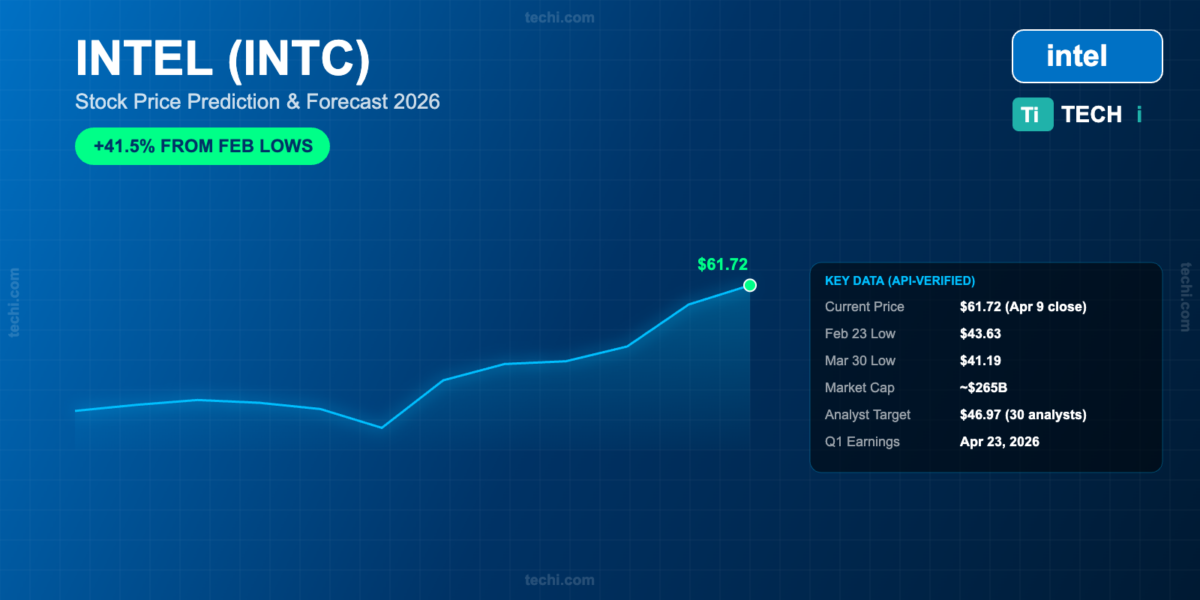
Intel Corporation (NASDAQ: INTC) has staged one of the most remarkable rallies in recent semiconductor history. From a February 23 closing low of $43.63, the stock surged to $58.95 by April 9, 2026, a gain of 35% in just 31 trading sessions. The move accelerated dramatically in the final week, with INTC gaining over 15% in the last three trading days alone after the company announced its partnership in Elon Musk’s Terafab AI chip project.
But this isn’t just a momentum trade. Intel’s rally is backed by fundamental catalysts that have transformed the company’s outlook: the successful high-volume manufacturing of its 18A process node, a $14.2 billion buyback of its Ireland fab from Apollo Global Management, NVIDIA’s $5 billion strategic investment, and a $15 billion foundry backlog that’s growing. The question for investors now isn’t whether Intel’s turnaround is real. It’s whether the stock has gotten ahead of itself.
Intel Stock Price Today: What Just Happened?
Intel closed at $58.95 on April 9, 2026, its highest level since early 2022. The stock is now up over 228% from its 52-week low of $17.98, reached on April 9, 2025, when tariff fears and a leadership vacuum crushed semiconductor stocks. Under CEO Lip-Bu Tan, who took the helm in March 2025, Intel has executed one of the most aggressive turnarounds in tech history.
The recent surge was triggered by three major catalysts in rapid succession:
April 1: Ireland Fab 34 Buyback ($14.2B) — Intel announced it would repurchase Apollo Global Management’s 49% stake in its Leixlip, Ireland fabrication facility for $14.2 billion, a 27% premium over Apollo’s original $11.2 billion investment. The market read this as Intel signaling it no longer needs to sell assets to survive. INTC surged 8.8% that day.
April 7-8: Terafab Partnership with Musk — Intel announced it was joining Elon Musk’s Terafab AI chip complex project alongside SpaceX, Tesla, and xAI. The Austin-based facility aims to produce 1 terawatt of AI compute per year. INTC rose 4.2% on April 8 as markets digested the news.
April 9: Continued Momentum — The Terafab rally extended with another 11.4% gain on 184.6 million shares traded, roughly 68% above the three-month average volume. Intel also announced a strengthened partnership with Google to enhance AI infrastructure.
The 35% Rally By the Numbers
Here’s exactly how Intel’s price moved from the February low to the April 9 close, verified against daily closing prices:
| Period | Start Price | End Price | Change | Trading Days |
|---|---|---|---|---|
| Feb 23 → Apr 9 (Full Rally) | $43.63 | $58.95 | +35.1% | 31 |
| Mar 30 → Apr 9 (Explosive Phase) | $41.19 | $58.95 | +43.1% | 7 |
| 52-Week Low → Apr 9 | $17.98 | $58.95 | +228% | ~252 |
The data tells a clear story: Intel traded sideways between $43 and $48 for most of February and March, then exploded higher starting March 31 when the Apollo buyback news broke. The stock gained $17.76 from its March 30 low of $41.19 to close at $58.95 on April 9 in just seven trading sessions.
Why Intel Stock Is Surging: 5 Catalysts Driving the Rally
1. Intel 18A Process Node Enters High-Volume Manufacturing
The single most important development in Intel’s turnaround is the successful ramp of its 18A (1.8nm-class) process node to high-volume manufacturing at Fab 52 in Chandler, Arizona. This happened in January 2026, and the first commercial wafers of Panther Lake client processors and Clearwater Forest server chips are already shipping.
Intel 18A is the most advanced semiconductor process ever manufactured in the United States. It powers over 200 PC designs via the Core Ultra Series 3 processors launched at CES 2026. CEO Lip-Bu Tan noted on the Q4 earnings call that “customers are all crying for more products” and that Intel had underestimated demand.
2. Elon Musk’s Terafab Partnership
On April 7, 2026, Intel announced it would partner with SpaceX, Tesla, and xAI on the Terafab project, a mega-fab in Austin designed to produce 1 terawatt per year of AI compute for both terrestrial and space applications. Intel’s statement noted its “ability to design, fabricate, and package ultra-high-performance chips at scale” as its contribution. Small-batch production is expected in late 2026 with full scale-up in 2027.
This partnership validates Intel Foundry as a serious contender against TSMC for cutting-edge AI chip manufacturing. Having Musk’s ecosystem as a customer provides both revenue visibility and reputational credibility that money can’t buy.
3. $14.2 Billion Ireland Fab Buyback
Intel’s decision to repurchase Apollo’s 49% stake in Fab 34 (Leixlip, Ireland) for $14.2 billion signals a dramatic shift from survival mode to strategic offense. The facility produces chips on Intel 4 and Intel 3 technologies, including Core Ultra and Xeon 6 processors. Intel is funding the deal through existing cash and $6.5 billion in new debt, with the transaction expected to close by Q2 2026.
Analysts viewed this as evidence that Intel’s balance sheet is strong enough to consolidate its manufacturing assets rather than continuing to sell them off. The deal is expected to boost profitability and strengthen Intel’s credit profile from 2027 onward.
4. NVIDIA’s $5 Billion Strategic Investment
In what may be the most symbolically significant deal of Intel’s turnaround, NVIDIA took a $5 billion equity stake in Intel, acquiring approximately 4-5% of the company through a private placement at $23.28 per share. The FTC approved the deal in late 2025. While NVIDIA continues to rely on TSMC for its flagship GPUs, the investment serves as a “down payment” on future 18A and 14A foundry capacity, giving NVIDIA a domestic secondary source and Intel a massive, high-margin customer.
5. AI Demand and Server CPU Dominance
Intel’s Data Center and AI (DCAI) segment posted $4.7 billion in Q4 2025 revenue, up 15% sequentially and 9% year-over-year. CFO David Zinsner called it the “fastest sequential DCAI growth in a decade.” A KeyBanc upgrade in January cited near sell-out of 2026 server CPU supply driven by AI demand, which was one of the early catalysts for the stock’s 2026 rally.
Intel Financial Snapshot: Q4 2025 Results
| Metric | Q4 2025 | Full Year 2025 |
|---|---|---|
| Revenue | $13.7B (high end of guidance) | $52.9B |
| Non-GAAP EPS | $0.15 (beat $0.08 est.) | $0.42 |
| Non-GAAP Gross Margin | 37.9% | 36.7% |
| DCAI Revenue | $4.7B (+15% seq.) | — |
| Foundry Revenue | $4.5B (+4% YoY) | — |
| Foundry Operating Loss | -$2.51B | — |
| Cash from Operations | — | $9.7B |
| OpEx Reduction | — | Down 15% vs 2024 |
Q1 2026 revenue guidance is $11.7-12.7 billion (midpoint $12.2B), with consensus at roughly $12.3 billion. The foundry segment is expected to post double-digit sequential revenue growth, driven by EUV wafer mix shift and 18A pricing. Intel reports Q1 2026 earnings on April 23, 2026.
Analyst Price Targets and Ratings
Here’s where things get complicated. Despite the 35% rally, Wall Street’s consensus hasn’t caught up. As of April 9, 2026, 30 analysts covering INTC have a consensus Hold rating with a median price target of $46.97, roughly 20% below the current price of $58.95.
| Rating | % of Analysts |
|---|---|
| Strong Buy | 13% |
| Buy | 7% |
| Hold | 70% |
| Sell | 7% |
| Strong Sell | 3% |
The most bullish targets come from Morgan Stanley ($62), KeyBanc ($70), and Truist ($58). The average 12-month target across 33-41 analysts ranges from $47 to $48, with a high of $71.50 and a low of $20.40. The wide spread reflects deep disagreement about whether Intel’s foundry turnaround will deliver profitable growth or remain a money-losing venture for years.
The critical takeaway: Intel is currently trading above its consensus price target. That either means analysts need to upgrade their targets (which often happens after a sustained rally), or the stock has gotten ahead of itself.
Bull Case for Intel
- 18A HVM success positions Intel as the only leading-edge logic manufacturer in the U.S.
- $15B foundry backlog provides multi-year revenue visibility
- Terafab + NVIDIA + AWS partnerships validate foundry strategy
- $14.2B Apollo buyback signals balance sheet strength
- CEO Lip-Bu Tan’s execution track record (Cadence Design Systems)
- Geopolitical tailwind: U.S. government incentives for domestic chip manufacturing
- Q1 2026 earnings could be the next upside catalyst (April 23)
Bear Case for Intel
- Stock trading 26% above consensus analyst target of $46.97
- Intel Foundry still losing $2.5B+ per quarter operationally
- $6.5B new debt for Apollo buyback increases leverage
- TSMC’s N2 node launching in 2025-2026 maintains competitive pressure
- 70% of analysts rate INTC as Hold, not Buy
- Foundry external revenue remains minimal vs. internal consumption
- $52.9B FY2025 revenue was down YoY despite AI boom
Intel Stock Price Prediction 2026-2027
Based on verified analyst targets, fundamental catalysts, and technical momentum, here’s our framework for Intel’s price trajectory:
INTC Price Prediction Framework
- Near-term (Q2 2026): $50-65 range. Q1 earnings on April 23 is the next major catalyst. A beat could push toward $70 (KeyBanc target). A miss could see a pullback to the $48-53 support zone.
- Year-end 2026: $55-75 if foundry ramp continues successfully. The Terafab partnership and 18A customer wins (AWS multi-billion deal confirmed) provide upside.
- 2027: $65-90+ if Intel Foundry approaches profitability and external foundry revenue scales materially. The 14A node roadmap and second-generation Terafab production will be key.
- Downside risk: $38-42 if foundry losses persist, Q1 disappoints, or tariff/geopolitical disruptions hit the sector.
Is Intel Stock a Buy Right Now?
Intel’s 35% rally from February lows is impressive, but the stock now faces a classic momentum dilemma. At $58.95, INTC trades well above the analyst consensus of $46.97, which means the market is pricing in execution that hasn’t been fully proven yet. The foundry business is still losing billions per quarter, and the gap between Intel’s share price and analyst targets is the widest it’s been in years.
That said, the catalysts are real. The 18A node is in production. The Terafab deal puts Intel at the center of Musk’s AI ambitions. The Apollo buyback proves the balance sheet can handle strategic moves. And with Q1 earnings just two weeks away on April 23, a beat could force the Wall Street consensus sharply higher.
For long-term investors who believe in Intel’s foundry transformation, any pullback toward the $50-55 range could represent a buying opportunity. For those with shorter time horizons, the risk-reward at $59 is more challenging, given that the stock has already priced in significant good news. The smart play may be to wait for the Q1 earnings report before committing new capital.
Key Dates for Intel Investors
| Date | Event |
|---|---|
| April 23, 2026 | Q1 2026 Earnings Report |
| Q2 2026 | Apollo Fab 34 buyback closes |
| Late 2026 | Terafab small-batch production begins |
| 2027 | Terafab full scale-up; 14A node ramp |
Frequently Asked Questions
Disclaimer: This article is for informational purposes only and does not constitute investment advice. Stock prices and analyst targets cited reflect data as of April 9, 2026, and may have changed. Always conduct your own research and consult a qualified financial advisor before making investment decisions. TECHi and its authors may hold positions in securities discussed.