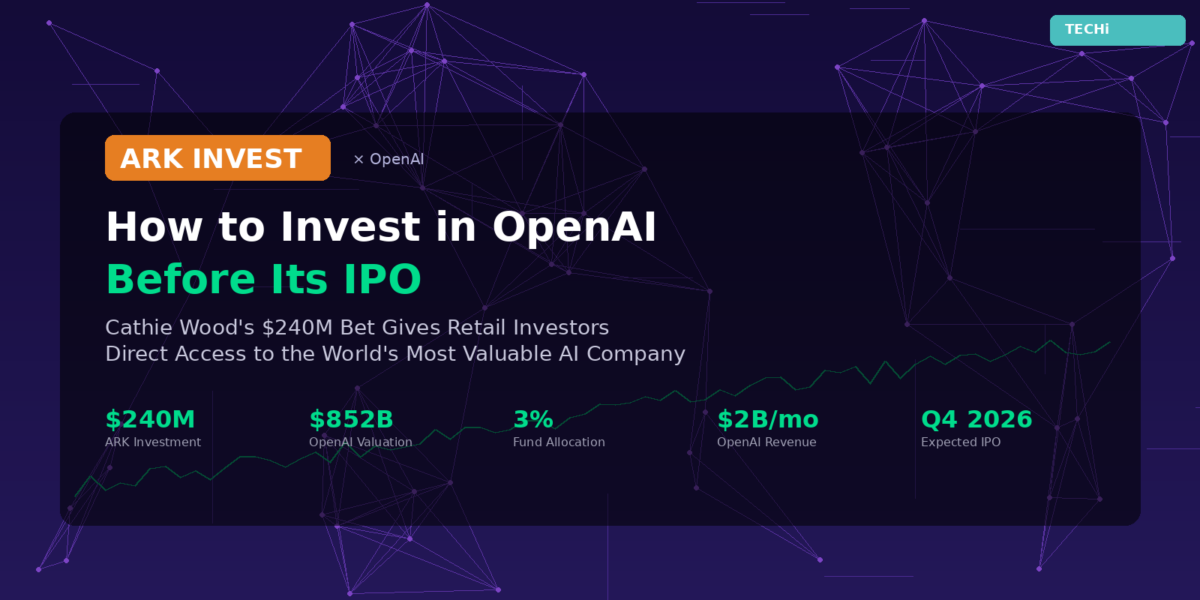
Cathie Wood just made a statement about the future of artificial intelligence and your portfolio. On March 31, ARK Invest quietly accumulated $240 million worth of OpenAI shares across three flagship ETFs, marking the first time retail investors could follow her into one of the world’s most valuable private companies. This wasn’t a fund manager’s whisper; it was a roaring declaration that OpenAI’s valuation has reached escape velocity, and the path to profitability is clearer than skeptics want to admit.
ARK Invest’s $240 Million OpenAI Play: The Full Breakdown
Let’s cut straight to what happened: On March 31, 2026, ARK Invest executed a Series C allocation purchase of 348,995 OpenAI share units valued at approximately $240 million. The shares landed across three funds: ARKK (ARK Innovation ETF), ARKW (ARK Next Generation Internet ETF), and ARKF (ARK Fintech Innovation ETF), with each fund receiving roughly 3% of its portfolio in OpenAI exposure.
This is the exact moment institutional-grade conviction meets retail accessibility. Before this allocation, only ARK Venture Fund held OpenAI shares, a closed-end fund reserved exclusively for accredited investors with minimum $50,000 commitments. Cathie Wood, ARK’s founder and Chief Investment Officer, essentially opened the door wider. If you own a single share of ARKK, ARKW, or ARKF, you now own a fractional piece of OpenAI.
The timing wasn’t random. Sarah Friar, OpenAI’s Chief Financial Officer, has publicly stated the company is “broadening the ownership base” ahead of its expected IPO. That translation: they’re moving away from the venture capital gatekeeping model toward a more inclusive cap table. The $3 billion that came from individual and retail investors during this funding round, roughly 2.5% of the $122 billion raised, signals a clear strategic shift.
For ARK, this move accomplishes multiple things at once. It demonstrates conviction in the secular AI trend, it provides exposure to infrastructure demand (which should benefit existing holdings like NVIDIA), and it hedges against the possibility that none of their current portfolio companies become the next OpenAI. Wood has been vocal about her belief that AI will drive 30+ years of innovation. This allocation is her putting real capital behind that thesis.
OpenAI’s $852 Billion Valuation: What’s Behind the Number
To understand why ARK would allocate 3% of its flagship funds to a private company, you need to grasp OpenAI’s financial reality. This isn’t speculative. This is a company printing cash at a scale most SaaS startups dream about.
OpenAI generated $2 billion in monthly revenue as of early 2026. That’s $24 billion annualized. But profitability remains elusive because running large language models at scale is extraordinarily expensive. Training and inference costs consume the majority of that revenue. The company burns significant capital maintaining its computational infrastructure and deploying new model improvements.
Yet the market, which includes SoftBank, Amazon, Nvidia, Microsoft, and now retail investors, believes they’ll reach profitability. The reasons are compelling. First, API pricing has room to compress without destroying margins. Second, efficiency improvements in model training reduce costs per inference. Third, the addressable market for enterprise AI applications is expanding faster than supply. OpenAI doesn’t need to corner consumer AI (though they’re doing fine there). Enterprise adoption alone justifies the valuation.
| Metric | Value | Context |
|---|---|---|
| Series C Valuation | $852B | Largest venture funding round in history |
| Total Raised (Series C) | $122B | Dwarfs previous records by 3x |
| Monthly Revenue | $2B | Annualized: $24B |
| Profitability Status | Not Profitable | Infrastructure costs offset revenue gains |
| Expected IPO Valuation | $1T+ | Q4 2026 timeline (unconfirmed) |
| Implied Revenue Multiple | ~35x | Based on $24B annualized revenue |
The $852 billion valuation anchors on a few assumptions. First, that OpenAI will maintain its technological lead in large language models. Second, that enterprise customers will continue migrating workloads to their platform at accelerating rates. Third, that competition from Anthropic, Gemini, and others won’t erode margins faster than price cuts can expand the user base. All three assumptions have merit, though none are guaranteed.
Who’s Funding OpenAI?
The investor lineup tells a story. SoftBank’s Vision Fund led with $30 billion. Amazon committed $50 billion in infrastructure spend. Nvidia allocated $30 billion. Microsoft has an undisclosed but substantial position from earlier rounds. UAE’s PIF and other sovereign wealth funds participated. This isn’t Silicon Valley money anymore; it’s global capital recognizing that AI infrastructure is as fundamental as electricity.
How to Buy OpenAI Stock Today Through ARK ETFs
Here’s where it gets practical. You don’t need $50,000, accredited investor status, or a venture capital connection. If you have a brokerage account and $100, you can own OpenAI shares through ARK’s ETFs. Here’s the process.
Step 1: Open a Brokerage Account. Use any major broker: Fidelity, Charles Schwab, Vanguard, Interactive Brokers, or commission-free apps like Robinhood or Webull. The process takes 10 minutes. You’ll need your Social Security number, driver’s license, and a bank account for deposits.
Step 2: Fund Your Account. Transfer cash from your bank. Most brokers offer ACH transfers that settle in 1 to 3 days. You can start with $100 or $10,000; there’s no minimum for ETF purchases.
Step 3: Search for Your Chosen ARK ETF. Type “ARKK,” “ARKW,” or “ARKF” into the search bar on your broker’s trading platform. These trade on exchanges just like Apple or Tesla shares.
Step 4: Place a Buy Order. Use a “market order” (buys at current market price) or a “limit order” (specifies a price you’re willing to pay). For ETFs, market orders are safe because they trade continuously with tight bid-ask spreads. Your order executes in seconds during market hours (9:30 AM to 4 PM ET).
Step 5: Hold and Monitor. Once your shares settle (usually the next business day), you own OpenAI exposure. ARK publishes daily fund holdings on its website, so you can verify your OpenAI position anytime.
That’s it. No accredited investor form. No minimum $50,000. No quarterly review from a fund administrator. You’re in.
ARKK vs ARKW vs ARKF: Which ARK ETF Is Best for OpenAI Exposure?
All three ARK funds now hold OpenAI, but they’re not interchangeable. Your choice should depend on your risk tolerance, investment thesis, and what else you want exposure to.
| ETF | Full Name | Focus | OpenAI Allocation | Expense Ratio | Best For |
|---|---|---|---|---|---|
| ARKK | ARK Innovation ETF | Broad disruptive tech | ~3% | 0.75% | Aggressive growth, multiple trends |
| ARKW | ARK Next Gen Internet | Internet and software | ~3% | 0.80% | Tech-focused with AI emphasis |
| ARKF | ARK Fintech Innovation | Financial services disruption | ~3% | 0.75% | Fintech thesis with AI exposure |
ARKK is the broadest fund. It holds Tesla (10.3% of holdings), CRISPR Therapeutics, Tempus AI, and energy innovators alongside OpenAI. Current price: approximately $68 per share. 52-week range: $38.57 to $92.65. Year-to-date performance (2026): down 9.58%. Full-year 2025 return: 35.49%. The volatility is real, but if you’re buying for the next 10 years, cheaper entry points are your friend.
ARKW concentrates on software, cloud infrastructure, and internet-native companies. The fund overweights AI winners more heavily than ARKK. If you think AI will disrupt the entire internet and software layer, ARKW is a narrower, more concentrated bet with a slightly higher 0.80% expense ratio.
ARKF bets on AI disrupting financial services. Think OpenAI powering the next generation of robo-advisors, fraud detection, or lending decisioning. It holds a mix of payments processors, blockchain infrastructure companies, and private equity managers.
The honest take: if you’re buying specifically for OpenAI exposure, it doesn’t matter much. All three allocations are roughly equal at 3%. Pick based on where else you want exposure. Want broad innovation? ARKK. Want internet/software concentration? ARKW. Want fintech specifically? ARKF.
The OpenAI IPO Timeline: What We Know About Q4 2026
Timing is everything in pre-IPO investing. OpenAI hasn’t announced a public offering date, but signals point toward Q4 2026.
The Series C round valued OpenAI at $852 billion. Market chatter suggests the IPO valuation could hit $1 trillion or beyond. That implies significant upside for pre-IPO shareholders like ARK fund holders. At a $1T valuation, the implied revenue multiple is 41x based on current $24B annualized revenue. For a company in hypergrowth, that’s reasonable but assumes continued explosive revenue growth and margin improvement.
OpenAI must file an S-1 registration statement with the SEC. That document includes audited financials, business risk factors, and management compensation. The company has prepared for this by hiring Sarah Friar as CFO specifically to professionalize financial operations for a public company. Look for an S-1 filing around September or October, with pricing in November or December.
Historically, mega-cap IPOs happen in Q4 when tax-loss harvesting and year-end portfolio rebalancing create demand for large offerings. There’s risk to this timeline: market volatility could push the IPO into 2027, and regulatory scrutiny could add delays. But barring a major macro shock, Q4 2026 is a reasonable expectation.
Risks of Investing in OpenAI Through ARK ETFs
Before you buy, understand what you’re actually risking. Investing in OpenAI through ARK isn’t free money.
Risk Warning: OpenAI IPO Is Not Guaranteed Upside
Just because ARK bought $240 million doesn’t mean the price will pop on IPO day. Tech IPOs routinely disappoint. Remember Uber (IPO priced at $45, fell to $26)? Or WeWork (collapsed entirely)? An OpenAI IPO at a $1T valuation gives you limited upside if the market reprices post-S1 filing. You could own shares at $852B that trade at $600B on day one. Cathie Wood’s conviction doesn’t override market mechanics.
Concentration Risk: ARKK’s top holding is Tesla at 10.3%. OpenAI at 3% is meaningful. If OpenAI faces a major setback, a critical safety failure, talent exodus, or competitive threat from Anthropic or Gemini, that hits returns directly.
Private Market Liquidity: OpenAI shares won’t trade freely until the IPO. If you need to exit before Q4 2026, you’re selling the fund itself, not OpenAI shares. You lose exposure to all other holdings simultaneously.
ARKK Volatility: ARKK is down 9.58% year-to-date. This fund can drop 30% in a correction. If you need the money in 2 years or can’t stomach volatility, ARKK will stress you out.
Regulatory and Competitive Risks: OpenAI operates in a regulatory gray zone. The EU is writing AI regulations. China banned GPT. If regulation becomes onerous, OpenAI’s addressable market could shrink. Anthropic, Google’s Gemini, and others are shipping competitive models monthly. Competition isn’t theoretical.
OpenAI vs Other Pre-IPO AI Investments
OpenAI isn’t the only way to access private AI companies. Here’s how it compares to realistic alternatives available to retail investors right now.
| Company | Valuation | Retail Access | Key Edge |
|---|---|---|---|
| OpenAI | $852B | ARK ETFs (ARKK, ARKW, ARKF) | Market-leading LLM, $2B/month revenue |
| Anthropic | ~$30B | None (accredited-only) | Safety-first approach, growing enterprise |
| xAI | ~$24B | None | Elon Musk backing, consumer angle |
| Nvidia (NVDA) | Public | Buy directly | AI infrastructure, GPU monopoly |
| Microsoft (MSFT) | Public | Buy directly | OpenAI investor, cloud platform |
Anthropic is arguably the strongest OpenAI competitor, but it’s been raising venture capital at 3% of OpenAI’s valuation. There’s no retail access. xAI has Elon’s backing but remains years behind on model capability. Public plays like Nvidia and Microsoft give you AI exposure with immediate liquidity, though you lose the pure AI software play.
The honest assessment: if you believe OpenAI’s technology and business model are defensible, buying through ARK ETFs is your best retail option. It’s simpler than seeking venture funds, cheaper than accredited minimums, and more liquid than secondary market shares.
Should You Buy ARKK for OpenAI Exposure?
The Bull Case: OpenAI’s Path to $1T Is Clear
OpenAI isn’t overvalued at $852B. The company generates $2B monthly revenue with secular tailwinds. Enterprise AI adoption is accelerating across industries. A $1T valuation would imply a 41x revenue multiple, high but not unreasonable for a duopoly player in a multi-trillion-dollar market. If Microsoft and Amazon see enough upside to commit tens of billions, retail investors buying at the same valuation through ARK ETFs aren’t being reckless. The IPO likely occurs Q4 2026, creating a catalyst.
Now for the reality check: Cathie Wood also loaded up on Zillow (down 70% from peak), held Roku as it collapsed, and has underperformed the S&P 500 for stretches. ARK funds are volatile. Her conviction isn’t a guarantee.
If you meet these criteria, buying ARKK makes sense: You have a 10+ year investment horizon. You believe AI will be one of the largest wealth creators this decade. You can tolerate 30 to 50% drawdowns without panic selling. You want exposure to multiple disruptive trends, not just OpenAI. You prefer simple ETF mechanics to venture capital complexity.
If you’re investing for income, need money in the next 5 years, or can’t stomach volatility, ARKK isn’t for you. Buy Microsoft or Nvidia for AI exposure instead. They’re less exciting but more stable.
For aggressive growth investors, ARKK at $68 per share is a reasonable entry point. You’re buying 3% OpenAI exposure alongside Tesla, CRISPR companies, autonomous vehicle makers, and energy innovators. The IPO catalyst in Q4 2026 is worth waiting for. Whether OpenAI re-rates to $1T or reprices down, you’ll know the answer within 6 months.
Frequently Asked Questions
Investment Disclaimer
This article is educational and informational only. It is not investment advice. Before investing in any ETF, mutual fund, or stock, consult with a licensed financial advisor who understands your personal situation, risk tolerance, and financial goals. Past performance does not guarantee future results. All investments carry risk, including potential loss of principal. ARK Innovation ETF (ARKK), ARK Next Generation Internet ETF (ARKW), and ARK Fintech Innovation ETF (ARKF) are subject to market volatility. OpenAI is a private company and carries pre-IPO risk. IPO timing, valuation, and availability are uncertain. The statements in this article about OpenAI’s revenue, valuation, and IPO timeline are based on publicly available information and market reporting as of April 8, 2026, and may change.