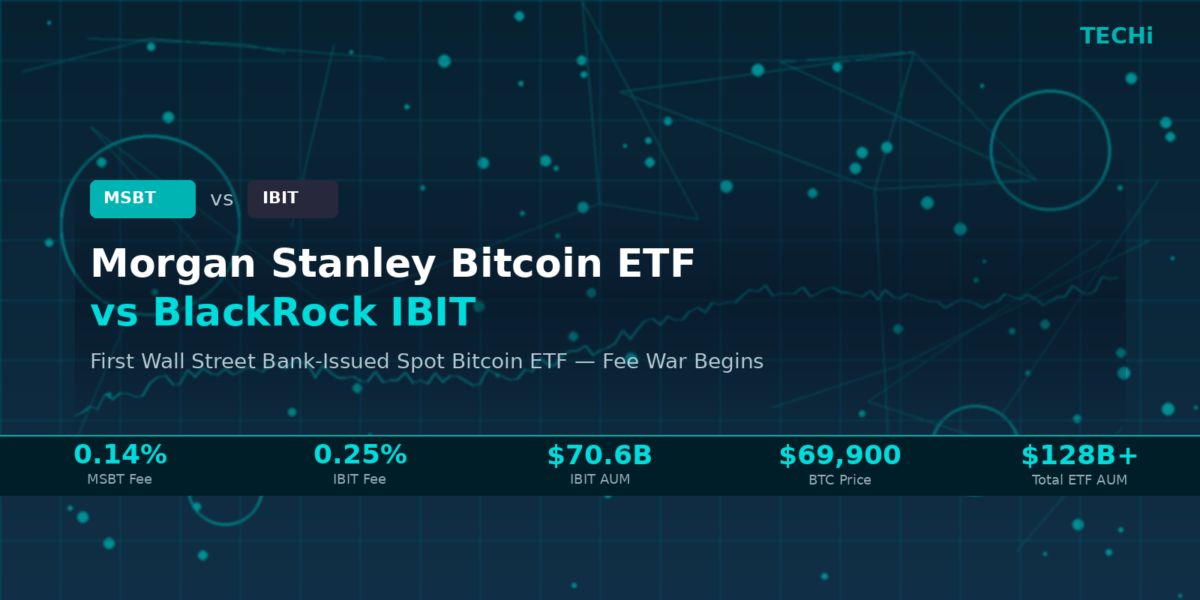
Morgan Stanley launches the first Wall Street bank-issued spot Bitcoin ETF today under ticker MSBT, charging just 0.14% annually and deploying its 16,000-advisor wealth management army against BlackRock’s IBIT, which commands $70.6 billion in assets and 45% of the entire spot Bitcoin ETF market. With Bitcoin trading near $70,200 and total ETF assets surpassing $128 billion, the battle between legacy banking distribution and asset-management scale will determine who controls the next wave of institutional crypto adoption.
Morgan Stanley Bitcoin Trust (MSBT): What You Need to Know
The Morgan Stanley Bitcoin Trust begins trading on NYSE Arca under ticker MSBT on April 8, 2026, making Morgan Stanley the first major U.S. bank to issue a spot Bitcoin ETF under its own name. The fund holds physical Bitcoin through a custodial arrangement and charges an annual expense ratio of 0.14%, undercutting every existing competitor in the market.
The filing journey started in January 2026 when Morgan Stanley submitted its initial S-1 registration with the SEC for both Bitcoin and Solana ETFs. A second amendment filed in March locked in the MSBT ticker and the 14-basis-point fee structure. NYSE Arca greenlit the listing and registration in late March, with analysts noting that exchange certification typically means launch is days away.
What makes MSBT strategically different from every other Bitcoin ETF on the market is not the product itself, which tracks Bitcoin’s spot price just like IBIT, FBTC, and the rest, but the distribution infrastructure behind it. Morgan Stanley operates approximately 16,000 financial advisors managing over $6.2 trillion in client assets. When those advisors recommend MSBT to wealth management clients, the fund does not compete on a brokerage shelf alongside eleven other options. It arrives as a proprietary recommendation from a trusted advisor relationship.
The ETF launch is also part of a broader crypto strategy. Morgan Stanley is simultaneously building out retail crypto spot trading through E*Trade, expected in the first half of 2026, starting with Bitcoin, Ethereum, and Solana. This creates a multi-channel approach: institutional clients get MSBT through their advisor, while self-directed retail investors trade crypto directly on E*Trade.
From “Value Could Be Zero” to Filing Its Own ETF: Morgan Stanley’s Bitcoin U-Turn
Morgan Stanley’s decision to launch a Bitcoin ETF becomes more remarkable when you trace the bank’s history with cryptocurrency. This is not a firm that embraced Bitcoin early. For years, Morgan Stanley was one of Wall Street’s loudest Bitcoin skeptics.
In December 2017, Morgan Stanley analyst James Faucette published a research note titled “Bitcoin Decrypted” that concluded Bitcoin’s true value could be zero. Faucette argued that Bitcoin had “virtually no acceptance, and shrinking,” that it could not function as a real currency because it carried no interest rate, and that unlike gold, it lacked any physical form to anchor its value. The same month, CEO James Gorman dismissed the cryptocurrency as “by definition speculative,” warning that “anybody who thinks they’re buying something that it’s a stable investment is deluding themselves.”
The shift began gradually. By October 2021, Gorman softened his language considerably, telling analysts on an earnings call that “I don’t think crypto’s a fad, I don’t think it’s going away.” He acknowledged that blockchain technology was “obviously very real and powerful,” though he maintained he did not know what Bitcoin should be worth. That same year, Morgan Stanley became the first major U.S. bank to offer wealthy clients access to Bitcoin funds through partnerships with Galaxy Digital and NYDIG, a quiet but significant step.
The SEC’s approval of spot Bitcoin ETFs in January 2024 accelerated the pivot. By August 2024, Morgan Stanley authorized its 16,000 wealth advisors to recommend BlackRock’s IBIT and Fidelity’s FBTC to eligible clients. The bank that once said Bitcoin’s value could be zero was now actively channeling client money into the asset.
When Ted Pick replaced Gorman as CEO in January 2024, the institutional posture shifted from cautious accommodation to active embrace. At the World Economic Forum in Davos in January 2025, Pick told CNBC that Morgan Stanley would “work with Treasury, and the other regulators to figure out how we can offer [crypto] in a safe way.” He questioned whether crypto had “hit escape velocity” and noted that “time is the friend; the longer it trades, perception becomes reality.”
By late 2025, Morgan Stanley was recommending that clients allocate 2% to 4% of their portfolios to cryptocurrency, describing Bitcoin as a “scarce asset, akin to digital gold.” The bank announced plans to bring spot crypto trading to E*Trade in 2026, and in January 2026, it filed its S-1 for both Bitcoin and Solana ETFs. The full journey from “value could be zero” to launching a proprietary Bitcoin ETF took less than nine years.
| Year | Morgan Stanley’s Bitcoin Stance |
|---|---|
| Dec 2017 | Analyst says Bitcoin’s true value “could be zero.” CEO calls it “by definition speculative.” |
| Oct 2021 | CEO Gorman: “I don’t think crypto’s a fad.” First major bank to offer Bitcoin fund access. |
| Jan 2024 | Ted Pick becomes CEO. Spot Bitcoin ETFs approved by SEC. |
| Aug 2024 | Authorizes 16,000 advisors to recommend IBIT and FBTC to eligible clients. |
| Jan 2025 | Pick at Davos: will “work with regulators” to offer crypto safely. E*Trade crypto trading planned. |
| Late 2025 | Recommends 2-4% crypto portfolio allocation. Describes BTC as “digital gold.” |
| Jan 2026 | Files S-1 for Bitcoin (MSBT) and Solana ETFs with SEC. |
| Apr 2026 | MSBT launches on NYSE Arca at 0.14% — the lowest-fee spot Bitcoin ETF in the market. |
BlackRock IBIT: The $70.6 Billion Incumbent
BlackRock’s iShares Bitcoin Trust (IBIT) has dominated the spot Bitcoin ETF market since its January 2024 launch. With approximately $70.6 billion in assets under management, IBIT holds more than 45% of all spot Bitcoin ETF assets, a concentration that gives the fund significant advantages in liquidity, bid-ask spreads, and institutional recognition.
Q1 2026 reinforced IBIT’s dominance. The fund attracted approximately $8.4 billion in net inflows during the quarter, roughly 45% of the $18.7 billion that flowed into all spot Bitcoin ETFs combined. On April 6 alone, IBIT absorbed $181.9 million as part of a $471 million inflow day across the category. IBIT is now approaching the $100 billion AUM milestone, which would make it one of the fastest ETFs in history to reach that threshold.
IBIT charges an annual expense ratio of 0.25%, which was market-competitive at launch but now sits above several newer entrants. The fund benefits from BlackRock’s institutional brand, its existing ETF distribution relationships with every major brokerage platform, and the simple fact that it was first to scale. In ETF markets, assets beget assets: larger funds attract more market makers, tighter spreads attract more institutional capital, and the cycle compounds.
| Metric | Morgan Stanley MSBT | BlackRock IBIT |
|---|---|---|
| Launch Date | April 8, 2026 | January 11, 2024 |
| Expense Ratio | 0.14% | 0.25% |
| AUM | New launch | ~$70.6B |
| Exchange | NYSE Arca | NASDAQ |
| Custodian | TBD (likely Coinbase) | Coinbase Prime |
| Issuer Type | Major U.S. Bank | Asset Manager |
| Advisor Network | ~16,000 advisors | Brokerage distribution |
| Client Assets | $6.2 trillion | $11.6 trillion (firm-wide) |
Fee War: 0.14% vs 0.25% and What It Costs You
Morgan Stanley’s 0.14% expense ratio undercuts BlackRock’s IBIT by 11 basis points. On a $10,000 investment, that difference amounts to $11 per year, which is negligible for most retail investors. But for institutional allocators deploying $10 million or more, the 11-basis-point gap translates to $11,000 annually, enough to matter in fee-sensitive portfolio construction.
| Investment Size | MSBT Annual Cost (0.14%) | IBIT Annual Cost (0.25%) | Annual Savings with MSBT |
|---|---|---|---|
| $10,000 | $14 | $25 | $11 |
| $100,000 | $140 | $250 | $110 |
| $1,000,000 | $1,400 | $2,500 | $1,100 |
| $10,000,000 | $14,000 | $25,000 | $11,000 |
The fee landscape across the broader market adds context. Grayscale’s Bitcoin Mini Trust (BTC) charges 0.15%, just one basis point above MSBT. Bitwise’s BITB charges 0.20%. ARK 21Shares’ ARKB charges 0.21%. Fidelity’s FBTC matches IBIT at 0.25%. And Grayscale’s original GBTC still charges 1.50%, a legacy fee structure from its pre-ETF conversion days that continues to drive outflows.
Distribution Battle: 16,000 Advisors vs ETF Shelf Space
The fundamental question for investors is whether Morgan Stanley’s advisor-driven distribution can overcome BlackRock’s two-year head start and massive liquidity advantage. The answer likely depends on which type of investor you are.
For self-directed investors who buy ETFs through Schwab, Fidelity, or Robinhood, IBIT’s liquidity makes it the default choice. The fund trades millions of shares daily, bid-ask spreads are consistently tight, and the tracking error relative to Bitcoin’s spot price is minimal. MSBT will need months or years to build comparable trading volume.
For wealth management clients, the dynamic flips entirely. Morgan Stanley’s advisors control the recommendation, and a proprietary product with lower fees and the Morgan Stanley brand will be the default allocation for clients seeking Bitcoin exposure. This channel alone manages $6.2 trillion in assets. Even a 1% allocation to Bitcoin across that base would represent $62 billion in potential inflows, nearly matching IBIT’s entire current AUM.
Morgan Stanley’s broader crypto infrastructure adds another dimension. The upcoming E*Trade spot crypto trading capability means clients who start with an MSBT allocation through their advisor can later trade Bitcoin directly. This creates a sticky ecosystem where Morgan Stanley captures the client at multiple touchpoints.
Full Spot Bitcoin ETF Comparison Table
| Fund | Ticker | Expense Ratio | AUM | Q1 2026 Inflows |
|---|---|---|---|---|
| BlackRock iShares Bitcoin Trust | IBIT | 0.25% | $70.6B | $8.4B |
| Fidelity Wise Origin Bitcoin Fund | FBTC | 0.25% | $20.6B | $4.1B |
| Grayscale Bitcoin Trust | GBTC | 1.50% | $19.5B | -$1.2B |
| ARK 21Shares Bitcoin ETF | ARKB | 0.21% | ~$5B | $1.8B |
| Grayscale Bitcoin Mini Trust | BTC | 0.15% | ~$4.5B | $1.1B |
| Bitwise Bitcoin ETF | BITB | 0.20% | ~$4B | $0.9B |
| Morgan Stanley Bitcoin Trust | MSBT | 0.14% | New | N/A |
Bitcoin’s current price of approximately $70,200 provides the backdrop for this competitive landscape. Total spot Bitcoin ETF assets under management have surpassed $128 billion as of mid-March 2026, with Q1 total inflows reaching $18.7 billion. The market is growing fast enough that MSBT does not need to steal share from IBIT to succeed; it needs to capture a portion of the new capital flowing into the category.
Which Bitcoin ETF Should You Buy?
The right choice depends on how you invest. Self-directed traders who value liquidity and tight spreads should stick with IBIT until MSBT proves it can build comparable trading volume. The 11-basis-point fee difference does not compensate for potential execution costs in a less liquid fund during its early months.
Morgan Stanley wealth management clients should seriously consider MSBT. The lower fee, combined with the seamless integration into your existing advisory relationship and the upcoming E*Trade crypto trading capabilities, creates a more cohesive investment experience. Your advisor can also help with tax-loss harvesting strategies between MSBT and other Bitcoin ETFs.
Cost-conscious long-term holders might find MSBT appealing regardless of their brokerage. At 0.14%, MSBT is the cheapest way to hold Bitcoin through an ETF, saving $1,100 per year on every $1 million invested compared to IBIT. Over a 10-year holding period, those savings compound meaningfully.
Diversifiers who want exposure to multiple issuers can consider splitting allocations between IBIT for liquidity and MSBT for cost efficiency, using tax-lot management to optimize between the two positions over time.
Bitcoin ETF Market Outlook: What Comes Next
Morgan Stanley’s entry signals a new phase in the Bitcoin ETF market. When the first wave of spot ETFs launched in January 2024, the issuers were asset managers and crypto-native firms. Now, the largest banks in the world are entering directly. This institutional validation is likely to accelerate adoption among conservative allocators who were waiting for a familiar brand before committing capital.
The fee war will intensify. BlackRock may respond with a fee cut on IBIT, particularly if MSBT’s advisor-driven inflows begin to erode its market share. A race toward zero is unlikely given the custodial costs of holding Bitcoin, but expense ratios across the category could converge around 0.10% to 0.15% within the next 12 months.
Ethereum and Solana ETFs are the next frontier. Morgan Stanley’s January filing included a Solana ETF alongside MSBT, and multiple issuers have pending applications for spot Ethereum ETFs with staking capabilities. The same distribution battle playing out in Bitcoin ETFs will eventually repeat across the broader crypto ETF landscape.
Disclaimer: This article is for informational purposes only and does not constitute investment advice, a recommendation, or a solicitation to buy or sell any securities or cryptocurrency. Bitcoin and crypto-related investments carry significant risk, including the potential for total loss of principal. ETF fees and fund details were accurate at the time of publication but are subject to change. Always conduct your own research and consult a licensed financial advisor before making investment decisions. TECHi and its authors may hold positions in the assets discussed.
What is Morgan Stanley’s Bitcoin ETF ticker?
Morgan Stanley’s spot Bitcoin ETF trades under the ticker MSBT on NYSE Arca. It launched on April 8, 2026, making Morgan Stanley the first major U.S. bank to issue a spot Bitcoin ETF under its own name. The fund charges an annual expense ratio of 0.14%, the lowest among all spot Bitcoin ETFs.
How does MSBT compare to BlackRock’s IBIT?
MSBT charges 0.14% annually versus IBIT’s 0.25%, saving investors $11 per year on every $10,000 invested. However, IBIT has a massive liquidity advantage with $70.6 billion in assets under management compared to MSBT’s day-one launch. MSBT’s key advantage is Morgan Stanley’s 16,000-advisor distribution network managing $6.2 trillion in client assets.
What is the cheapest Bitcoin ETF?
As of April 2026, Morgan Stanley’s MSBT is the cheapest spot Bitcoin ETF at 0.14% annually. The next cheapest is Grayscale’s Bitcoin Mini Trust (BTC) at 0.15%, followed by Bitwise BITB at 0.20%, ARK 21Shares ARKB at 0.21%, and both BlackRock IBIT and Fidelity FBTC at 0.25%.
Should I switch from IBIT to MSBT?
For most self-directed investors, the 0.11% fee difference alone does not justify switching, especially given IBIT’s superior liquidity and tighter bid-ask spreads. However, Morgan Stanley wealth management clients, long-term holders focused on cost minimization, and investors making new Bitcoin ETF allocations may prefer MSBT’s lower fee structure. Consider tax implications before selling existing ETF positions.
How much money is in Bitcoin ETFs?
Total spot Bitcoin ETF assets under management surpassed $128 billion by mid-March 2026. BlackRock’s IBIT leads with approximately $70.6 billion, followed by Fidelity’s FBTC at $20.6 billion and Grayscale’s GBTC at $19.5 billion. Q1 2026 saw $18.7 billion in total net inflows across all spot Bitcoin ETFs.