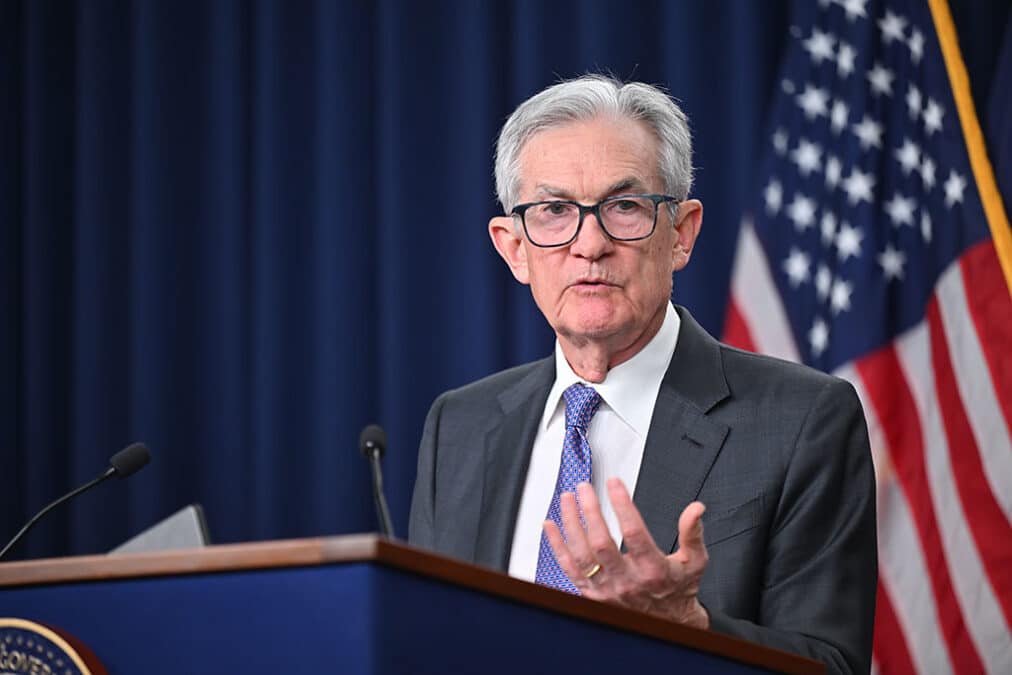
Federal Reserve Chair Jerome Powell told a roomful of Harvard economics students Monday morning that the Fed is watching the $3 trillion private credit market “super carefully” — while making clear he sees no reason to raise interest rates in response to the oil shock triggered by the Iran war.
The remarks, delivered during a guest appearance in Harvard’s introductory macroeconomics class, amounted to Powell’s most detailed public comments on two of the biggest risks facing the U.S. economy: an energy-driven inflation spike and the possibility that stress in unregulated lending markets could spill into the broader financial system. Bond markets responded immediately. Treasury yields dropped 10 basis points across the curve.
Powell Tells Markets: We Are Not Hiking Rates
Going into Monday, traders had priced in a better than 50% chance of a quarter-point rate hike at the Fed’s next meeting. By the time Powell finished speaking, those odds had collapsed to 2.2%.
The shift was driven by Powell’s explicit framing of the oil shock as temporary. “Energy shocks have tended to come and go pretty quickly,” he told the class, according to CNBC. “By the time the effects of tightening in monetary policy take effect, the oil price shock is probably long gone.”
Translation: the Fed plans to sit tight. The federal funds rate stays at 3.50%-3.75%, where it has been since the March 18 meeting. Powell described this as “a good place” to wait while the Iran conflict, tariff impacts, and labor market signals play out simultaneously.
But he was careful not to rule anything out entirely. “There’s sort of downside risk to the labor market, which suggests keep rates low, but there’s upside risk to inflation, which suggests maybe don’t keep rates low,” Powell said, per Bloomberg. He called the current environment one of genuine “tension” between the Fed’s dual mandates of price stability and maximum employment — and said he welcomed the recent string of dissents among Fed members rather than viewing them as dysfunction.
The Inflation Picture: Anchored, but Barely
Powell’s central message on inflation was reassurance with a caveat. He said inflation expectations “appear to be well anchored beyond the short term,” but stressed that the Fed needs to keep monitoring them closely because five consecutive years of above-target inflation have eroded the central bank’s margin for error.
The numbers paint a complicated picture. Brent crude traded around $114 per barrel Monday, up 51% for the month. WTI hovered near $100.50. U.S. gasoline has hit $4 per gallon nationally. The PCE price index — the Fed’s preferred inflation gauge — stood at 2.9% as of the latest reading, well above the 2% target that has been missed since March 2021.
Powell’s instinct, clearly, is to “look through” the energy shock the way the Fed has historically treated supply-driven price spikes. He told students that “the tendency is to look through any kind of a supply shock” but added what he called “a critical, essential aspect” — the Fed has to watch whether short-term energy price spikes begin to shift people’s expectations about future inflation. Once expectations become unanchored, the temporary becomes permanent. That is the scenario that would force the Fed’s hand.
According to a St. Louis Fed analysis published this month, the conflict between the Fed’s two mandates has rarely been this acute. Unemployment has crept up to 4.3%, hiring has slowed to an estimated 67,000 jobs per month, yet inflation remains stubbornly elevated. Classical monetary policy offers no clean answer to this combination.
Private Credit: “Watching It Super Carefully”
The private credit comments may have been buried in the student Q&A portion of the event, but they carried significant weight for financial markets. Powell said the Fed is monitoring the $3 trillion private credit sector closely and is in “regular contact with industry participants and investors.” He described private credit as a “relatively small part of a very large asset pool” — a characterization that downplayed systemic risk while acknowledging the Fed is paying attention.
The context matters. Bloomberg reported last week that private credit is facing mounting stress. The U.S. Private Credit Default Rate hit 5.8% in early 2026, with Morgan Stanley warning it could spike toward 8%. Fitch Ratings found that distressed exchanges accounted for 94% of all private credit downgrades in the past twelve months. Several major funds have already capped redemptions — Ares Strategic Income Fund limited withdrawals after investors tried to pull 11.6% of shares, Apollo enforced a 5% cap, and Blackstone’s $48 billion BCRED posted its first monthly loss since 2022.
The Financial Stability Oversight Council, led by Treasury Secretary Scott Bessent, voted in late March to publish new guidance on nonbank financial company oversight. The next major flashpoint is June 30, when business development companies and private credit funds file semiannual reports and must mark holdings to fair value. That reporting cycle will provide the first real transparency into the extent of losses across the sector.
Powell’s tone was deliberately measured. He did not raise alarms, but he did not dismiss the risks either. For an institution that has been criticized for being slow to recognize systemic buildups in 2007 and again in 2019’s repo market crisis, the Fed chair’s choice to specifically name private credit as something he is watching “super carefully” tells you more than his words might suggest on their own.
What Powell Did Not Say Is Just as Important
Powell sidestepped several questions that would have generated even bigger headlines. He avoided commenting on the policy inclinations of Kevin Warsh, his designated successor whose Senate confirmation is being held up while U.S. Attorney Jeanine Pirro continues an investigation into renovations at Fed headquarters. He declined to speculate on the longer-term direction of rates beyond his remaining tenure, which ends May 15 with only one more policy meeting before then.
He also pushed back on a student’s question about pandemic-era inflation, rejecting the monetarist argument that money supply expansion was the primary driver. “Monetary quantities are a very challenging way to try to think about inflation,” he said, attributing the 2021-2023 price surge to “red hot demand” colliding with constrained supply — a framing that puts distance between the Fed and the fiscal policy decisions made by both the Trump and Biden administrations.
Market Reaction: Bonds Rally, Rate Hike Odds Collapse
Financial markets moved decisively on Powell’s remarks. The 2-year Treasury yield dropped 10 basis points to 3.83%. The 5-year fell to 3.97%. The benchmark 10-year Treasury declined to 4.33%, also down 10 basis points. These are significant moves for a single speech, particularly one delivered to an undergraduate economics class rather than a formal policy venue.
The bond market’s message is clear: traders believe Powell just took a rate hike off the table for the remainder of his tenure. With only one FOMC meeting left before May 15 and rate hike odds at 2.2%, the most likely outcome is that Powell exits with rates exactly where they are.
For equity investors, the dovish hold is mixed news. Lower rates support valuations, but they also signal the Fed is worried enough about the labor market and growth outlook that it is willing to tolerate above-target inflation rather than risk a contraction. That is not the all-clear signal equity bulls want to hear — it is the Fed choosing the lesser of two bad options.
The Bigger Picture: Powell’s Last Stand
Monday’s Harvard speech was almost certainly one of Jerome Powell’s final public appearances as Fed chair. He has led the central bank through COVID, the worst inflation in four decades, the fastest rate hiking cycle since the 1980s, and now an oil shock driven by a Middle East war. His legacy will be debated for years.
What he left behind at Harvard, though, was a clear framework for how he thinks the Fed should handle the current moment: hold rates, monitor expectations, look through the energy shock unless it proves persistent, and keep an eye on private credit without overreacting. Whether his successor follows that playbook is an entirely different question — and one that markets will begin pricing in the moment the Senate confirms Kevin Warsh.
The Fed’s next policy meeting is in late April. By then, we will know whether the oil shock is abating or intensifying, whether private credit stress is contained or spreading, and whether inflation expectations have held their anchor or begun to drift. Powell has told us what he would do. What his successor will do remains one of the most consequential open questions in global finance.
This is a developing story. Updated: March 30, 2026, 12:15 PM ET.