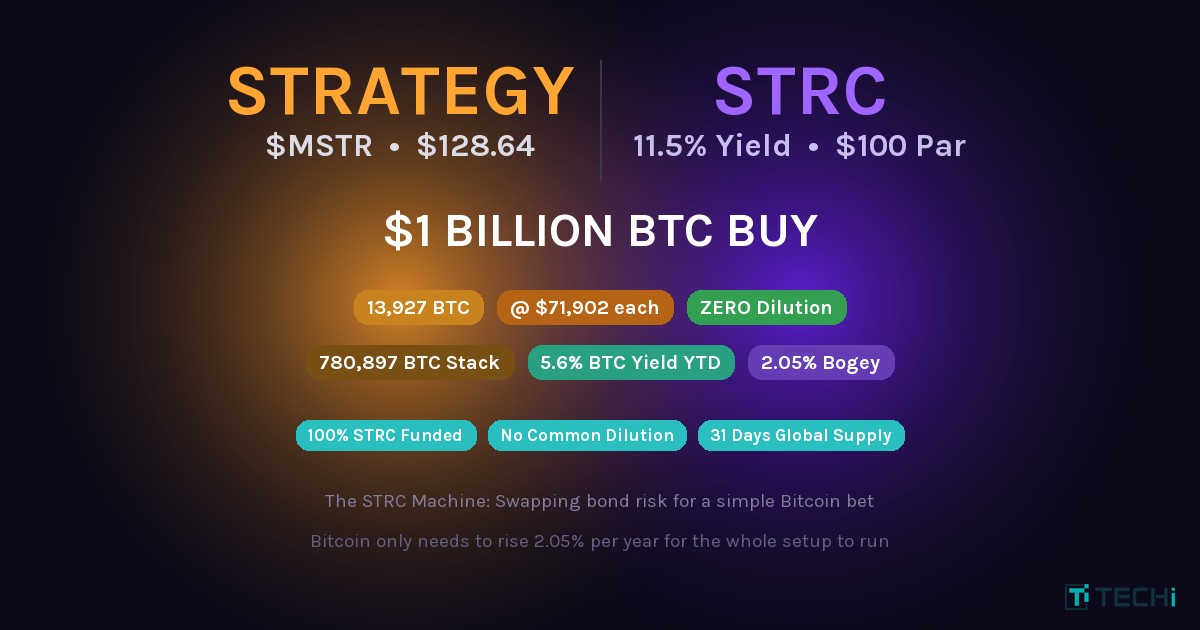
Michael Saylor’s Strategy (formerly MicroStrategy) just executed a $1.00 billion Bitcoin purchase, acquiring 13,927 BTC at an average price of approximately $71,902 per coin. The entire buy was funded by STRC, the company’s Variable Rate Series A Perpetual Stretch Preferred Stock. Zero common MSTR shares were issued. Not one share of dilution for existing equity holders.
That $1 billion represents roughly 31 days of the entire planet’s new Bitcoin supply, absorbed by a single corporate buyer in a single week. Strategy’s total stack now sits at 780,897 BTC, acquired at an average cost of approximately $75,577 per coin. The company’s BTC Yield for 2026 stands at 5.6%.
The STRC machine, as Saylor’s followers have dubbed it, is printing capital. And the mechanics behind it deserve a closer look.
Key Takeaways
- $1B Bitcoin Buy Strategy acquired 13,927 BTC at ~$71,902 each, entirely funded by STRC preferred stock with zero MSTR common share dilution.
- Total Stack Strategy now holds 780,897 BTC at an average cost of ~$75,577, making it the largest corporate Bitcoin treasury on earth.
- 2.05% Bogey Bitcoin only needs to appreciate 2.05% annually for the STRC dividend structure to sustain itself indefinitely, covering the 11.5% preferred yield.
- BTC Yield 5.6% Each MSTR common share represents 5.6% more Bitcoin than at the start of 2026, achieved without issuing any new common equity.
- Three Key Risks Single-asset balance sheet concentration, capital flow dependency for the accumulation engine, and panic-driven volatility below STRC par value.
Last updated: April 13, 2026 at 7:00 PM ET
How the STRC Machine Works
STRC is Strategy’s perpetual preferred stock, listed on Nasdaq at a $100 par value. It pays a variable annual dividend currently set at 11.5%, distributed monthly in cash. The dividend rate adjusts to encourage STRC to trade near its $100 par, which effectively strips away the wild price swings that MSTR common stock is known for.
The mechanism is elegant in its simplicity. When STRC trades at or above $100, Strategy sells new STRC shares through at-the-market offerings. Those proceeds go directly into buying Bitcoin. The preferred shareholders receive their 11.5% annual yield. The common MSTR shareholders see no dilution because no new common shares are created.
Since launching in July 2025, STRC has seen seven consecutive monthly dividend increases before holding steady at 11.5% for April 2026, the first month without an increase since inception. The monthly cash dividend of $0.9583 per share has been treated as a non-taxable return of capital for U.S. federal income tax purposes, adding a tax efficiency layer that makes STRC attractive to income-focused investors.
Saylor has essentially created a financial instrument that converts fixed-income demand into Bitcoin accumulation. Investors who want steady, high-yield cash flow buy STRC. Strategy takes that capital and buys Bitcoin. Everyone gets what they want without touching the common equity.
The $1 Billion Purchase: Breaking Down the Numbers
The latest acquisition of 13,927 BTC at $71,902 brings Strategy’s total holdings to 780,897 Bitcoin. At Bitcoin’s Friday close of $70,767, that stack is worth approximately $55.3 billion. The aggregate purchase cost across all acquisitions stands at roughly $59 billion, meaning the portfolio sits at a modest unrealized loss at current prices.
To contextualize the scale: Bitcoin miners produce approximately 450 new BTC per day (post-halving block reward of 3.125 BTC per block, roughly 144 blocks daily). Strategy’s 13,927 BTC purchase represents about 31 days of total global mining output. One company, in one week, absorbed a month of the world’s new Bitcoin supply.
MSTR common stock closed at $128.64 on Friday, April 10. The stock has become a leveraged proxy for Bitcoin, amplifying both upside moves and drawdowns. According to Strategy’s official purchase tracker, the company has made dozens of acquisitions since its initial Bitcoin purchase in August 2020, systematically building the largest corporate Bitcoin treasury on earth.
Saylor’s 2.05% Magic Bogey
The math behind the STRC structure reveals why Saylor is so confident. Bitcoin only needs to appreciate approximately 2.05% per year for the entire setup to sustain itself indefinitely.
STRC pays an 11.5% variable dividend. That sounds expensive. But Strategy holds 780,897 BTC against the preferred stock obligations. If Bitcoin grows at even a modest 2% compound annual rate, the appreciation in the Bitcoin treasury generates more than enough value to cover the STRC dividend payments. The excess value accrues to common MSTR shareholders, who bear zero dilution from the preferred stock issuance.
Put differently: Saylor is swapping traditional bond risk for a straightforward bet on Bitcoin. Instead of paying fixed coupons on corporate debt (which must be paid regardless of asset performance), he is paying variable dividends on preferred stock backed by an asset he believes will appreciate faster than 2% annually over the long term. If Bitcoin’s 15-year CAGR of roughly 80% is any guide, 2.05% is a remarkably low bar to clear.
The CoinDesk analysis of this dynamic concluded that Strategy has effectively engineered a perpetual Bitcoin accumulation engine: modest Bitcoin growth equals high yields for preferred holders and dilution protection for everyone else.
The STRC Risk Profile: What Can Go Wrong
STRC is not risk-free. Saylor has traded away conventional bond risks in exchange for three specific, concentrated risks that investors must understand before buying.
Risk 1: Single-Asset Balance Sheet Dependency
Everything about STRC depends on Strategy’s Bitcoin holdings and financial health. The company is, for all practical purposes, a publicly traded Bitcoin fund with a software business attached. If Bitcoin enters a prolonged bear market and drops 50-70% from current levels, the value backing STRC’s dividend obligations deteriorates rapidly. Unlike a diversified corporate balance sheet, there is no revenue from other business lines large enough to cover the preferred dividends independently. The original MicroStrategy software business generates approximately $475 million in annual revenue, a fraction of what would be needed to service the preferred stock at scale.
Risk 2: Cash Flow Dependency on New Capital
The STRC machine works best when new investor capital keeps flowing in. Strategy raises money by selling STRC shares at the $100 par value and deploys those proceeds into Bitcoin. If demand for STRC dries up, perhaps because broader market sentiment shifts against yield products or Bitcoin, the capital engine stalls. Strategy could still pay existing dividends from cash reserves or software revenue, but the Bitcoin accumulation flywheel would slow dramatically.
Risk 3: Panic-Driven Volatility
STRC is designed to trade near $100 through its variable dividend mechanism. In theory, the dividend adjusts to keep the price anchored. In practice, investor fear can overwhelm any yield-based anchor. During periods of acute market stress, STRC has traded as low as $85-95, creating opportunities for value buyers but generating paper losses and anxiety for holders who need price stability. The preferred stock is less volatile than MSTR common, but it is not a bond. It carries equity-like risk in tail scenarios.
What This Means for MSTR Common Shareholders
For holders of MSTR common stock, the STRC mechanism is arguably the most shareholder-friendly capital markets innovation in corporate Bitcoin history. Every dollar raised through STRC adds Bitcoin to the treasury without increasing the common share count. The Bitcoin-per-share metric, which Saylor has rebranded as “BTC Yield,” increases with every STRC-funded purchase.
The 5.6% BTC Yield year-to-date means that each MSTR share now represents 5.6% more Bitcoin than it did on January 1, 2026. That accretion happens without common shareholders contributing a single additional dollar. In traditional finance terms, it functions like a stock buyback funded by preferred equity issuance, except instead of reducing share count, it increases the Bitcoin backing per share.
MSTR at $128.64 trades at a significant premium to its net asset value. The 780,897 BTC at $70,767 per coin equals roughly $55.3 billion in Bitcoin, against a market capitalization for the common stock of approximately $33.8 billion (based on roughly 263 million diluted shares). That implies the market is actually pricing MSTR at a discount to its Bitcoin holdings when accounting for the preferred stock and debt obligations. The exact NAV premium or discount depends on how you model the preferred stock liabilities and the software business value.
The Bigger Picture: Corporate Treasury Revolution
Strategy’s STRC model is being studied by corporate treasurers and capital markets teams across every major industry. The idea that a company can raise capital through a preferred instrument, deploy it into Bitcoin, and generate enough return to cover the preferred dividend while accreting value to common equity is a powerful concept that challenges conventional corporate finance assumptions.
Critics call it a Ponzi-adjacent structure that requires perpetual new capital. Supporters call it the most efficient Bitcoin accumulation vehicle ever designed. The truth likely sits between those extremes: STRC is a genuinely innovative financial instrument that works spectacularly well in a rising or stable Bitcoin environment and faces real stress in a prolonged downturn.
With 780,897 BTC and counting, Saylor has put $59 billion behind his conviction. The STRC machine appears nowhere close to finished. The question is whether Bitcoin’s next move validates or punishes the largest corporate bet in the history of digital assets.
What is STRC?
STRC is Strategy’s (formerly MicroStrategy) Variable Rate Series A Perpetual Stretch Preferred Stock, listed on Nasdaq at a $100 par value. It pays a variable annual dividend currently set at 11.5%, distributed monthly in cash. Proceeds from STRC sales fund Bitcoin purchases without diluting MSTR common shares.
How much Bitcoin did Strategy buy with STRC?
Strategy purchased 13,927 BTC at approximately $71,902 each for a total of $1.00 billion. The purchase was 100% funded by STRC preferred stock issuance with zero MSTR common share dilution. This brought Strategy’s total holdings to 780,897 BTC.
What is Strategy’s BTC Yield?
BTC Yield measures how much additional Bitcoin each MSTR common share represents over time. The 2026 year-to-date BTC Yield is 5.6%, meaning each share represents 5.6% more Bitcoin than at the start of the year, achieved without issuing new common shares.
Why does Saylor say Bitcoin only needs to grow 2.05% per year?
STRC pays an 11.5% annual dividend, but it’s backed by Strategy’s massive 780,897 BTC treasury. If Bitcoin appreciates just 2.05% annually, the increase in Bitcoin value covers the preferred dividend obligations. Any growth above 2.05% accrues as excess value to MSTR common shareholders.
What are the main risks of STRC?
Three primary risks: (1) Balance sheet concentration — everything depends on Bitcoin’s price and Strategy’s financial health as a single-asset bet. (2) Capital flow dependency — the accumulation engine works best with steady new investor money. (3) Panic volatility — despite the dividend anchor, STRC can trade well below $100 during market stress events.
What is MSTR stock trading at?
MSTR closed at $128.64 on Friday, April 10, 2026. The stock functions as a leveraged Bitcoin proxy, amplifying both gains and losses relative to Bitcoin’s price movement. Strategy holds 780,897 BTC at an average cost of approximately $75,577 per coin.
Disclaimer: This article is for informational purposes only and does not constitute investment advice. TECHi and its authors may hold positions in securities mentioned. Always conduct your own research and consult a licensed financial advisor before making investment decisions.