Reviewed by Rana Umair Aslam, Finance Editor. This article is for informational purposes only and does not constitute investment advice. See the full disclaimer at the bottom of this article.
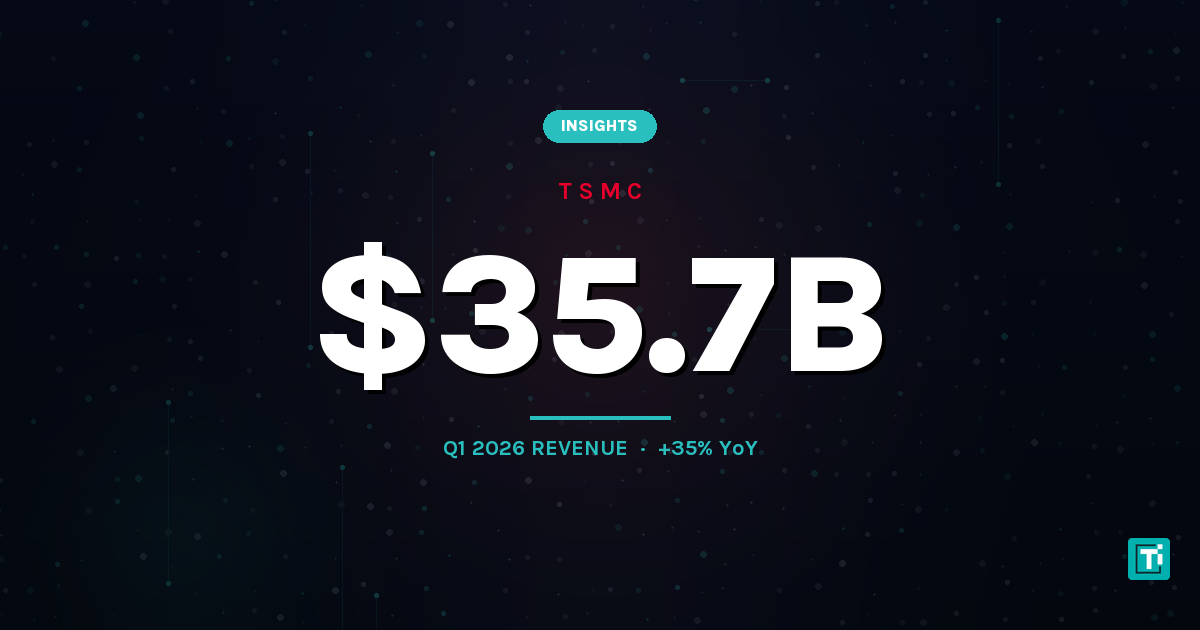
Taiwan Semiconductor Manufacturing Company reported March 2026 revenue of NT$415.19 billion on Friday — up 45.2% year over year and 30.7% from February — pushing Q1 2026 consolidated sales to NT$1,134.10 billion, roughly $35.71 billion at the current exchange rate. That is a 35.1% year-over-year jump in NT dollars, and it lands at the very top of the $34.6–$35.8 billion range TSMC guided in January.
In plain terms: the company that fabricates roughly nine out of every ten advanced AI accelerators on the planet just had its strongest March on record, beat the LSEG consensus estimate of NT$1.125 trillion, and did it before the full earnings call on Thursday, April 16. Taipei-listed shares climbed 2.3% on the news and are now up roughly 29% year to date, outpacing a benchmark TAIEX that has risen in the low-20% range over the same stretch.
Key Takeaways
- Q1 2026 revenue NT$1,134.10B (~$35.71B), up 35.1% YoY in NT dollars, landing at the high end of January guidance of $34.6–$35.8B.
- March 2026 alone NT$415.19B, up 45.2% YoY and 30.7% MoM — the strongest March on record for TSMC.
- Beat consensus Topped the LSEG consensus estimate of NT$1.125 trillion despite FX headwinds and smartphone seasonality.
- 2026 capex Record $52–56B guided, up ~30% from $40.9B spent in 2025 — the clearest signal of 2027–2028 demand visibility.
- What to watch Full Q1 call on Thursday, April 16 — Q2 guidance, margin detail, and any capex revision will move TSM and every semi equipment name tied to it.
Last updated: April 10, 2026 at 11:45 AM ET
The Headline Number and What It Actually Means
NT$1,134.10 billion is the number every analyst will type into a spreadsheet this morning. Converted at Friday’s USD/TWD rate of 31.73, that’s $35.71 billion in Q1 2026 revenue — a figure large enough that TSMC’s single-quarter sales now exceed the full-year 2019 revenue of either Intel’s foundry business or GlobalFoundries on its own.
The 35.1% year-over-year growth rate in NT dollars is the important context. Q1 2025 revenue was NT$839.25 billion, so the absolute delta is almost NT$295 billion of fresh quarterly sales — created in twelve months, during a period when most of the semiconductor industry outside of AI was flat or contracting. Memory makers had a rough year. Analog and power-chip specialists had a rough year. TSMC just added the equivalent of a mid-cap foundry’s entire annual revenue to its quarterly run rate.
The March 2026 single-month revenue of NT$415.19 billion is the more interesting data point for anyone tracking demand velocity. A 30.7% month-over-month jump off of February — a short month, granted — is an unusual reading for a company this size, and the 45.2% year-over-year print on the same month suggests the Q2 ramp is already underway.
Why This Report Is Different From the Last Few
TSMC has been hitting or exceeding its own revenue guidance consistently through the AI cycle, so another in-range print on its own isn’t the story. What makes the Q1 2026 release noteworthy is the composition.
First, the company guided Q1 revenue to $34.6–$35.8 billion back in January and flagged two known headwinds: a smartphone seasonality drag that typically pulls Q1 down 10–15% from Q4, and a stronger Taiwan dollar that would mechanically hurt the USD conversion. Both happened. TSMC landed at the top of the range anyway, which means the underlying order book for AI accelerators was strong enough to offset both drags simultaneously. That’s a very different operating environment than the one investors were bracing for.
Second, March 2026 is the first monthly print to reflect the N2 (2-nanometer) ramp in any meaningful way. TSMC began volume production of N2 in the second half of 2025, with wafer starts accelerating through late 2025 and into early 2026. Analyst channel checks from Nikkei Asia suggested N2 output would step up sharply in March — the 45.2% year-over-year monthly growth rate is consistent with that thesis.
Third, and easiest to overlook: TSMC is posting this growth while absorbing tariff uncertainty. The February tariff headlines targeting semiconductor imports from Taiwan created a short-lived panic in the group, and TSMC’s Taipei shares briefly dropped 8% on the news. Friday’s report effectively rebuts the thesis that customers were pulling orders forward or hedging against the policy risk. The demand is real, not pulled.
The AI Customer Concentration Question
Every TSMC earnings cycle now comes with the same question from the buy-side: how much of this is Nvidia? The honest answer, based on recent disclosures and sell-side estimates, is “a lot and growing.” HPC — TSMC’s category for data-center AI silicon — has been the largest platform by revenue for several quarters and accounted for the majority of sales in Q3 and Q4 of 2025. Sell-side analysts have estimated Nvidia alone contributes roughly 22–25% of TSMC’s total sales at current run rates — a level of single-customer concentration that would make the risk committee of any smaller foundry nervous.
Friday’s monthly number doesn’t break out customer mix, but the magnitude of the March beat strongly suggests HPC continued to grow as a percentage of the total. Smartphone and automotive are both in seasonally weak windows. The only end market likely to have grown sequentially in March is data-center AI.
That’s both the bull case and the bear case wrapped into a single data point. If the Blackwell and upcoming Rubin cycle continues to accelerate — and NVDA closed at $183.91 on Thursday with GTC 2026 fresh in investors’ minds — TSMC’s revenue growth stays elevated. If hyperscaler capex discipline finally arrives, the same concentration becomes a liability. There is not much comfortable middle ground.
The $52–56 Billion Capex Tell
The clearest signal TSMC management has given about 2026 demand isn’t in the revenue line — it’s in the capex number. Back in January, the company guided 2026 capital expenditures to $52–56 billion, a record and a roughly 30% jump from the $40.9 billion spent in 2025. That spend is going into three places: the N2 volume ramp in Taiwan, the A16 node (TSMC’s first to combine gate-all-around transistors with backside power delivery, with volume production scheduled for the second half of 2026), and the Arizona Fab 21 build-out supporting US production for major customers.
A foundry doesn’t spend that much money unless its customers have already signed the wafer supply agreements to fill the capacity. Capex of this magnitude implies TSMC has visibility on 2027–2028 demand that is materially higher than 2026. That visibility is almost entirely a function of the AI accelerator roadmap — specifically the Nvidia Rubin generation, AMD’s MI400 series on N2, and the custom silicon that Google, Amazon, and Meta are all fabricating on TSMC’s leading edge.
The January guidance also included Q1 2026 gross margin of 63–65% and operating margin of 54–56%. Those are the highest forward margins TSMC has ever guided. For a business that prints over NT$4 trillion in annual revenue, a one-point beat on gross margin is billions of dollars of incremental operating income. Analysts will be watching the April 16 call for confirmation that the N2 ramp isn’t eroding those margins — it’s the one thing that could derail the narrative.
How the Stock Is Reacting
TSMC’s Taipei-listed shares opened stronger and closed 2.3% higher, hitting an intraday high of TWD 2,000, extending a year-to-date gain of roughly 29% that has outpaced the benchmark TAIEX. The New York-listed ADR (ticker TSM) closed at $365.49 on Thursday ahead of the monthly release — and it has been one of the better-performing mega-cap semi names of 2026 alongside Broadcom and Nvidia.
The ADR trades at roughly 24x forward earnings, which is a discount to the S&P 500 average once growth is factored in. That compression is the interesting set-up heading into the April 16 call. If management reiterates the $52–56 billion capex plan and holds or lifts the “close to 30%” full-year 2026 USD revenue growth target, the multiple has room to re-rate. If management softens capex or flags order-timing concerns, the concentrated AI exposure cuts the other way. There isn’t much room for a middle scenario.
For a deeper fundamental breakdown, see our full TSMC stock analysis covering the 2026 growth drivers, margin trajectory, and valuation framework.
What Customers Are Saying (Indirectly)
Apple is TSMC’s largest single customer by revenue and is widely reported to be the lead partner for N2, with the A20 Pro expected to debut in the iPhone 18 lineup in fall 2026 as the first Apple silicon built on the node. The M-series Mac chips are expected to transition to N2 on a similar timeline. AMD has publicly pointed to its MI400 series AI accelerator as the N2 part in its roadmap, with the earlier MI350 continuing on N3-family process technology. Other mobile and HPC customers have committed to N2 for products launching into 2027. Each of those commitments translates into wafer volume TSMC has already booked.
Nvidia is the variable. Blackwell Ultra ships on N3-family process technology, and Rubin is expected to move the highest-volume AI accelerator on the market to TSMC’s most advanced node. Nvidia management has repeatedly described the Rubin ramp as aggressive, and the company’s stated roadmap calls for an annual cadence of new architectures — a pace that assumes TSMC can deliver matching wafer capacity.
TSMC’s answer has been to keep pulling capacity in: the Kaohsiung N2 fab cluster, the A16 volume ramp in H2 2026, and the Arizona Fab 21 expansion. Friday’s revenue number is the first evidence that the acceleration is translating into real dollars, not just press releases.
What to Watch on Thursday, April 16
TSMC will host its full Q1 2026 earnings call at 14:00 Taipei time on Thursday, April 16 (02:00 ET). The preliminary revenue number is in hand — the April 16 call is about the numbers that actually move the stock:
- Q2 2026 revenue guidance. Consensus is currently in the $37–38 billion area. Anything above the top of that range would imply HPC is still accelerating into Q2. Anything noticeably below it would be read as a warning flag on trajectory.
- Full-year 2026 revenue growth. Management guided “close to 30% in USD terms” in January. Holding or raising that number would confirm the AI cycle has another leg. Walking it back — even by a couple of percentage points — would be the most important negative surprise of the call.
- 2026 capex reiteration. The $52–56 billion range is the single most important number in the entire semiconductor food chain. If it moves up, every equipment maker from ASML to Applied Materials benefits. If it moves down, that’s the signal to start worrying.
The call will also include commentary on N2 yields, which is the operational detail most likely to affect margins. N2 is TSMC’s first node using gate-all-around (GAA) transistor architecture, a fundamental change from the FinFET design used for N5, N4, and N3. Yield ramps on architecture transitions are historically slower than straight node shrinks, and the first few quarters of N2 volume are the period where margin surprises tend to show up. Management has been confident in public. The April 16 commentary will be a test of that confidence.
The Editorial Take
Friday’s monthly number is a quiet one in the sense that TSMC didn’t hold a press conference or move the stock 10%. It’s a loud one in the sense that every assumption about the 2026 AI capex cycle — the one thing tying together every semiconductor and hyperscaler thesis on the market — just got validated in hard currency.
The consensus narrative for 2026 was that AI-driven growth would moderate from the torrid pace of 2024 and settle into a more sustainable band. In USD terms, TSMC’s Q1 2026 growth is roughly in line with Q1 2025 rather than materially decelerating — the FX-adjusted story is more “steady” than “slowing.” The question the April 16 call needs to answer is whether the trajectory holds at current levels through the rest of 2026 or whether Q2 and Q3 step up further as N2 volume fills more of the mix. That is a $30+ stock move either direction for TSM.
The one thing that’s clear from the monthly number alone: there is no demand collapse. Whatever happens to tariffs, whatever happens to the Taiwan-China relationship, whatever happens to individual customers — the AI training-to-inference pipeline is still pulling more wafers off TSMC’s leading edge every month than it did the month before. That’s a fact, not a forecast. The rest is interpretation.
How much revenue did TSMC report for Q1 2026?
TSMC reported Q1 2026 consolidated revenue of NT$1,134.10 billion, roughly $35.71 billion at current exchange rates. That represents 35.1% year-over-year growth in NT dollars and lands at the high end of the $34.6 billion to $35.8 billion guidance range the company issued in January 2026.
What was special about March 2026 for TSMC?
March 2026 single-month revenue of NT$415.19 billion was the highest March in TSMC’s history, up 45.2% year over year and 30.7% sequentially from February. The jump reflects the continued ramp of N2 (2-nanometer) production and accelerating AI accelerator orders from customers including Nvidia, AMD, and Apple.
Did TSMC beat analyst estimates for Q1 2026?
Yes. TSMC beat the LSEG consensus estimate of NT$1.125 trillion. The beat came despite two known headwinds: seasonal smartphone weakness in Q1 and a stronger Taiwan dollar that mechanically reduced USD-equivalent revenue.
What is TSMC’s 2026 capital expenditure guidance?
TSMC guided 2026 capex to $52 billion to $56 billion on its January earnings call, a record level and a roughly 30% increase from the $40.9 billion spent in 2025. The spend is concentrated on N2 volume ramp in Taiwan, the A16 node ramp scheduled for the second half of 2026, and the Arizona Fab 21 build-out supporting US production.
When is TSMC’s full Q1 2026 earnings call?
TSMC will hold its full Q1 2026 earnings conference call on Thursday, April 16, 2026 at 14:00 Taipei time (02:00 ET). That call will include margin detail, Q2 guidance, full-year 2026 outlook, and any updates to the $52 to $56 billion capex plan.
How is TSMC stock performing in 2026?
TSMC’s Taipei-listed shares are up roughly 29% year to date through April 10, 2026, outpacing the benchmark TAIEX. The New York-listed ADR (ticker TSM) closed at $365.49 on Thursday ahead of the monthly release and trades at roughly 24x forward earnings, a discount to the S&P 500 average once growth is factored in.
Sources: Q1 2026 consolidated revenue and March monthly figures from TSMC’s investor relations disclosures. Analyst estimates via LSEG. Additional market context from CNBC Technology, Nikkei Asia Semiconductors, and Yahoo Finance. Historical filings available via the SEC EDGAR database.
Disclaimer: This article is for informational purposes only and does not constitute investment advice. TECHi and its authors may hold positions in securities mentioned. Always conduct your own research and consult a licensed financial advisor before making investment decisions.