

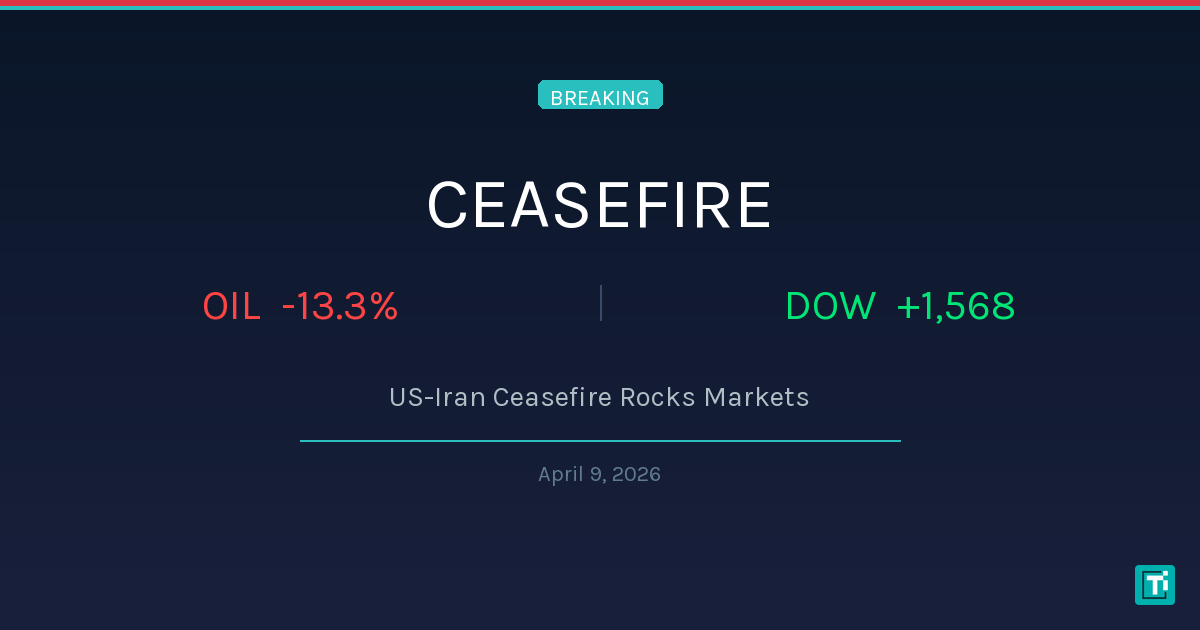
The Dow Jones Industrial Average surged 1,568 points on April 8, its best single-day performance since April 2025. Brent crude collapsed 13.3% in the same session. Gold pushed above $4,768 per ounce. All because a two-week ceasefire between the United States and Iran, brokered by Pakistani Prime Minister Shehbaz Sharif with less than two hours to spare before Trump’s own military deadline, briefly convinced Wall Street that the 40-day war might actually end.
The numbers tell a clear story: this is a relief rally, not a resolution rally. Airlines that gapped up 13% at the open sold off to close up just 3-5%. Defense contractors barely budged. And physical oil markets remain disconnected from futures, with spot Brent still above $120 while futures settled near $95. The ceasefire is real, but the market’s body language suggests deep skepticism about whether it holds past the April 22 expiration.
Key Takeaways
Last updated: April 9, 2026 at 10:30 AM ET
The Ceasefire Deal: What Actually Happened
Trump announced the ceasefire on Truth Social on April 7 at approximately 6:00 PM ET, less than two hours before his self-imposed 8:00 PM deadline for Iran to reopen the Strait of Hormuz or face what he called “devastating attacks on civilian infrastructure.” Iran’s Foreign Minister confirmed acceptance the same evening.
The deal, formally dubbed the “Islamabad Accord” framework, carries three critical provisions. First, Iran agreed to allow safe passage through the Strait of Hormuz for the ceasefire’s duration, though Iran’s Foreign Minister qualified this by stating passage would require “coordination with Iran’s Armed Forces.” Second, the ceasefire lasts exactly two weeks, expiring April 22. Third, delegations from both nations are scheduled to begin peace talks in Islamabad on April 10 under Pakistani mediation.
The complications started immediately. Israeli Prime Minister Benjamin Netanyahu declared the ceasefire does not apply to Lebanon operations and launched Operation Eternal Darkness against Hezbollah, striking command and control centers across southern Lebanon, Beirut, and the Beqaa Valley. Iran threatened to attack Israel if the Lebanon strikes did not stop. Pakistan, as mediator, insists Lebanon is covered by the ceasefire. The White House sided with Israel’s interpretation.
This three-way disagreement over the ceasefire’s scope is exactly why the market’s reaction on April 8 told two different stories depending on when you checked the tape.
Market Reaction: The Biggest Rally in a Year
The headline numbers are staggering. The Dow Jones Industrial Average closed at 47,909.92, gaining 1,568 points or 3.38% in a single session. The S&P 500 climbed 2.51% to 6,782.81, adding $165.96 points. The Nasdaq Composite rose 2.80% to 22,634.99, a gain of 617 points.
JPMorgan’s trading desk captured the mood in a note to clients: “Assuming that this is not a feint from any of the parties, the market is likely to treat this as a de facto end of the conflict despite the economic damage that is still coming across all regions.”
That qualifying phrase, “assuming this is not a feint,” matters more than the bullish headline. Evercore’s vice chairman Krishna Guha struck a more cautious tone: “We are not out of the woods yet. The ceasefire could fall apart. There will still be an initial inflation shock.”
For context, the S&P 500 is still down significantly from its pre-war highs. This single-day surge recovered a fraction of the damage from 40 days of conflict. Investors who sold during the initial panic in late February are not made whole by one green day.
Oil’s Biggest Single-Day Drop Since April 2020
WTI crude futures plunged 16.4% to $94.41 per barrel on the ceasefire announcement, the largest single-session decline since the pandemic demand collapse of April 2020. Brent crude dropped 13.3% to $94.75. By April 9, WTI had recovered slightly to $99.42 and Brent to $98.52 as traders reassessed the supply picture.
The recovery matters. Oil was trading around $67-70 per barrel before the war began in late February 2026. Even after the ceasefire crash, prices remain roughly 40% above pre-conflict levels. Iran’s agreement to reopen the Strait of Hormuz theoretically removes the supply chokepoint that drove crude from $70 to $125 in six weeks. But physically moving oil through the Strait requires logistics, insurance, and trust that takes days to rebuild.
This is why spot Brent crude remained above $120 on April 8, even as futures settled near $95. The physical oil market and the paper market are telling two different stories. Futures are pricing in peace. Spot markets are pricing in the reality that tanker captains need more than a Truth Social post to risk their ships in the Strait.
Airlines Gapped Up 13%, Then Reality Set In
No sector illustrates the market’s internal conflict better than airlines. Delta Air Lines opened at $73.00 on April 8, a gap up of 11.2% from its previous close of $65.62. American Airlines opened at $12.03, up 11.3% from $10.81. JetBlue gapped up similarly.
Then the selling started. Delta closed at $68.08, giving back more than two-thirds of its gains to finish up just 3.74%. American Airlines closed at $11.41, up 5.5% but well below its opening print. JetBlue settled at $5.04, barely above its prior close.
The morning gap reflected the obvious trade: cheaper jet fuel equals fatter margins equals higher stock prices. Airlines spent the first 40 days of the Iran conflict watching their fuel hedges deteriorate as crude screamed from $70 to $125. A ceasefire reversing even half that move would add hundreds of millions to their bottom lines.
The afternoon selloff reflected something harder to quantify: institutional skepticism. Fund managers who have watched the Middle East cycle through ceasefires, escalations, and broken promises for decades know that a two-week pause brokered under deadline pressure, immediately contested by Israel, and dependent on talks that haven’t started yet, is not the same as peace. The trade was to sell the opening gap, not hold through the uncertainty.
Gold Stays Elevated at $4,768 Despite De-Escalation
Gold futures climbed 2.39% to $4,768.20 per ounce on April 8, a counterintuitive move during a risk-on session. If markets genuinely believed the war was ending, gold should have sold off. Instead, it hit an intraday high near $4,886.
Three forces explain the gold-oil divergence. First, while the ceasefire addresses the immediate military conflict, it does nothing to resolve the inflation shock already baked into the economy. Oil spent six weeks above $100, and those costs are flowing through supply chains into consumer prices right now. The Cleveland Fed’s models show inflation potentially hitting 3.5% in April. Second, central bank gold buying, particularly from China and India, has not slowed despite the ceasefire. Third, the ceasefire’s fragility is itself a gold catalyst. If it collapses on April 22, the gold price could spike well above $5,000.
For investors who were long gold before the war, the ceasefire changes nothing about the structural thesis. For those considering an entry, the question is whether $4,768 gold with a two-week ceasefire is more or less attractive than $4,200 gold before the war started. The risk premium is real, and it is not leaving until a permanent deal is signed.
Defense Stocks: The War Premium Evaporates
Defense contractors were the only sector that moved against the broader rally. Lockheed Martin fell 0.25%, Northrop Grumman dropped 0.66%, and General Dynamics slipped 0.27%. These are modest declines compared to the gains elsewhere, but they reverse months of war-fueled outperformance.
Lockheed Martin had gained approximately 30% year-to-date heading into the ceasefire, powered by the expanded defense spending that accompanies active military operations. Raytheon (RTX) had fired more than 850 Tomahawk missiles during the 40-day conflict, and restocking contracts will generate revenue regardless of whether the ceasefire holds.
The proposed $1.5 trillion US defense budget for 2027 provides a floor for the sector. But the easy money in defense trades is gone for now. The market is repricing these stocks from “active war” multiples back toward “elevated geopolitical tension” multiples, a meaningful haircut.
The 2-Week Window: What Investors Should Watch
The Islamabad peace talks begin April 10. Both sides are working from different frameworks: Iran brought a 10-point plan, the US has a 15-point plan. The gap between these positions will determine whether the ceasefire extends or collapses.
Four specific triggers could break the ceasefire before April 22:
- Israel-Lebanon escalation. If Israel’s Operation Eternal Darkness provokes an Iranian response, the ceasefire’s scope becomes irrelevant. Iran has already threatened retaliation if Lebanon strikes continue.
- Strait of Hormuz incidents. Iran agreed to safe passage under military coordination. A single incident involving a tanker, whether deliberate or accidental, could unravel the entire agreement.
- Domestic political pressure. Both Trump and Iranian leadership face hardliners who view the ceasefire as weakness. Any public pressure from within either government could lead to posturing that escalates back into conflict.
- Islamabad talks failure. If the first round of negotiations stall, markets will begin pricing in the ceasefire’s expiration well before April 22, likely starting around April 16-17.
How to Position: The Asymmetric Risk
The ceasefire creates an unusual asymmetric setup. If it holds and extends into a permanent deal, equities have significant room to recover toward pre-war levels. The S&P 500 was trading above 6,900 before the conflict. Oil would likely settle in the $75-85 range, boosting consumer discretionary and airline margins. Gold would correct 10-15%.
If the ceasefire collapses, the downside is steeper than the upside from peace. Oil would likely retest $120+ within days. The stock market would give back all of April 8’s gains and then some, as the war narrative shifts from “temporary conflict” to “intractable quagmire.” Gold would push toward $5,000+.
This is not a market to chase. The traders who bought the open on April 8 and sold by noon made money. The traders who bought at the close, hoping the rally continues, are now exposed to binary event risk on a two-week timer. Portfolio managers should be reducing position sizes, not adding, until the Islamabad talks produce something concrete.
The Bigger Picture: Inflation Doesn’t Pause for Ceasefires
Even the most optimistic ceasefire scenario does not fix the damage already inflicted on the global economy. Six weeks of oil above $100 have pushed transportation costs, manufacturing inputs, and energy bills higher across every sector. Those costs are working through supply chains right now and will show up in inflation data for months.
The Federal Reserve held rates at 3.5-3.75% at its March meeting, but a top Fed official has publicly said a rate hike could be appropriate if inflation stays above 2%. With the Cleveland Fed’s models showing inflation at 3.5% in April, the ceasefire actually complicates the rate outlook. If oil stays near $100 despite the truce, the inflationary impact persists. If oil crashes back to $75 on a permanent peace deal, the Fed gets breathing room, but Wells Fargo has already scrapped its forecast for any 2026 rate cuts.
For a deeper analysis of the Iran-Hormuz confrontation that preceded this ceasefire, including the timeline of Trump’s ultimatums and the oil supply mechanics, read our detailed breakdown published before the ceasefire announcement.
Disclaimer: This article is for informational purposes only and does not constitute investment advice. TECHi and its authors may hold positions in securities mentioned. Always conduct your own research and consult a licensed financial advisor before making investment decisions.
What caused the stock market rally on April 8, 2026?
A two-week ceasefire between the United States and Iran, brokered by Pakistani Prime Minister Shehbaz Sharif, triggered the rally. The Dow Jones surged 1,568 points (3.38%), the S&P 500 gained 2.51%, and the Nasdaq rose 2.80%. The ceasefire included Iran’s agreement to reopen the Strait of Hormuz for commercial shipping.
How much did oil prices drop after the US-Iran ceasefire?
WTI crude fell 16.4% to $94.41 per barrel on April 8, the biggest single-day decline since April 2020. Brent crude dropped 13.3% to $94.75. Prices partially recovered to $99.42 (WTI) and $98.52 (Brent) by April 9 as the market digested the fragile nature of the agreement.
Why did gold go up during the ceasefire rally?
Gold rose 2.39% to $4,768.20 because the ceasefire does not resolve the inflation shock from six weeks of elevated oil prices. Additionally, central bank buying remains strong, and the ceasefire’s two-week duration means geopolitical risk has not been eliminated. Gold is pricing in the possibility the truce collapses.
How long does the US-Iran ceasefire last?
The ceasefire lasts two weeks, expiring April 22, 2026. Peace talks are scheduled to begin in Islamabad, Pakistan on April 10 under Pakistani mediation. Both the US and Iran have submitted separate frameworks for negotiation, and extension depends on progress in those talks.
Should investors buy stocks after the ceasefire?
The ceasefire creates asymmetric risk. If it holds and extends into a permanent deal, equities could recover toward pre-war levels with the S&P 500 reclaiming 6,900+. If it collapses, markets would likely give back all gains and more. Portfolio managers should reduce position sizes rather than chase the rally until the Islamabad talks produce concrete results.
What happened to defense stocks during the ceasefire rally?
Defense stocks were the only sector that declined. Lockheed Martin fell 0.25%, Northrop Grumman dropped 0.66%, and General Dynamics slipped 0.27%. These stocks had gained roughly 30% year-to-date on war spending and are now repricing from active war multiples back toward elevated tension multiples.