Have you noticed how smart glasses are quietly moving to be the next hotshot in tech? If you’ve been keeping an ear to the ground in the world of wearables, you’ve probably heard whispers of something called Martha. It’s not a new AI assistant or secret messaging app. Google Martha seems to be the codename for its upcoming Android XR smart glasses, and if the rumors pan out, we might be on the verge of the most serious push into wearable AR/VR (or XR) since Google Glass tried to change the world over a decade ago. But before we get into what Martha might be, let’s rewind just a bit.
Google and the AR Smart Glasses Struggle 🔗
Let me take you back to when Google Glass tried to change the world, and completely flopped. Back in 2013, Google unveiled Glass, promising to give us our sci-fi superhero moment, turning everyday people into futuristic beings. But instead, most people just felt awkward wearing these glasses in public. Not really because the tech was bad, but because people weren’t ready for this kind of change.
Privacy concerns, limited functionality, and the most important, the price tag, all played a part in the downfall of Glass. But a tech giant like Google was never going to give up so easily. Over the years, it quietly kept working in the XR space. Acquisitions like North (the makers of Focals smart glasses) and years of ARCore development showed they weren’t done, just recalibrating. Now, fast forwarding to 2025, something’s brewing again. The codename Martha popped up in Google’s code repositories and developer notes, and hopefully, this time, it isn’t just another experiment.
To give a quick flashback, Martha didn’t come out of nowhere. Google’s been obsessed with smart wearables for years, but they have just been mostly quiet about it. Here’s the path Google’s been walking, mostly in shadows:
- 2013: Google Glass launches, dies publicly.
- 2019: They acquire North, makers of stylish AR glasses.
- 2022: A live demo shows AR glasses translating languages in real time.
- 2023: Google confirms it’s building Android XR in collaboration with Samsung and Qualcomm.
- 2024: The name Martha surfaces in XR build logs.
Each move was basically a tiptoe, but they all pointed in the same direction. Now, it finally feels like they are ready to show the world what they have been building in the dark for years.
Also Read: Meta Unveils AR Smart Glasses Hypernova
What is Martha? 🔗
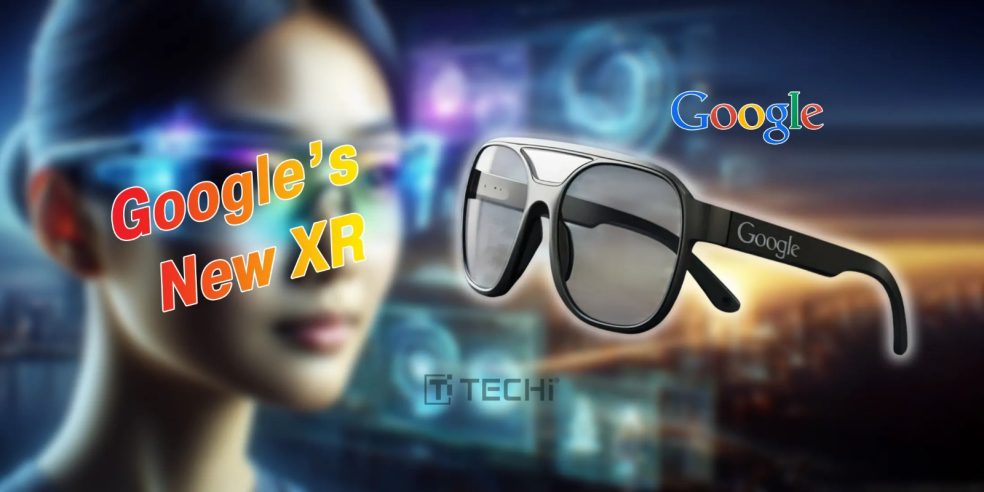
Martha’s more than a codename floating through developer forums; it’s a real piece of hardware. In 2025 at Google I/O, the company unveiled a low-key new prototype of its Android XR smart glasses. There was no drumroll, no flashy teaser, just a subtle peek at something quietly powerful. This device runs on the new Android XR platform. Developers have already seen it referenced in Google’s own companion app, similar to how you manage a Pixel Watch. That alone makes it clear, this ain’t a one-off test.
It contains a prism-style display on its right lens. There’s a small camera and microphone tucked in. A touchpad along the side that lets you activate Gemini, Google’s own AI brain, to handle things like live translation, notifications, and even record-your-view features, all baked directly into the glasses.
Is This About Beating Apple’s Vision Pro? 🔗
Apple unveiled its Vision Pro at the very beginning of 2024, and it made many headlines because of its improved eye-tracking system, sleek design, and luxury segmentation. It was designed at a launch price of approximately $3500 and was aimed at the developer, techies, and early adopters, and not the general consumer. Although technical in its excellence, it is also restricted by expense and its use of immersive, closed-world situations.
Google’s approach with Martha seems different. For one, it’s likely to be far more affordable; rumors suggest a sub-$1,000 range. And rather than being a full-on VR headset, Martha could lean more toward AR and pass-through mixed reality, meaning you’ll still see the world but with digital layers on top. Think notifications, maps, fitness tracking, translation, all projected into your field of view.
And Google isn’t trying to amaze us with cinematic trailers or futuristic promises, it’s actually building tools. The Android XR SDK is already live. Developers are encouraged to start building, and when Google gives developers the green light? It usually means the hardware isn’t far behind.
XR War Is Heating Up 🔗
Extended reality, covering AR, VR, and everything in between, is not just experimental anymore. As Statista has it, it is estimated that the world XR market will exceed $100.77 billion by 2026, which is an indication of how seriously space has been taken. Big-shot players like Meta, Apple, and Microsoft have already put their visions in a row and attempted to conceptualize what the future should be.
Whereas they have been making headlines, Google has been going behind the scenes. With Martha, we might be seeing their re-entry strategy. Not just a cool gadget, but an anchor device for an entire XR ecosystem built on Android. That could reshape how we think about wearables and who controls them. Remember, Android already dominates mobile. Extending it to wearables and spatial computing? That’s how you win the next platform war.
What can Martha do? 🔗
That’s still under wraps, but we can take some solid guesses about it. For example, you are walking downtown, and you say, Hey Google, where’s the nearest pharmacy?, Then, instead of taking out your phone, your glasses will show you a floating arrow on the street. Now you can be glancing at a menu written in French, and a second later, it will be auto-translated in your field of view. Then a call comes in, no buzz, no ringtone, just a soft pop-up at the edge of your view.
Now add Google Gemini into the mix, its most powerful AI yet. Suddenly, Martha isn’t just showing you things; she’s thinking alongside you. It helps you to summarize emails, breaking down content like a sidekick in your lenses. Even though these are all just generalizations from what we know about AR/VR tech, it still sounds pretty compelling.
Pixel for the Face? 🔗
If Martha becomes real hardware, it might act like a Pixel Glass, a reference device for Android XR. Just like Pixel phones show off what Android can really do, Martha could show developers how to build immersive, lightweight, smart experiences right on your face. The potential is huge, not just for productivity or navigation, because it also aims for fitness, live transcription, virtual meetings, games, and even accessibility tools.
Imagine glasses that read signs aloud for someone with low vision. Or live captioning for someone who has hearing loss. It’s not a small deal; it’s potentially life-changing for people who’ve been left out of tech’s progress.
But Can We Trust Google to Stick With It? 🔗
Google has a graveyard of abandoned ideas, including Stadia. Daydream VR. Google Allo. But this time feels different. Why? Because the world finally caught up. The hardware is cheaper. The chips are faster. The use cases are clearer. And AI has made spatial computing feel actually useful.
Final Thoughts 🔗
Martha is Google’s redemption arc. It’s also a well-timed move toward changing how we interact with technology in everyday life. With the rise of spatial computing, real-time AI assistance, and the growing demand for hands-free access to information, Martha could become a defining device of this new era.
Backed by Android XR and powered by Gemini, it’s not about chasing trends anymore; it’s about building tools that are essentially life-altering. If done right, Martha could be the beginning of something much bigger than a pair of glasses; it could be the first truly natural interface between humans and information.
Also Read: Apple AR Glasses: Release Date, Features, and Challenges