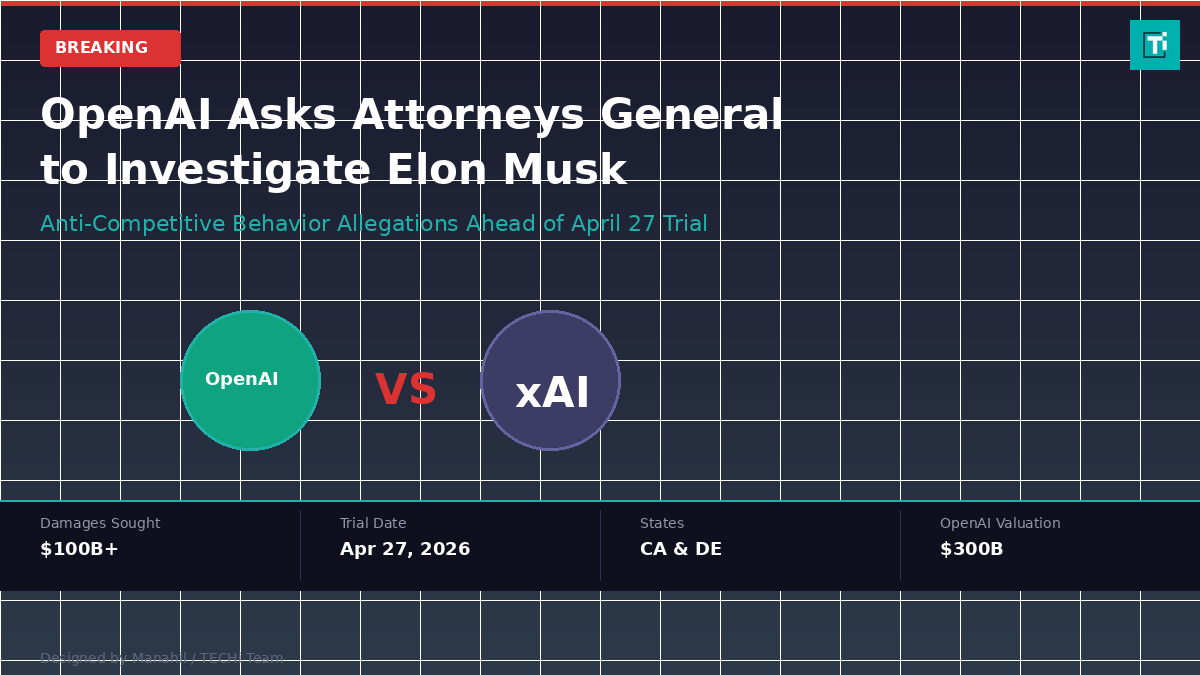
OpenAI fired a legal broadside on Monday, sending a letter to the attorneys general of California and Delaware demanding they investigate what the company calls “improper and anti-competitive behavior” by Elon Musk. The move comes just three weeks before jury selection begins in a trial where Musk is seeking between $79 billion and $134 billion in damages from the organization he co-founded in 2015.
What OpenAI Is Alleging
Jason Kwon, OpenAI’s chief strategy officer, authored the letter addressed to California Attorney General Rob Bonta and Delaware Attorney General Kathy Jennings. The core allegation: Musk “has repeatedly attempted, and failed, to wrest control of the nonprofit for his personal gain” in a broader bid to control the trajectory of artificial intelligence development.
The letter outlines several specific claims. OpenAI alleges that Musk and his “intermediaries” conducted extensive opposition research on CEO Sam Altman, including tracking his flights and movements. The company further claims this research, along with what OpenAI describes as “false allegations of sexual misconduct” against Altman, was then circulated to media outlets and company rivals.
OpenAI is not filing a lawsuit with this letter. Instead, the company is asking state law enforcement officials to open their own investigations into whether Musk’s actions constitute violations of state antitrust or corporate governance laws. California and Delaware have jurisdiction because OpenAI is incorporated in Delaware and headquartered in San Francisco.
The Musk-OpenAI Timeline: From Co-Founder to Courtroom
| Date | Event |
|---|---|
| December 2015 | Musk and Altman co-found OpenAI as a nonprofit AI research lab |
| February 2018 | Musk departs OpenAI board after attempting to merge it with Tesla |
| January 2023 | Microsoft invests $10 billion in OpenAI, accelerating its commercial pivot |
| July 2023 | Musk launches xAI as a direct competitor to OpenAI |
| February 2024 | Musk files first lawsuit against OpenAI alleging breach of founding agreement |
| November 2025 | Musk’s lawsuit is amended to seek $79B-$134B in damages |
| February 2026 | xAI merges with SpaceX in $1.25 trillion combined deal |
| April 6, 2026 | OpenAI sends letter to CA and DE attorneys general requesting investigation |
| April 27, 2026 | Jury selection scheduled to begin in Oakland federal court |
The relationship between Musk and OpenAI deteriorated gradually, then all at once. Musk contributed approximately $50 million to OpenAI during its early years and served on its board until 2018. His departure came after he proposed merging OpenAI with Tesla, a move that other board members rejected as contrary to the nonprofit’s mission of developing AI for broad human benefit.
The real fracture came when OpenAI partnered with Microsoft and began its transition toward a commercial model. Musk has argued that this pivot fundamentally betrayed the founding agreement. OpenAI counters that Musk left voluntarily and that the commercial pivot was necessary to fund the enormous compute costs required for frontier AI research. For context, ChatGPT now serves over 800 million weekly active users, a scale that would be impossible to sustain under a purely nonprofit model.
The Zuckerberg Connection
Perhaps the most eyebrow-raising claim in Kwon’s letter is the allegation that Musk coordinated anti-OpenAI efforts with Meta CEO Mark Zuckerberg. The two billionaires have a history of public antagonism, from their competing AI visions to the briefly entertained prospect of a cage match in 2023. An alliance between them to undermine a shared competitor would mark a dramatic strategic shift.
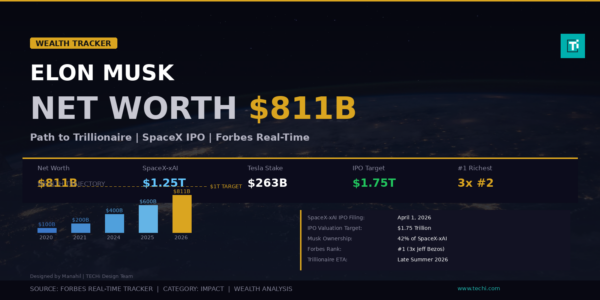
OpenAI did not provide detailed evidence of the alleged Musk-Zuckerberg coordination in the publicly available portions of the letter. Meta has not commented on the allegation. Musk, whose net worth sits at approximately $811 billion following the SpaceX-xAI merger, has the financial resources to wage extended legal and competitive battles on multiple fronts simultaneously.
The strategic logic for both parties is not difficult to construct. Musk runs xAI, which competes directly with OpenAI through its Grok chatbot. Meta operates Llama, its open-source AI model suite. Both companies would benefit commercially if OpenAI’s nonprofit-to-for-profit conversion were blocked or significantly delayed, as it would restrict OpenAI’s ability to raise the capital needed to compete at the frontier of AI development.
The $100 Billion Lawsuit Heading to Trial
The letter to the attorneys general is part of a broader legal strategy as OpenAI prepares for what could be one of the largest technology trials in history. Musk’s lawsuit, filed initially in February 2024 and amended multiple times since, seeks damages that OpenAI says exceed $100 billion. Musk’s legal team has framed the damages range at $79 billion to $134 billion, though U.S. District Judge Yvonne Gonzalez Rogers has already questioned the methodology behind those figures.
OpenAI’s letter to the attorneys general serves a dual purpose. On the surface, it asks state officials to investigate Musk’s conduct. Strategically, it plants a narrative ahead of the April 27 trial: that Musk is not a wronged co-founder seeking justice but a competitor using litigation as a weapon to hobble a rival while his own AI company, xAI (which recently launched its Grok 3 model), fights for market share.
Musk has publicly stated he would donate any winnings from the lawsuit to charity. His legal team has argued that the case is fundamentally about holding OpenAI accountable to its founding promise of developing AI that benefits humanity, not enriching a select group of insiders. OpenAI has separately sought dismissal of xAI’s trade secret claims, arguing that employee departures between AI companies are routine in the industry.
What Happens Next
Neither the California nor Delaware attorney general has publicly responded to OpenAI’s letter. State AG investigations are typically neither confirmed nor denied until charges are filed or subpoenas issued. Several possible outcomes exist, each with different implications for the AI industry.
If either attorney general opens a formal investigation, it could complicate Musk’s legal position ahead of the April 27 trial. Discovery from a state probe could surface communications or documents relevant to the federal case. Conversely, if the attorneys general decline to investigate, it could weaken OpenAI’s narrative that Musk’s actions rise to the level of state law violations.
The trial itself will be closely watched across the technology sector. A Musk victory with substantial damages could force OpenAI to restructure its conversion plans or seek additional emergency funding. A loss for Musk would clear a major legal obstacle to OpenAI’s commercial ambitions and potentially set precedent for how nonprofit-to-commercial conversions in AI are treated under the law.
Market Implications for AI Investors
The legal battle between Musk and OpenAI has direct implications for investors in the AI sector. Microsoft, which holds an investment in OpenAI’s for-profit arm valued at roughly $135 billion based on the company’s approximately $300 billion valuation, is the most exposed public company. A Musk victory that successfully blocks or reverses OpenAI’s corporate restructuring could impair the value of Microsoft’s stake, though the exact financial impact would depend on the specific court ruling.
Tesla and the newly merged SpaceX-xAI entity represent the other side of the trade. If the trial weakens OpenAI’s competitive position or distracts its leadership during a critical period of AI model development, xAI’s Grok platform stands to benefit. The xAI acquisition of X (formerly Twitter) in a $33 billion deal gives Musk’s AI company a unique distribution advantage through X’s user base.
For broader AI sector investors, the case highlights the regulatory and legal risks inherent in a sector that is still defining its corporate governance norms. TECHi’s analysis of the top AI stocks for 2026 provides additional context on how the competitive dynamics between these companies affect investment positioning.
Disclaimer: This article is for informational purposes only and does not constitute investment advice, a recommendation, or a solicitation to buy or sell any securities. Always conduct your own research and consult a licensed financial advisor before making investment decisions. TECHi and its authors may hold positions in the securities discussed.
Why did OpenAI ask attorneys general to investigate Elon Musk?
OpenAI sent a letter to the California and Delaware attorneys general alleging that Musk engaged in improper and anti-competitive behavior to undermine the company. The specific allegations include conducting opposition research on CEO Sam Altman, circulating false claims, and coordinating with Meta CEO Mark Zuckerberg to block OpenAI’s conversion from a nonprofit to a for-profit entity.
When does the Musk vs OpenAI trial start?
Jury selection is scheduled to begin on April 27, 2026 in Oakland, California. The trial is expected to last approximately four weeks and will be heard by U.S. District Judge Yvonne Gonzalez Rogers.
How much is Musk suing OpenAI for?
Musk is seeking between $79 billion and $134 billion in damages from OpenAI’s nonprofit foundation. OpenAI has characterized this as a lawsuit seeking more than $100 billion that would effectively cripple the organization if successful.
What is the relationship between Elon Musk and OpenAI?
Musk co-founded OpenAI in 2015 alongside Sam Altman and others as a nonprofit AI research lab. He served on its board until 2018, when he departed after proposing a merger with Tesla. He later launched xAI as a competing AI company and sued OpenAI in 2024, alleging the company abandoned its founding mission by pursuing commercial interests.
Did Elon Musk and Mark Zuckerberg work together against OpenAI?
OpenAI alleges in its letter that Musk coordinated his efforts to undermine the company with Meta CEO Mark Zuckerberg. Neither Musk nor Meta has publicly responded to this specific allegation. Both run AI companies that compete with OpenAI.