



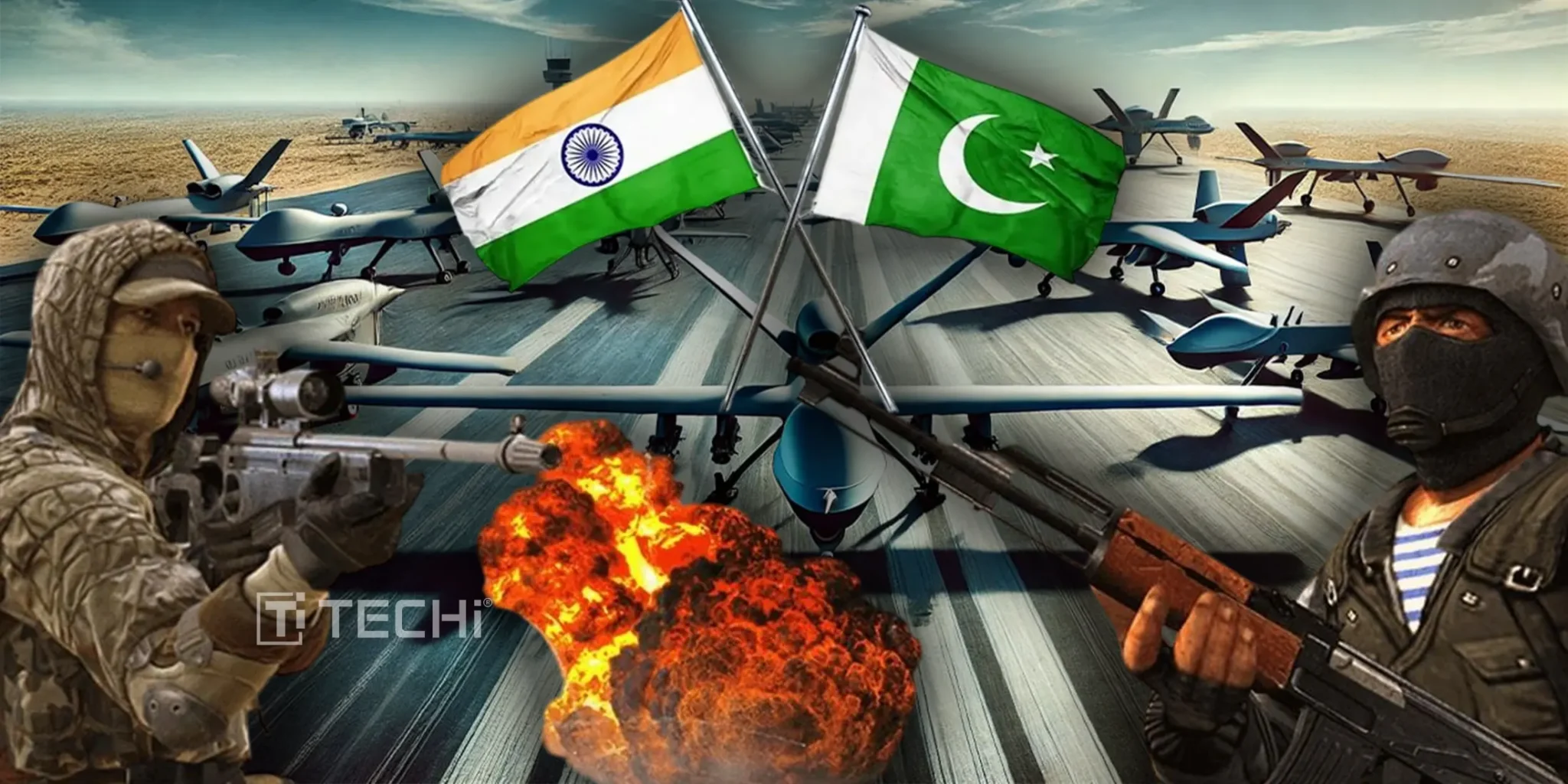
Since the India-Pakistan cross-border tension has entered into a drone war situation, with both sides claiming to intercept each other's drones, there is a critical difference in terms of quantity, capability, and origin of Unmanned Aerial Vehicles (UAVs). While both nuclear powers integrated UAVs into their military arsenals for multiple purposes, their operational effectiveness remains unproven for drone warfare.
Quantitative Variance
In terms of quantity, India’s inventory includes approximately 200 Medium Altitude Long Endurance (MALE) UAVs, 980 mini-UAVs, and various in-procurement variants. Meanwhile, Pakistan possesses a smaller fleet of around 60 MALE UAVs, 60 navy UAVs, 70 air force tactical UAVs, 100 army tactical UAVs, and some mini-UAVs. Although exact figures vary across sources; however, the overall numerical gap between the two neighbouring countries remains evident.
Diverging Procurement Origins
In recent years, India and Pakistan have spearheaded the development of indigenous UAV programs. However, the majority of their drone fleet remains largely reliant on imports. It indicates the distinct strategic and procurement preferences of both countries. India primarily sources its UAVs from Israel and the United States, leveraging advanced platforms such as the Heron series and the MQ-9B SeaGuardian. In contrast, Pakistan’s UAV inventory is predominantly composed of Turkish and Chinese systems, including models like the Bayraktar TB2 and the CH-4.
Technological Polarity
Although both India and Pakistan have advanced UAVs, their operational utility, combat effectiveness, and technological sophistication reveal notable disparities. India possesses some of the latest Israeli loitering munitions such as the Harop and Harpy, designed for precision strikes and electronic warfare roles. Meanwhile, Pakistan operates the widely acclaimed Turkish-origin Bayraktar TB2 armed drones, which have demonstrated battlefield success in the 2020 Nagorno-Karabakh War. These differences reflect not only divergent procurement strategies but also varying levels of integration and battlefield experience. Some of the key UAVs from both countries include:
India’s UAVs
Harpy
Feature | Details |
Type | Loitering munition, |
|---|---|
Company | Israel Aerospace Industries (IAI) |
Mission | SEAD (Suppression of Enemy Air Defenses) and DEAD (Destruction of Enemy Air Defenses) |
Operation | Fully autonomous; operates in “fire-and-forget” mode |
Targeting system | Anti-radiation seeker that detects and homes in on radar emissions |
Loitering Time | Up to 9 hours |
Range | up to 500 km |
Warhead | 32 kg of high-explosive |
Cost | $4 million per unit |
Harop
Feature | Details |
Type | Loitering munition with surveillance and strike capabilities |
|---|---|
Developer | Israel Aerospace Industries (IAI) |
Loitering Time | Up to 9 hours |
Operational Range | Up to 1,000 km, enabling deep standoff attacks |
Payload | 23 kg high-explosive warhead |
Launch Platforms | Canister-launched from land vehicles, naval vessels and configured for air launch |
Jamming Resistance | Immune to GNSS/satellite navigation jamming for contested environments |
Attack Profile | Can engage from multiple angles and return if target not found to reduce collateral damage |
MQ-9 Reaper
Feature | Details |
Manufacturer | General Atomics (USA) |
|---|---|
Role | Armed reconnaissance, surveillance, and precision strike |
Combat History | Extensively used in Iraq, Afghanistan, and Syria |
Payload Capacity | Up to 1,700 kg (can carry missiles, bombs, and sensors) |
Endurance | 27 hours |
Range | 1,850 km (with satellite control for global operations) |
Sensor Suite | Electro-optical/Infrared (EO/IR), Lynx Multimode Radar, Electronic Support Measures (ESM), 161 embedded GPS/inertial navigation systems, 35 L3 Rio Grande communications and intelligence sensor suites |
Variants Acquired by India | MQ-9B SeaGuardian and SkyGuardian |
Purchase Cost | Approx. $32 million per unit (excluding cost of missiles and advanced sensors) |
Rustom-II
Feature | Details |
Developer | Defence Research and Development Organisation (DRDO), India |
|---|---|
Role | Intelligence, Surveillance, and Reconnaissance (ISR); future strike capabilities |
Payload Capacity | 350 kg (includes EO sensors and Synthetic Aperture Radar) |
Endurance | 12 hours |
Range | 180–200 km (with planned upgrades to extend significantly) |
Sensor & Equipment Suite | COMINT, ELINT, Maritime Patrol Radar, Synthetic Aperture Radar, Medium- and Long-Range Electro-Optics |
Stealth Features | Airframe includes 3mm Kevlar and Carbon Fibre Composite (CFC) for reduced radar signature |
Weapons Capability | Compatible with Helina Anti-Tank Guided Missiles (ATGM) and laser-guided rockets |
Purchase Cost | $5–6 million per unit |
Maintenance Cost | 20–30% lower than imported drones due to indigenous production and supply chains |
Lifecycle | 12–15 years |
Operational Status | Under testing and induction phase; reflects India’s focus on self-reliance in drone technology |
Pakistan’s UAVs
Bayraktar Akıncı
Feature | Details |
Origin | Turkey |
|---|---|
Class | High-Altitude Long-Endurance (HALE) Combat UAV |
Primary Role | Air-to-air and air-to-ground combat missions |
Length | 12.2 meters |
Height | 4.1 meters |
Wingspan | 20 meters |
Maximum Take-Off Weight | 6,000 kg |
Payload Capacity | 1,500 kg (includes missiles, precision-guided munitions, and sensors) |
Operational Ceiling | 40,000 feet |
Armament Capability | Equipped with a wide array of missiles (air-to-air and air-to-ground) |
Significance | One of the most advanced combat drones in Pakistan’s UAV inventory |
Bayraktar TB2
Feature | Details |
Type | Tactical Armed Unmanned Aerial Vehicle (UAV) |
|---|---|
Origin | Turkey |
Manufacturer | Baykar Technologies |
Length | 6.5 meters |
Wingspan | 12 meters |
Maximum Take-Off Weight | 700 kg |
Payload Capacity | 150 kg (can carry precision-guided munitions and ISR equipment) |
Cruising Speed | 130 km/h |
Maximum Speed | 220 km/h |
Endurance | Up to 27 hours |
Operational Altitude | 18,000 feet (5,486 meters) |
Primary Roles | Intelligence, Surveillance, Target Acquisition, Reconnaissance (ISTAR), and strike missions |
Armament Capability | Equipped with MAM-L and MAM-C smart micro munitions |
Notable Combat Use | Played a major role in conflicts like Libya, Syria, and the 2020 Nagorno-Karabakh war |
CH-4
Feature | Details |
Type | Medium-Altitude Long-Endurance (MALE) Combat UAV |
|---|---|
Origin | China |
Manufacturer | China Aerospace Science and Technology Corporation (CASC) |
Length | 8.5 meters |
Wingspan | 18 meters |
Maximum Take-Off Weight | 1,330 kg |
Payload Capacity | 345 kg |
Endurance | Up to 40 hours (CH-4A for ISR), 14 hours (CH-4B for combat) |
Operational Ceiling | 26,000 feet (approximately 8,000 meters) |
Range | 2,000–5,000 km depending on version and satellite link |
Cruising Speed | 180 km/h |
Primary Roles | Intelligence, Surveillance, Reconnaissance (ISR), and precision strike missions |
Armament Capability | Can carry guided bombs and air-to-surface missiles (AR-1, FT-9, HJ-10, etc.) |
Shahpar
Feature | Details |
Type | Tactical Unmanned Aerial Vehicle (UAV) |
|---|---|
Developer | Global Industrial Defence Solutions (GIDS) in collaboration with NESCOM |
Fuselage Length | 4.2 meters |
Wingspan | 6.6 meters |
Cruising Speed | 150 km/h |
Operational Endurance | Over 7 hours |
Maximum Take-Off Weight | 480 kg |
Operational Altitude | Up to 5,000 meters |
Primary Roles | Intelligence, Surveillance, Reconnaissance (ISR), and disaster response |
In 2021, Pakistan unveiled an advanced variant, Shahpar II. This new model exhibits multiple improvements, especially in endurance and operational altitude. In 2024, Pakistan unveiled another variant, Shahpar-III, having Intelligence, Surveillance, Reconnaissance (ISR), and multi-role combat missions.
About the Author

Munazza Shaheen is an AI and technology researcher at TECHi with a deep interest in machine learning, automation, and emerging tech trends. Her work focuses on exploring the impact of artificial intelligence on industries, ethical AI development, and future innovations. She actively follows advancements in deep learning, robotics, and AI-driven solutions, contributing insights into how technology is shaping the world.





Comments