



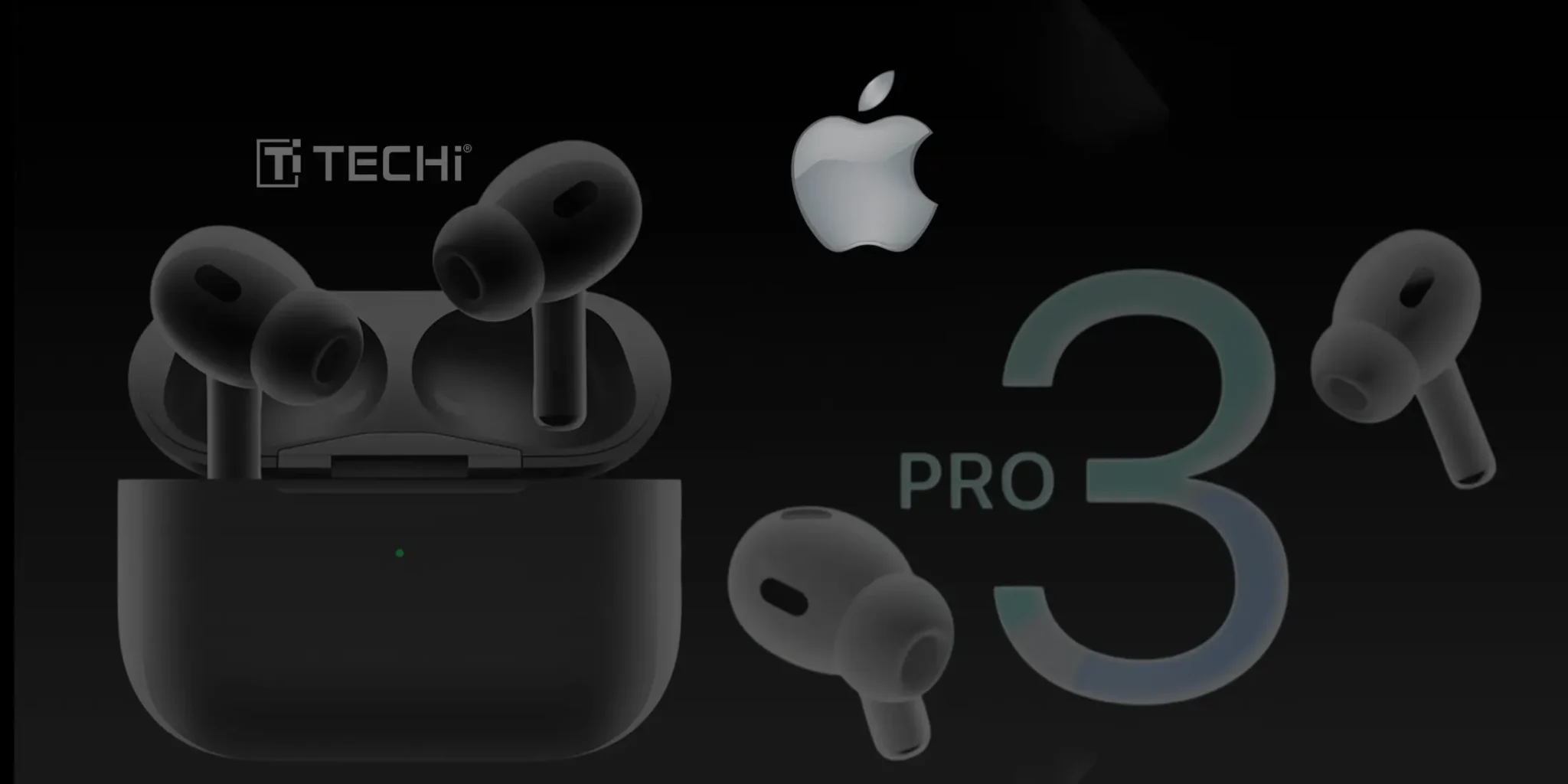
Apple's AirPods Pro 3 have been on sale since September 19, 2025, and they do not have cameras. Worth stating plainly, because two stories keep getting tangled together: the earbuds Apple actually ships, and the earbuds a supply-chain analyst says Apple intends to build.
What the third-generation Pro actually added
Apple announced AirPods Pro 3 on September 9 and shipped them ten days later at $249, holding the price of the model they replace.
The headline change is a sensor, not a lens. A custom photoplethysmography module — LEDs pulsing invisible light through the ear, read alongside the accelerometers — tracks heart rate during workouts across roughly 50 exercise types in the Fitness app. Apple also claims up to twice the active noise cancellation of AirPods Pro 2, an IP57 rating for both buds and case, five foam-infused ear-tip sizes including a new XXS, and eight hours of listening with ANC on, ten in Transparency mode. Details are in Apple's announcement and the published tech specs.
The other addition is Live Translation, which pipes a translated conversation through the buds hands-free. It launched in English, French, German, Portuguese and Spanish, with Italian, Japanese, Korean and Simplified Chinese promised by year-end. European buyers did not get it at all at first — Apple withheld the feature over Digital Markets Act compliance and only switched it on with iOS 26.2 on December 12.
All microphone, sensor and silicon work. There is no imaging hardware anywhere in the product.
Where the infrared camera story actually comes from
The camera claim traces to Ming-Chi Kuo. In a June 2024 note, reported by 9to5Mac, Kuo said Apple was developing AirPods carrying an infrared camera close in design to the Face ID module, with Foxconn as the new-product-introduction supplier and a planned annual capacity of 18 to 20 million camera units — enough for roughly 10 million pairs of earbuds. Mass production was targeted for 2026. He restated that timing in May 2025, and again days before the September launch, when he paired "AirPods Pro 3 in 2H25" with IR cameras in 2026.
What the cameras would do has little to do with photography. In Kuo's account, infrared sensing gives the buds a coarse read of the space around the wearer: detecting motion for in-air gestures, and feeding head-orientation and environmental data to Vision Pro so spatial audio can follow where someone is looking. Bloomberg's Power On newsletter described a similar component in October, placing it in a future AirPods Pro 4 and AirPods 5 and framing it closer to a proximity system — noticing whether a bud is in an ear or sitting on a desk, catching a hand wave — with the readings handed off to an iPhone or a headset.
None of it has shipped. Both accounts describe a component decision and a production timetable, not a device Apple has demonstrated or acknowledged.
The wider bet is easier to read. Bloomberg reported in October that Apple pulled engineers off a Vision Pro redesign to move faster on smart glasses. Sensor-equipped AirPods sit in the same strategy: give Siri some sense of what is in front of a wearer without requiring them to raise a phone. Whether that arrives in 2026, as Kuo maintains, is a question about Apple's software readiness as much as Foxconn's line capacity.
The market Apple is defending
Apple can afford to be deliberate. Canalys counted 78.3 million TWS units shipped globally in the first quarter of 2025, up 18% year over year, with Apple and Beats together at 18.2 million units and about 23% share — roughly double second-place Xiaomi at 11.5%, and more than half of North America.
That lead was built on fit, pairing and ecosystem lock-in rather than novel sensing, which is precisely why the infrared question matters. The competitive threat to AirPods is not another set of earbuds. It is camera-equipped eyewear that answers questions about what the wearer is looking at. Apple has bought itself a year of quiet with a heart-rate sensor and a translation feature. What it does with the next generation is still, on the public record, a supply-chain forecast and nothing more.
About the Author

Warisha Rashid covers AI stocks and crypto markets for TECHi. Recent work explains what changed when Worldcoin cut its WLD token unlock, how AMD's rack-scale Helios design fits an asset-light strategy, and how Nvidia, Alphabet, Palantir, AMD and Broadcom compare as AI businesses.



Comments