



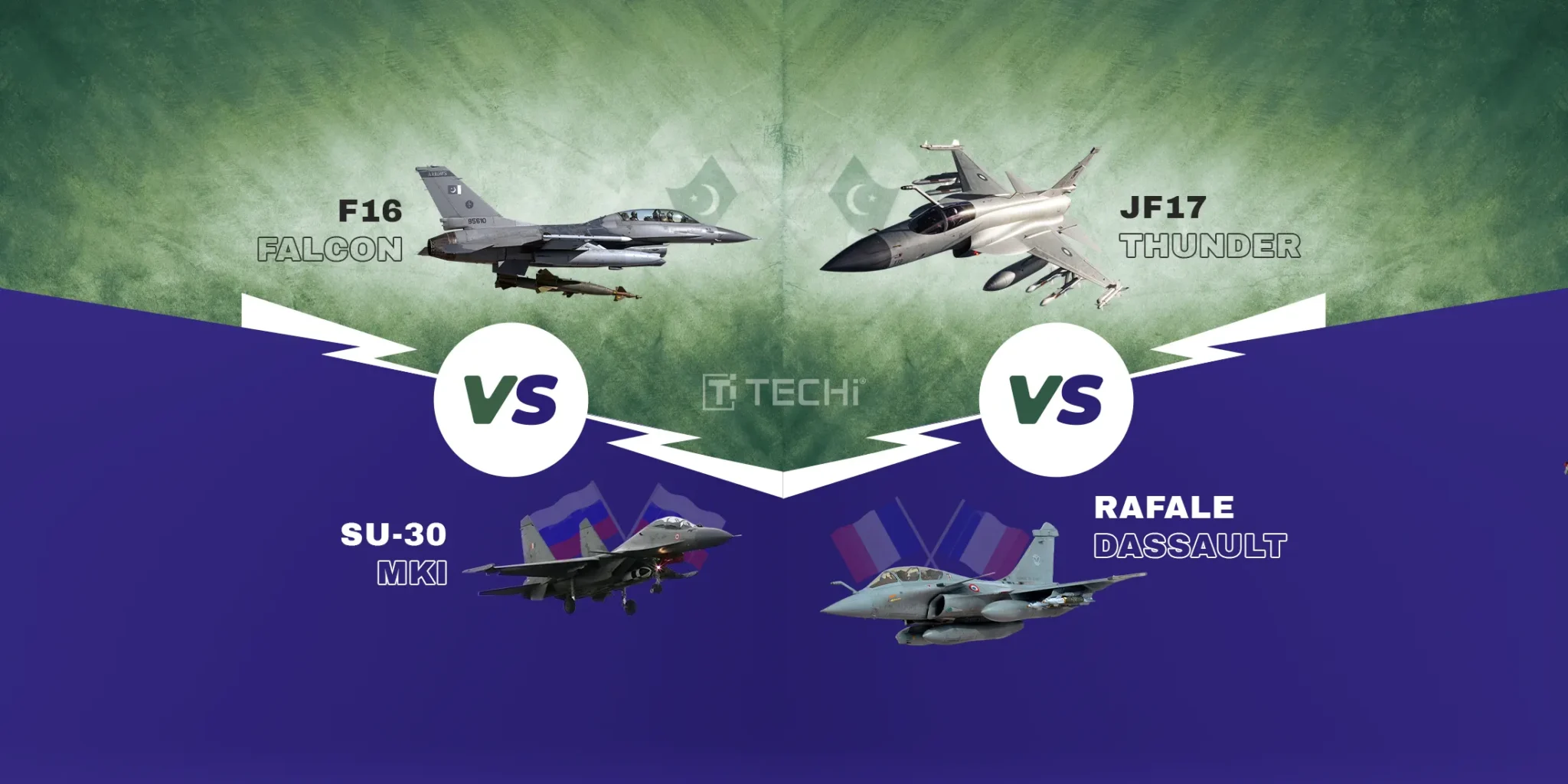
In the latest exchange of air strikes between India and Pakistan, the Pakistan Air Force (PAF) claims to have shot down three Rafale jets, a MiG-29, an SU-30, and a Heron surveillance drone. This development has ignited the debate over the strategic effectiveness of France's Dassault Aviation Rafale against the China-Pakistan collaborative JF-17 Thunder. While Pakistan holds near air parity against India, the recent arsenal engagements have raised fresh questions about the credibility of this balance and the effectiveness of operational swiftness over advanced technology.
JF-17 Thunder vs Rafale: A Comparative Analysis
While Rafale is a 4.5-generation multi-role fighter jet, the JF-17 Thunder is a fourth-generation, lightweight, single-engine, multi-role combat aircraft.
Size
In terms of size, Rafale is larger than JF-17, with a height of 5.34 m and a wingspan of 10.80 m, and has a far higher maximum take-off weight of 24.5 tonnes, compared to JF-17’s 12.4 tonnes.
Engine
Rafale also features twin engines with a combined thrust, enabling a higher thrust-to-weight ratio. Comparatively, JF-17 is a single-engine aircraft having a height of 4.72m and a width of 9.48 m.
Speed
Rafale has a maximum speed of Mach 1.8 (1,915 km/h) (1,034 knots), whereas the JF-17 has a speed of Mach 1.6 (1,960.1 km/h) (1,058 knots).
Range
Rafale has a range of 1,850 km (999 nautical miles), while JF-17 Thunder has 3,482 km (1,880 nautical miles). Those two numbers are not like-for-like: the JF-17 figure is a ferry range, while the Rafale figure is a combat range. However, the Rafale's range can be extended through mid-air refuelling.
Cost
Rafale’s unit cost is $74 million (Rafale B), while JF-17 costs $25–32 million. Given all these technological advantages that Rafale holds, the claims about the shooting down of three jets by the PAF have made the credibility of Dassault Aviation questionable.
Su-30MKI vs F-16: A Comparative Analysis
Both the Su-30MKI and the F-16 are highly regarded in modern warfare, and while they were built for very different roles, both have impressive features. Consider the categories listed below to better understand their differences.
Generation
The Su-30MKI is classified as a 4.5 generation dual-engine fighter while the F-16 is a single-engine 4th generation multirole fighter.
Size
With a length of 21.9 metres and a wingspan spanning out to 14.7 metres, the Sukhoi 30MKI is significantly larger than the F-16 which has a length of 15 metres and a 9.96 metres wingspan.
Engine
The dual engines strapped onto the Su-30MKI produce far more total thrust than the single engine powering the F-16, though the lighter F-16 is prized for its acceleration when taking on enemy interceptors.
Speed
The Sukhoi 30MKI clocks in at a maximum speed of roughly Mach 2 in level flight, while the F-16 tops out at about Mach 2 as well.
Range
The Su-30MKI has a ferry range of about 3,000 km on internal fuel, which in-flight refuelling can extend considerably. Equipped with drop tanks, the F-16 has an operational range of 4,220 km, giving it greater endurance during air-to-air combat and strategic missions.
Avionics & Sensors
Although the Su-30MKI’s larger radar cross-section is a detriment, it is still incredibly effective in electronic warfare, boasting advanced infrared sensors, radars, and electronic warfare systems. The F-16 is fitted with upgraded variants of modern AESA radar and highly integrated electronic countermeasures, which greatly increases its survivability when tracked by enemy radars.
Weapons & Tactics
Both aircraft are outfitted with an extensive arsenal of air-to-air missiles, including state-of-the-art BVRAAMs, significantly improving long-range combat. The Su-30MKI specialises locally in the air superiority and ground attack roles, while the F-16 is renowned throughout the world for its extraordinary manoeuvrability in dogfights. Both aircraft are supported by AWACS, which provides real-time targeting data, making engagements extremely versatile.
Combat Record
The F-16 is well-known for its apparent combat success, achieving multiple victories in air conflicts. Pakistan also flies the F-16, though its officials credited J-10C fighters with the claimed shootdowns of Indian jets. The Su-30MKI has been successful in performing multiple roles, but Pakistan has claimed to have downed one during the recent exchanges, a claim India had not confirmed at the time.
Cost
The Su-30MKI is claimed to be priced at $62 million per unit, which considers its advanced functionalities and multi-role capabilities. The cost of the F-16 varies from $30 million to $70 million per unit based on the variant, making it a relatively affordable option with impressive combat credentials.
Strategic Implication
The Su-30MKI versus F-16 confrontation highlights the technological sophistication of each aircraft and underscores the significance of tactical execution and real-time data integration in modern aerial combat. The Indo-Pakistani aerial confrontations underscore the susceptibility of advanced aircraft under such conditions. These aircraft represent the military doctrines of their nations, and the persistent strategic competition in South Asia is poised to influence future aerial combat strategies. The ramifications of this conflict on international relations illustrate the intersecting factors of aerial supremacy, national defence capabilities, and geostrategic positioning.
Disclaimer
This article is for informational purposes only and does not constitute financial, investment, tax, or legal advice. Market data, tax rules, and prices can change after the article date. TECHi and its authors may hold positions in securities or digital assets mentioned. Always conduct your own research and consult a licensed financial, tax, or legal professional before making decisions.
About the Author

Munazza Shaheen is an AI and technology researcher at TECHi with a deep interest in machine learning, automation, and emerging tech trends. Her work focuses on exploring the impact of artificial intelligence on industries, ethical AI development, and future innovations. She actively follows advancements in deep learning, robotics, and AI-driven solutions, contributing insights into how technology is shaping the world.



Comments