



- The divergenceTesla's April 2026 China wholesale jumped 36% YoY while retail registrations fell 10% YoY — a 46-point gap inflated by Giga Shanghai exports masking weak domestic demand.
- The signalCnEVPost and China Auto Daily publish Tesla's China weekly insurance registrations every Monday — a retail proxy that arrives three weeks before Tesla's official Q2 delivery report.
- The mathRolling 4-week sum of China insurance regs, divided by an assumed China retail share of ~0.32, has tracked reported global quarterly deliveries within ±15,000 vehicles across 2024-2025.
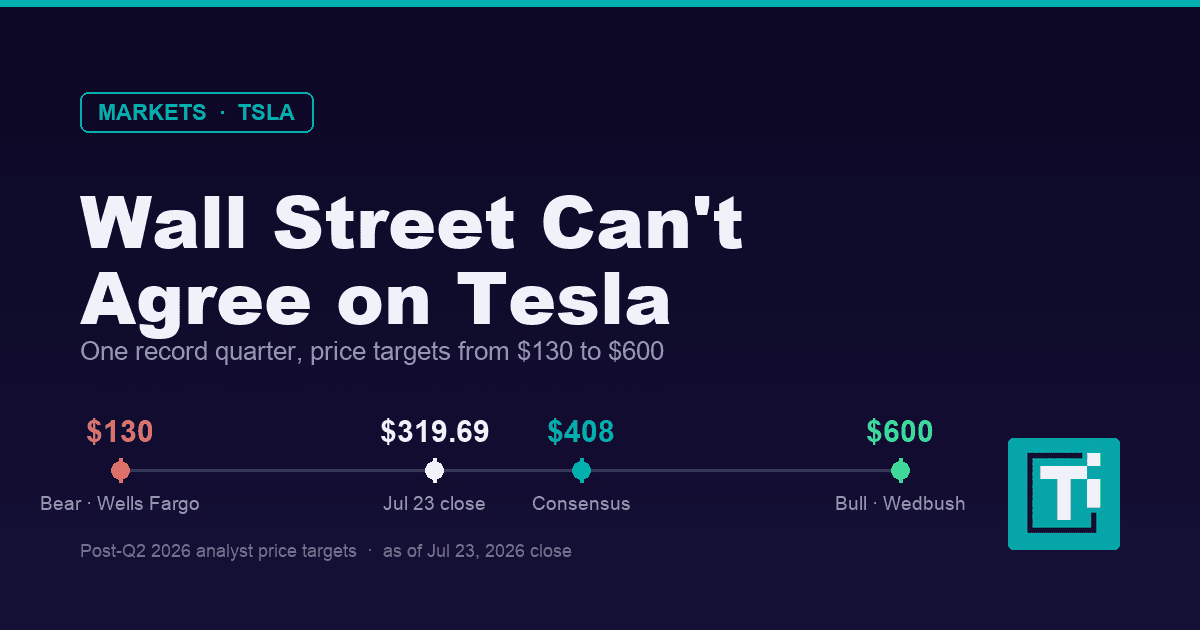
- Consensus is wideQ2 2026 sell-side delivery estimates span 390K-420K — not really a consensus. Mid-point around 408K. The width reflects the wholesale/retail unresolved gap.
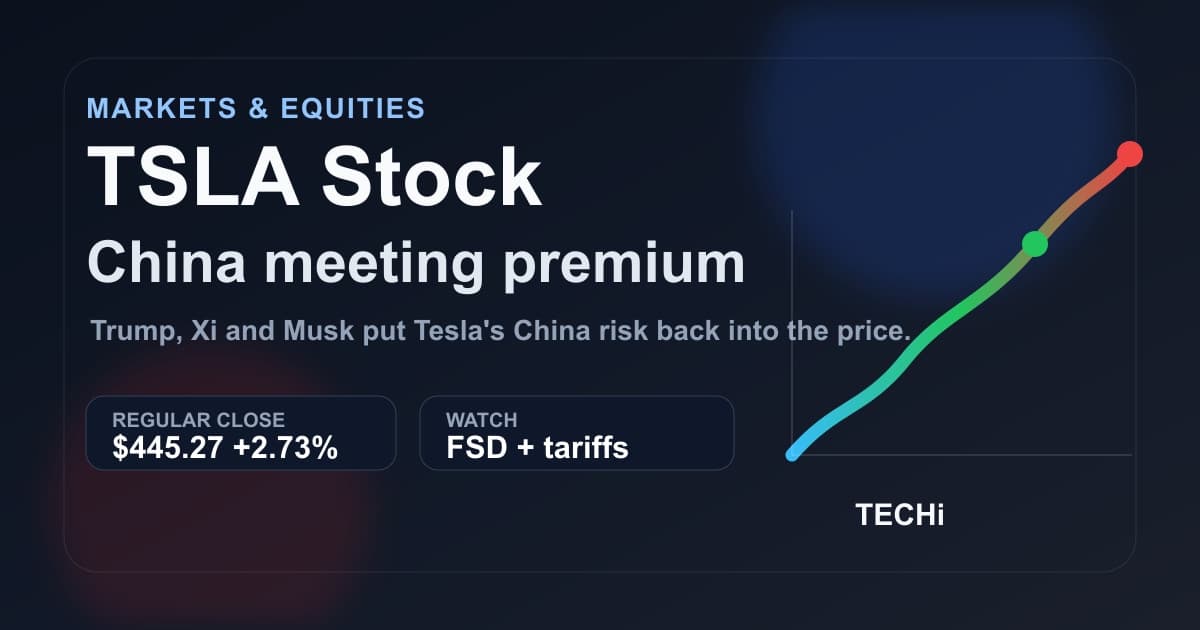
- Trade implicationTSLA closed $445 on May 11, up ~30% from the April 7 low. The rally is pricing the wholesale story. The insurance reg data is the binary tell on which Q2 print is coming.
Tesla beat the Street on Q1 2026 wholesale revenue by roughly 1 percent, reporting $22.39 billion against the $22.17 billion consensus. Over the same period, its retail sales in China — measured by actual buyers walking into showrooms and registering vehicles with insurance — fell 16 percent year-over-year, with March alone collapsing 24 percent according to Electrek's analysis of CPCA data. Going into Q2 2026 — deliveries reported the first week of July, earnings call confirmed for July 22, 2026 — the gap between those two numbers is the entire trade. And there is a publicly available dataset that calls which one is right roughly three weeks before Tesla does: China's weekly EV insurance registrations, published every Monday.
The signal nobody reads weekly
Two streams of Tesla data come out of China each quarter. The first is the CPCA wholesale figure — vehicles shipped from Giga Shanghai, including the tens of thousands exported to Europe, Australia, and Southeast Asia each month. The second is insurance registrations — the legally required moment when an actual buyer takes delivery, insures the car, and drives it off the lot. Wholesale tells you what Tesla shipped. Insurance registrations tell you what Tesla sold to a Chinese consumer.
For Tesla in 2026, the two have diverged sharply. April 2026 wholesale rose 36 percent year-over-year. April retail (insurance regs) fell 10 percent per Electrek's analysis of the underlying registration data. That is a 46-point gap, structural and unusual, and it explains why Q2 2026 delivery consensus on the sell-side currently spans from 390,000 to 420,000 vehicles — a range so wide it's not really a consensus.
US financial media reports the wholesale headline on the day it drops. The retail data comes out every Monday from CnEVPost and China Auto Daily, and it is, on average, the more accurate proxy for what Tesla will actually report. The full 2026 Tesla quarterly history sits on the TSLA quote page.
How the regression works
Tesla's China retail share of total global quarterly deliveries has run in the 30-35 percent band across 2024 and 2025. The methodology is mechanical.
- Each Monday, pull Tesla's weekly insurance registrations in China from CnEVPost or an equivalent feed sourced to the national insurance registration database.
- Sum a rolling 4-week trailing window — smooths out promotional spike weeks (when Tesla cuts price) and quiet weeks (when the factory ships inventory overseas).
- Annualize to the quarter by multiplying the 4-week sum by 3.25 (13 weeks / 4 weeks) — the implied quarterly China retail figure.
- Divide by s = 0.32 (China retail share of global) — the implied global delivery figure.
Across 2024 and 2025, that 4-week-rolling sum, annualized and divided by the 32-percent share, tracked Tesla's reported global quarterly deliveries within roughly ±15,000 vehicles. For an alpha signal available three weeks before the official print, that is useful precision.
Calibrating the multiplier
The 0.32 share isn't a guess. It comes from cross-referencing Tesla's reported quarterly global deliveries against the sum of CnEVPost's weekly China registrations for the same 13-week window. A few publicly verifiable anchor weeks from 2024 and 2025:
- Week ending Apr 28, 2024: Tesla 14,860 (CnEVPost)
- Week ending May 26, 2024: 13,100
- Week ending Apr 27, 2025: 10,280
- Week ending May 4, 2025: 7,290
- Week ending May 18, 2025: 11,130
- Week ending Sep 21, 2025: 17,300
The series is noisy week-to-week — promotional resets, holiday weeks, and end-of-quarter pushes can move a single week by 50 percent. The rolling 4-week sum is what matters. Use the raw weekly print as the headline, the rolling sum as the model input.
What April 2026 actually said
Strip the Giga Shanghai exports out of the wholesale number and the April picture is bleaker than the +36 percent headline suggests. The math from the CPCA breakdown: exports absorbed the entire 46-point gap between wholesale and retail and then some. Domestic demand for the Model Y refresh, the cheaper Model 3, and the Model Y L six-seater is, in real terms, flat to declining.
Project that April run-rate forward through May and June at the same retail pace and the implied Q2 2026 China retail trajectory lands well below the level Street consensus is modeling. The wholesale number can keep printing positive — Tesla exports more Shanghai-built cars to Europe in Q2 traditionally — but the retail leg of the equation, the one that maps cleanly to global deliveries, is the leg that drives the Q2 print. For broader context on how AI-capex and EV-capex cycles compare, see TECHi's earlier read on NVDA's hyperscaler-funded growth bar.
What this means for the trade
Tesla closed at $445.00 on May 11, 2026, up 5.41 percent on 78.4 million shares — the strongest single-session move in months. The stock has now rallied roughly 30 percent off the April 7 close near $343, recovering most of the post-Q1-miss damage. The recovery is consistent with the wholesale story. It is not consistent with the retail story.
For longs, the question between now and the first week of July is which of the two China data streams is the leading indicator and which is the noise. The retail (insurance registration) series has historically been the better predictor of Tesla's reported global deliveries. If the rolling 4-week average stays below 9,000 registrations into mid-June, the Q2 delivery print is on track to disappoint and the May rally will look premature. If it pushes back toward 12,000, the wholesale narrative wins and the stock has room to break $470 toward all-time highs. The longer-term thesis layers — Model Y L, FSD progression, Optimus — sit alongside the broader electric-vehicle market coverage on TECHi.
The check costs nothing. Every Monday between now and July 2, CnEVPost posts the new number. Three weeks before Tesla does.
FAQ
Frequently asked questions
When does Tesla report Q2 2026 deliveries?
Tesla typically reports quarterly delivery numbers within the first 1-3 trading days of the following month, putting Q2 2026 delivery results around July 1-3, 2026. The Q2 2026 earnings call is confirmed for Wednesday, July 22, 2026 after the close, per the Benzinga earnings dataset.
What is the consensus estimate for Tesla Q2 2026 deliveries?
Sell-side estimates span roughly 390,000 to 420,000 vehicles, with a midpoint near 408,000. The wide range reflects an unresolved divergence between Tesla's strong April wholesale numbers (+36% YoY) and the underlying retail data in China (-10% YoY).
What are China's weekly EV insurance registrations and where are they published?
China's weekly EV insurance registrations report how many newly registered vehicles each automaker actually sold to end consumers, by week. They are published every Monday by CnEVPost and China Auto Daily, sourced from China's national insurance registration database. Unlike wholesale data, they exclude vehicles shipped to dealers or exported, making them a cleaner retail signal.
How accurate is the rolling 4-week regression on Tesla quarterly deliveries?
Across 2024 and 2025, summing 13 weeks of Tesla's China insurance registrations and dividing by an assumed China retail share of roughly 32 percent has tracked Tesla's reported global quarterly deliveries within approximately plus-or-minus 15,000 vehicles. Useful precision for a signal available three weeks before the official print.
Disclaimer
This article is for informational purposes only and does not constitute financial, investment, tax, or legal advice. Market data, tax rules, and prices can change after the article date. TECHi and its authors may hold positions in securities or digital assets mentioned. Always conduct your own research and consult a licensed financial, tax, or legal professional before making decisions.
About the Author

Omer Sheikh covers Tesla and SpaceX as public-market stories, from the federal audit of Cybercab's safety certification to how much more SpaceX now spends on AI than on rockets. He also follows the capital moving through AI, including Nvidia's reported talks to anchor Anthropic's IPO and Intel's $15 billion request to investors.


Comments