



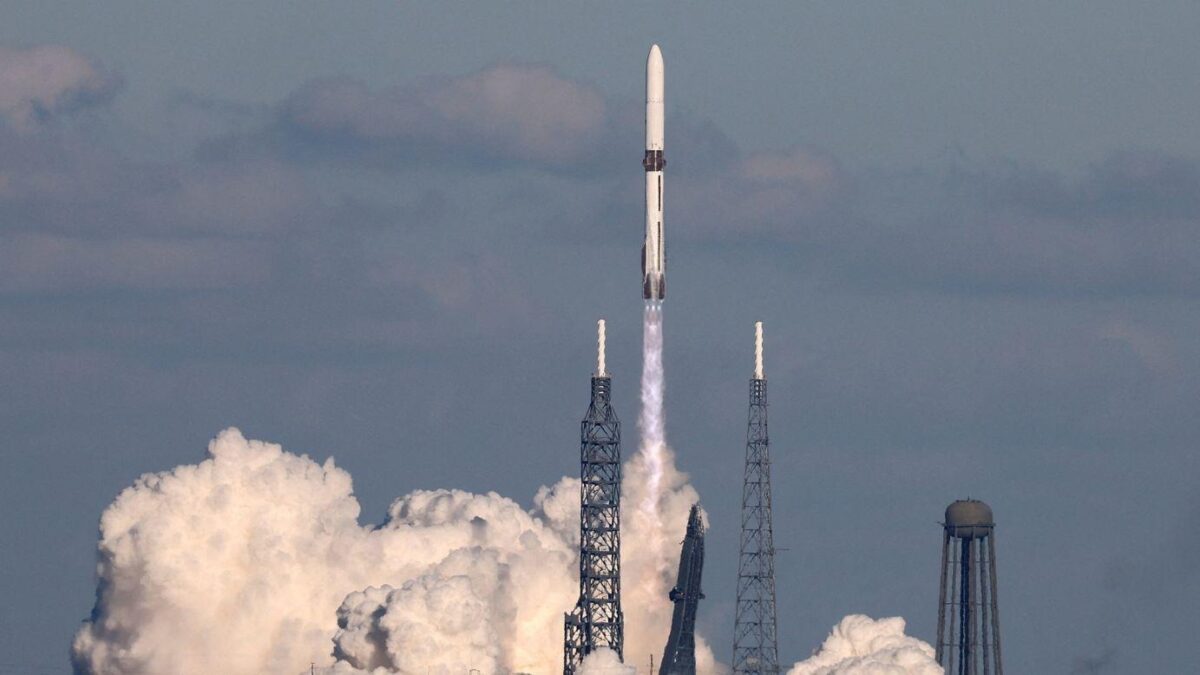
One of the milestones that Blue Origin managed to attain was the successful launch of its New Glenn rocket by NASA in its trip mission called Escapade. It was launched out of Cape Canaveral just before 4 p.m. ET and put two miniature satellites that will eventually be launched toward Mars. The event was significant both in its assistance of a NASA flight and in that it was the first primary qualification of New Glenn with a similar commercial payload.
This was launched after earlier failures in the same week, which could be explained by the constant presence of clouds and a temporary prohibition on the daytime launch, which prevailed during the closing of the federal government. After receiving the required clearances, the vehicle worked according to its flight schedule, which put Blue Origin in a better position to become an equalizer to SpaceX as a leading player in the commercial launch market.
An Orbital Booster Landing
A historical accomplishment of the mission occurred after the vehicle had been launched into orbit. Blue Origin landed the New Glenn first stage on a floating platform named after Jeff Bezos's mother, Jacklyn. It is a significant achievement, considering that the company had failed to retrieve the booster in the first flight of New Glenn in January.
The use of the reusable boosters’ forms part of the long-term strategic perspective of Blue Origin. Repeated launch and recovery of rockets reduces the cost per mission significantly and increase the scope of other operations. In spite of the fact that SpaceX is already leading in this field, Blue Origin believes that the victories of New Glenn will cause the competition in the field of launches to increase. The exact recovery witnessed in this case is a confirmation that the improvements put in place in the last ten months have worked.
The Long Journey toward Mars by Escapade
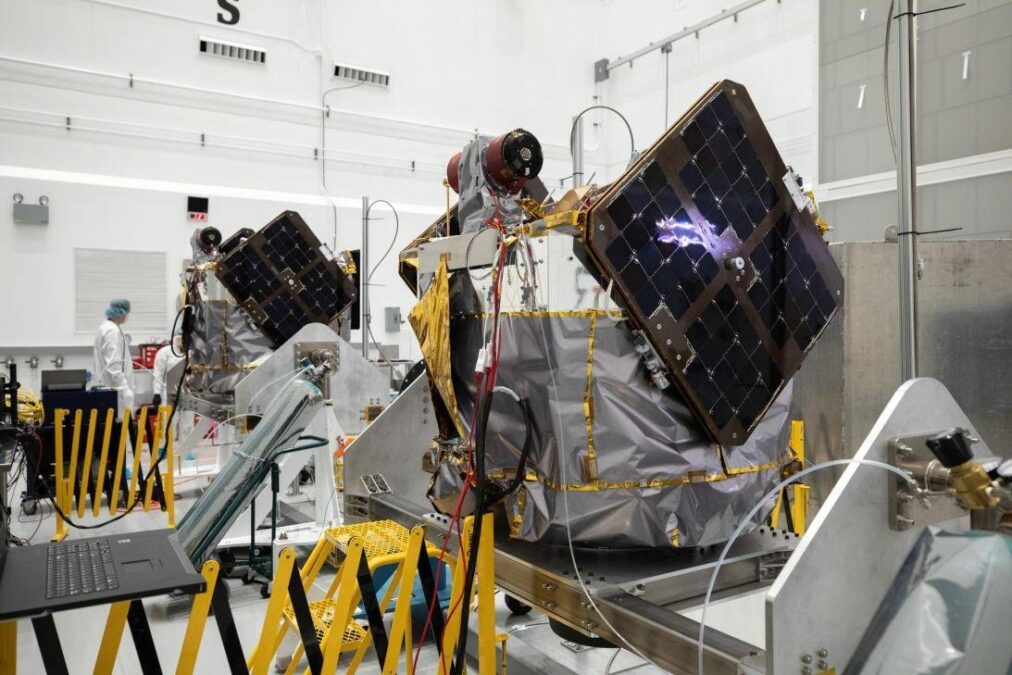
The two satellite Escapades are currently on their way to the second solar-system Lagrange point L2, a quasi-stable 1.5 million kilometers above the Earth. They will stay in that area till the 2026 transfer window. The spacecraft will swing by Earth out of L2, then continue to Mars, with both predicted to be successfully orbited around the planet in September 2027.
Even in size, the scientific goals of Escapade are big. The scientists at the University of California, Berkeley, are planning to use the satellites to study the historic loss of the dense atmosphere of Mars and to determine the radiation levels that humans will face in the future. The mission will provide a more detailed insight into the upper atmosphere and magnetosphere of Mars since it will be collecting contemporaneous data in different planetary locations.
Why This Mission Matters
A sharp change in the paradigms of space exploration is highlighted in this mission. The NASA Simplex program awards projects that are cost-effective, and Escapade was designed and introduced at a cost of less than 100M, significantly lower than the multi-billion-dollar expenditure of bigger Mars orbiters. NASA intends to use small payloads and commercial launch vehicles like New Glenn to support a greater rate of scientifically valuable missions.
In the case of Blue Origin, the success was not just a normal launch, but it was the ability of New Glenn to deliver critical cargo and retrieve its booster, two success factors that will define the business in the launch industry. With the increased competition and other organizations coming up with extensive reusable launch capabilities, the aerospace field is in an evolutionary phase.
The success of Blue Origin with Escapade suggests that the corporation is willing to play a significantly bigger role in interplanetary exploration outside of the Earth.
Disclaimer
This article is for informational purposes only and does not constitute financial, investment, tax, or legal advice. Market data, tax rules, and prices can change after the article date. TECHi and its authors may hold positions in securities or digital assets mentioned. Always conduct your own research and consult a licensed financial, tax, or legal professional before making decisions.
About the Author

Layloma Rashid writes about AI platforms and the companies selling them, from OpenAI's new teen alert on ChatGPT and GPT-5.6's arrival on Amazon Bedrock to C3.ai's enterprise AI earnings. She also follows chip policy for TECHi, including how many Nvidia H200s are shipping to China.

Comments