

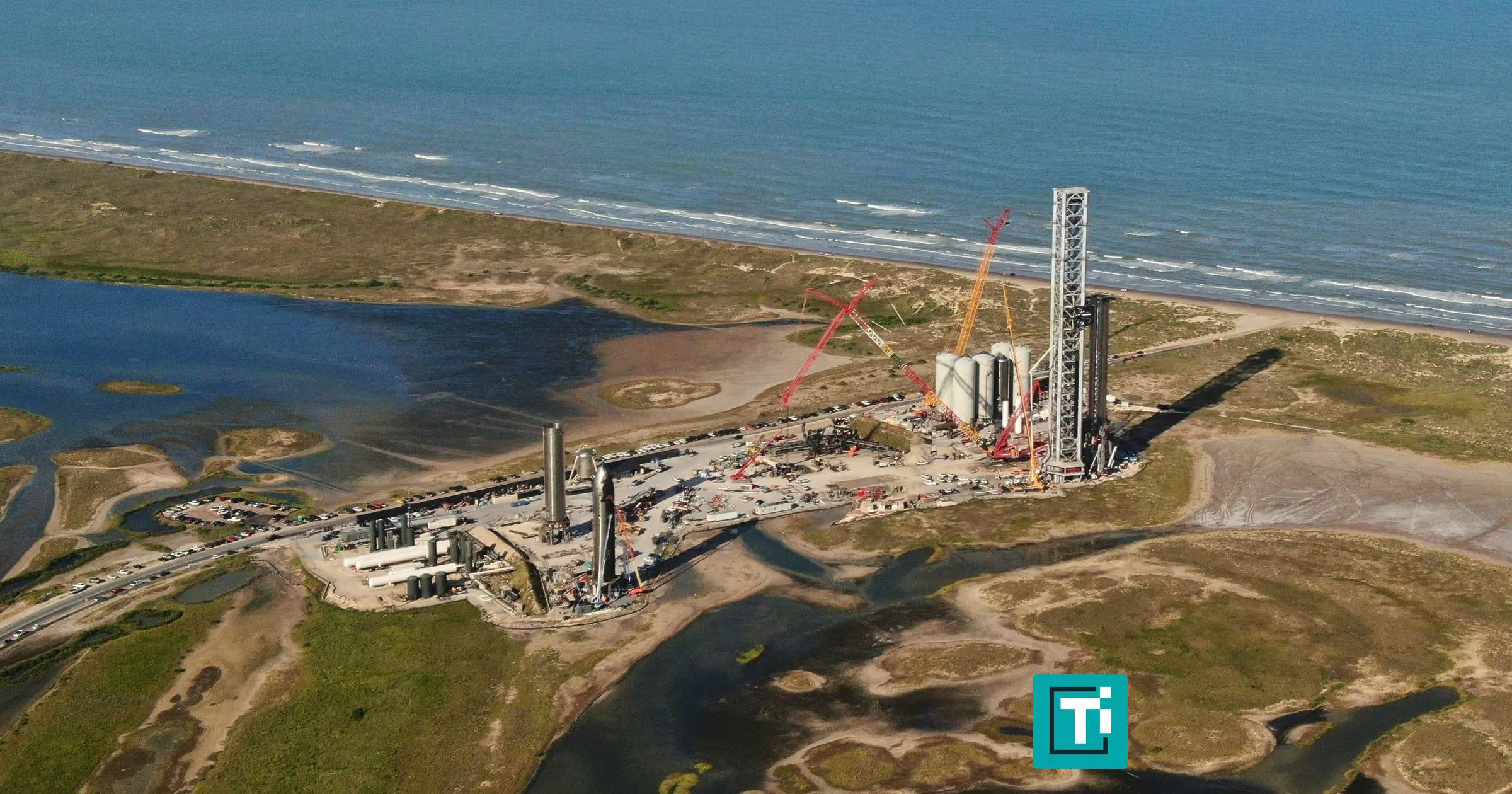
A SpaceX Starship lifts off from Starbase, Texas. Photo: Steve Jurvetson via Wikimedia Commons (CC BY 2.0), cropped with TECHi publisher mark added.
SpaceX (Nasdaq: SPCX) reported its first quarterly profit as a public company on Tuesday, posting net income of $4.4 billion for the third quarter as revenue rose 161% to $14.6 billion, well above the $12.7 billion analysts expected, with its Super Intelligence segment overtaking Starlink's parent business to become the company's largest.
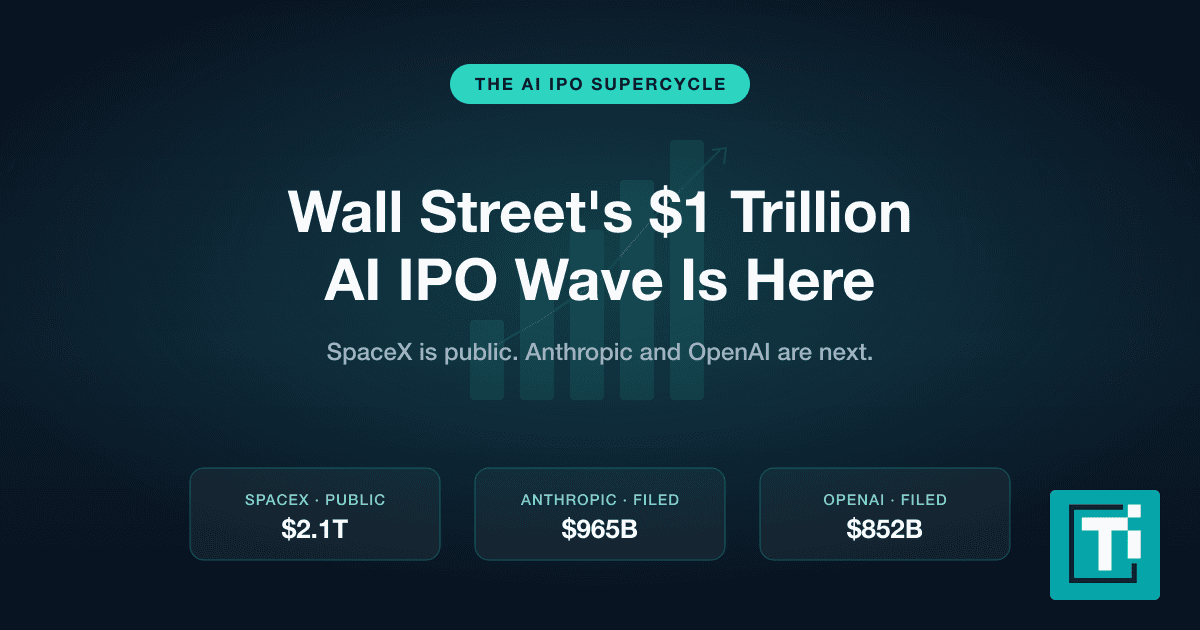
The stock rose 7.8% on Wednesday to close at $159.31, its first session after the release. Diluted earnings per share were $0.35, against consensus expectations of about $0.14. Adjusted EBITDA reached $8.8 billion, up 306% from a year earlier. TECHi's preview of the report said the quarter would be judged against the bar set in Q2, because SpaceX gives no guidance: a full quarter of its Cursor acquisition, a full quarter of interest on its $25 billion bond, and an AI capital bill that had already doubled once. On the measures the preview set, SpaceX cleared the bar — and the same release shows what the clearance cost.
- First profitNet income of $4.4 billion versus a $1.1 billion loss a year earlier; diluted EPS of $0.35 against expectations of about $0.14.
- AI is the majoritySuper Intelligence revenue of $7.56 billion was 51.9% of the total, up from 15% a year ago, and the segment posted its first operating profit.
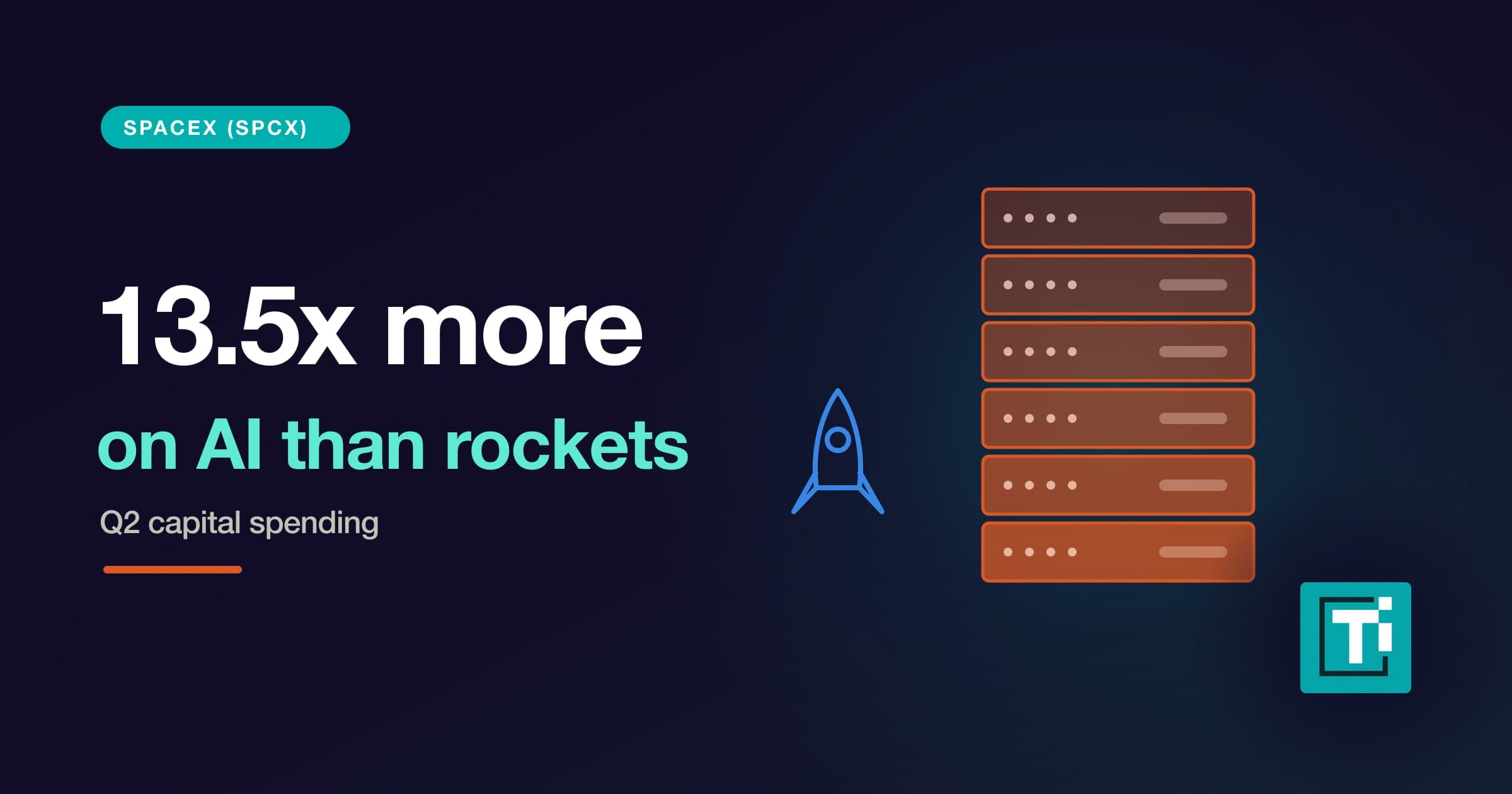
- The spending billCapital expenditure of $19.6 billion equalled 134% of quarterly revenue; SI alone spent $16.4 billion, 2.2 times its own revenue.
- Profit qualityAbout 37% of net income came from below the operating line — interest income, a $1.03 billion other-income line and a tax benefit — and nine-month free cash flow was about −$35.0 billion (TECHi calculation).
- Starlink13.6 million consumer subscribers, up 1.6 million in the quarter; consumer ARPU of $69 was down from $83 a year earlier.
The quarter against the bar Q2 set
Revenue of $14.575 billion was up 87% from Q2's $7.814 billion in a single quarter. Income from operations swung to $2.791 billion from a $143 million loss in Q2 and a $273 million loss a year earlier. The net income figure compares with a net loss of $1.054 billion in the third quarter of 2025; for the nine months to September 30, SpaceX remains $413 million in the red, because the first half's losses have not yet been fully earned back.
Segment detail from the release: Super Intelligence revenue $7.560 billion (Q2: $2.561 billion), Connectivity $5.248 billion (Q2: $4.291 billion), Space $1.767 billion (Q2: $962 million). Every segment beat the consensus figures circulating before the report, with total revenue about 15% above the $12.72 billion LSEG consensus.
| Metric | Q3 2026 | Q2 2026 | Q3 2025 |
|---|---|---|---|
| Revenue | $14.58B | $7.81B | $5.58B |
| Operating income (loss) | $2.79B | −$0.14B | −$0.27B |
| Adjusted EBITDA | $8.81B | $3.54B | $2.17B |
| Capital expenditure | $19.59B | $18.37B | $6.88B |
| Super Intelligence revenue | $7.56B | $2.56B | $0.81B |
Where the $4.4 billion came from
The operating business earned $2.791 billion of the $4.404 billion net income — about 63%. TECHi's calculation from the statements in the release shows the remaining $1.613 billion, roughly 37%, arrived below the operating line: $873 million of interest income, earned largely on the cash pile from June's IPO; $1.025 billion of other income, net, of which $561 million is identified as related-party; less $675 million of interest expense, of which $351 million is related-party; plus a $390 million income-tax benefit that added to, rather than reduced, the result.
None of that makes the profit artificial — interest income on a $51.3 billion cash balance is real money, and the operating swing from a $143 million loss to a $2.791 billion profit in one quarter is the genuine inflection. But the composition matters for what repeats. The related-party share of both the interest bill and the other-income line runs through the wider Musk ecosystem of companies, and the release does not break out what the $561 million related-party gain consists of. That detail, if it comes, will arrive in the quarterly 10-Q rather than the earnings release.
Super Intelligence is now the company
A year ago the segment SpaceX then called Artificial Intelligence produced $813 million, 15% of revenue. In Q2 it produced $2.561 billion, 33%. In Q3, renamed Super Intelligence, it produced $7.560 billion — 51.9% of everything SpaceX sold, more than Connectivity and Space combined. TECHi's calculation: $5.0 billion of the $6.8 billion of revenue SpaceX added versus Q2 came from SI alone, driven, the company says, by new cloud services agreements, the acquisition of Cursor — completed in August and consolidated for a full quarter for the first time — and adoption of its SI models and software, including Grok Bot.
SI also posted its first operating profit: $431 million, against a $1.257 billion operating loss in Q2 and a $1.722 billion loss a year earlier. Its operating margin, though, was 5.7%, against 45.1% for Connectivity — the satellite business remains far more profitable per dollar of revenue. And SI's expansion is capital-hungry in a way Starlink never was: the segment's capital expenditure was $16.444 billion in the quarter, 2.2 times its own revenue and 84% of the company total. Nameplate compute reached 1.7 gigawatts at September 30, up from 1.4 GW at June 30 and 0.6 GW a year earlier.
Starlink keeps compounding — at thinner prices
Connectivity revenue rose 69% year over year to $5.248 billion, with operating income up 99% to $2.367 billion. Starlink consumer subscribers reached 13.6 million at September 30, up 1.6 million in the quarter and from 7.2 million a year earlier; enterprise and government revenue within the segment was $2.127 billion. The trade-off is price: consumer ARPU was $69 a month, up from $66 in Q2 but down from $83 a year ago, as growth comes from cheaper plans and markets.
The Space segment, meanwhile, nearly broke even — an operating loss of just $7 million on $1.767 billion of revenue, against a $542 million loss in Q2. SpaceX flew 35 launches in the quarter (12 customer, 23 internal) and completed its first revenue-generating Starship mission, delivering 26 Starlink V3 satellites — about ten times the downlink capacity of a Falcon 9 Starlink launch, the company says.
The cash equation underneath
Total capital expenditure was $19.593 billion in the quarter, 134% of revenue. Across the nine months, SpaceX generated $13.097 billion of operating cash flow and spent $48.069 billion on property, plant and equipment — free cash flow of roughly negative $35.0 billion, by TECHi's calculation. The funding is not in question this year: cash and equivalents stood at $51.294 billion at September 30, and the company also bought $46.8 billion of marketable securities during the nine months, parking IPO proceeds. The open question is duration: at Q3's pace of spending, even a $51 billion cash balance plus securities is a runway measured in quarters, which makes SI's revenue durability — how much of Q3's cloud-agreement surge is recurring — the number that decides the story in Q4.
The merger question
On Tuesday's earnings call, Elon Musk said the boards of SpaceX and Tesla have formed committees to discuss a merger of the two companies, according to reports of the call, and argued there is "a lot of merit" in combining them. Wedbush's Dan Ives was reported estimating an 80% to 90% chance of a merger by the end of 2027. Nothing about a transaction is in the earnings release, and the two companies already transact with each other — the related-party interest and income lines above are part of that existing web — so investors should treat the committee news as a direction of travel, not a deal.
What to watch
Three things decide whether Q3 was an inflection or a spike. First, the 10-Q: it should detail the related-party other income, the digital-asset position ($1.573 billion at September 30, with a $64 million unrealized loss over nine months) and any colour on how much SI revenue is contracted versus one-off. Second, Q4 SI revenue: Q3 included the first full quarter of Cursor and the start of new cloud agreements; a flat or falling SI line would reframe this quarter as a step-change in level rather than in growth rate. Third, the spending line: capex has risen from $6.9 billion a year ago to $19.6 billion, and the market is now capitalising the company above $2 trillion on the assumption that the SI build-out converts to durable, higher-margin revenue before the cash pile thins.

Disclaimer
This article is for informational purposes only and does not constitute financial, investment, tax, or legal advice. Market data, tax rules, and prices can change after the article date. TECHi and its authors may hold positions in securities or digital assets mentioned. Always conduct your own research and consult a licensed financial, tax, or legal professional before making decisions.
About the Author
Jazib ZamanJazib Zaman founded TECHi in 2010 and is chief executive of its publisher, TechAbout LLC. He is a former member of the Forbes Technology Council. His TECHi writing covers AI infrastructure, semiconductor businesses and the financial tradeoffs of adopting new technology. His published work includes company earnings and valuations, AI software costs, and the effect of technology investment on public markets.


Comments