

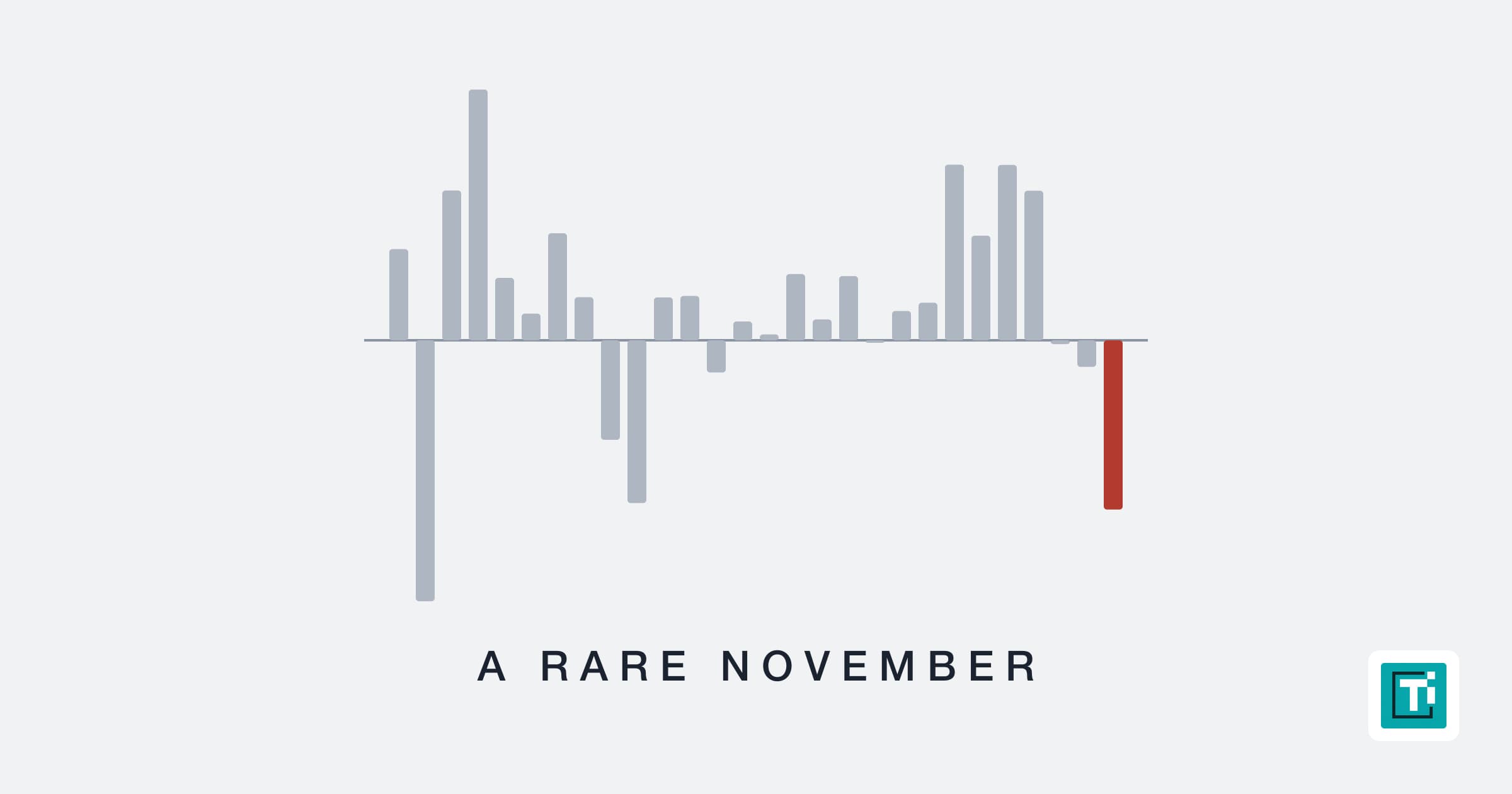
Editorial illustration drawn to scale from the Philadelphia Semiconductor Index's monthly changes from January to November 2026; the darker bar is November. Illustration: TECHi, from Nasdaq index data.
The Philadelphia Semiconductor Index rose 4.69% in Friday's shortened session to 9,186.71, but it ended November down 14.05%, its third-worst November since the index's history begins in 1999, behind only 2000 and 2008, TECHi calculates from Nasdaq index data. The gain was enough to lift the month out of second place, where it stood at Wednesday's close.
The Nasdaq Composite rose 2.31% to 24,129.50 and finished November down 5.14%, its fourth-worst November since 2000, behind 2000, 2008 and 2007. Nvidia gained only 0.8% to $150.49, after trading 4.2% higher before the open, and ended the month down 26.46%, its second-worst month in the ten years of daily prices Nasdaq publishes for the stock, behind April 2022.
Key Takeaways
- Chip indexUp 4.69% on Friday, down 14.05% for November: its third-worst November since 1999.
- NasdaqThe Composite ended November down 5.14%, its fourth-worst November since 2000.
- NvidiaDown 26.46% for the month, still its second-worst month in ten years of Nasdaq data.
- Final sessionAll ten AI hardware stocks rose on Friday, by 4.8% on average; only Arista Networks finished November higher.
- Two monthsOctober and November together cost the chip index 27.3%.
How did the last session of November go?
All ten AI hardware stocks TECHi tracks rose on Friday, by 4.85% on average from Wednesday's close, in a session that ran from 9:30 a.m. to 1 p.m. Eastern after the Thanksgiving holiday. The biggest gains were in Micron, up 7.6%, Marvell, up 7.3%, and Dell, up 6.7%. The smallest were in Vertiv, up 3.1%, and Super Micro, up 1.9%.
Neither index traded below Wednesday's close at any point. The chip index's lowest level of the day was 0.16% above Wednesday's close and its highest 5.00%, while the Nasdaq Composite ranged from 0.44% to 2.39% higher. That was a quieter session than Wednesday's, when the chip index recovered from a 7.96% fall to close down 0.65%.
| Stock | Oct. 30 close | Nov. 25 close | Nov. 27 close | Friday | November |
|---|---|---|---|---|---|
| Nvidia | $204.64 | $149.30 | $150.49 | +0.8% | −26.5% |
| Broadcom | $326.08 | $300.86 | $312.34 | +3.8% | −4.2% |
| AMD | $504.80 | $406.03 | $424.54 | +4.6% | −15.9% |
| Arista Networks | $168.86 | $163.99 | $174.73 | +6.5% | +3.5% |
| Vertiv | $232.50 | $173.37 | $178.71 | +3.1% | −23.1% |
| Super Micro | $32.95 | $23.31 | $23.76 | +1.9% | −27.9% |
| TSMC | $406.13 | $342.34 | $353.34 | +3.2% | −13.0% |
| Micron | $884.74 | $601.25 | $646.95 | +7.6% | −26.9% |
| Marvell | $196.40 | $130.93 | $140.54 | +7.3% | −28.4% |
| Dell | $424.30 | $297.06 | $316.96 | +6.7% | −25.3% |
| CoreWeave | $54.87 | $42.57 | $44.15 | +3.7% | −19.5% |
How did November rank?
The chip index's 14.05% fall in November follows a 15.36% fall in October. Over the two months, the index lost 27.25%, which ranks as its 9th-worst two-month stretch out of 324 since 1999, TECHi calculates; all eight worse stretches came between 2000 and early 2003 or in late 2008. Measured against every month since 1999, November ranks 18th from the bottom of 325.
On Thursday, TECHi calculated that the chip index needed a gain of more than 0.84% on Friday to drop to third place, behind 2008's 17.2% fall, and that the Nasdaq Composite needed more than 0.37% to move from third place to fourth, as TECHi reported. Both cleared those levels easily. Nvidia needed a gain of more than 2.58% to finish ahead of May 2019's 25.2% fall and rank third-worst; its 0.8% rise fell short, so November 2026 stays its second-worst month in Nasdaq's data, behind April 2022's 32.0% fall.
The ten AI hardware stocks ended the month down 18.08% on average, against 21.84% at Wednesday's close, TECHi calculates from their October 30 closes. Arista Networks was the only one of the ten to finish November higher, up 3.5%. The weakest were Marvell, down 28.4%, Super Micro, down 27.9%, Micron, down 26.9%, and Dell, down 25.3%.
How does the year look?
November was the chip index's third double-digit monthly fall of 2026, after July's 20.6% and October's 15.4%. Those losses followed gains of 38.4% in April and 22.1% in May, and the index was still 29.7% higher for 2026 at Friday's close, TECHi calculates from its month-end values.
Down Novembers have been uncommon. Before this year, the Nasdaq Composite fell in 6 of the 26 Novembers since 2000 and the chip index in 7 of 27 since 1999. For Nvidia, November followed a 10.4% fall in October, leaving the stock 34.1% lower over the two months.
How did the month unfold?
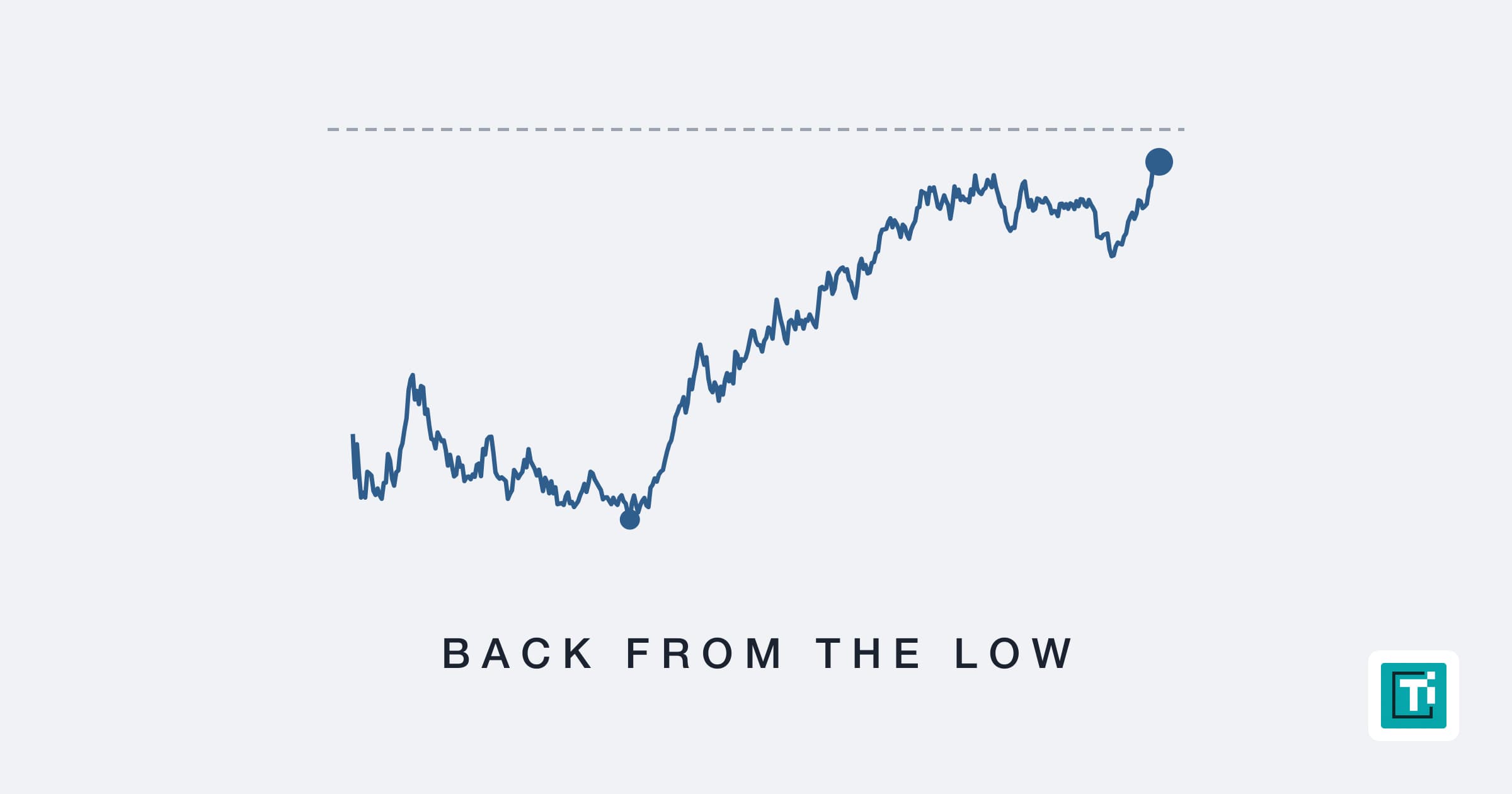
November was a month of very large daily moves. The chip index fell 12.25% on November 5 and 10.73% on November 20, when it reached its lowest close of the month at 8,408.59, down 21.33% from October's close. It then jumped 14.03% on Monday, November 23, when Nvidia's board reinstated Jensen Huang, fell 7.88% on Tuesday and slipped 0.65% on Wednesday before Friday's 4.69% gain.
From that November 20 low, the index recovered 9.25% in four sessions, which cut its monthly loss from more than a fifth to about a seventh. The Nasdaq Composite followed a similar path: it was down 11.08% for the month at its November 20 close of 22,617.73 and recovered to finish down 5.14%, TECHi calculates from Nasdaq data.
The final week's recovery means the monthly figures understate how far prices fell inside the month. Measured at the November 20 close, an investment in the chip index made at the end of October had lost more than 21%, before the rebound.
What happened to Nvidia on Friday?
Nvidia rose less on Friday than any of the ten AI hardware stocks TECHi tracks. Before the open, at 5:44 a.m. Eastern, it was up 4.2% at $155.52, as TECHi reported, but it closed at $150.49, up 0.8% from Wednesday. The move added about $29 billion of market value, based on the roughly 24.1 billion shares TECHi has used in earlier reports, against a loss of about $1.31 trillion for the month from its October 30 close of $204.64.
Over the week, the picture was different. From last Friday's close of $125.53, before its board reinstated Jensen Huang, the stock rose 19.9%, helped by a 31.5% jump on Monday, its largest one-day gain in Nasdaq's data since November 2016.
How close were the pre-market readings?
Friday's pre-market reading came closer to the final result than Monday's or Wednesday's. At 5:44 a.m., the ten stocks were up 5.84% on average; they closed up 4.85%. On Monday, TECHi's 4:30 a.m. reading had them up 7.4% and they closed up 13.6%, and on Wednesday the 6 a.m. reading had them down 5.1% and they closed down 0.8%, as TECHi reported at the time.
Individual stocks varied more. Vertiv was up 6.6% before the open and closed up 3.1%, and CoreWeave went from 7.4% to 3.7%, while Micron, Arista Networks and Dell closed higher than their pre-market readings.
How did the week end?
From last Friday's closes, the ten stocks rose 8.45% on average over the holiday week, the chip index 9.25% and the Nasdaq Composite 6.68%. The week included Monday's rally, losses on Tuesday and Wednesday morning, the Thanksgiving break and Friday's half-day gains. The S&P 500 rose 1.60% on Friday.
The weekly gains were uneven. Among the ten, Marvell rose 14.9%, Dell 14.0% and CoreWeave 11.7% from last Friday's closes, while AMD ended the week 0.04% higher and Broadcom 2.6% higher, TECHi calculates. Nvidia's 19.9% weekly gain was larger than any of theirs.
Among other stocks TECHi covered on Friday, Applied Digital rose 5.7% to $12.99, after TECHi calculated that its newest data center lease pays about 18% more per megawatt than its earlier leases, as TECHi reported. SK hynix's Nasdaq-listed shares rose 7.5% to $119.50, about 44% above the value of the Seoul shares they represent at Friday's Seoul close, after trading at a gap of about 42% before the open, as TECHi reported. SanDisk, the flash memory maker, rose 16.0%.
What to watch
- Monday's first December session, and whether chip stocks hold Friday's gains after a 9.3% weekly rise in the chip index.
- Asian chip stocks when Seoul and Taipei reopen on Monday, after Friday's rally in Seoul.
- South Korea's November export figures, due on December 1, which include memory chip shipments.
- Nvidia's first sessions in December, after its second-worst month in ten years of Nasdaq data.
- Whether SK hynix's U.S. shares keep their premium to Seoul after the Korean market reopens.
- Memory stocks, after SanDisk's 16.0% and Micron's 7.6% gains on Friday.

Disclaimer
This article is for informational purposes only and does not constitute financial, investment, tax, or legal advice. Market data, tax rules, and prices can change after the article date. TECHi and its authors may hold positions in securities or digital assets mentioned. Always conduct your own research and consult a licensed financial, tax, or legal professional before making decisions.




Comments