



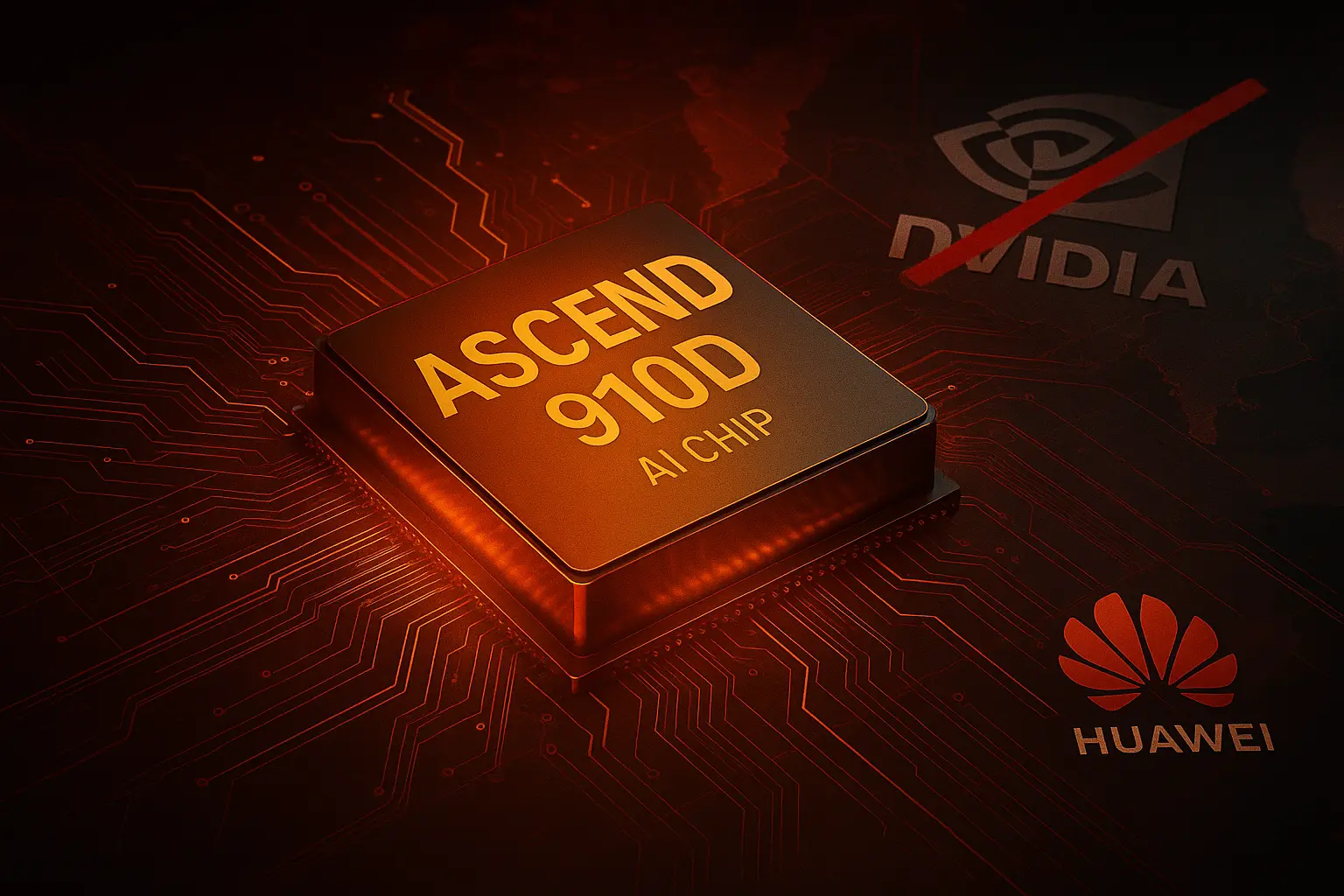
Long ago, China opened war fronts with the US. Whether it is the economy, technology, education, defence, or innovation, China is head-on competing with its Western rival. With Trump’s Liberation Day Tariffs, which led to 145% tariffs on Chinese imported goods, the trade war has escalated. In this tense situation, Chinese tech companies are also taking part by launching their latest products and innovating new technologies.
In this regard, China’s Huawei Technologies is also claiming to launch its most powerful AI chip, Ascend 910D, that will replace US chip giant Nvidia by May this year. The company is hoping that its Ascend AI processor will be more powerful than Nvidia’s H100.
910C to Replace H20
Recently, the Chinese company announced that its 910C chip will be available to Chinese customers by next month. This Chinese Chip is capable of replacing Nvidia’s H20, that is recently been banned by Trump for export without a license. The chip generated an estimated $12 billion to $15 billion in 2024. China is Nvidia’s fourth-largest region in terms of sales after the US, Singapore, and Taiwan. The US government put this license requirement in place for an indefinite period. Notably, DeepSeek’s model R1 used H20 in its research.
Along with this, the US has also restricted Nvidia from exporting the B200 chip to China.
910D Launch
The news of Huawei’s 910D chip has been broken by the Wall Street Journal, stating that a person familiar with the matter disclosed this advancement. However, the company has refrained from officially commenting on this news.
Disclaimer
This article is for informational purposes only and does not constitute financial, investment, tax, or legal advice. Market data, tax rules, and prices can change after the article date. TECHi and its authors may hold positions in securities or digital assets mentioned. Always conduct your own research and consult a licensed financial, tax, or legal professional before making decisions.
About the Author

Naba Fatima covers AI models and the software that keeps chip demand locked in. She has written about Kimi K3's low API pricing and missing open weights, Qualcomm's $3.9 billion move against Nvidia's CUDA ecosystem and Nvidia's context-memory advantage in AI data centers.

Comments