



- Revenue is not the scoreboardTesla has the bigger revenue base, but valuation prices future control, scarcity, margins, and strategic optionality.
- Tesla is a demand storyIts bull case depends on converting EV scale into software, autonomy, energy, and robotics profit pools.
- SpaceX is a bottleneck storyIts private-market premium reflects reusable launch cadence, Starlink subscription economics, and strategic orbital infrastructure.
- The risk profiles divergeTesla risks slow conversion of narrative into earnings; SpaceX risks technical, regulatory, spectrum, and mission-concentration exposure.
As of May 19, 2026, the most interesting comparison between Tesla and SpaceX is not which company is bigger. It is why investors appear willing to pay radically different prices for radically different kinds of revenue.
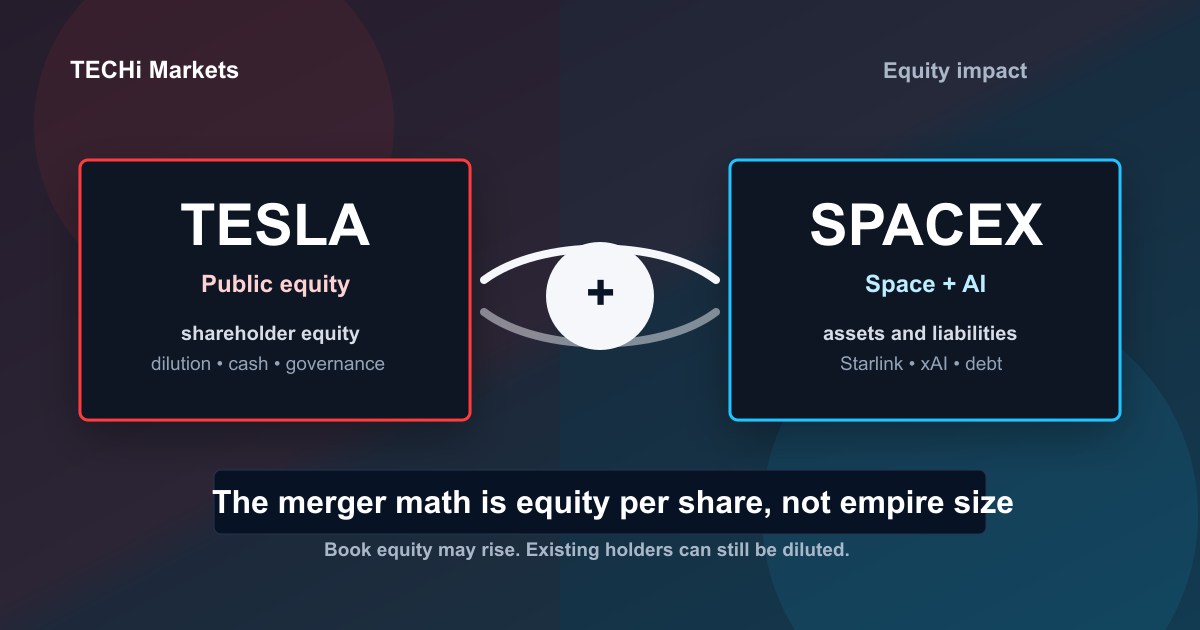
Tesla is the larger revenue machine. In its 2025 Form 10-K, Tesla reported $94.8 billion of annual revenue. In Q1 2026, it added another $22.4 billion of revenue. SpaceX, by contrast, is still private, but recent press reports put its 2025 revenue around $15 billion to $16 billion, with reported profit near $8 billion. That makes Tesla far larger on sales.
And yet the market has not priced the two companies as if revenue were the only scoreboard. Tesla trades like a public automaker trying to become an AI, energy, mobility, and robotics platform. SpaceX has been priced in private markets like scarce infrastructure: launch capacity, orbital logistics, satellite broadband, national-security connectivity, and a possible cost reset through Starship.
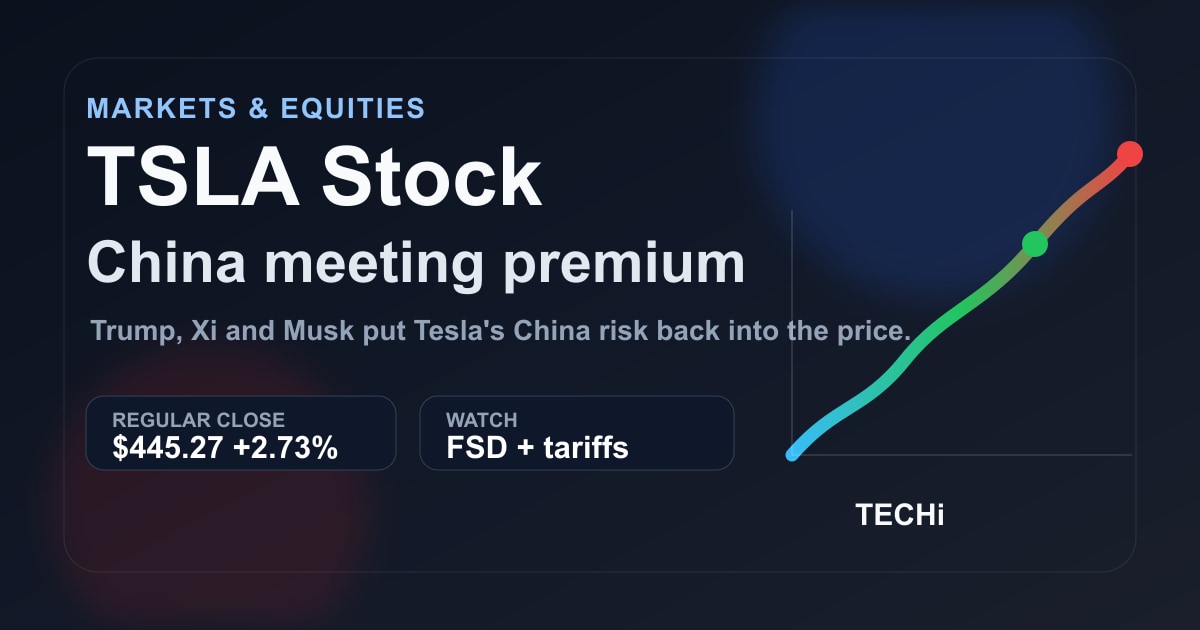
For live public-market context, TECHi tracks Tesla on its TSLA quote page, while the broader editorial lens belongs in Markets & Equities, where valuation depends on more than headline sales.
That is the puzzle. Tesla has more revenue. SpaceX may have the tighter bottleneck.
The short version
Revenue measures what customers paid last year. Valuation measures what investors think a company can control tomorrow.
Tesla’s revenue sits in the world’s largest consumer durable category, but much of it is exposed to price competition, factory utilization, subsidies, financing conditions, model cycles, China demand, and EV margin pressure. SpaceX’s revenue base is much smaller, but it is attached to something the world has very little of: reliable, reusable, high-cadence access to orbit.
That distinction changes everything. A dollar of auto revenue does not deserve the same multiple as a dollar of strategic infrastructure revenue if the second dollar has higher scarcity, better operating leverage, and fewer credible substitutes.
The undercovered point is not that one company is “better.” It is that Tesla and SpaceX are selling into different economic physics.
Business model differences: demand machine vs. constraint machine
Tesla is still, financially, a manufacturer first. Its story now stretches across autonomous driving, robotaxis, humanoid robots, batteries, charging, insurance, energy storage, and AI training infrastructure. But the financial statements remain shaped by cars, services, energy deployments, incentives, warranty costs, and factory economics.
That matters because manufacturing revenue is expensive revenue. It requires plants, labor, logistics, inventory, component supply, warranty reserves, price adjustments, working capital, and constant product refreshes. Even when Tesla is operating well, the business has to fight the basic gravity of cars: buyers compare models, competitors copy features, lenders change monthly payments, governments change incentives, and consumers delay purchases when affordability weakens.
SpaceX is different. It began as a launch company, but its model has become a vertical infrastructure loop. Reusable rockets reduce launch cost. Lower launch cost lets SpaceX deploy Starlink at a pace rivals struggle to match. Starlink creates recurring subscription revenue. Subscription revenue and government contracts help fund more rockets, more satellites, and Starship. If Starship works at scale, the cost curve could move again.
Tesla’s flywheel depends on consumer adoption and software conversion. SpaceX’s flywheel depends on physical capacity that competitors cannot quickly rent, clone, or negotiate into existence.
That is the first valuation divide. Tesla sells products into a giant competitive market. SpaceX increasingly sells access to a constrained layer of the global economy.
TAM: Tesla has the bigger map; SpaceX may have the better tollbooth
Tesla’s theoretical addressable market is enormous. Global auto revenue alone is measured in the trillions. Add grid batteries, home energy, fleet software, insurance, charging, autonomy, robotaxis, and Optimus, and the pitch becomes one of the largest TAM stories in public markets.
The EV market is still growing. The IEA’s Global EV Outlook 2025 said electric cars were on track to exceed 40% of global car sales by 2030 under stated policies. If Tesla’s autonomy stack turns privately owned vehicles into revenue-generating fleet assets, the TAM expands beyond vehicle sales into mobility services. If Optimus becomes commercially useful, the story expands again into labor substitution.
But TAM is only valuable when it can be captured. Tesla’s challenge is that every large market it targets also attracts aggressive competition. China’s EV market has become a pricing arena. Legacy automakers may be slow, but they are not dead. Battery suppliers, software companies, mapping providers, robotaxi operators, charging networks, and national champions all want pieces of the same economics.
SpaceX’s TAM is smaller if measured as “launch revenue.” That framing is too narrow. The better frame is space infrastructure. McKinsey and the World Economic Forum estimated the global space economy at about $630 billion in 2023 and projected it could reach $1.8 trillion by 2035. Launch, broadband, defense, earth observation, lunar logistics, direct-to-device connectivity, and orbital services all sit inside that opportunity.
SpaceX does not need to own every space application to be valuable. It needs to own the rails that make many of those applications cheaper or possible.
That is why SpaceX’s smaller TAM can be priced so aggressively. A smaller market with unusually high capture can beat a larger market with brutal competition.
Competitive moat: brand is not the same as bottleneck
Tesla’s moat is real. It has a global brand, manufacturing experience, battery know-how, software distribution, a major charging network, a large installed base, and an owner community that still functions like free marketing. It also has a cultural advantage: Tesla can change software faster than traditional automakers and can use its fleet as a learning surface.
But most of Tesla’s moat is contested. EV rivals can copy large screens, fast acceleration, over-the-air updates, minimalist interiors, route planning, charging partnerships, and driver-assistance features. Battery cost advantages narrow over time. Charging-network exclusivity weakens as standards open. China-based competitors can compress price in a way that turns differentiation into a moving target.
Tesla’s moat depends on staying ahead.
SpaceX’s moat depends on being hard to approach at all. Reusable launch is not just a patent or a product feature. It is an operating system made from engineering, failure history, landing data, regulatory experience, launch-site access, supplier discipline, and flight cadence. The more SpaceX launches, the more data it collects. The more rockets it lands, the more it learns about reuse. The more Starlink satellites it launches, the more network capacity it controls.
The FCC’s 2026 Starlink Gen2 order is a reminder that this is not a conventional telecom buildout. SpaceX is asking regulators to authorize a moving, orbital network that most competitors cannot practically replicate at the same speed.
That is a moat of execution, not just technology. Execution moats are ugly to build and difficult to value, but they can be extraordinary once they compound.
Growth rates: Tesla is proving a transition; SpaceX is scaling a platform
Tesla’s 2025 numbers showed the tension clearly. Total revenue declined 3% from 2024, automotive revenue declined 10%, and net income attributable to common stockholders was $3.8 billion, according to Tesla’s 10-K. Q1 2026 improved, with revenue up 16% year over year, but the strategic question did not disappear.
Tesla is not simply trying to sell more cars. It is trying to convince investors that today’s cars are the base layer for tomorrow’s higher-margin businesses. That includes FSD subscriptions, robotaxi usage, energy software, charging economics, insurance, and eventually robots. The market is pricing a transition that is not fully visible in the current income statement.
SpaceX appears to be in a different phase. Press reports summarized by Le Monde described 2025 revenue around $15 billion to $16 billion and profit near $8 billion. Those figures should be treated carefully because SpaceX is private and does not publish Tesla-style SEC filings. But the direction is important: Starlink appears to be turning launch advantage into recurring revenue and operating leverage.
Tesla is trying to turn hardware scale into software economics. SpaceX is trying to turn infrastructure dominance into subscription economics.
Those are not the same growth stories.
Valuation multiples: why SpaceX can look expensive and rational at the same time
On sales, SpaceX looks extraordinarily expensive. If private-market valuations near the hundreds of billions are applied to roughly $15 billion to $16 billion of revenue, the sales multiple is far above what a mature industrial company would receive.
But revenue multiples can be crude. A low-margin, high-competition dollar of revenue is not equal to a high-margin, scarce-capacity dollar. If SpaceX’s reported profit number is even directionally right, the company’s earnings power is far more advanced than its revenue base suggests.
Tesla has the opposite problem. Its revenue base is massive, and its public equity value is supported by far more than the present car business. TECHi’s TSLA quote page showed a rich forward multiple on May 19, 2026, which means investors are already looking past current GAAP earnings toward a future where autonomy, energy, and robotics carry more profit weight.
So the valuation comparison flips depending on the denominator.
On revenue, Tesla looks cheaper and SpaceX looks expensive. On strategic control, SpaceX may look less stretched. On current GAAP profits, Tesla’s valuation asks for a major business-model upgrade. On reported private-company profit, SpaceX looks like a company whose operating leverage may have arrived earlier than many expected.
The market is not just buying revenue. It is buying the probability that revenue becomes durable profit.
Risk profile: Tesla risks execution fatigue; SpaceX risks mission concentration
Tesla’s risk is narrative conversion. The company is valued as if autonomy, robotics, and energy will matter much more than they do in today’s financial statements. If Tesla remains mostly an EV manufacturer with a growing energy division, the valuation becomes harder to defend. If robotaxi economics work, the current revenue mix becomes less important.
Tesla also faces public-market volatility. Every delivery number, margin print, regulatory change, FSD update, China price move, and political controversy can reset sentiment. Public-market visibility is useful, but it is also punishing.
SpaceX has a different risk stack. It faces technical risk, launch failure risk, Starship schedule risk, orbital debris risk, spectrum risk, defense dependency, export-control constraints, customer concentration, and private-company opacity. The NASA Inspector General’s 2026 report on the Human Landing System program underlined that Starship delays matter not only to SpaceX, but to NASA’s Artemis schedule.
NASA’s second Artemis moon-landing contract option also shows why SpaceX is strategically important. Its risk is not that nobody needs it. Its risk is that too many important systems begin to depend on it.
Tesla’s risk is that future businesses do not arrive fast enough. SpaceX’s risk is that its future arrives with national-level complexity attached.
The deeper pricing lesson
The Tesla-SpaceX comparison is often reduced to personality, hype, or Elon Musk’s ability to sell the future. That misses the actual finance lesson.
Valuation is not a linear function of revenue. It is a judgment about the quality of future cash flows. Quality depends on margin, reinvestment needs, competition, regulation, capital intensity, customer stickiness, pricing power, and strategic scarcity.
Tesla’s bull case is that it stops being valued like a car company because cars become the data, distribution, and hardware base for autonomy and robotics. SpaceX’s bull case is that it stops being valued like a launch company because launch becomes the internal cost advantage behind a telecom and space-infrastructure platform.
Both stories require belief. The difference is where the proof is already visible.
Tesla has proven it can manufacture EVs at global scale, but it still has to prove the next layer of software and autonomy profits. SpaceX has proven it can dominate launch cadence and deploy Starlink at scale, but it still has to prove that private valuation, Starship ambition, and regulatory permission can coexist without breaking the model.
The market is not saying Tesla’s revenue is bad. It is saying revenue from a contested product market and revenue from a strategic bottleneck should not be priced the same way.
That is the answer to the pricing puzzle.
Tesla owns the larger income statement. SpaceX owns the scarcer chokepoint.
And in valuation, scarcity often beats size.
FAQ
Frequently asked questions
Why can SpaceX be valued so highly with less revenue than Tesla?
Because investors may be pricing scarce launch capacity, Starlink recurring revenue, strategic infrastructure control, and higher reported operating leverage rather than revenue size alone.
Is Tesla still primarily an automaker?
Financially, Tesla still depends heavily on vehicle revenue, but its valuation also reflects expected future profit from autonomy, energy storage, software, robotaxis, and robotics.
Are SpaceX revenue and profit figures audited public data?
No. SpaceX is private, so revenue and profit figures cited in the article are based on reputable media reports and should be read as estimates.
What is the main valuation lesson from Tesla vs. SpaceX?
A dollar of revenue from a competitive hardware market does not deserve the same multiple as a dollar tied to scarce infrastructure, high operating leverage, or strategic bottlenecks.
Disclaimer
This article is for informational purposes only and does not constitute financial, investment, tax, or legal advice. Market data, tax rules, and prices can change after the article date. TECHi and its authors may hold positions in securities or digital assets mentioned. Always conduct your own research and consult a licensed financial, tax, or legal professional before making decisions.
About the Author

Omer Sheikh covers Elon Musk-led and Musk-adjacent companies for TECHi, with a focus on Tesla, xAI, SpaceX, X, Neuralink, The Boring Company, and the public-market read-throughs from their product cycles, capital needs, AI infrastructure plans, supply chains, and regulatory risk. He also follows MicroStrategy/Strategy and its Bitcoin treasury strategy, using his finance background to connect balance-sheet decisions, capital markets, valuation, catalysts, and downside risk. His work is built for readers who want the investment case behind the headline: what changed, what it means for cash flow or market value, and what would prove the thesis wrong.