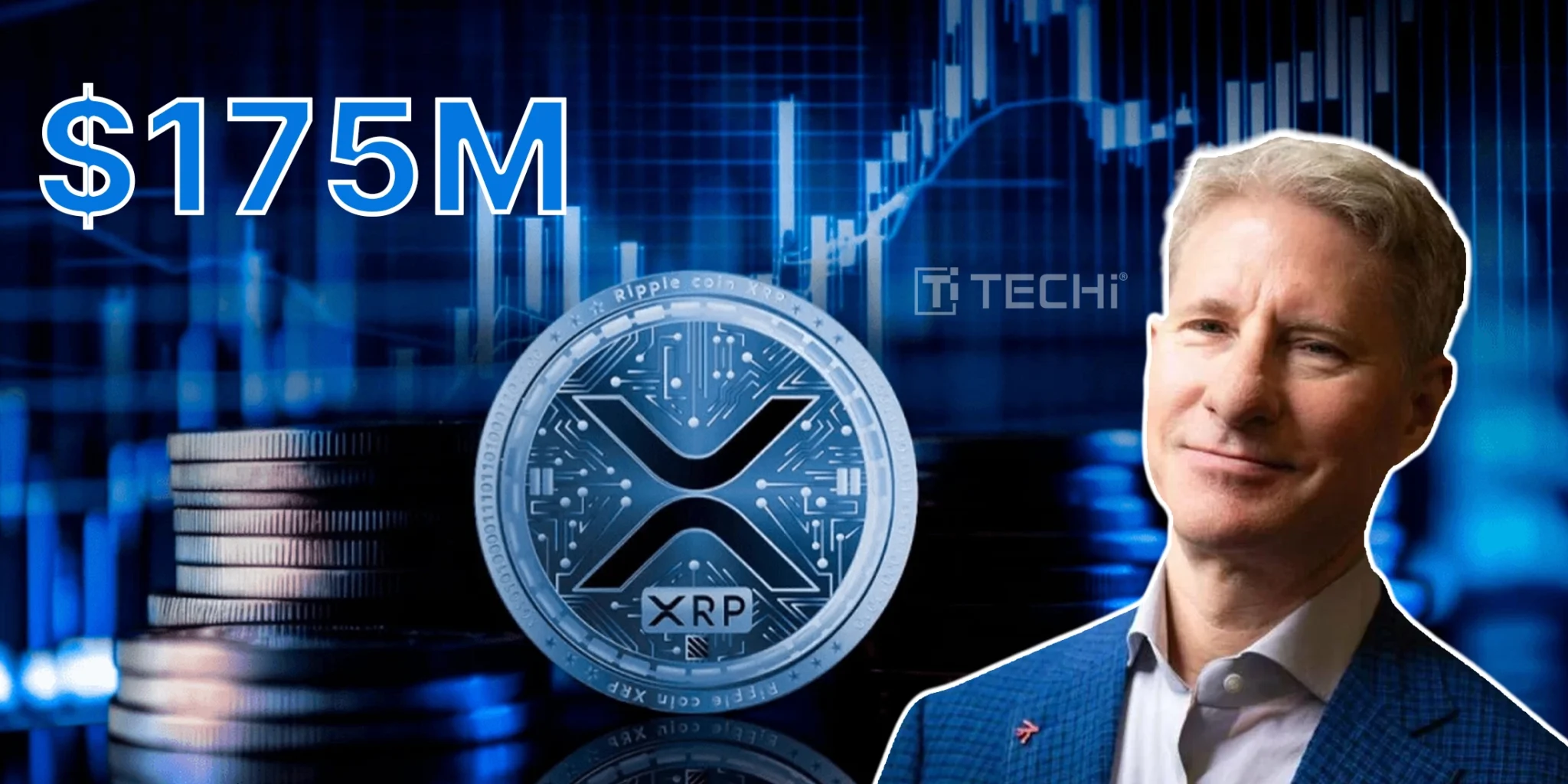
Ripple’s co-founder Chris Larsen has triggered renewed volatility in the XRP market after transferring nearly $175 million worth of XRP to multiple wallets, with a significant portion routed to centralized exchanges. The move, which came as XRP approached a multi-month price peak, has raised concerns of a potential market dump and revived long-standing debates about token distribution and insider activity.
According to reports, the transfers were conducted between July 17 and July 24, 2025. Approximately 50 million XRP was moved, with around 40 million reportedly reaching exchanges or intermediaries, sparking speculation of an impending liquidation.
The dollar figures floating around describe one batch of tokens, not two. ZachXBT priced the full 50 million XRP at about $175 million; the roughly 40 million tokens that landed at exchanges or services account for the $140 million figure, and the remaining 10 million XRP went to two freshly created wallets holding 5 million each, with no prior history. Cointelegraph's earlier report valued the same 50 million XRP at about $161 million simply because XRP had already slipped to $3.22 by the time it was written. The wallet's last comparable activity dates to 2022, which is part of why on-chain trackers picked it up so quickly.
Large Scale Transfers Track With Market Timing
The timing of Larsen’s transfers has not gone unnoticed. XRP had rallied significantly in recent weeks, buoyed by broader crypto market optimism and growing investor interest following Ripple’s partial legal victory over the U.S. Securities and Exchange Commission in 2023.
Data from CoinMarketCap shows XRP reached as high as $3.65 before retracing to the $3.08–$3.15 range following news of the transfer. The roughly 14% drop closely followed the appearance of large wallet outflows, aligning with historical patterns where insider activity often precedes price dips.
For scale: XRP set that $3.65 all-time high on July 18, the day after the first outflow. By Friday it was changing hands near $3.22, still up roughly 419% over twelve months, with a market capitalization above $190 billion that keeps it the third-largest cryptocurrency, according to CoinMarketCap. Twenty-four-hour volume ran to $15.5 billion as the transfers made the rounds. The broader market gave it cover: Bitcoin dominance held near 60% and total crypto market capitalization climbed to $3.96 trillion, so the dip read as a token-specific wobble rather than a risk-off move.
“This isn’t the first time we’ve seen major price movement follow wallet shifts by Ripple’s early stakeholders,”
said Ryan Wu, a crypto markets analyst.
“It tends to spook retail investors, and in highly emotional markets like crypto, that can trigger chain reactions.”
Also, read on about how XRP’s Seven-Year Wait Finally Pays Off
On-Chain Evidence Points to Exchange Liquidity
Blockchain tracking tools indicate the XRP was distributed across at least four addresses, with most of the volume eventually reaching exchange wallets. Some of the tokens were sent to unknown new wallets, raising additional questions about the intended destination.
A report by Cointelegraph said the wallet activity was “consistent with pre-sale behaviors” seen in past XRP dumps, including prior incidents involving Jed McCaleb—another Ripple co-founder known for structured XRP sales during earlier bull markets.
ZachXBT’s [post on X](https://x.com/zachxbt/status/1948277287033409710) read: “Since July 17, 2025 an address linked to Ripple co-founder Chris Larsen transferred out 50M XRP ($175M) to four addresses. ~$140M ended up at exchanges/services.” The post listed the recipient addresses, including one that took 30 million XRP and another that took 10 million.
XRP Price Holds Near Key Support But Volatility Remains
Following the initial price dip, XRP stabilized above $3.10, with trading volumes spiking as traders attempted to digest the market impact. Technical analysts view the $3.00–$3.15 range as a key support zone.
XRP’s performance had been among the strongest in the large-cap crypto segment this quarter, buoyed by speculation around an XRP ETF and expanded adoption through Ripple’s institutional banking partners. Ripple continues to expand its On-Demand Liquidity (ODL) product in regions including Latin America, Southeast Asia and the Middle East.
Ripple Distances Itself From Larsen’s Actions
Despite the optics, Ripple Labs has yet to issue a formal statement regarding the transfer. Historically, the company has emphasized that token holdings and decisions by founders such as Chris Larsen and Jed McCaleb are independent from the company’s strategy.
According to a 2024 legal filing reviewed by Decrypt, Ripple reiterated that Larsen’s holdings are “personal assets” not tied to Ripple’s operational treasury or ongoing partnerships.
Still, the company has faced criticism for failing to introduce mechanisms to limit sudden token dumps. Over 2.8 billion XRP about 2.8% of the total supply remains in wallets tied to Ripple co-founders, a concentration that continues to weigh on the token’s decentralization narrative.
The unease has a paper trail. When the SEC sued Ripple in December 2020, its complaint alleged that Larsen and his wife had sold more than 1.7 billion XRP on public markets for at least $450 million, and that CEO Brad Garlinghouse had sold over 321 million XRP for roughly $150 million. Both denied wrongdoing, and the SEC dropped its claims against the two executives in October 2023. Nothing about this week's transfers breaches a current restriction, but that history is why a founder's wallet heading for an exchange draws more scrutiny than any other whale's.
What’s Next for XRP Traders?
The XRP community was divided in its reaction to the news. On Binance Square, several users voiced frustration over what they perceive as recurring price manipulation. Others downplayed the event, citing growing adoption and legal clarity as more significant drivers of long-term value.
Traders and investors are closely monitoring on-chain data for signs of further movement from Larsen-linked wallets. While the co-founder has not confirmed a sale, historical data suggests large transfers are typically followed by gradual offloading.
Short-term traders are advised to watch resistance at $3.30 and support at $3.00, while long-term holders remain focused on Ripple’s ongoing partnerships and developments in token utility.
Market analysts also point to macroeconomic factors, such as rate decisions and regulatory news, as potential influences on XRP’s next move. Any renewed institutional interest especially around a spot ETF could help absorb selling pressure and revive momentum.
Conclusion
The $175 million XRP transfer by Ripple co-founder Chris Larsen has revived old questions about supply centralization and founder influence just as the token gained bullish traction. While the price has so far absorbed the shock, the market’s reaction underscores the sensitivity of crypto ecosystems to large-holder actions.
As XRP hovers above key support and Ripple pushes forward on adoption fronts, the next few days will be crucial in determining whether the token’s recent gains can be sustained or if this selloff becomes a pivot point in market sentiment.
For continued updates on this story, follow TECHi.com







Comments