

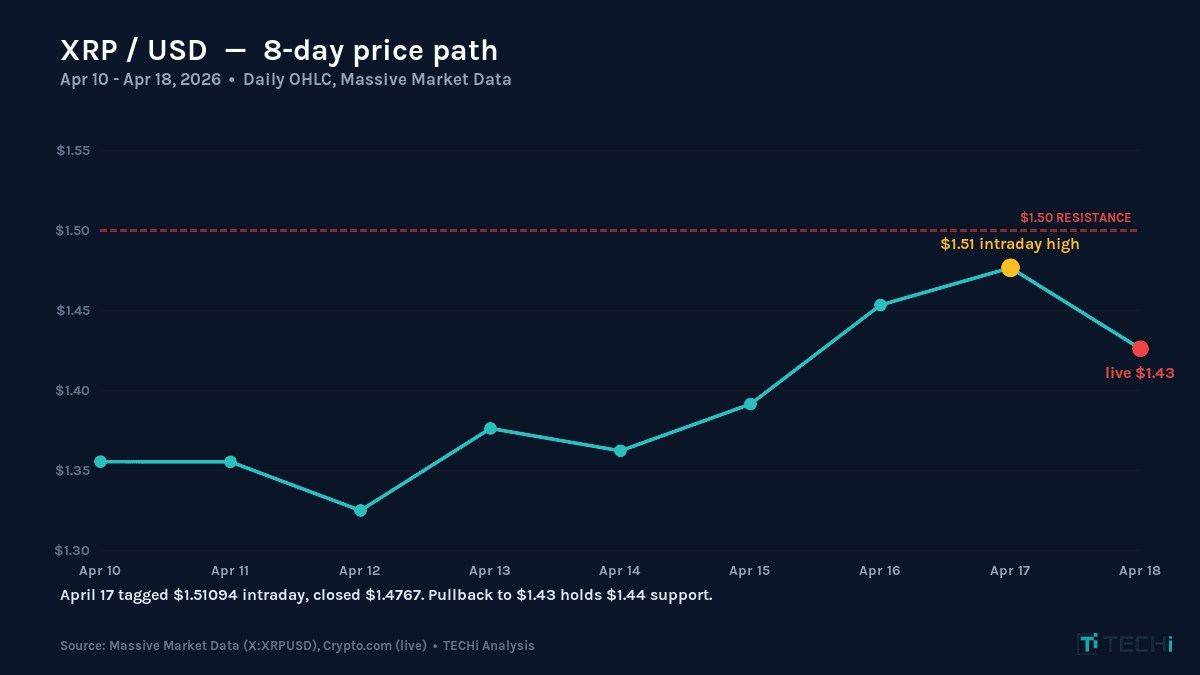
- XRP First Touched $1.50 in 2026XRP printed an intraday high of $1.51094 on April 17, the first tap of $1.50 from below since the token broke beneath that level during the February 4-5 flash sell-off to $1.21. It closed April 17 at $1.47666 on volume of 179.9M tokens. By April 19 it traded at $1.4278 on Crypto.com, still 22.4% below its 2026 opening print of $1.8392.
- Rakuten Lit Up 44M Japanese WalletsOn April 15, Rakuten Wallet launched XRP as both a listed asset and a payment method reaching 44M Rakuten Pay users and 5M merchant locations. Rakuten's 3 trillion loyalty points ($23B in circulation) can now convert to XRP.
- Six Spot ETFs, ~$1B in AUMCanary XRPC (launched Nov 13, 2025, first pure 1933 Act spot product) was joined by Bitwise, Franklin Templeton (0.19% fee), Grayscale, 21Shares, and Amplify. Combined AUM is ~$1B with ~787M XRP locked. REX-Osprey's XRPR (Sept 2025, 1940 Act wrapper) preceded them but is structurally a strategy fund. Week-ending April 11 inflows hit $119.6M, strongest since December.
- SEC-CFTC Framework Removed the OverhangOn March 17, 2026, a joint SEC-CFTC framework classified 16 digital assets as commodities, XRP included alongside BTC and ETH. This closed the last regulatory overhang from the Ripple Labs litigation settled in August 2025.
- Bear Case Is Symmetric, Not Optional7-day RSI closed at 77 (overbought). Support sits at $1.38 (50d EMA), $1.30 historical, and $1.08 if ETF inflows reverse. Top 50 wallets control 40-45% of supply; top 100 control 75-80% including exchange custody and escrow. XRP trades at 1.5-2.0x BTC beta in macro shocks.
XRP traded above $1.50 on April 17 for the first time since the February flush. It closed the session at $1.47, gave back another 3% the next morning, and by April 19 was changing hands at $1.4278 on Crypto.com. Every price screen read the same way: a 4% pullback from a local top. That framing is what most readers will see. It is also the least interesting part of what happened.
The reason XRP reached $1.50 in the first place is not technical. It is the convergence of three things that did not exist during any of XRP's prior breakout attempts: a live U.S. spot ETF ecosystem with roughly $1 billion in combined assets, a payment rail to 44 million Japanese wallets that launched on April 15, and a joint SEC-CFTC framework from March 17 that classifies XRP as a digital commodity alongside Bitcoin and Ethereum. The pullback tells you almost nothing. The setup behind it tells you almost everything.
XRP / USD · Live
$1.4278
-5.4% from Apr 17 high · -22.4% YTD
Apr 17 Close
-22.4%
Performance snapshot. XRP opened 2026 at $1.8392. The current $1.4278 print is a 22.4% year-to-date drawdown, even as the token has rallied 8.9% week-over-week on a close basis and 12.7% from the April 12 local low of $1.3250 to the April 17 high of $1.51094. The April 17 rejection has retraced 54% of that weekly move. Investors reading "XRP near $1.50" as a breakout signal should read it against a token that remains firmly below its 2026 opening print.
Why $1.50 Is the Line That Matters
The number on the screen matters less than the location. The rally that peaked at $3.66 on July 18, 2025 unwound through the fall. XRP traded roughly $2.30 to $3.10 into November, then compressed to $1.80 to $2.10 in December as the first wave of ETF creation flows matured. The structural break came during the February 4-5 flash sell-off, when XRP lost the $2.00 handle and printed an intraday low near $1.21 before stabilizing. Since that break, $1.50 has been overhead resistance, not a support shelf. April 17 was the first real upside test of $1.50 from below since the February flush.
What makes the April test different from earlier recovery attempts is the composition of the bid. Every XRP rally between February and March was retail-led on futures venues, with Binance and OKX open interest spiking before spot flows confirmed. The April run reversed that order: spot ETF inflows came first and futures chased. CoinDesk's flow tracker showed XRP investment products pulled in $224 million in the first week of April, the largest single-country-led inflow rebound since December. The difference in composition matters because ETF shares do not liquidate on a leverage unwind. Futures do.
The Rakuten Integration Is Not a Listing. It Is a Payment Rail.
On April 15, Rakuten Wallet went live with XRP as both a listed asset and a native payment method. Rakuten Pay has 44 million users in Japan. The broader Rakuten ecosystem, which includes commerce, mobile, and financial products, reaches more than 100 million members. Users can now buy XRP directly with Rakuten Points, hold it in the wallet, and spend it at over 5 million merchant locations via Rakuten Cash. CoinDesk's April 14 writeup called it the largest real-world payment integration XRP has ever received.
The number that matters most is buried. Rakuten's loyalty system has approximately 3 trillion points in active circulation, worth roughly $23 billion at the standard one-point-per-yen conversion. A sliver of that balance rotating into XRP represents a demand floor that is structurally separate from ETF flows and from speculative trading on Bybit or OKX. Loyalty-point holders are not looking at RSI. They are looking at whether they can use points at 7-Eleven. This is the first time XRP has had that kind of utility bid underneath it in any developed market.
Japan is also a jurisdiction where XRP faces no regulatory overhang. The Financial Services Agency classified XRP as a crypto asset years before the U.S. reached a conclusion. Rakuten's compliance infrastructure, which already handles KYC for tens of millions of Japanese consumers, is what made the April 15 launch possible at that scale. A Binance listing does not come with a compliance moat. Rakuten does.
Six ETFs, $1 Billion in AUM, and a Flow Curve That Has Not Stalled
Canary Capital's XRPC became the first pure 1933 Act spot XRP ETF when it opened for trading on Nasdaq on November 13, 2025. REX-Osprey's XRPR, launched in September 2025 under a 1940 Act wrapper with roughly 80% direct spot exposure, preceded it but sits structurally closer to a crypto strategy fund than a pure physically backed spot product. XRPC booked $59 million of first-day volume and closed its debut session with roughly $250 million in AUM, the highest first-day AUM of any crypto ETF launch in 2025. Franklin Templeton, Grayscale, Bitwise, 21Shares, and Amplify followed in the subsequent weeks. By mid-April 2026 there are six active spot XRP ETFs in the U.S. with combined assets of approximately $1 billion and around 787 million XRP locked in custody, per the CoinGlass ETF tracker.
Expense ratios are a live pricing signal most readers ignore. Franklin Templeton's XRPZ charges 0.19% annually, the cheapest fee in the group. Canary's XRPC sits at 0.50%. The spread implies that issuers expect the AUM race to continue into a much larger pool. When issuers undercut on fees, it is because they believe the category is about to get bigger. The Franklin Templeton fee is the same structural bet that allowed iShares and Fidelity to win the Bitcoin ETF wallet share war against Grayscale.
Weekly inflows tell the second half of the story. For the week ending April 11, XRP investment products took in $119.6 million, the strongest weekly figure since December 2025. Daily inflows during the week of April 14 averaged $17 million, with Bitwise and 21Shares leading. Cumulative net inflows since the category opened in November are approaching $1.27 billion. None of this rhymes with a product category that is done absorbing capital.
The SEC-CFTC March 17 Framework Is the Missing Piece
On March 17, 2026, the SEC and CFTC jointly issued a framework designating 16 digital assets as commodities. XRP appears on the list alongside Bitcoin, Ethereum, Solana, Cardano, Avalanche, Dogecoin, Litecoin, Chainlink, Polkadot, Hedera, Bitcoin Cash, Shiba Inu, Stellar, Tezos, and Aptos. The operational effect is that spot ETFs on any of those assets can clear the generic listing standards the SEC approved last year without being challenged on security-classification grounds. For XRP specifically, this closes out the last overhang from the Ripple Labs litigation that settled in August 2025.
This is the backdrop for why Q2 2026 looks different from Q1. Issuers that filed during the ambiguity window (Canary, Bitwise, 21Shares, Grayscale, Franklin Templeton, Amplify) are already trading. The second-wave filings from WisdomTree and others are now in final review without the legal cloud that delayed their peers. For the XRP Ledger itself, run by the XRPL Foundation, the effect is that institutional settlement integrations can proceed without a custody partner worrying about retroactive security classification.
The Bull Case: Why $1.50 Could Break Cleanly This Time
The bull case is mechanical, not narrative. If spot ETF demand continues at the pace of the last four weeks, the six funds absorb another roughly $400 million in Q2 alone. XRP has approximately 59 billion tokens in circulating supply outside escrow, but the materially smaller tradable spot float, once exchange custody, Ripple operational holdings, and long-dormant wallets are netted out, is the relevant denominator. A sustained bid that withdraws 200 million tokens per quarter from that tradable float is not a demand shock Binance order books have priced.
Layer the Rakuten bid on top. If even 0.5% of Rakuten's 3 trillion points rotate into XRP over the next twelve months, the conversion is roughly $115 million of spot demand from Japanese retail alone. That number is an order of magnitude bigger than Korean or Japanese crypto inflows have been at any point in the 2024 to 2026 cycle. TECHi's broader coverage of XRP's long-term path to $5 based on adoption, not hype, lays out why utility-driven demand compresses the path to higher prices differently than speculative flow.
If these two demand streams hold and Bitcoin stays range-bound through the summer, the arithmetic on a clean $1.50 break becomes straightforward. A close above $1.57 opens the March 2025 downtrend line. Above that, the next material resistance sits near $2.25 where the May 2025 distribution zone traded. Standard Chartered currently projects $12 by late 2027 on sustained ETF creations; Bitwise frames $3.50 as a base case tied to a $200 billion fully diluted valuation. Neither of those targets requires a euphoric cycle. They require the current flow picture to continue.
The Bear Case: Why the Pullback Could Deepen
Every bull case has a symmetric bear case. XRP investors who skip the downside case are buying a one-sided trade.
Overbought technicals. The 7-day RSI closed April 17 at 77. Any reading above 70 is overbought, and prints above 75 typically unwind to a 40 to 45 RSI before the next sustainable move higher. If that pattern repeats, the next stop is not $1.44 support. It is the 50-day EMA near $1.38. A cleaner technical reset would test the $1.30 historical support zone, which would mark a 14% drawdown from the April 17 high.
Macro overhang. Geopolitical risk remains live. An Iran ceasefire framework negotiated in late March faces scheduled review windows through late April, and any breakdown that pushes oil above $100 a barrel would flip risk-asset correlation back on. XRP, like most altcoins, trades with a beta of roughly 1.5x to 2.0x to Bitcoin on macro shocks. If Bitcoin retraces 8% on a geopolitical event, XRP tends to give up 12% to 16%. The comparison to broader BTC behavior is covered in TECHi's Bitcoin price today tracker and in the Bitcoin vs XRP market outlook.
Escrow unlock. Ripple releases one billion XRP from escrow monthly. The company typically re-escrows most of it, but the net release averages 200 to 400 million tokens per month in open market supply. If ETF demand slows at the same time that Ripple's monthly release lands, the spot float expands faster than the demand curve absorbs. This is the mechanical reason XRP rallies have historically given back large percentages in summer months, when retail flow thins and the escrow release becomes the marginal seller.
Concentration risk. The top 50 XRP wallets control roughly 40% to 45% of circulating supply, and the top 100 control 75% to 80% once exchange custody and escrow addresses are included. A single holder de-risking, as happened during the Larsen transfers of mid-2025, can mechanically push spot price down 6% to 9% in a session. The April 18 pullback, on lower volume than April 17, contained no identifiable whale signature. The next pullback might.
ETF gravity cuts both ways. If weekly inflows flip to outflows, the mechanical effect reverses. XRP's six ETFs combined hold around 787 million tokens. A $200 million weekly outflow forces redemption of approximately 140 million XRP into the spot market. That is a one-week supply shock equivalent to 40% of a typical monthly escrow unlock. The category has not been tested in an outflow regime yet. It will be.
Bear scenario roadmap. If XRP loses $1.38 (50-day EMA) on a weekly close with ETF outflows confirming, the next test is $1.30. Below $1.30, the January 2026 accumulation zone at $1.08 opens. A full retrace to $1.00 in the next 90 days would require either a Bitcoin breakdown below $58,000 or an ETF demand reversal. Neither is priced in, both are possible.
What the April 17 Session Actually Tells You
The most important detail from April 17 is not the $1.51 print. It is that XRP held the $1.44 level on the pullback. Every prior failed rally in the current structure retraced to the $1.28 to $1.30 zone within 48 hours. This time, 30 hours after the rejection, spot was still transacting in the $1.42 to $1.44 range. That behavior is consistent with a market where ETF authorized participants are buying the dip to rebalance against fund creations rather than selling into strength.
It is also consistent with a market that has not yet run out of sellers. Distinguishing between the two requires another 48 to 72 hours of tape. Until XRP prints either a decisive close above $1.51 with follow-through volume, or a decisive break of $1.38 on continuation, the most defensible read is that the April 17 session was a liquidity test of the $1.50 zone rather than a trend decision.
The Nine-Month Record: How $1.50 Became the Line
Anyone reading the April 17 tape in isolation will treat it as a standalone event. It is not. XRP has traced a full cycle in the last nine months, and the tape is specific. Reading it in order makes the $1.50 test, the 2026 YTD drawdown, and the structural shift in flow composition land in context.
July 2025 · the blow-off top. XRP printed its cycle high of $3.6662 on July 18, 2025. By July 26, K33 Research and multiple analyst desks had raised targets to $4, with $4.64 floated as an extended move on renewed ETF speculation. At the time, XRP was up roughly 66% year-to-date from a $1.90 January 2025 open. That was the peak of the narrative. It was also the peak of the price.
Late July-August 2025 · the Larsen transfers. On July 17, Ripple co-founder Chris Larsen moved approximately $175 million in XRP, with around $140 million of that flowing to exchange wallets. The transfer hit tape as XRP touched $3.66 and triggered a cascade of profit-taking. Glassnode read more than 93% of all XRP supply as in profit at the time of the transfer, a reading historically associated with aggressive distribution. By August 1 XRP was trading just above $3.07. By early August CryptoQuant flagged whale wallets offloading roughly 640 million XRP (~$1.91 billion) since early July, with distribution concentrated in the $2.28 to $3.54 range.
Early August 2025 · the $3 retest that did not hold. On August 7, XRP reclaimed $3 briefly, closing at $2.98 on Upbit-led Korean volume (~$95 million in XRP trades at the peak hour), with the SEC's scheduled discussion of Ripple's appeal withdrawal as the catalyst. The level broke back down within the session. SBI Holdings' BTC-XRP ETF filing in Japan hit the same week. Neither catalyst produced a sustained close above $3.
September 2025 · 47 days of sub-$3 consolidation. By September 8 XRP had spent 47 consecutive days below $3, stabilizing above $2.82 with resistance pinned at $2.88-$2.89 and psychological resistance at $3. Whale accumulation reappeared (~$340 million of buying in the preceding weeks) and exchange balances rose above $3.5 billion, suggesting a two-sided tape rather than a clean accumulation structure.
October 2025 · the rejection and the cascade. XRP was rejected above $3 in early October, and the October 10 liquidation cascade then drove the token down more than 40% intraday. A second attempt in late October pushed prices to $2.43 on renewed Q4 2025 ETF approval speculation, but the rally unwound without a decisive close above $2.50. This was the origin of the supply zone that would later cap every rally attempt through Q1 2026.
November 13, 2025 · Canary XRPC opens. The first pure 1933 Act spot XRP ETF began trading on Nasdaq, booking $59 million first-day volume and closing with roughly $250 million in AUM, the highest debut of any 2025 crypto ETF. This is the reference point that resets the flow regime. From this date forward, ETF creations become a measurable component of demand rather than a speculative narrative.
December 2025 · the divergence that mattered. December delivered the first cross-asset flow signal: XRP ETFs pulled in $483 million for the month while Bitcoin ETFs lost $1.09 billion and Ethereum products lost $564 million. Exchange balances contracted ~15% year-over-year to levels last seen in 2018. Standard Chartered's Geoffrey Kendrick published the now-widely-cited $8 price target on the thesis that XRP was absorbing flow Bitcoin was shedding.
January 2026 · the 18% ETF-driven open. XRP gained 18% in the first five trading days of 2026, clearing $2.16 on a daily chart breakout above a multi-month falling wedge. Volume on the breakout ran 25% above the 30-day average. This was the last print above $2 in the current cycle.
February 4-5, 2026 · the flush. XRP lost the $2.00 handle on heavy liquidation-driven selling, printing an intraday low near $1.21. This is the event that reset $1.50 from a rally waypoint into structural overhead resistance. Every subsequent price action reference in the current structure uses this low as its denominator.
March 17, 2026 · the SEC-CFTC framework. Joint regulatory designation of XRP and 15 other digital assets as commodities closed the last overhang from the Ripple litigation that had settled in August 2025.
April 15-17, 2026 · the Rakuten launch and the $1.50 test. Rakuten Wallet went live on April 15. Two sessions later, on April 17, XRP tapped $1.51094 for the first time since the February flush. It closed $1.47666 on 179.9M in volume and pulled back to $1.43 by April 18. That is where the tape stood at the end of that week.
The structural read. The 2025 peak happened on narrative-driven futures leverage with insiders distributing. The 2026 test is happening with spot ETFs leading flow, Rakuten providing non-speculative retail demand, and the regulatory overhang gone. Same price level is the wrong frame. The composition of the bid at $1.50 in April 2026 has no analog in the last nine months of XRP tape.
For a broader view of where Bitcoin sits in this same flow environment, TECHi's Bitcoin price prediction analysis covers the macro framework within which XRP now trades. The correlation has tightened materially since the SEC-CFTC framework cleared the security classification risk.
The Bottom Line
XRP at $1.43 is trading roughly 5% below the April 17 intraday high and roughly 22% below where it opened 2026. The 4% pullback that captured the headlines is not a trend decision. The question that matters is whether the combination of six live ETFs, the Rakuten payment rail, and the SEC-CFTC framework produces sustained flow into the asset over the next two quarters. If it does, the $1.50 zone converts from resistance into support and the 2025 high near $3.66 comes back on the map. If any of those pillars fails, the technical structure points to $1.30 first and $1.08 next. Investors who hold XRP today are making a bet on the durability of institutional flow, not on any single news event. The symmetric nature of that bet is the part worth thinking about.

Disclaimer
This article is for informational purposes only and does not constitute financial, investment, tax, or legal advice. Market data, tax rules, and prices can change after the article date. TECHi and its authors may hold positions in securities or digital assets mentioned. Always conduct your own research and consult a licensed financial, tax, or legal professional before making decisions.
About the Author
Muhammad Zeshan SarwarMuhammad Zeshan Sarwar is Editor-in-Chief of TECHi. His published work covers public companies, AI infrastructure and cryptocurrency networks. His portfolio includes company financial results, stock forecasts and comparisons, and explanations of blockchain upgrades and crypto-market developments.


Comments