

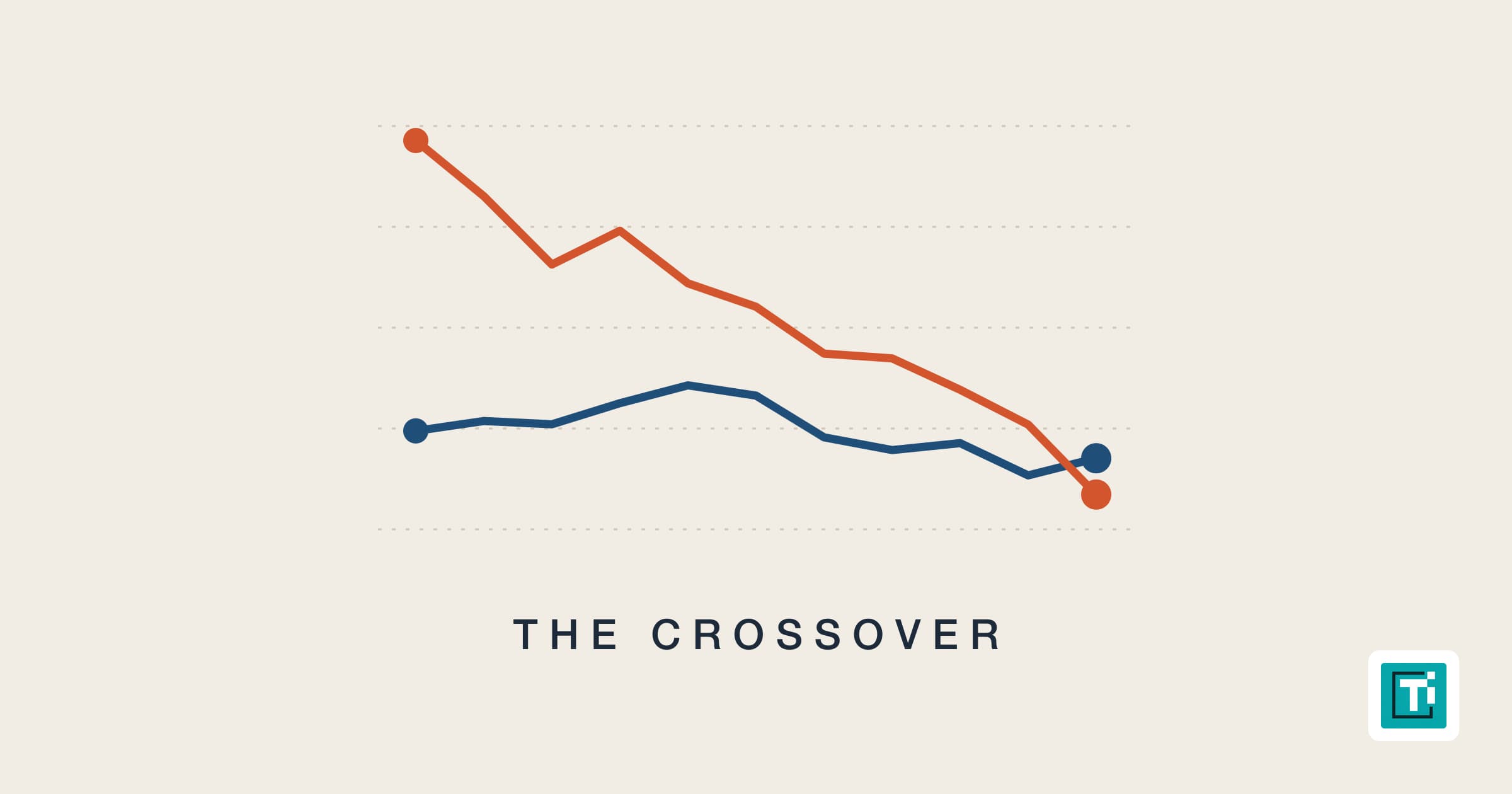
Editorial illustration. The line is the premium of TSMC's US-listed shares over the value of the five Taipei shares each one represents, by trading day from August 2024 to November 20, 2026, smoothed over five days and drawn to scale above zero; the dot marks November 20. Illustration: TECHi, from Nasdaq, Taiwan Stock Exchange and Taiwan central bank data.
TSMC's American shares have lost most of the premium they usually carry over the company's shares in Taipei. Each US-listed share represents five Taiwan shares, and it closed on Friday, November 20, 2026 at $318.71, Nasdaq data show, down 9.5% on the day. That left it worth 5.0% more than the five underlying shares at their last Taipei close, TECHi's calculation from exchange and central bank data shows. Over the past two years the gap has averaged about 18.6%.
Taipei had its first chance to react on Monday, November 23, and the shares closed at NT$2,030, up 1.5% from Friday, according to the Taiwan Stock Exchange. New curbs on short selling took effect in Taiwan the same morning. In Seoul the main index fell 3.3%, while US stock-index futures pointed to a rebound in New York.
Key Takeaways
- The gapTSMC’s US shares closed Friday at $318.71, just 5.0% above the value of the five Taipei shares each represents. The two-year median is 18.6%.
- The recordOnly one day since August 2024 showed a smaller premium: November 5, at 3.6%. A day later it was back at 15.2%.
- The weekThe ADR fell 20.1% last week and the Taipei shares 14.9%. From their October highs the falls are 34.4% and 22.6%.
- Monday in TaipeiTSMC’s Taipei shares rose 1.5% on the first day of new curbs on short selling. The Taiex rose 2.2%.
- Seoul and New YorkSeoul’s main index fell 3.3% and SK hynix 1.4%. Nasdaq-100 futures were up 2.8% after Friday’s fall.
What is the premium, and how far has it fallen?
It is the extra that investors in New York pay for TSMC compared with investors in Taipei. The company's American depositary shares trade on the New York Stock Exchange in dollars. Each one stands for five ordinary shares, which trade on the Taiwan Stock Exchange in New Taiwan dollars. Convert the Taipei price at the central bank's closing rate for the Taiwan dollar, multiply by five, and the result can be set against the ADR price.
The premium is not a fee, and no one collects it. It is the difference between the prices at which buyers and sellers in two markets are willing to trade, and it can change without either price being wrong.
The ADR has cost more for as long as the data TECHi checked goes back, to August 2024. Across 544 trading days the premium ranged from 3.6% to 33.5%, with a median of 18.6%. Over the past year the median was 15.9%. In October it was 15.3%.
Friday's figure, 5.0%, is the second-lowest in that period. The only lower reading came on November 5, at 3.6%.
The slide has been fast. A week earlier, on November 13, the premium was 11.4%. On Thursday it was 10.5%. Most of the drop came on Friday, when the ADR fell 9.5% and Taipei, whose session had ended before New York opened, did not trade again until Monday.
| Date | ADR close | Taipei close | NT$ per US$ | Five shares in US$ | ADR premium |
|---|---|---|---|---|---|
| Nov 5 | $353.10 | NT$2,240 | 32.876 | $340.67 | 3.6% |
| Nov 6 | $375.44 | NT$2,135 | 32.768 | $325.78 | 15.2% |
| Nov 13 | $398.73 | NT$2,350 | 32.838 | $357.82 | 11.4% |
| Nov 19 | $352.09 | NT$2,100 | 32.942 | $318.74 | 10.5% |
| Nov 20 | $318.71 | NT$2,000 | 32.936 | $303.62 | 5.0% |
| Nov 23 Taipei, Nov 20 ADR | $318.71 | NT$2,030 | 32.871 | $308.78 | 3.2% |
| Two-year median | n/a | n/a | n/a | n/a | 18.6% |
Why did New York fall harder than Taipei?
Partly timing, and partly who was selling. Taipei's Friday session closed at 12:30 a.m. Eastern time, nine hours before trading began in New York. The heaviest selling in US chip stocks came during the New York session that followed, as TECHi reported on Friday.
Over the whole week the gap is plain. The ADR fell 20.1% from its close on November 13. The Taipei shares fell 14.9% over the same five sessions, even though Taiwan's main index, the Taiex, dropped 17.5%, its worst week in exchange data going back to July 2024.
Measured from their highs the difference is larger still. The ADR's best close was $485.80 on October 5, and Friday's price is 34.4% below it. The Taipei shares peaked at NT$2,585 on October 6 and on Friday were 22.6% lower.
Who sold cannot be read from prices. What the numbers show is that US investors were willing to pay much less for TSMC on Friday, relative to Taipei, than at any time in the past two years except one day earlier this month.
What happened in Taipei on Monday?
The market opened lower and recovered. TSMC closed at NT$2,030, up 1.5% from Friday. It traded as low as NT$1,970 before recovering. The Taiex rose 2.2% by the close.
The rise came after a report over the weekend. Nikkei Asia reported on Sunday, citing an unnamed source, that TSMC had paused some shipments to Chinese chip designers, according to an account of the report by Tom's Hardware. The new US export rule asks chipmakers to treat chips made at 16 or 14 nanometers or finer as controlled unless their designers document their performance, that account says. TECHi could not read the original report, and the account does not include a response from TSMC.
Monday was the first day of new rules. On Saturday, Taiwan's Financial Supervisory Commission announced five measures from November 23. Investors may not sell listed shares short below the previous day's closing price, with an exception for hedging by brokers and futures firms. The minimum margin on short sales rises to 150% from 130%. Applications to issue new put warrants are suspended. The commission also encouraged listed companies to buy back their own shares and asked lenders to stop lending shares out and to recall loans where contracts allow.
At Monday's Taipei close and the current exchange rate of 32.871 Taiwan dollars per US dollar, five TSMC shares are worth $308.78. Friday's ADR close is 3.2% above that.
What does that mean for the ADR when New York opens?
The premium has to land somewhere, and where it lands sets the ADR price. TECHi's arithmetic, at Monday's Taipei close, shows three cases. If the premium stayed at Friday's 5.0%, the ADR would be worth about $324. At November's median of 11.5% it would be about $344. At the two-year median of 18.6% it would be about $366.
These are not forecasts. The premium has no fixed level, and the ADR will trade on whatever New York investors decide on Monday.
There is a recent example of how fast it can move. After the premium fell to 3.6% on November 5, it was back at 15.2% a day later. Both markets moved: the ADR rose 6.3% on November 6, and the Taipei shares fell 4.7%.
Early signals point to a higher open in New York. In Friday's after-hours trading the ADR changed hands at $328.60, 6.4% above Monday's Taipei value. Nasdaq-100 futures were up 2.8% at 1:22 a.m. Eastern time on Monday, after the Nasdaq-100 index fell 5.6% on Friday, and S&P 500 futures were up 2.0%.
What happened in Seoul?
A second day of heavy selling. The Korea Composite Stock Price Index closed down 3.3% from Friday's close, according to Korea Exchange prices published by Naver Finance. Samsung Electronics fell 1.9% and SK hynix fell 1.4%. Both supply memory chips used in AI servers, and their moves are watched in New York as a read on Micron.
The Korea Exchange suspended program trading for five minutes on Monday morning, the second session in a row it has done so, Yonhap reported. Finance Minister Lee Hyoung-il said the government had a contingency plan beyond a market stabilization fund that the authorities agreed on Sunday to prepare, but he was cautious about using the fund, saying a decision would follow a close review of the market, the news agency reported. The fund was last used after the 2008 financial crisis.
The selling came on the same morning that Korea's customs data showed chip exports in the first 20 days of November nearly quadrupling from a year earlier, to a record $38.5 billion, according to Yonhap.
What does it mean for TSMC shareholders?
It depends on which market they hold. For Taipei shareholders, Monday's close leaves the stock near where Friday ended, under new rules that limit short selling. For ADR holders, Friday's loss was larger, and part of it was a loss of premium that Taipei never matched.
The premium has been shrinking for months. Its monthly median was above 20% in nine months of 2025 and has been between 11% and 16% in each month since July. Friday's reading took it far below that.
There is a case that it comes back. It has rebounded quickly before, and the futures market pointed higher on Sunday night. There is also a case that it does not. A premium is a measure of how much extra demand there is in New York, and that demand fell sharply last week.
What to watch
The ADR's first trade on Monday, and where it leaves the premium. Whether Taipei holds its level on Tuesday after the ADR has traded. Any decision in Seoul to use the stabilization fund. TECHi's TSMC quote page carries the live price.

Disclaimer
This article is for informational purposes only and does not constitute financial, investment, tax, or legal advice. Market data, tax rules, and prices can change after the article date. TECHi and its authors may hold positions in securities or digital assets mentioned. Always conduct your own research and consult a licensed financial, tax, or legal professional before making decisions.



Comments