



Arm Holdings shares closed Monday at $322.90, up 17.16% in one session, after investors linked Meta’s fast-starting Muse agent to a much larger market for the CPUs that coordinate AI work. The move was powerful enough to create an awkward forecast: ARM now trades above the price most analysts expect it to reach a year from now.
The TECHi ARM forecast dashboard puts the primary Wall Street target at $288.71, or 10.59% below Monday’s close. Yet the same dataset still carries a Buy consensus, with 27 of 45 tracked analysts in the buy or strong-buy camp. That contradiction is the story. The market has pulled future agentic-AI demand into today’s price faster than analyst models have caught up.
This does not make the rally irrational. Arm has real operating evidence behind the excitement: data-center royalties more than doubled in its latest reported quarter, demand for its first Arm-designed data-center CPU exceeded $2 billion across fiscal 2027 and 2028, and the company has already delivered initial product to multiple customers. The difficult question is how much of that evidence is already reflected in a $344.86 billion market value.
Why ARM stock rose 17% in one day
Monday’s move was part of a broader CPU rally. Arm gained 17.16%, Intel rose 12.14% and AMD added 9.95% as investors treated Meta Muse’s early adoption as a sign that autonomous agents could create a new layer of compute demand. Meta itself jumped 11.43%.
The reasoning is more specific than “AI needs chips.” Training large models remains dominated by accelerators. Agents create work around those accelerators: planning, retrieval, memory management, database queries, code execution, tool calls and coordination across services. CPUs handle much of that orchestration. If a personal agent performs dozens of actions for each user request, CPU demand can rise even when the underlying language model becomes cheaper or more efficient.
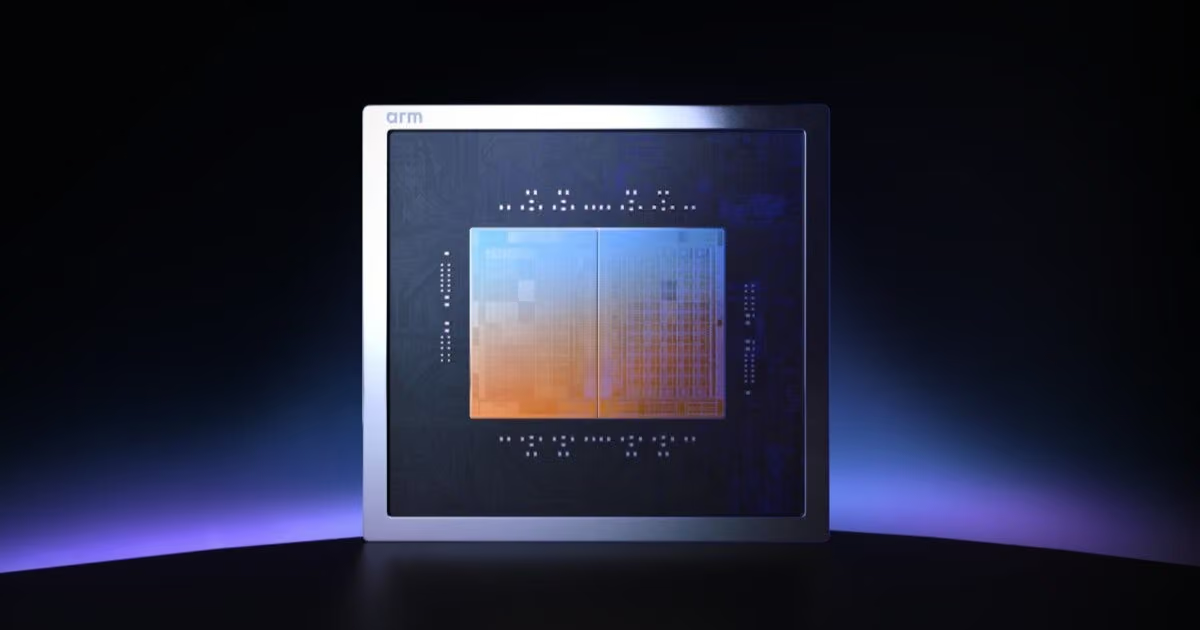
Arm has exposure to that shift through two channels. Its traditional business collects licensing fees and royalties when partners ship Arm-based silicon. Its newer AGI CPU business moves the company into finished data-center processors, where each sale can carry far more revenue but also introduces manufacturing, supply and execution risk. TECHi’s earlier Arm analysis identified this change from IP toll collector to direct AI-infrastructure supplier before Monday’s repricing.
That second channel is why the stock reacted so sharply. Muse did not announce an order for Arm products on Monday. Investors instead used the app’s download momentum as evidence that the market Arm has been describing may arrive sooner than expected.
The forecast gap investors cannot ignore
ARM’s price has outrun the current analyst base case. TECHi’s forecast page tracks a $288.71 primary target and a $278.60 median target against the $322.90 close. The high target is $500, while the low target is $125. That creates a 116.14% spread relative to the current share price.
A wide target range is useful because it exposes weak consensus. Analysts broadly like the company, but they disagree about how much of the AI infrastructure opportunity belongs in the share price today. The average target implies a decline, the most optimistic target implies 54.85% upside, and the low target implies 61.29% downside.
TECHi’s own signal-versus-consensus comparison adds another warning. The analyst rating score is 3.64 out of 5, which maps to Buy, while the TECHi Signal stance is 3.00, or Balanced watch. The gap does not say the rally must reverse. It says the market price now demands stronger evidence than the analyst label alone provides.
Monday’s volume strengthens the importance of the move. ARM traded about 12.9 million shares, nearly twice Friday’s 6.9 million. The session range ran from $293.08 to $324.16, and the stock closed near the high. Buyers did not merely lift the opening print; they kept paying higher prices through the day.
Arm has operating proof, not just an AI slogan
The strongest part of the bullish case comes from Arm’s own filings. In its fiscal first-quarter shareholder letter, the company reported $1.29 billion of revenue, up 22% year over year. Royalty revenue rose 22% to $715 million, licensing revenue climbed 23% to $574 million, and non-GAAP earnings per share increased 29% to $0.45.
Data-center royalties more than doubled from the prior year. Arm also said Neoverse shipments had passed 1.5 billion cores, with the latest 500 million shipped in nine months after the first billion took six years. That acceleration predates the Muse excitement and gives the CPU thesis a measurable base.
The new AGI CPU adds a more direct growth lever. Arm said customer demand had exceeded $2 billion across fiscal 2027 and 2028, while it had secured manufacturing capacity to support the $1 billion opportunity included in its outlook. Initial products had reached multiple customers, and the company was working to add supply.
The distinction between demand and recognized revenue matters. More than $2 billion of customer interest is not the same as $2 billion already booked on the income statement. Arm must turn the pipeline into production, ship on time and protect margins while moving beyond its familiar licensing model.
The company’s September infrastructure update named OpenAI, Meta, Cloudflare, Oracle, SAP, Lenovo, Supermicro and Verda among companies developing around the AGI CPU. That list makes the opportunity credible. It also raises the bar: investors will expect customer logos to become disclosed deployments and revenue, not remain ecosystem language.
A three-case ARM stock forecast
The next 12 months turn on whether Arm can convert enthusiasm into estimates. Monday’s closing price already sits above the consensus target, so the most useful forecast is conditional rather than a single-point promise.
Bull case: $400 to $500
ARM can move into the $400-$500 range if AGI CPU demand converts faster than management’s current $1 billion opportunity, data-center royalties keep doubling, and estimate revisions spread beyond the recent burst. The existing $500 high target implies 54.85% upside from Monday’s close.
This case needs more than strong app downloads. Arm would have to show that agent workloads materially increase CPU utilization and that the company captures the economics through both silicon sales and higher-value royalties. A successful Meta deployment would help, but broader adoption across cloud providers would make the thesis more durable.
Base case: $280 to $340
The base case is a volatile consolidation around the current analyst target range. ARM could hold much of Monday’s gain if the CPU-demand thesis remains intact, while the lack of near-term revenue proof limits further multiple expansion. The $288.71 consensus target sits inside this band.
This scenario allows the business to keep growing without assuming every agentic-AI forecast arrives at once. It also recognizes that a stock can remain above consensus targets while analysts revise their models. The important signal would be upward revenue and EPS revisions, not simply more Buy ratings.
Bear case: $220 to $260
ARM could fall toward $220-$260 if the Muse rally proves to be a sentiment event, AGI CPU shipments slip, or the company cannot expand manufacturing capacity at attractive margins. This range would still leave the stock well above its 52-week low of $100.02, but it would erase much of September’s repricing.
The bear case does not require AI demand to disappear. It only requires the revenue conversion to arrive more slowly than the valuation assumes. A broad rise in bond yields or a reversal in high-multiple semiconductor stocks would increase that risk.
The technical setup changed overnight
Before Monday’s surge, the TECHi technical dashboard showed ARM above its 20-day, 50-day and 200-day averages, with balanced RSI momentum as of Friday. Monday then carried the stock far beyond the prior $272.23 upper Bollinger reference.
That makes the old indicator values less useful as entry signals. The breakout is real, but the distance traveled in one session raises the chance of a retest. Monday’s low at $293.08 is the first practical reference because it marks where buyers defended the opening gap. Friday’s close at $275.61 is the more important level if enthusiasm fades.
On the upside, $324.16 is the session high. A clean hold above that level in regular trading would show that investors are willing to add exposure after the first wave of headlines. A quick reversal below $293 would suggest the market pulled too much demand forward.
What can move the forecast next
The first catalyst is evidence that Muse usage persists after the launch burst. Download rankings attract attention, but sustained actions per user matter more for infrastructure demand. Arm benefits when agents run continuously and coordinate more services, not when users install an app and stop using it.
The second catalyst is Arm’s next earnings report, tentatively scheduled for November 4. Investors should watch AGI CPU supply, recognized silicon revenue, data-center royalty growth and changes to the $1 billion opportunity. The company has already said demand exceeds available capacity; the forecast improves only if capacity and shipments catch up.
The third catalyst is analyst revisions. TECHi tracks 27 upward EPS revisions against four downward revisions over the latest 30-day window. If price targets rise toward the stock rather than ratings changing without new estimates, the target gap will become less concerning.
The clearest risk is valuation. A company can execute well while its stock underperforms because the market paid for several years of growth in advance. ARM’s 17% jump did not follow a new quarterly report or a raised company forecast. It followed a change in how investors interpreted the size and timing of agentic-AI demand.
Is ARM stock a buy after the rally?
ARM now offers a strong business thesis at a demanding entry price. The company has measurable data-center royalty growth, a new silicon product with more than $2 billion of stated demand and a broad customer ecosystem. Those facts separate it from speculative AI names with little revenue proof.
The stock price also sits above the analyst base target after a 17% daily move. Investors buying here are betting that analyst estimates will rise quickly enough to close that gap. The risk-reward looks better on a controlled retest near $293 than on another vertical move above Monday’s high.
Existing holders can use the AGI CPU conversion milestones as the test: shipments, revenue, gross margin and expanded capacity. New buyers should treat $324 as a confirmation level and $293 as the first support reference rather than assuming a Buy consensus guarantees upside.
The forecast is constructive on Arm’s business and cautious on the stock’s immediate setup. Agentic AI may create the CPU cycle investors expect. At $322.90, ARM already charges them for a meaningful part of it.
- PriceARM closed at $322.90 after a 17.16% one-day rally, with volume near 12.9 million shares.
- Target gapTECHi's tracked $288.71 analyst target now sits 10.59% below the market price.
- Business proofArm reported data-center royalties more than doubling and AGI CPU demand exceeding $2 billion across fiscal 2027 and 2028.
- ForecastThe bull case reaches $400-$500, while the base case is $280-$340 and the bear case is $220-$260.
FAQ
Frequently asked questions
What is the current ARM stock forecast?
TECHi's tracked analyst dataset has a primary 12-month target of $288.71, with targets ranging from $125 to $500. After ARM closed at $322.90, the primary target implied 10.59% downside.
Why did ARM stock rise 17%?
Investors linked the early adoption of Meta's Muse AI agent to stronger demand for CPUs that orchestrate agentic workloads. Arm also has existing data-center royalty growth and more than $2 billion of stated AGI CPU demand across fiscal 2027 and 2028.
What are the bull and bear cases for ARM stock?
TECHi's conditional bull range is $400-$500 if AGI CPU revenue converts quickly. The base range is $280-$340, while the bear range is $220-$260 if the agentic-AI trade cools or execution slips.
When does Arm report earnings next?
Arm's investor calendar tentatively lists its fiscal second-quarter 2027 earnings for November 4, 2026.
Disclaimer
This article is for informational purposes only and does not constitute financial, investment, tax, or legal advice. Market data, tax rules, and prices can change after the article date. TECHi and its authors may hold positions in securities or digital assets mentioned. Always conduct your own research and consult a licensed financial, tax, or legal professional before making decisions.
About the Author

Omer Sheikh covers Tesla and SpaceX as public-market stories, from the federal audit of Cybercab's safety certification to how much more SpaceX now spends on AI than on rockets. He also follows the capital moving through AI, including Nvidia's reported talks to anchor Anthropic's IPO and Intel's $15 billion request to investors.

Comments