



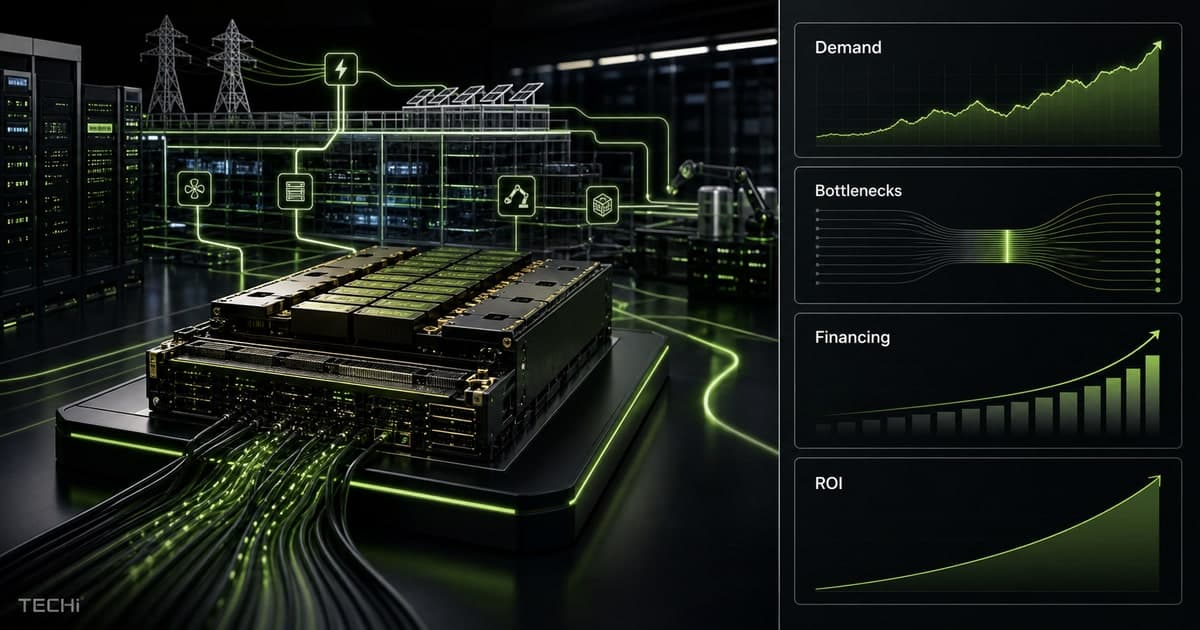
- The issueCoreWeave's Q1 proved AI cloud demand, but the stock reaction was about financing that demand.
- The backlogRevenue backlog reached $99.4 billion at March 31, 2026, up sharply from the prior year.
- The debt testQ2 guidance calls for $650 million to $730 million of interest expense against only $30 million to $90 million of adjusted operating income.
- The Nvidia linkNvidia is both CoreWeave's strategic advantage and the dependency investors must keep pricing.
CoreWeave stock did not sell off because AI demand disappeared. It sold off because Q1 numbers made the financing math harder to ignore: revenue reached $2.078 billion, revenue backlog hit $99.4 billion, net loss widened to $740 million, and interest expense doubled year over year to $536 million.
Before Nasdaq premarket trading opened on May 8, 2026, Yahoo Finance chart data showed CRWV's latest extended-hours print at $116.90, down about 15.3% from the May 6 regular close of $137.98. The regular session on May 7 closed at $128.84, down 6.6%. That is not a normal reaction to 112% revenue growth. It is the market asking whether CoreWeave can turn contracted AI-cloud demand into equity value after debt, capex and Nvidia dependency are paid for.
That makes this a different story from the earlier CoreWeave stock setup, when the main question was whether backlog growth could support the rally. After Q1, the cleaner question is whether the backlog is enough to carry the balance sheet.
The quarter was strong. The reaction was rational.
CoreWeave gave bulls plenty to work with. The company reported Q1 revenue of $2.078 billion, up 112% year over year, and adjusted EBITDA of $1.157 billion, up from $606 million in the year-earlier quarter. Backlog rose to $99.4 billion, and the company said it had surpassed 1 GW of active power while contracted power exceeded 3.5 GW.
The selloff makes sense because the same deck shows adjusted operating income dropping to $21 million from $163 million a year earlier. CoreWeave's own explanation is the important part: deployment expenses are arriving before revenue fully ramps, according to the earnings deck.
That timing gap is the whole stock. If new AI factories fill quickly, the current margin pressure can look temporary. If utilization, power delivery, component costs or customer timing slip, the gap gets financed with more debt, more dilution, or both.
The number investors should not skip
The most important line in the outlook deck is not the full-year revenue guide of $12 billion to $13 billion. It is the Q2 interest-expense guide of $650 million to $730 million against Q2 adjusted operating income guidance of only $30 million to $90 million.
Based on those ranges, guided Q2 interest expense could be more than seven times the high end of guided adjusted operating income. At the low end, the mismatch is much larger. That does not mean CoreWeave is broken. It means the equity is extremely sensitive to whether revenue arrives exactly when the financed capacity starts costing money.
The balance sheet explains why. The SEC exhibit lists $7.547 billion of current debt and $17.312 billion of non-current debt at March 31, 2026, or $24.859 billion before operating and finance lease liabilities. Total liabilities were $50.814 billion.
That is the debt test behind CRWV. Backlog is real demand visibility, but it is not cash in the door. It has to be converted through data centers, power, Nvidia systems, customer deployments and service availability.
Backlog is the asset, not the profit
CoreWeave defines revenue backlog as remaining performance obligations plus other estimated future revenue under committed customer contracts, subject to delivery and service-availability requirements. That definition matters because it is not the same as near-term revenue, free cash flow, or profit.
The Q1 deck breaks the $99.4 billion backlog into $98.8 billion of remaining performance obligations and $0.6 billion of other estimated future revenue. It also shows that the backlog stretches across multiple years, which is useful for visibility but slower for balance-sheet repair.
For investors who already know the Anthropic deal, this is the next layer. Contract wins can raise the ceiling, but the floor depends on execution: building capacity at the right cost, keeping customers attached to the platform, and turning GPU supply into recurring workloads instead of idle depreciation.
Nvidia is the advantage and the dependency
CoreWeave's Nvidia relationship is not a side note. Nvidia and CoreWeave said in January that they would expand their collaboration to accelerate more than 5 GW of AI factories by 2030, and Nvidia invested $2 billion in CoreWeave Class A shares at $87.20 per share, according to the Nvidia release.
That relationship gives CoreWeave a stronger claim on next-generation Nvidia infrastructure than most AI-cloud challengers. The same release says the companies intend to deploy multiple Nvidia generations across CoreWeave's platform, including Rubin, Vera CPUs and BlueField storage systems.
The risk is that CoreWeave's differentiation also ties the equity story to Nvidia availability, Nvidia architecture cycles and Nvidia-driven capital intensity. Investors comparing CRWV with Nvidia stock are not comparing two simple AI winners. Nvidia sells the scarce platform. CoreWeave finances, deploys and operates the capacity in a business where timing and utilization decide whether growth becomes equity value.
Valuation is now about conversion, not bookings
Public analyst-target snapshots may not fully reflect post-Q1 revisions yet, but StockAnalysis listed an average CRWV price target near $127 before the next full estimate reset. That matters because the latest extended-hours price was already close to the old consensus line, even after a sharp drop.
That leaves less room for a generic revenue-beat argument. The bull case needs evidence that the $31 billion to $35 billion FY26 capex plan in the outlook deck is tied tightly enough to signed demand to avoid stranded capacity. The bear case needs only one pressure point: interest expense, component costs, power timing, or customer concentration moving faster than operating income.
The wider AI trade still helps. Hyperscalers and AI labs need capacity, and TECHi's broader AI stocks coverage keeps pointing to compute as one of the few areas where demand remains visible. But visible demand is not the same as clean equity economics.
What would make the stock work from here
CoreWeave does not need investors to believe a vague AI story anymore. It needs them to believe a sequence: Q2 revenue lands within or above the $2.45 billion to $2.60 billion guide, adjusted operating income improves from Q1, interest expense stops rising faster than revenue, and capex converts into active customer workloads.
The first proof point will be margin. If adjusted operating income rebounds while the backlog keeps expanding, the market can treat Q1 as an expensive ramp quarter. If interest expense keeps overwhelming operating income, the stock will trade less like a pure AI growth name and more like a leveraged infrastructure vehicle.
That is also why Nvidia dependency cuts both ways. If Nvidia access lets CoreWeave bring scarce AI capacity online faster than hyperscalers can build it themselves, CRWV can deserve a premium. If Nvidia-linked spending forces CoreWeave to keep borrowing ahead of profit, the backlog can grow while common shareholders still feel pressure.
The bottom line for CoreWeave stock is simple: Q1 proved demand, but demand was not the question investors punished. The question now is whether a $99.4 billion backlog can outrun a balance sheet built to buy and deploy Nvidia-powered capacity at extraordinary speed.
FAQ
Frequently asked questions
Why did CoreWeave stock fall after Q1 2026 earnings?
CoreWeave beat Q1 revenue expectations, but investors focused on the wider net loss, heavy capex, rising interest expense and the time needed to convert backlog into profitable revenue.
How large is CoreWeave's revenue backlog?
CoreWeave reported $99.4 billion of revenue backlog as of March 31, 2026, including remaining performance obligations and other estimated future revenue under committed customer contracts.
How much debt does CoreWeave have?
CoreWeave's Q1 2026 balance sheet listed $7.547 billion of current debt and $17.312 billion of non-current debt, or $24.859 billion before lease liabilities.
Is CoreWeave dependent on Nvidia?
CoreWeave is deeply tied to Nvidia through infrastructure, GPU platforms and a January 2026 partnership expansion that included a $2 billion Nvidia investment in CoreWeave Class A shares.
Disclaimer
This article is for informational purposes only and does not constitute financial, investment, tax, or legal advice. Market data, tax rules, and prices can change after the article date. TECHi and its authors may hold positions in securities or digital assets mentioned. Always conduct your own research and consult a licensed financial, tax, or legal professional before making decisions.
About the Author

Muhammad Saqib has written for TECHi on crypto prices and AI infrastructure companies, including why CoreWeave's $99 billion backlog faces a debt test, a NetApp earnings preview centred on AI storage demand and why Dogecoin's price trends still matter to crypto investors.
Comments