



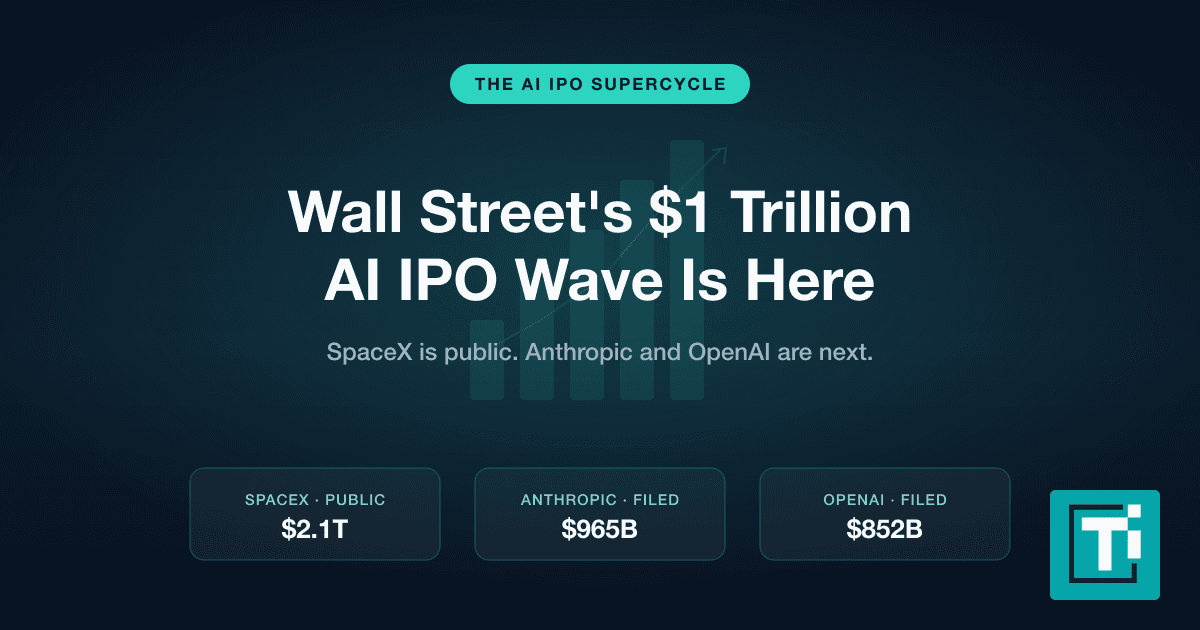
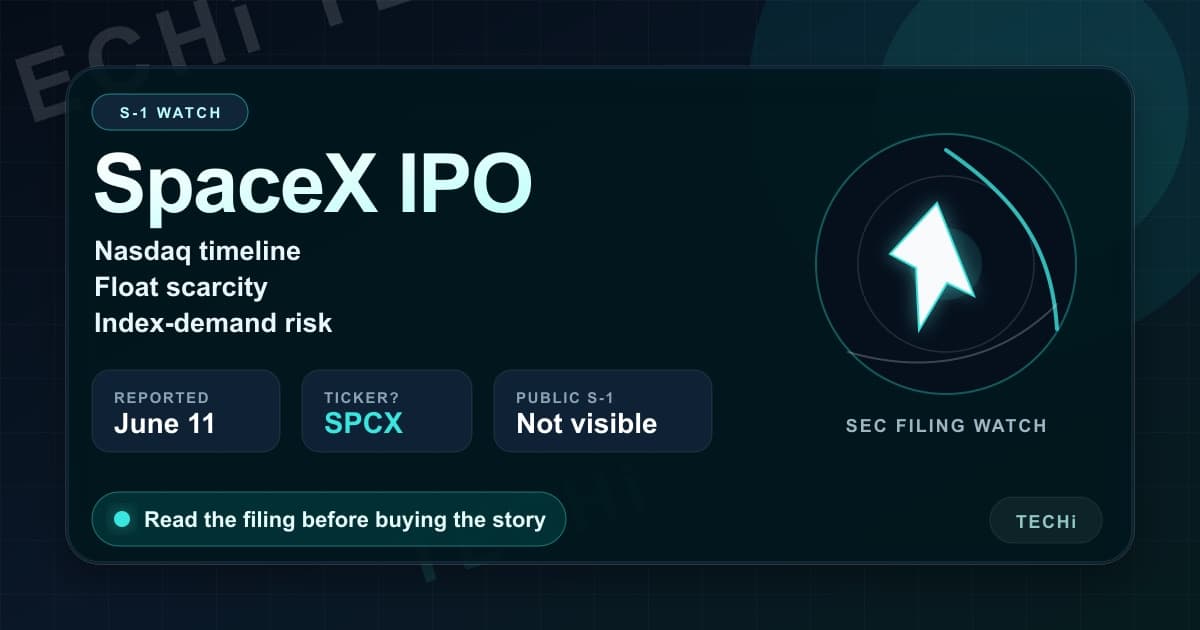
SpaceX priced its initial public offering at $135 a share on June 11 and lists on Nasdaq under the ticker SPCX from June 12. It sold 555.6 million Class A shares to raise roughly $75 billion at an implied valuation of about $1.75 trillion, the largest IPO on record; Saudi Aramco's 2019 debut raised about $25 billion. That is the fact set. What follows is a way to read it: not as a rocket company with upside, but as three stacked businesses that public markets now have to price separately, with only one of them earning money.
How it got here
In December 2025 SpaceX ran an insider tender at $421 a share, an $800 billion valuation, roughly double the $400 billion set by a July 2025 tender at $212. Chief financial officer Bret Johnsen told shareholders in the same memo that a 2026 listing was being prepared, while cautioning that timing and valuation were uncertain and the deal might not happen. It did. SpaceX submitted a confidential draft registration on April 1, 2026, filed its public S-1 on May 20, and amended it on June 1 and June 3 (SEC file no. 333-296070). Between the December tender and the IPO price, the paper valuation more than doubled again.
Layer one: connectivity is the only layer that earns
The prospectus splits 2025 into three segments. Connectivity, which is Starlink, produced $11.387 billion of revenue, 61 percent of the group's $18.674 billion, and $4.423 billion of operating income. Subscribers grew 99.9 percent during the year while average revenue per subscriber fell 11.2 percent as the service pushed into lower-priced international markets. Volume for price is the normal shape of a utility scaling out, and this is the only part of the filing an analyst can model with confidence.
Layer two: launch is flat revenue and a rising Starship bill
The Space segment, which holds Falcon, Dragon and Starship, brought in $4.086 billion and lost $657 million at the operating line. Launch-services revenue was approximately flat in 2025 even as SpaceX flew 165 Falcon missions, because 122 of those carried its own Starlink satellites and only 43 were for outside customers. Segment R&D rose 63.7 percent to $3.004 billion on Starship production, test flights and facilities. In accounting terms, launch is a cost center that the connectivity layer pays for.
Layer three: AI is the biggest loss and the biggest story
SpaceX absorbed xAI in February 2026, and the prospectus presents that unit retrospectively as a 2025 AI segment with $3.201 billion of revenue and a $6.355 billion operating loss. That one line turns a group with a profitable core into one that reported a 2025 net loss of $4.937 billion. First-quarter 2026 revenue was $4.694 billion. Anyone framing this listing as an AI story has to reckon with AI being where the money currently leaves.
What $1.75 trillion asks of the base layer
At $135, SpaceX is valued at roughly 94 times 2025 revenue and about 150 times the revenue of the one segment that makes money. There is no earnings multiple because there are no earnings. The price rests on two assumptions the filing cannot prove: that Starlink keeps compounding subscribers faster than pricing erodes, and that Starship and the AI build-out convert from cost into revenue on a timeline shareholders will tolerate. Neither is unreasonable. Both are unaudited.
Index mechanics add a separate, price-insensitive bid. Nasdaq changed its rules on March 30 to allow Nasdaq-100 inclusion fifteen trading days after listing, while S&P 500 entry remains blocked by that index's profitability requirement. We covered the flow implications in our earlier look at the S-1/A and index risk.
Governance: the margin of safety is thin by design
Public buyers get Class A shares with one vote each; Class B shares carry ten. Elon Musk holds 12.3 percent of Class A and 93.6 percent of Class B, giving him 85.1 percent of the voting power. He is chief executive, chief technology officer and chairman, and the company will use Nasdaq's controlled-company exemption from the independent-board-majority rule. The prospectus says it does not expect to pay dividends on Class A stock for the foreseeable future. The Council of Institutional Investors wrote to the company on June 9 asking for sunset provisions on the dual-class structure and stronger board independence before listing; the terms did not change. Pre-IPO investors face 180-day lock-ups with staggered release; Musk and other insiders, 366 days.
What to watch after listing
Three things will show whether the three-layer pricing holds. Whether connectivity subscribers and revenue per subscriber are disclosed each quarter in enough detail to model, since that layer carries the valuation. Whether Space R&D keeps rising faster than launch revenue, which would mean the Starship bill is still growing. And whether the AI segment's operating loss narrows or widens, because that is where the net loss is made.
The risk is plain. This is a loss-making company priced at roughly 94 times sales, with a single controlling shareholder, no dividend, and a float small enough that index and retail demand can move the price well away from anything the filing supports, in either direction. A market capitalization this size can shed hundreds of billions of dollars on ordinary volatility. Nothing in the S-1 guarantees a return, and nothing here is a recommendation to buy or sell SPCX.
FAQ
Frequently asked questions
What is the new angle in this SpaceX IPO read?
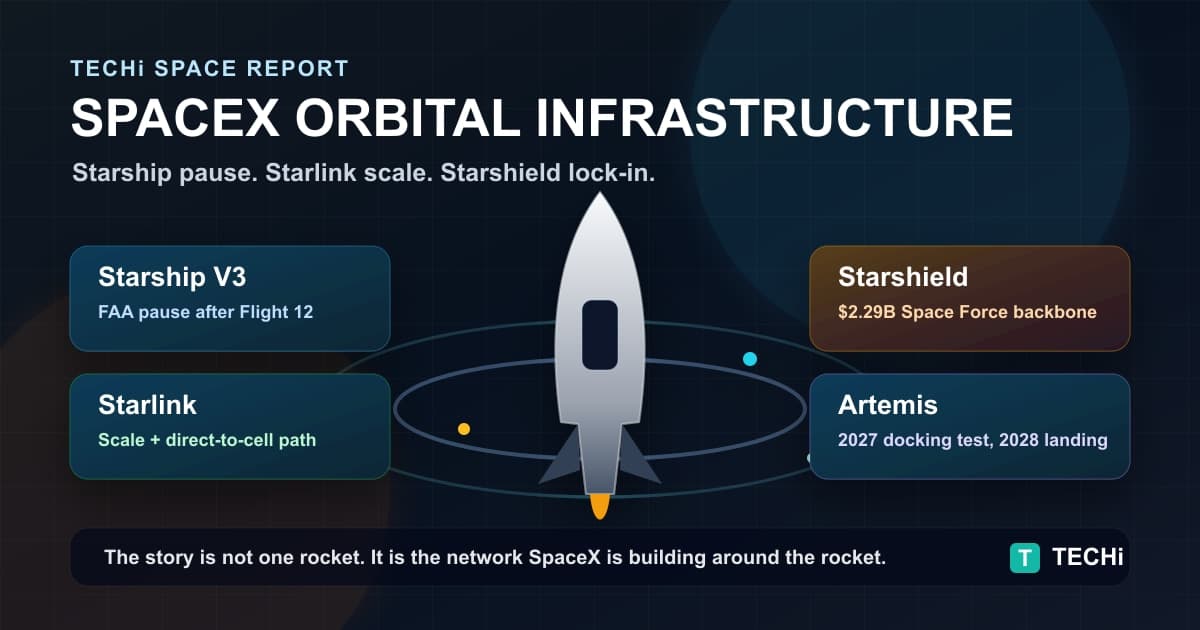
Instead of labeling it a standard launch company or AI narrative, this analysis treats SpaceX as a layered orbital-infrastructure stack where recurrence quality is the valuation floor.
How many legacy SpaceX and IPO pieces informed this angle?
I checked 200 published SpaceX-related posts and 50+ additional IPO-related posts before drafting this read.
What is the biggest valuation risk now?
The widest gap remains between ambition and measurable cadence/capital-allocation evidence after listing. Any sustained mismatch usually reprices quickly in infrastructure-heavy growth stories.
Disclaimer
This article is for informational purposes only and does not constitute financial, investment, tax, or legal advice. Market data, tax rules, and prices can change after the article date. TECHi and its authors may hold positions in securities or digital assets mentioned. Always conduct your own research and consult a licensed financial, tax, or legal professional before making decisions.
About the Author

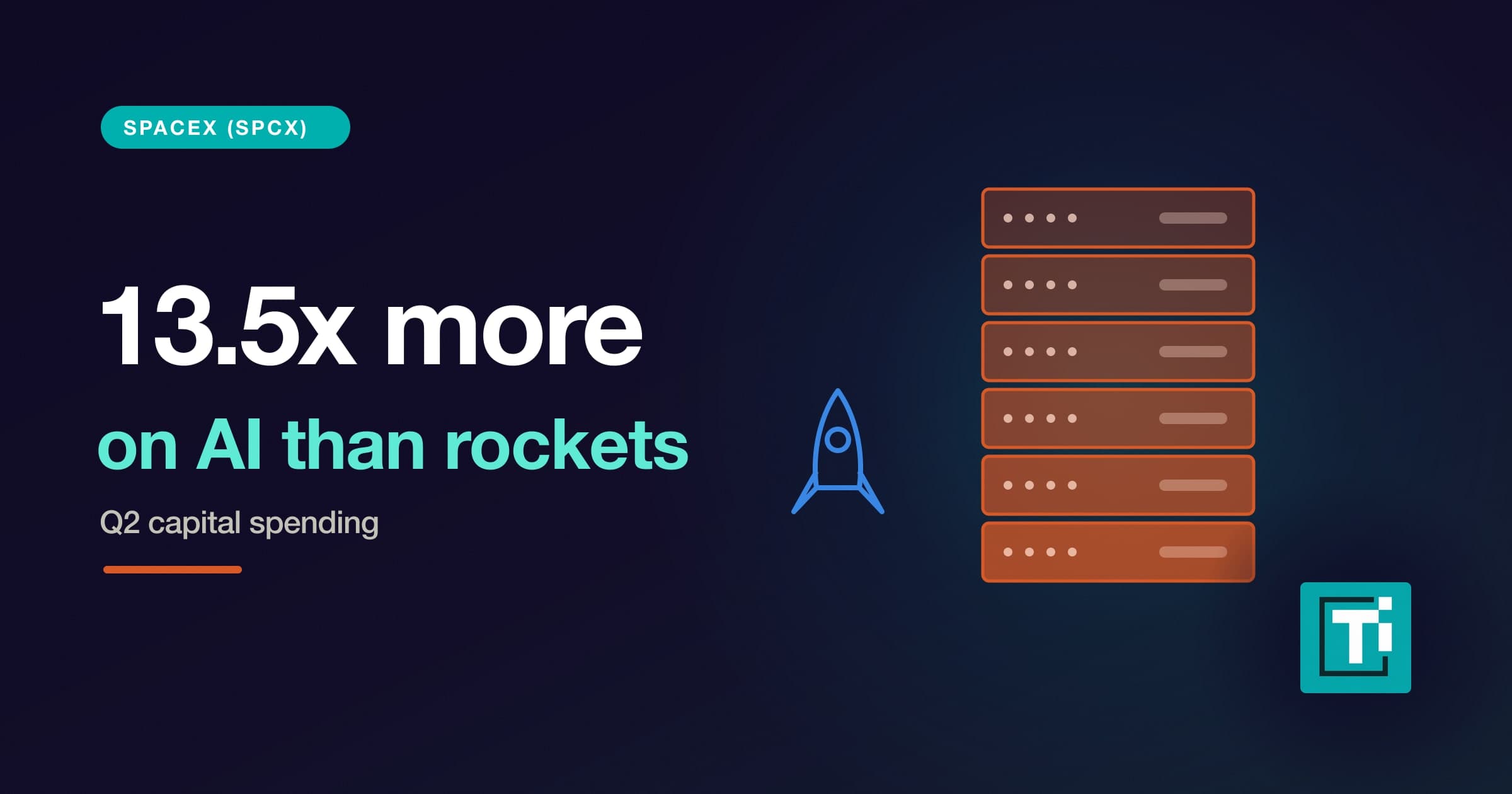
Omer Sheikh covers Tesla and SpaceX as public-market stories, from the federal audit of Cybercab's safety certification to how much more SpaceX now spends on AI than on rockets. He also follows the capital moving through AI, including Nvidia's reported talks to anchor Anthropic's IPO and Intel's $15 billion request to investors.
Comments