

A Tesla Model Y photographed in Neu-Ulm, Germany, in April 2024. Photo: Alexander Migl / Wikimedia Commons, CC BY-SA 4.0. Cropped and branded by TECHi.
Tesla approaches its third-quarter report with analysts expecting negative $4.506 billion of free cash flow. Its October 19 compilation of estimates reports sell-side forecasts, not management guidance or actual results.
For shareholders, the useful question is what could make the eventual figure better or worse. Stronger operating cash generation would improve Tesla’s ability to finance its investments. Paying for less equipment during the quarter would also improve free cash flow, but could leave a larger bill ahead.
Tesla will release its results after the market closes on Wednesday, October 21, followed by a question-and-answer webcast at 5:30 p.m. Eastern. The distinction between earning more cash and spending it later will help readers judge what the report actually establishes.
The expectations behind the cash deficit
The consensus averages are $3.267 billion of operating cash flow and $7.771 billion of capital expenditure. The operating-cash and free-cash-flow rows each contain 20 inputs; capex contains 21. Subtracting the component averages produces negative $4.504 billion, slightly different from the separately reported FCF average. With different input counts, these averages do not form one reconciled model; rounding may also contribute to the small difference.
Tesla does not endorse the forecasts. The comparison therefore needs that qualification.
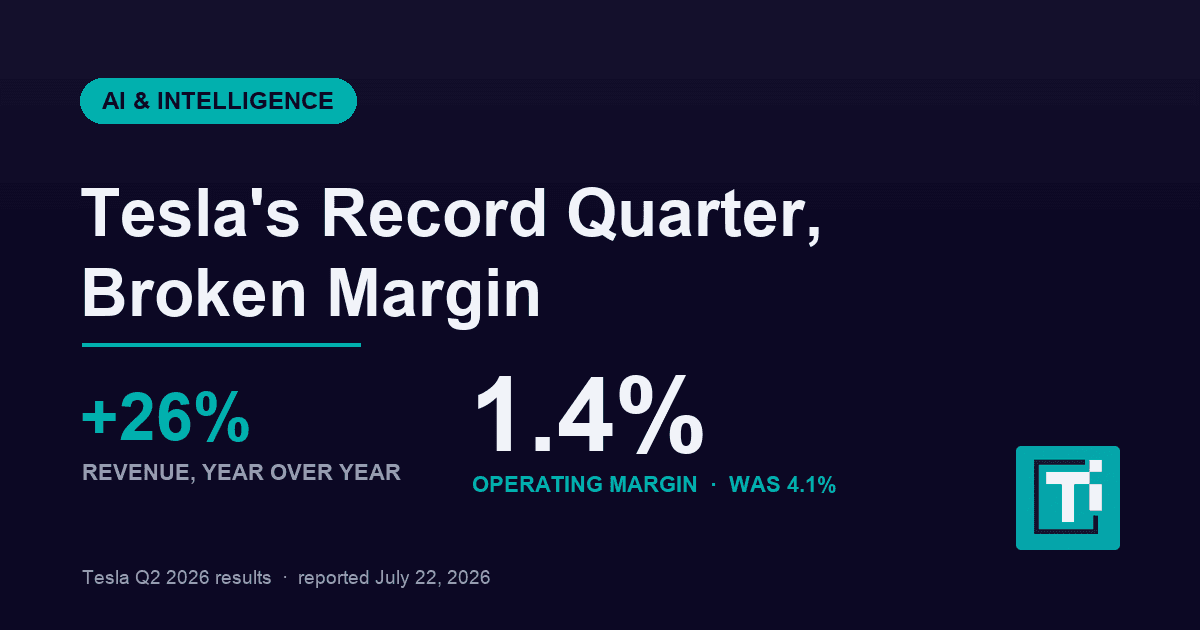
The June-quarter shareholder update provides the latest reported comparison. Tesla generated $4.697 billion from operations, spent $5.789 billion on capital assets and recorded negative $1.092 billion of free cash flow. Operating income was $398 million, with a 1.4% operating margin. Those figures describe different aspects of the business: accounting profitability, operating cash movements and investment spending.
TECHi’s earlier analysis of Tesla’s Q2 spending and margins examined that squeeze. The new October estimates make the next question more specific: which part of the cash statement would have to improve for a better result to be durable?
A cash-flow beat can have different causes
Consider two hypothetical outcomes. In one, Tesla collects an additional $1 billion from operations while investment payments match expectations. In the other, operating cash matches expectations but capital payments are $1 billion lower. Each improves free cash flow by the same amount.
The first outcome provides more internally generated cash during the period. The second retains cash that otherwise would have been invested. Neither is automatically good or bad. Their implications depend on why the change happened and whether it carries into subsequent quarters.
A reduction in investment spending could reflect more efficient construction or equipment procurement. If Tesla obtains the same productive capacity for less money, that is a substantive improvement. Alternatively, spending could fall because installation slips, equipment arrives later or a project is delayed. The cash benefit then comes with a different operating consequence.
Likewise, stronger operating cash flow deserves a closer look before it is called a permanent improvement. It can reflect better earnings, faster customer collections, inventory moving through the system or changes in payment timing. The cash is real, but the repeatability differs.
The practical reading is to compare the reported free-cash-flow result with both its components, then look for management’s explanation. A smaller deficit is a starting point for analysis. The cash-flow statement and project timetable establish what changed.
The cash balance answers a different question again. A company can borrow money and increase its reserves while reporting negative free cash flow. It can also repay debt and reduce cash despite positive free cash flow. Purchases and sales of investments introduce further movements. The balance therefore needs to be reconciled through operating, investing and financing activities; its change cannot be assumed to equal free cash flow. That separation makes a financing decision easier to interpret without confusing access to capital with cash generated by the business.
The annual plan leaves a large fourth-quarter question
Tesla’s second-quarter Form 10-Q said it expected capital expenditure above $25 billion in 2026. Its stated purposes included AI compute, data centers, manufacturing and research facilities, and company-operated assets. The filing also said spending cadence could vary with priorities, milestones and production adjustments.
The first-quarter update reported $2.493 billion in capex. Adding the June quarter’s $5.789 billion gives $8.282 billion for the first half. Against an annual plan above $25 billion, that leaves more than $16.718 billion for the second half.
There is a useful conditional calculation for Wednesday. If third-quarter spending equals the analyst average and Tesla retains that annual plan, fourth-quarter capex would need to exceed $8.947 billion, or roughly $8.95 billion. This is TECHi’s subtraction, not a quarterly forecast issued by Tesla.
A third-quarter capex undershoot would raise that remaining amount dollar for dollar if the annual plan stayed unchanged. That is why a favorable cash-flow headline could coexist with a more demanding final quarter.
Management could instead revise the annual plan. Readers would then need to distinguish a lasting efficiency gain from capacity moved into another year. The relevant evidence would be the revised spending amount, the affected projects and their production schedules.
The reverse deserves equal attention. Higher spending now could weaken quarterly free cash flow while bringing useful capacity closer to operation. Judging that result requires evidence that the assets are progressing toward productive use, rather than treating every additional dollar as either waste or future profit.
The prior-year comparison changes the perspective
Tesla’s third-quarter 2025 update reported $6.238 billion of operating cash flow, $2.248 billion of capital expenditure and positive $3.990 billion of free cash flow. That is the year-earlier comparison, distinct from the June-quarter baseline.
It reminds readers that the sign of free cash flow depends on both cash generation and investment intensity. A business can remain cash-generative before investment and still report a substantial deficit afterward. It can also report positive free cash flow while investing too little to deliver its longer-term plans.
The appropriate question is whether spending and operating performance fit together. Equipment that supports a credible production ramp has a different economic purpose from capacity with uncertain demand. A growing cash balance is helpful, but it does not independently establish that management is investing well.
The evidence needed is therefore broader than a single quarterly comparison: cash conversion in the existing business, execution of the investment program and the financial returns those assets can eventually support.
Deliveries do not settle the funding question
Tesla has already reported 486,532 vehicle deliveries and 13.7 GWh of energy-storage deployments for Q3. Its operating release cautions that those measures do not establish quarterly financial performance, which also depends on selling prices, costs and other factors.
Readers should resist filling those missing financial details with the delivery count. A customer handover is an operating milestone. How much cash it generates depends on the transaction and its costs. The earnings report supplies the missing connection between the products delivered and the company’s ability to finance its plans.
Analysts also expect $0.23 GAAP diluted EPS and $0.45 non-GAAP EPS. Neither substitutes for cash flow: the accounting basis must remain clear when comparing earnings.
Capital expenditure should also remain separate from operating expenses. As the SEC’s guide to financial statements explains, the cost of long-lived assets is spread over the periods they are used through depreciation or amortization. It is misleading to subtract the entire capex bill from operating profit as though it were an ordinary quarterly expense.
What would constitute stronger evidence?
The constructive outcome would pair better operating cash generation with investment progress that remains credible. The case would strengthen further if the improvement survives scrutiny of inventory, receivables and payments, rather than depending mainly on timing changes that could reverse.
A less decisive result would show reduced cash spending accompanied by a later project schedule. That may be a sensible management decision, but it would leave investors waiting longer for the returns expected from the assets.
A weaker result would combine disappointing operating cash generation with continued heavy investment and no clearer explanation of future cash returns. A large balance sheet can finance a period of imbalance; it cannot demonstrate that the investment itself will earn an adequate return.
Tesla’s report can resolve some of these questions through the cash-flow statement, updated spending outlook and project commentary. Where it does not provide enough detail, uncertainty should remain visible. The strongest evidence would connect a better cash result to an operating improvement Tesla can sustain.

Disclaimer
This article is for informational purposes only and does not constitute financial, investment, tax, or legal advice. Market data, tax rules, and prices can change after the article date. TECHi and its authors may hold positions in securities or digital assets mentioned. Always conduct your own research and consult a licensed financial, tax, or legal professional before making decisions.
About the Author
Omer SheikhOmer Sheikh is a markets editor at TECHi. His published work covers public companies, with particular attention to AI infrastructure, semiconductors, Tesla and SpaceX. His portfolio includes company results, stock comparisons and conditional forecasts, examining demand, capital spending and the business assumptions behind market valuations.




Comments