

Key Takeaways
- Record top lineQ2 2026 revenue rose 26% to $28.24 billion, a company record, on 480,126 deliveries — the fastest delivery growth since 2023.
- Profit collapsedOperating income fell about 57% to roughly $400 million and operating margin sank to 1.4%, from 4.1% a year earlier.
- The AI bill came dueCapital spending jumped 142% to $5.79 billion and R&D rose 49% to $2.37 billion; free cash flow turned negative at about $1.1 billion.
- Autonomy is real but tinyRobotaxi runs unsupervised in seven metros yet has logged only ~2.5 million cumulative paid miles — a rounding error against the quarterly spend.
- Net income flatters itGAAP net income held near $1.11 billion mostly on non-operating income, not the car-and-energy business, which barely broke even.
Tesla just posted its biggest revenue quarter ever, and the market treated it like a warning. Revenue rose 26% year over year to a record $28.24 billion in the second quarter of 2026, comfortably ahead of Wall Street's roughly $25.5 billion estimate. Then the stock dropped about 4% in after-hours trading, after slipping around 1.3% during the regular session. The distance between the record and the reaction is the whole quarter, and it lives in one line of the income statement: operating profit.
A record quarter that lost its profit
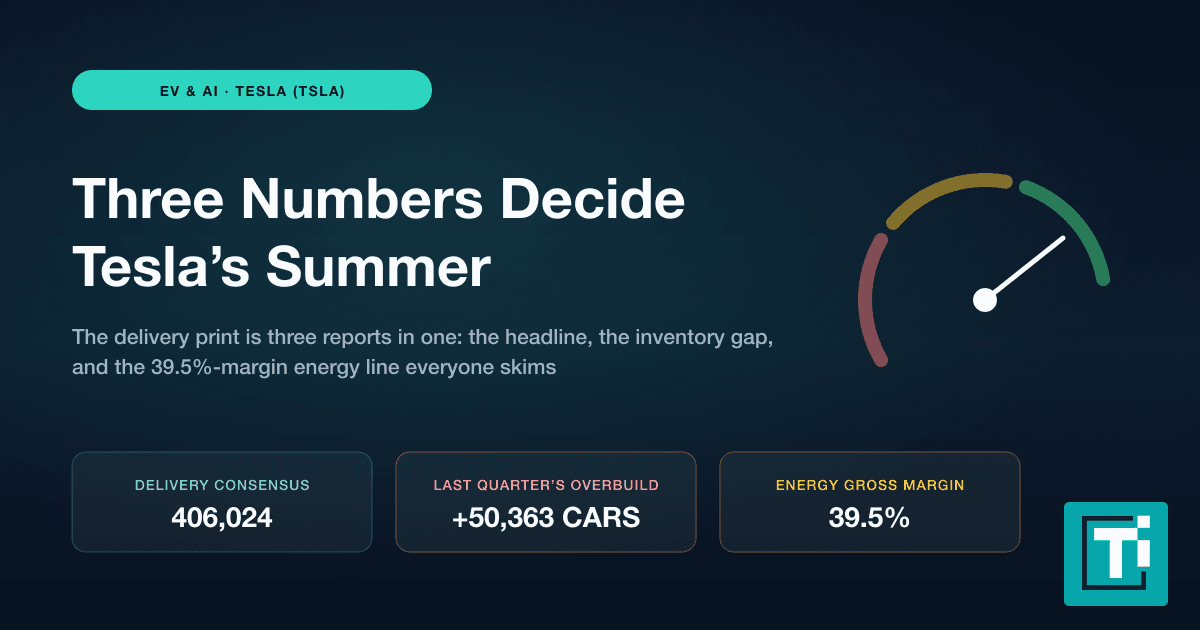
The top of the report reads like a company firing on every cylinder. Tesla delivered 480,126 vehicles, up about 25% and its fastest growth rate since 2023 — numbers we walked through when the delivery figures first landed. The Model 3 and Model Y carried the volume at 467,762 units, with the more expensive S, X, and Cybertruck lineup adding 12,364. Energy storage deployments reached 13.5 gigawatt-hours, and energy revenue rose about 13% to roughly $3.1 billion. Measured on volume and revenue alone, this was the strongest quarter in Tesla's history.
Underneath that record, the operating business barely made money. Operating income fell roughly 57% to about $400 million, and operating margin dropped to 1.4% from 4.1% a year earlier, according to Tesla's second-quarter shareholder update and its 8-K filing. Adjusted earnings landed at $0.33 a share, well short of the roughly $0.49 analysts had penciled in. A company that sold a record number of cars kept almost none of the money it took in.
Price is part of the squeeze. Average revenue per vehicle slipped to about $42,730 from roughly $45,345 a year earlier, and reported automotive gross margin held in the mid-teens, near 16%. Tesla is moving more metal at a lower price, which lifts revenue and deliveries but does little for the bottom line. Volume growth is real; pricing power is not what it was. That combination is survivable on its own — carmakers run thin margins all the time — but it collides with a spending decision Tesla made at the same moment.
Where the profit went
The money did not vanish; it was redirected. Research and development spending rose 49% to $2.37 billion. Capital expenditure jumped 142% to $5.79 billion, up from $2.39 billion a year earlier, per the Q2 financials. With that spending front-loaded, free cash flow swung to roughly negative $1.1 billion — meaning the business consumed more cash than it generated for the quarter. In plain terms, Tesla spent more building what it plans to sell next than it earned selling what it makes today.
The line items behind that spend are all AI and autonomy: the Robotaxi fleet and its charging and depot footprint, a purpose-built Cybercab line, the first Optimus manufacturing space, and silicon for the next inference chip. None of these are traditional carmaking investments that pay back through the next batch of Model Ys. They are bets on a business Tesla does not yet run at scale. That is what makes the 1.4% operating margin read differently than a normal down quarter: the profit did not evaporate into discounts or a demand air pocket, it was deliberately reinvested into an autonomy program whose revenue has barely started.
This is the shape we flagged before the print, when the pattern was still a forecast rather than a filing: AI capital spending was already eating the EV cash machine. The Q2 numbers move it from thesis to fact. The autonomy-and-robotics build is now large enough to swamp the margins of the car business that funds it, and management has signaled the elevated spending continues rather than snapping back next quarter.
There is a broader pattern Tesla now shares with the rest of the AI economy. The largest cloud companies have spent the past two years pouring capital into data centers and chips well ahead of the revenue those build-outs are meant to produce, betting that scale now buys a durable lead later. Tesla is running the same playbook in the physical world — vehicles, depots, and robots instead of server racks — and it carries the same risk: if the payoff arrives slower than the spending, the market stops paying for the promise and asks for the profit. The difference is that hyperscalers fund their bets from businesses throwing off huge free cash flow. Tesla is funding its bet from a car operation that, this quarter, generated almost no operating profit at all.
What $5.8 billion a quarter is buying
The spending is not going nowhere. Tesla now runs unsupervised Robotaxi service in seven metropolitan areas, expanded its Austin geofence, and launched commercially in Miami, Orlando, and Tampa, with Phoenix and Las Vegas in preparation and the San Francisco Bay Area still using safety drivers under state rules. On the Q2 earnings call, management said the fleet had logged about 2.5 million cumulative paid Robotaxi miles and roughly 380,000 unsupervised miles with no notable incidents, growing at close to 10% a week.
Sit with the scale for a moment. At any plausible per-mile fare, 2.5 million cumulative paid miles is a low-single-digit-million-dollar revenue stream against $5.79 billion of capital spending in a single quarter. The service is expanding quickly in percentage terms precisely because it is starting from almost nothing. That is not a criticism of the technology — a week-over-week growth rate near 10% is genuinely fast, and the reported safety record is clean so far — but it frames the honest gap between what the network costs to build today and what it earns today. We laid out why fleet density, not headline city count, is the metric that will decide the economics in our look at Robotaxi's density test.
The supervised software is scaling faster and already earns money. Full Self-Driving subscriptions reached about 1.48 million, up 56% year over year, and more than 55% of new North American deliveries now include FSD at purchase. Cumulative supervised FSD miles approached 12 billion. Cybercab production has begun at Gigafactory Texas, an Optimus line is being stood up for initial runs in the third quarter, and Tesla is targeting volume production of its next-generation AI5 inference chip next year. The autonomy program is real and moving; the question the quarter forces is how long the bill runs ahead of the revenue.
That timing gap is the same one that separates Tesla from the picks-and-shovels side of the AI trade, a contrast we drew in our NVIDIA-versus-Tesla breakdown. One company sells the compute today and books the margin now; the other is spending heavily to build a service that is supposed to pay off later. Both can be good businesses, but they ask an investor to price very different things — proven cash flow versus a credible promise — and Q2 sharpened which side of that line Tesla currently sits on.
Why the net income line flatters the quarter
On the surface, profit looks resilient: GAAP net income held near $1.11 billion, down only about 5% year over year. But that figure leans on non-operating income — interest on Tesla's large cash pile and investment gains — rather than the core operation, which ran at a 1.4% margin. Strip out the financial income and the car-and-energy business is close to breakeven while it carries the AI build. The headline earnings number is real, but it is not being produced by the thing most people think they are buying when they buy Tesla: the products.
One familiar cushion also thinned out. Regulatory credit revenue, historically near-pure profit, fell to about $146 million, down roughly 62% from the prior quarter. That high-margin buffer has propped up Tesla's bottom line for years, and its decline removes a shock absorber at exactly the moment operating margin needs one. As credits fade and pricing stays soft, the operating business has fewer places to hide a heavy capital-spending quarter — which is why a revenue record still translated into a profit miss.
What to watch from here
For anyone holding or watching the stock, three lines now matter more than the headline revenue. First, the autonomy revenue itself: whether Robotaxi begins showing up as material dollars in the financials, not just miles and metros in the slides. Second, the capital-spending path — whether 2026 proves to be the peak-investment year management implies, or whether the number keeps climbing into 2027. Third, operating margin, and whether it recovers as newer lines such as the Tesla Semi and Megapack 3 ramp on their stated 2026 timeline.
The paths from here are not complicated to picture. In the bullish case, Robotaxi revenue becomes a reported, material line and the capex reads as a moat under construction. In the base case, spending stays near record levels while autonomy grows fast off a tiny base, margins stay compressed, and the stock trades on milestones rather than earnings. In the bearish case, capex keeps climbing while robotaxi scaling slows or meets a safety or regulatory wall, and the market prices the AI premium back out of the stock.
None of this makes Tesla's AI bet wrong. It makes the bet visible. For most of the past two years the autonomy story lived on slides and demos while the car business quietly paid the bills; Q2 is the quarter where the spending grew large enough to show up in the margin line and the cash flow statement at the same time. Until Robotaxi and Optimus turn miles and prototypes into reported margin, Tesla is asking the market to underwrite a multi-year build on the strength of the promise. This quarter, that promise got measurably more expensive to hold — and the after-hours drop said investors noticed.
FAQ
Frequently asked questions
Did Tesla beat earnings in Q2 2026?
Partly. Revenue beat at a record $28.24 billion, up 26% year over year, but adjusted earnings of $0.33 a share missed the roughly $0.49 estimate and operating income fell about 57%.
Why did Tesla's operating margin fall to 1.4%?
A 142% jump in capital spending to $5.79 billion and a 49% rise in R&D — mostly robotaxi, Cybercab, Optimus and AI chips — combined with softer vehicle pricing and a sharp drop in high-margin regulatory-credit revenue.
How big is Tesla's robotaxi business so far?
Small. Tesla reported about 2.5 million cumulative paid robotaxi miles across seven metros, growing near 10% a week, against $5.79 billion of capital spending in the quarter.


Comments