

Key Takeaways
- The moveTesla closed at $319.69 on July 23, 2026, down 14.5% to an 11-month low after its Q2 report.
- The splitPost-earnings price targets ran from $130 (Wells Fargo) to $600 (Wedbush) - a gap of nearly $470 on the same stock.
- The causeRecord $28.24B revenue, but operating margin fell to 1.4% as capex jumped 142% to $5.79B on autonomy and robotics.
- The real debateAnalysts cannot agree whether Tesla is a cyclical automaker or a pre-revenue AI company - and the miss sharpened that fight.
- What to watchOperating-margin direction, the capex trajectory, and any autonomy metric with real revenue attached.
Tesla sold a record number of cars last quarter and lost almost all the profit doing it. Wall Street spent Thursday deciding what that means, and the verdict was brutal: the stock closed at $319.69, down 14.5% on the day, its worst session in months and an 11-month low. Then the research notes landed, and they did not agree on a single thing except that the old math no longer works.
Look at where the price targets settled after the print. JPMorgan sees $145. Wedbush still sees $600. That is a $455 gap on the same stock, reading the same income statement, on the same afternoon. A spread that wide is not a rounding difference between optimists and pessimists. It is two different companies being valued under one ticker, and the second quarter forced the disagreement into the open instead of settling it.
The downgrade wave was really a repricing
The headline was a wall of cut targets. Goldman Sachs took its number to $375 from $405 and stayed at Hold. Truist went to $400 from $438, also Hold. Morgan Stanley trimmed to $400 from $417 and kept an Equal-Weight rating, with analyst Andrew Percoco summarizing the setup in two words: "patience required." Even the bulls shaved a little. Cantor Fitzgerald cut to $485 from $510 but held Overweight, and Baird nudged to $538 from $548 while keeping Outperform.
Two things stand out once you line the notes up. First, most of the moves were small. A firm going from $438 to $400 is not abandoning the stock; it is marking to a lower entry point while keeping the thesis. Second, the ratings barely budged. The analysts who liked Tesla before the quarter still like it, and the ones who did not still do not. The margin miss changed the price they will pay, not the story they believe. That is a repricing, not a capitulation, and it is why the same session that produced a 14.5% drop also produced a street-high target near $600.
The outliers tell the real story. On the low end, JPMorgan's Ryan Brinkman sat at $145 with an Underweight rating, and Wells Fargo held Underweight with a target of $130 - a level that implies the stock would need to lose more than half its value to be fairly priced. On the high end, Wedbush held its bullish $600 call without flinching. When the bear case says the stock is worth $130 and the bull case says $600, the consensus number near $408 is not a forecast. It is the midpoint of an argument nobody has won.
What the record quarter actually delivered
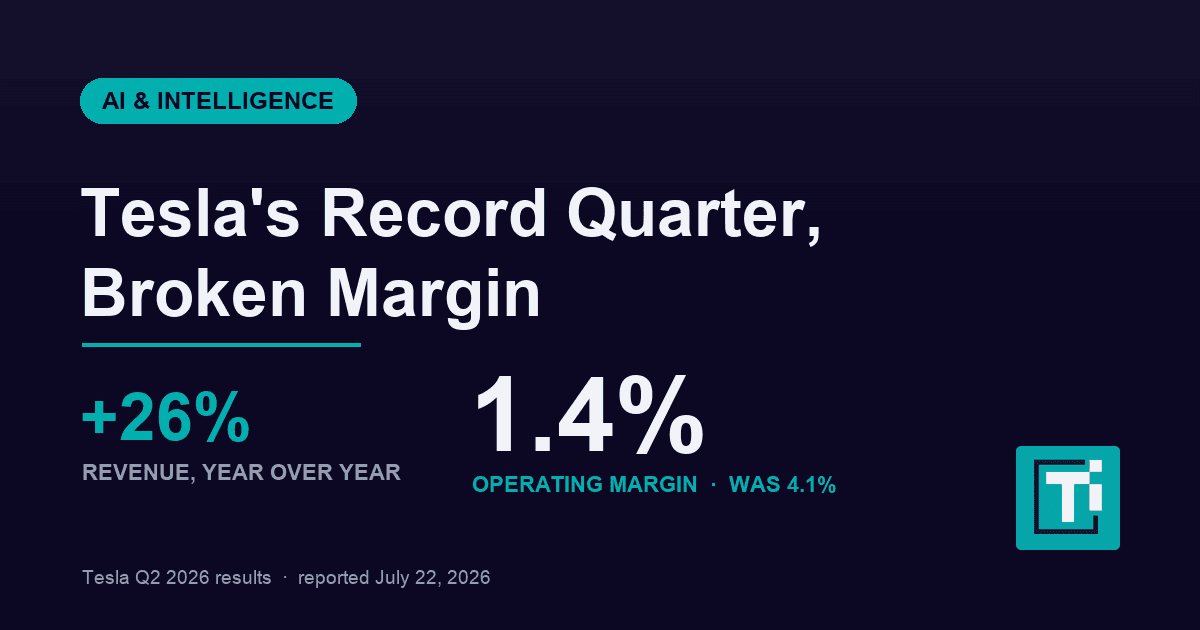
The numbers behind the reaction are not in dispute. Revenue rose 26% year over year to a record $28.24 billion, ahead of the roughly $25.7 billion Wall Street expected. Deliveries hit 480,126 vehicles, the fastest growth rate since 2023, the three delivery numbers investors had circled going in. By the top line, it was the strongest quarter Tesla has ever reported.
Everything good stopped at the operating line. Operating income fell about 57% to roughly $398 million, and operating margin dropped to 1.4% from 4.1% a year earlier. Adjusted earnings came in at $0.33 a share against the $0.49 or so analysts modeled. One familiar cushion thinned out at the same time: regulatory credit revenue, a near-pure-profit line Tesla has leaned on for years, collapsed to $146 million. A company that sold a record number of cars kept almost none of the money it took in, and the reason is the same one we traced through the margin math when the filing landed.
The money did not vanish. Capital expenditure jumped 142% to $5.79 billion, research and development rose to $2.37 billion, and free cash flow swung to roughly negative $1.1 billion. The spend went into the Robotaxi fleet, a purpose-built Cybercab line, the first Optimus manufacturing space, and silicon for the next inference chip. None of it pays back through the next batch of Model Ys. All of it is a bet on autonomy and robotics that Tesla does not yet run at scale.
The $455 question hiding in the targets
Here is why the analysts scattered instead of converging. If you read Tesla as a carmaker, this quarter was a disaster with a nice revenue headline: pricing power is eroding, the credit cushion is deflating, and the company is burning cash to defend volume that earns almost nothing. Value it on the car business and you land near JPMorgan's $145. The margin miss is not noise; it is the trend.
If you read Tesla as an autonomy and robotics platform that happens to fund itself by selling cars, the same quarter looks like a company pulling spending forward to build the thing that matters. Value it on the option, not the operating line, and you land closer to Wedbush's $600. The missing profit is not a wound; it is the invoice for the future.
Both camps are looking at identical figures. The disagreement is not about what happened but about which business you are buying. That is unusual for a megacap. Analysts argue about Nvidia's growth rate or Apple's services multiple, but they agree on what those companies are. On Tesla, after a record-revenue quarter, the market cannot agree whether it owns a cyclical automaker or a pre-revenue AI company, and the price targets are the scoreboard of that unresolved fight. It is a sharper version of the mismatch we pulled apart in why revenue and valuation keep pointing in different directions across Elon Musk's companies.
Why the miss sharpened the debate instead of ending it
A cleaner quarter would have quieted the argument. This one inflamed it, because the profit did not leak away into discounts or a demand air pocket. It was deliberately redirected into the exact autonomy program the bulls are underwriting and the bears refuse to pay for. The bull sees confirmation that management is committing at scale. The bear sees a car business whose economics are deteriorating in real time, with the payoff still a promise. The same $5.79 billion is Exhibit A for both.
Morgan Stanley put the tension in plain terms even while cutting its target, calling Tesla's "accelerating capex cycle a necessary investment to secure leadership in autonomy and robotics." Necessary, and still a reason to sit at Equal-Weight. That is the whole market in one sentence: the spending might be right and still leave the stock fairly valued at today's price, because the return is years out and the car business is thinner every quarter that funds it.
What the quarter did not provide was a timeline. Management offered few concrete new autonomy milestones on the call, which is the detail that let the bears keep their targets low and forced even friendly analysts to hedge. Robotaxi is expanding city by city and the reported safety record is clean so far, a build we walked through when fleet orders started testing Tesla's autonomy margins. But expansion is not the same as economics, and a network measured in millions of cumulative paid miles is still a rounding error against $5.79 billion of quarterly capex. Without a date attached to the payoff, every analyst is free to pencil in their own, and they did.
What the sell-off says beyond Tesla
Thursday was not only a Tesla story. The S&P 500 fell 1.21% to 7,408.30 and the Nasdaq Composite dropped 2.15% to 25,138, with Tesla the heaviest single drag. EV peers followed it down, with Rivian off 4.19% and Lucid off 4.87%, even though neither reported anything. Volume in Tesla ran to 114.2 million shares, about 131% above its three-month average, the kind of turnover that marks a genuine change of hands rather than a quiet drift.
The broader read is one Tesla now shares with the rest of the AI economy. The largest cloud companies have spent two years pouring capital into data centers and chips well ahead of the revenue those build-outs are meant to produce, and the market has mostly paid for the promise. Tesla is running the same playbook in the physical world, with depots and robots instead of server racks, but with one difference that Thursday exposed: the hyperscalers fund their bets from businesses throwing off enormous free cash flow, while Tesla is funding its bet from a car operation that this quarter generated almost no operating profit at all. When the cash engine sputters, the market stops paying for the promise and asks to see the profit. That is what an 11-month low priced in.
What to watch from here
For anyone holding or watching the stock, the useful signals are narrow and specific. The first is margin direction: operating margin at 1.4% is the number that turned a record into a sell-off, and whether it stabilizes or keeps sliding next quarter matters more than the revenue headline. The second is the capex line. Management signaled the elevated spending continues rather than snapping back, so a further step up would confirm the autonomy commitment and deepen the near-term drag at the same time.
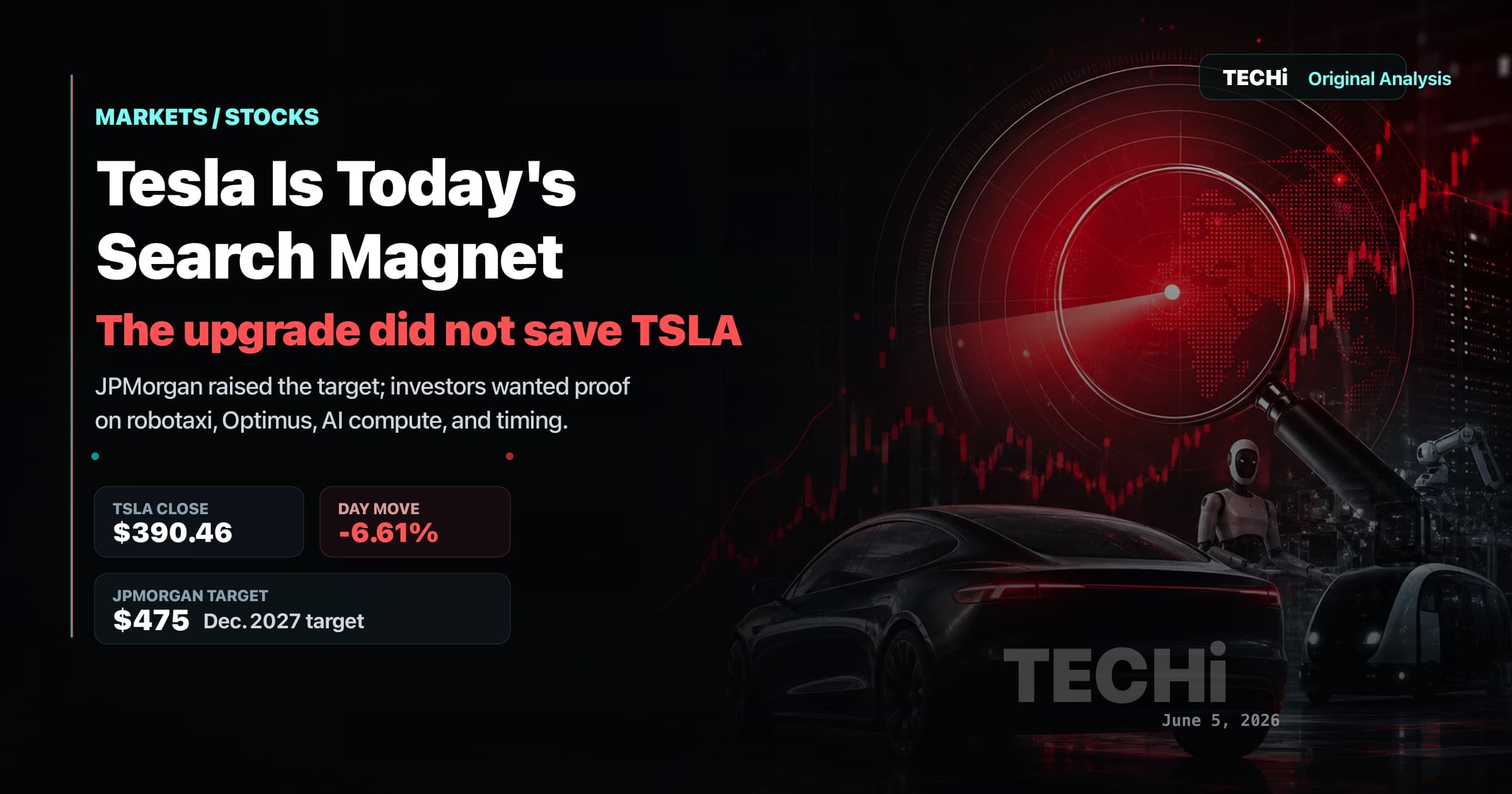
The third is any concrete autonomy metric with economics attached - paid Robotaxi miles that translate into disclosed revenue, a firm Cybercab production date, or an Optimus unit target. The bull case at $600 and the bear case at $130 both resolve the moment Tesla attaches real numbers to the autonomy story. Until it does, the stock trades on the argument, not the earnings, and days like Thursday are what that looks like. It is a long way from the mood only a few months ago, when a single upgrade was enough to make Tesla the market's search magnet.
None of this makes Tesla's AI bet wrong. It makes the bet visible, and expensive, and unhedged by profit. The record quarter proved Tesla can still sell cars faster than anyone expected. The 14.5% drop proved the market will no longer pay for that alone. Somewhere between $130 and $600 is a company that has to show the autonomy math works. The second quarter moved that deadline closer without answering the question.
FAQ
Frequently asked questions
Why did Tesla stock fall after Q2 2026 earnings?
Tesla reported record Q2 revenue of $28.24 billion, but operating margin fell to 1.4% from 4.1% a year earlier as capital spending jumped 142% to $5.79 billion. The stock closed down 14.5% at $319.69 on July 23, 2026, an 11-month low.
What are the analyst price targets for Tesla after Q2 2026?
Post-earnings targets ranged widely: Wells Fargo at $130 and JPMorgan at $145, both Underweight, on the low end, up to Wedbush at $600, Bullish, on the high end. The consensus sat near $408.
Did analysts downgrade Tesla after the Q2 miss?
Most firms cut price targets but kept their ratings. Goldman Sachs went to $375 (Hold), Truist to $400 (Hold), and Morgan Stanley to $400 (Equal-Weight). It was a repricing rather than a wave of downgrades.
Is Tesla a car company or an AI company?
That question is the core of the analyst disagreement. Valued on its car business, Tesla looks worth around $145; valued on its autonomy and robotics bet, closer to $600. Q2 capital spending went into Robotaxi, Cybercab, and Optimus rather than current car profit.

Disclaimer
This article is for informational purposes only and does not constitute financial, investment, tax, or legal advice. Market data, tax rules, and prices can change after the article date. TECHi and its authors may hold positions in securities or digital assets mentioned. Always conduct your own research and consult a licensed financial, tax, or legal professional before making decisions.


Comments