

- Search signalTesla was the cleanest single-stock search/trending candidate on June 5, 2026, as TSLA dominated same-day attention despite a sharp selloff.
- Upgrade tensionJPMorgan moved Tesla from underweight to neutral and raised its December 2027 target to $475, but TSLA still closed near $390.46.
- Proof gapThe stock is now a proof-of-platform trade: robotaxi, Optimus, AI compute, energy storage, and execution timelines matter more than a normal EV multiple.
Friday's most searched stock was not the one with the cleanest chart. It was Tesla, because TSLA gave investors the kind of contradiction that forces a search: a major Wall Street bear moved closer to neutral, the price target jumped, and the stock still sold off hard.
That is the right way to read the day. This was not a simple bullish upgrade story. It was a referendum on what Tesla is now supposed to be: an electric-vehicle company with expensive optionality, or a physical-AI platform whose auto business is only the first layer.
Yahoo Finance's Trending Stocks surface and same-day TSLA quote/news traffic made Tesla the cleanest single-stock search candidate on June 5, 2026. The catalyst was obvious. Reuters, via Investing.com, reported that J.P. Morgan upgraded Tesla to neutral from underweight, arguing that the company's valuation is increasingly tied to autonomous driving and robotics rather than near-term EV earnings. A separate Investing.com note put the new December 2027 target at $475, up from $145.
By the close, TSLA was near $390.46, down about 6.6% on the day. A $475 target implies roughly 22% upside from that closing level. That gap is the whole story. Investors were not ignoring the upgrade. They were asking whether the upgrade had finally caught up with the market's imagination rather than with the company's current earnings base.
Why Tesla became the day's search stock
Tesla's search pull came from the collision of three narratives.
The first is the JPMorgan pivot. For years, Tesla bulls argued that the company should not be valued as a normal automaker. The new JPMorgan framing moved closer to that view by emphasizing robotaxis, humanoid robots, AI chips, software services, and energy storage. That matters because it validates the argument that Tesla's multiple is not really about this year's vehicle margin.
The second is the proof gap. A neutral rating is not a table-pounding buy, and a higher target does not erase execution risk. The market can accept that Tesla has more optionality than Ford or GM and still decide that a trillion-dollar-plus valuation already discounts too much of it.
The third is timing. Same-day reports said Tesla had pushed the next-generation Roadster demo to August or later because of thruster-system issues. The Roadster itself is not the financial center of the Tesla thesis. But another delay matters symbolically because TSLA trades on timelines. Robotaxi, Optimus, AI5, Cybercab, Semi, Megapack 3, and SpaceX collaboration all depend on investors believing that hard engineering milestones become real businesses on a reasonable schedule.
The bull case has more evidence than it used to
The strongest Tesla argument is not that the stock is cheap on current earnings. It is that current earnings are a bad map for what the company is trying to become.
Tesla's Q1 2026 update gave bulls real material to work with. The company reported $22.387 billion of revenue, up 16% year over year; $941 million of GAAP operating income, up 136%; $477 million of GAAP net income; and $1.444 billion of free cash flow. It also ended the quarter with $44.743 billion of cash, equivalents, and short-term investments.
The operating layer matters more than the headline revenue. Tesla said it had launched unsupervised Robotaxi rides in Dallas and Houston in April, continued ramping AI compute, prepared production lines for Cybercab and Semi, and advanced Optimus factory work. Its Q1 operating summary also showed 1.28 million active FSD subscriptions and 8.8 GWh of storage deployed. Earlier in April, Tesla said it had delivered 358,023 vehicles in Q1.
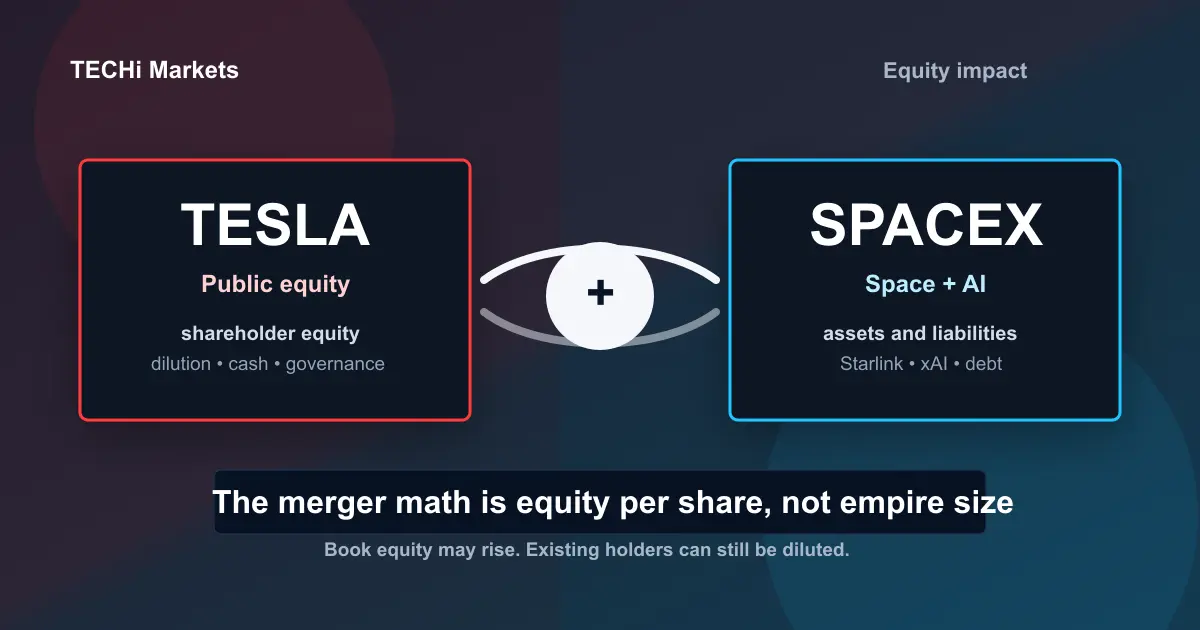
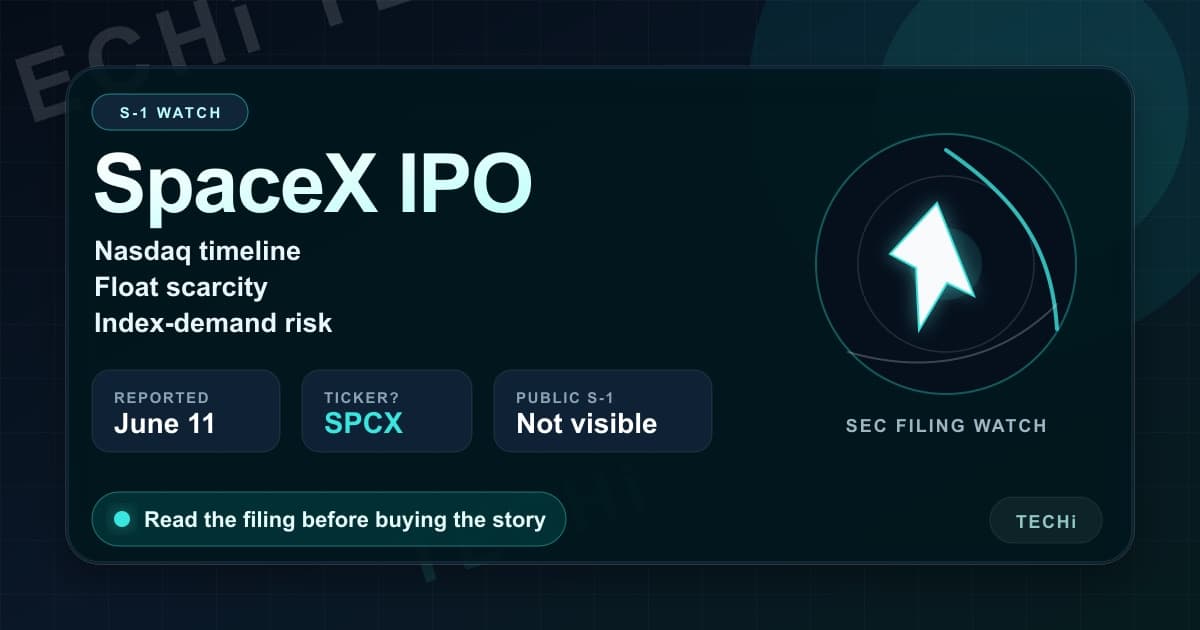
That mix is why the stock keeps attracting searches even on down days. Tesla is not just a car ticker anymore in the public-market imagination. It is a bundle of questions about autonomy, robotics, energy storage, AI inference, manufacturing, and SpaceX overlap. TECHi's recent Tesla-SpaceX wealth thesis and SpaceX IPO analysis covered the larger convergence story; today's TSLA move narrows the question to whether public investors are getting enough proof for the price.
Why the stock still fell
The bearish answer is simple: Tesla still has to earn the story.
At roughly $390 per share and a market value around $1.4 trillion, the stock does not need investors to believe Tesla can sell more Model Ys. It needs them to believe that autonomy and robotics can become large, high-margin profit pools before dilution, competition, regulation, or execution delays eat the optionality.
That is why the JPMorgan note did not save the tape. A sell-side model can raise the terminal opportunity set, but the market still has to mark the present. If robotaxi revenue stays small in 2026, if Optimus remains mostly a factory-demo narrative, or if auto margins compress while capex rises, then the stock's premium becomes harder to defend.
Tesla's own Q1 deck shows both sides. The cash balance and free cash flow give the company time. The $2.493 billion of Q1 capital expenditures and the broader buildout of AI compute, battery materials, robotics capacity, and supporting infrastructure show how expensive the transition is. Optionality is valuable, but it is not free.
The TECHi lens: TSLA is a proof-of-platform trade
The useful way to analyze TSLA now is not EV bull versus EV bear. That argument is too small.
On TECHi's TSLA quote page, the stock belongs in the same research universe as AI infrastructure and autonomy names, not just auto manufacturers. The better comparison set lives across TECHi's stocks command center: AI platforms, autonomy, energy, semiconductors, and infrastructure businesses that are all trying to turn physical-world bottlenecks into software-driven margins.
That does not mean Tesla should trade like Nvidia. Nvidia is selling the compute layer today. Tesla is trying to convert physical assets, vehicles, factories, energy systems, and robots into recurring software and services over time. That makes the payoff potentially huge, but also less proven.
The next data points should be operational, not promotional. Investors need robotaxi utilization, safety record, revenue per mile, expansion pace, and regulatory clarity. They need Optimus doing repeatable factory work at meaningful scale. They need storage growth without margin disappointment. They need evidence that AI5, Dojo, and Tesla's manufacturing integration reduce cost rather than simply absorb capital.
What would change the argument
The bull case gets stronger if Tesla can show that physical AI is moving from narrative to measured economics. A few signs would matter more than another price-target hike: commercial robotaxi miles rising by market, paid FSD adoption climbing without heavy discounting, Optimus improving factory throughput, Cybercab and Semi moving into volume production, and energy storage scaling with credible margins.
The bear case gets stronger if the opposite happens: timeline slippage, regulatory pauses, weak delivery momentum, margin pressure, or AI/robotics spend that keeps pushing the payoff further out. That is why the Roadster delay had an outsized narrative effect. It reminds investors that even products outside the core model can reinforce a broader timeline discount.
Bottom line
Tesla was today's search stock because it gave both sides something to work with. Bulls got a high-profile validation that TSLA is increasingly an autonomy and robotics story. Bears got a stock that still fell sharply despite that validation.
That is not confusion. It is price discovery.
The market is no longer asking whether Tesla is only an automaker. That debate is fading. The question now is tougher: how much of the robotaxi, Optimus, energy, AI chip, and SpaceX-adjacent future should be paid for before the proof shows up in cash flow?
Until that answer is clearer, TSLA will keep doing what it did today: dominating search interest, splitting the tape, and forcing investors to decide whether they are underwriting a company or a mission.
FAQ
Frequently asked questions
Why was Tesla the most searched stock today?
Tesla drew outsized attention on June 5, 2026 because JPMorgan upgraded TSLA to neutral and raised its target to $475, while the stock still sold off sharply. That contradiction made investors reassess the robotaxi, Optimus, AI, and EV valuation story.
Did JPMorgan turn bullish on Tesla?
JPMorgan moved Tesla from underweight to neutral and raised its December 2027 target to $475. That is more constructive than its prior stance, but it is not the same as a buy rating.
What is the key issue for TSLA stock now?
The key issue is proof. Investors need evidence that robotaxi, Optimus, AI compute, energy storage, and software can become large profit pools rather than long-term optionality priced into the stock too early.
Is this Tesla article investment advice?
No. TECHi market articles are educational and editorial analysis only, not personalized financial advice or a recommendation to buy, sell, or hold any security.

Disclaimer
This article is for informational purposes only and does not constitute financial, investment, tax, or legal advice. Market data, tax rules, and prices can change after the article date. TECHi and its authors may hold positions in securities or digital assets mentioned. Always conduct your own research and consult a licensed financial, tax, or legal professional before making decisions.
About the Author
Omer SheikhOmer Sheikh is a markets editor at TECHi. His published work covers public companies, with particular attention to AI infrastructure, semiconductors, Tesla and SpaceX. His portfolio includes company results, stock comparisons and conditional forecasts, examining demand, capital spending and the business assumptions behind market valuations.


Comments