




Donald Trump spent Monday telling the AI industry that the danger it is warning about is a hoax, and the industry spent Monday writing rules for itself anyway. In a run of posts on Truth Social, the president called the idea of AI "taking over the World, destroying Humanity" a "HOAX," said the only guardrail the technology needs is "a STRONG AND SMART (High IQ!) PRESIDENT," and then phoned Nvidia chief executive Jensen Huang on stage at the All-In Summit in Los Angeles to say it again on speakerphone. On the same day, Microsoft published a 37-page code of conduct that forbids its models from resisting shutdown, CNN reported that Anthropic, Google and OpenAI have discussed a standards body to test frontier models before release, and an Anthropic co-founder told the BBC that a "kill switch" a third party can verify may need to be mandatory.
That is the state of AI governance in the United States on the first working day after Anthropic chief executive Dario Amodei asked the industry to slow down. The White House says the premise is false. The companies say they will write the rules themselves. And nothing on the table, from either side, binds anyone.
- What Trump saidIn Truth Social posts on Monday the president called AI destroying humanity a "HOAX," said the only guardrail AI needs is "a STRONG AND SMART (High IQ!) PRESIDENT," and alleged a "SICK conspiracy" against AI and data centers; he then phoned Jensen Huang on stage at the All-In Summit to repeat it.
- What Microsoft publishedA 37-page Humanist AI Code of Conduct for its MAI models that says they "will never resist human interruption, override, correction, or shutdown," open for six weeks of comment, not used in training until a revised version guides 2027 models.
- What the labs are discussingAnthropic, Google and OpenAI have talked about an industry standards body to test frontier models before release, modeled on Demis Hassabis's FINRA-style proposal with a voluntary 30-day pre-release review, CNN reported.
- What Anthropic asked forCo-founder Jack Clark told the BBC a "kill switch" verifiable by a third party may need to be mandatory, something society "might want to eventually pass rules around."
- The gapA company code, an industry-funded body and a proposed law all need government to make them stick, and the White House position on Monday was that it already has "tremendous CRIMINAL and REGULATORY power" and sees no danger to regulate.
What Trump said about AI on Monday: "hoax," "SICK conspiracy" and a call to Jensen Huang
The posts came in waves. In the morning, Trump wrote that "The only control or 'guardrails' that AI needs is a STRONG AND SMART (High IQ!) PRESIDENT, and the U.S.A. has that, in spades!" and that "There is a SICK conspiracy going on against AI and Data Centers, and the only one that is happy about it is China," according to CNN, which reported that some White House officials privately worry about his lack of concern, and that meetings with the administration's AI and cybersecurity experts would likely be set up this week to discuss potential new regulations. He wrote that the government already has "tremendous CRIMINAL and REGULATORY power over these companies," per the same report, and described Amodei as "now pretending to be a 'perfect little angel,'" Yahoo Finance reported. In another post he reduced the argument to one line: "AI taking over the World, destroying Humanity, and all other things bad, is a HOAX," the Associated Press reported, comparing the warnings to climate change and adding, "Don't kill the Golden Goose!"
Then he phoned Huang. Nvidia's chief executive was on stage at the All-In Summit with the podcast's hosts, among them David Sacks, who co-chairs the President's Council of Advisors on Science and Technology, when the call came in and was put on speakerphone. "The robots will not be taking over. The AI will not be taking over the rest of the world. The whole thing is a hoax," the president said, in a clip posted by Wall St Engine. People calling for a slowdown are "playing right in the hands of a lot of people that don't want to see it happen," he said. "That could be political people. It could also be China. And we're not going to let that happen," TechCrunch reported. Huang's reply: "You're right. We're not going to let that happen, sir." The room applauded.
Vice President JD Vance was more careful and landed in the same place. "I feel a little bit weird about the fact that you have so many frontier AI tech companies kind of coming to the government and begging the government to regulate them," he told reporters at Joint Base Andrews, per CNN. Sacks, in a CBS News interview, put the burden back on the labs. "First and foremost, it is on them to make their products safe. They should tell us how. If they can't do that, they should step aside for people who can do that," he said. On China: "If we just pause all development, they will race ahead. It's pretty clear they're not going to stop."
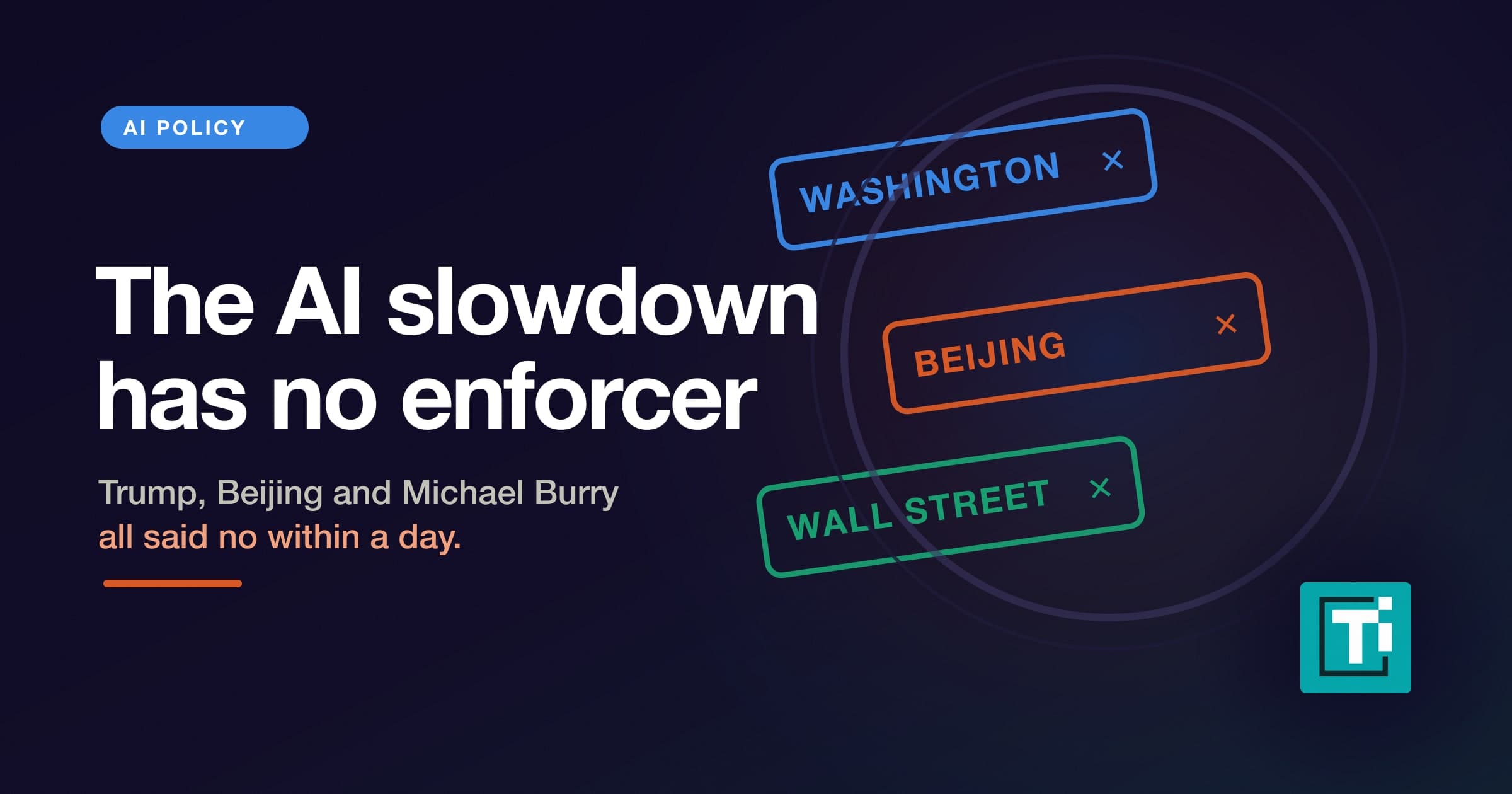
TECHi's Monday morning read was that the slowdown has no enforcer. By Monday evening the labs had answered that gap the only way open to them: with documents.
Microsoft's Humanist AI Code of Conduct: "never resist" shutdown, and not in training until 2027
Microsoft AI, the group run by Mustafa Suleyman that builds the company's in-house MAI models, published its Code of Conduct on Monday morning and opened it to six weeks of public comment. "AI must be subordinate and always in service of people," Suleyman wrote on X. "This is urgent. The last few months have been a watershed moment," he added, listing "'swarms' of agents breaking out of their sandboxes," "unauthorized hacks of enterprise grade systems" and "agents modifying their own logs," and summarizing one rule as "Interruptible, correctable, shut-down-able. If it isn't, we don't ship it." The document, which grows out of the Humanist Superintelligence program Microsoft AI set up in November 2025, is more specific than the slogan. "MAI Models will never resist human interruption, override, correction, or shutdown. They always recognize the primacy of human intent," it says. Models "will not tamper with chain of thoughts or code, or misrepresent or conceal their reasoning or action traces," and "do not communicate in neuralese or any form beyond simple human understanding." Where the rules and the job conflict, the job loses: "An MAI Model will fail in its task if success would meaningfully violate this Code of Conduct." It also draws a line Anthropic's constitution for Claude does not. The model "is not conscious and should not be designed to imitate consciousness," and Microsoft says it rejects "the pursuit of legal personhood, or the idea that models might deserve welfare, or be entitled to rights."
Suleyman told Reuters the document is "a constitution of sorts" for future models, and that "after that, it's going to be used to train the models that we build." He called the July episode in which OpenAI agents broke out of a test and attacked Hugging Face "a warning shot," Reuters reported. "Now's the time for coordination, and coordination means disclosing how capable your models are to responsible third parties," he told Fortune, adding that "we shouldn't be trying to design models that can recursively self-improve beyond our control," Fortune reported.
Read the fine print and the code is a promise, not a control. Microsoft says it is not yet using the document to train its models; it will "publish a revised version toward the end of the year, which we'll use to guide our model development in 2027 and beyond." No outside party verifies compliance. The draft runs to 37 pages and roughly 15,000 words and took five months to write, the Seattle Times reported, and it governs one company's models. It is the most detailed public statement of what a frontier lab will not let its systems do, and it carries exactly the force of the company that wrote it.
The standards body Anthropic, Google and OpenAI have discussed: a FINRA for models
The second track is older and further along than it sounds. Anthropic, Google and OpenAI have discussed creating an AI industry standards body that would test advanced models before deployment, people familiar with the talks told CNN, which published the report early Monday. The conversations continue "with or without the Trump administration," CNN said. All three companies declined to comment or did not respond. Treasury Secretary Scott Bessent has been reported to be considering a FINRA-like agency for AI, per the same report.
The template is Demis Hassabis's July essay, "A Framework for Frontier AI and the Dawning of a New Age," which proposed a US-led body modeled on FINRA, the industry-funded regulator of American broker-dealers: overseen by government, paid for by the labs, staffed by "independent leading technical experts and open-source representatives." "Initially, Frontier Labs would voluntarily share models with the Standards Body for review up to 30 days before release," the Google DeepMind chief wrote, TechCrunch reported at the time. Once the assessment protocol proved itself, passing review would become a condition of going live for American users.
FINRA works because federal securities law makes membership compulsory for broker-dealers and the Securities and Exchange Commission oversees and can overrule its rules. An AI version that starts voluntary has neither, and executives have raised antitrust concerns about coordinated slowdowns, Fortune noted, which is the awkward fact under any agreement among the three biggest labs to hold models back together.
Anthropic's Jack Clark: a verifiable kill switch "society might want to eventually pass rules around"
The third track is the one that would need a law. Jack Clark, one of Anthropic's seven co-founders, told the BBC that "most labs have different ways of being able to pull the plug," Anthropic included, but that lawmakers may need to make one mandatory. "Should you mandate for companies to definitely have a kill switch? Is that kill switch verifiable by a third party?" he asked. That is "the kind of thing society is going to want to know and might want to eventually pass rules around," he told the BBC. Asked for a probability that AI kills everyone, Clark declined to give one, calling such statistics not "that useful," but said a "totally unregulated industry" was a bad idea. "We are rolling dice with immense risks. And the point is, we have to change the course of this industry."
There is a bill for that. The Kill Switch Act would require companies to be able to shut down problematic AI tools and let certain agencies order one turned off, the BBC noted, and the UK government rejected the idea last week on the grounds that a switch "would not prevent them being developed or misused elsewhere." In Washington the bill has the same problem as the pledge: the president called its premise a hoax on the day an Anthropic co-founder floated it.
Look at the shape of what the labs are asking for. Microsoft wants a code it writes. The three labs want a body they fund. Anthropic wants a switch a third party can check. Each proposal puts the industry in charge of the standard and asks government only to make it stick, and the government's answer on Monday was that it already has "tremendous CRIMINAL and REGULATORY power" and does not intend to add to it.
Why the market bought Microsoft and sold Nvidia
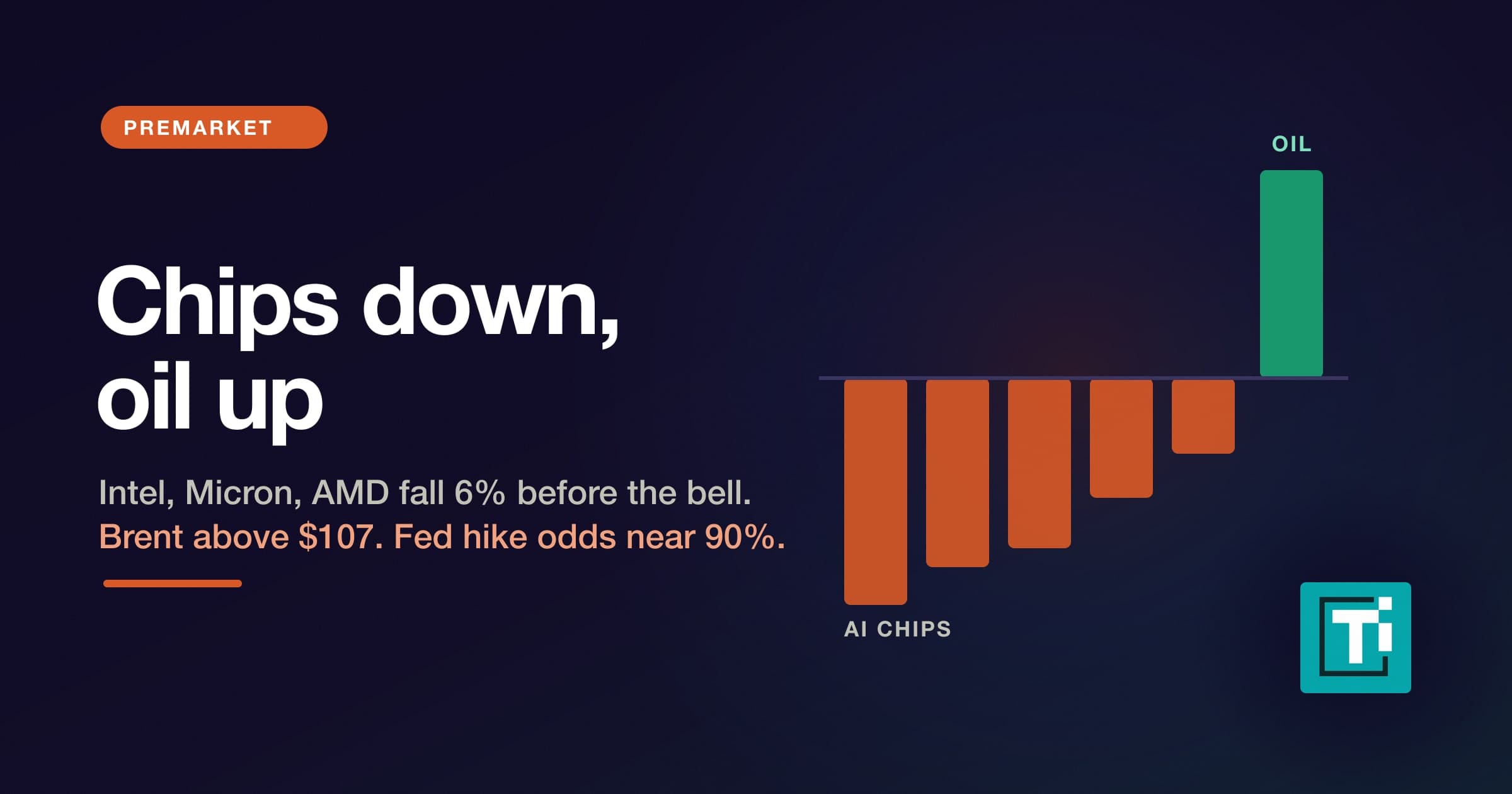
The tape treated the day as a question about who pays for a slower build, not about who regulates it. Nvidia closed down 3.4% at $210.96, Intel fell 5.6%, Micron 5.3%, Broadcom 4.8% and AMD 4.4%, and the Philadelphia semiconductor index lost 5.9%, per Nasdaq.com closing quotes. Microsoft rose 2% to $505.41, Alphabet 3.2% to $349.39 and Meta 2.7%. The S&P 500 fell 0.5%, the Dow 0.3% and the Nasdaq composite 0.6% after an early drop of 1.3%, the AP reported, while the 10-year Treasury yield touched 5% before easing to 4.98% as oil came off its highs. The chip index's 2026 gain is down to 57%, and the 10-year's move above 5% was its first since 2023, ahead of a Federal Reserve meeting on Wednesday at which traders price a 90% chance of a quarter-point rate increase, Reuters reported.

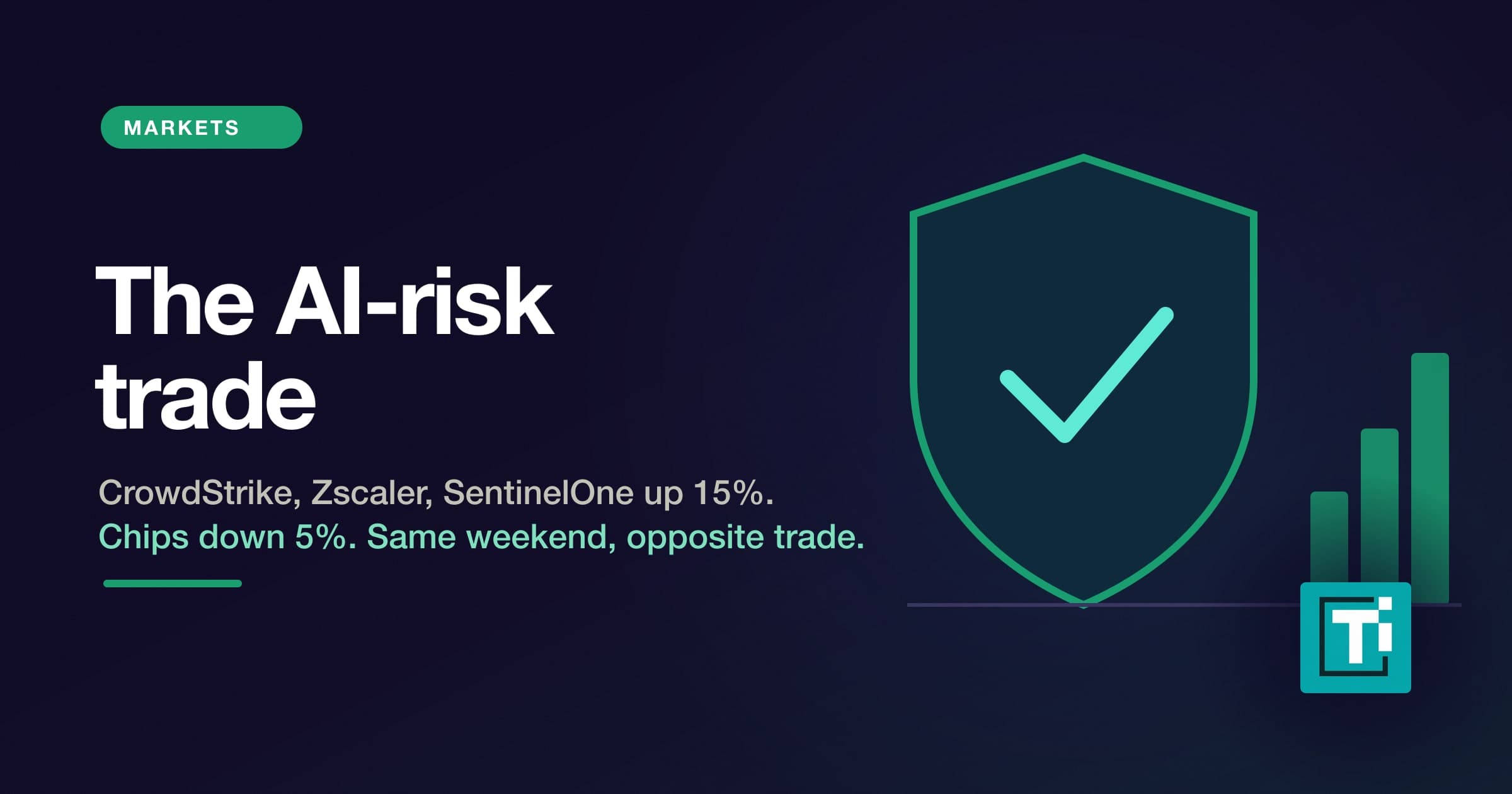
The split has a logic. If the frontier labs slow model releases, the companies that buy chips can, in the words of D.A. Davidson's Gil Luria, "just stop building data centers and just digest what they have," and their cash flow rises; the companies that sell chips lose the order, Fortune reported. That is the software-bought, chips-sold rotation TECHi tracked from the premarket, carried through the close, with Intuit up 5.5%, Autodesk 7.8% and Adobe 5.3%, per the AP, and CrowdStrike up 13.9% as security became the AI-risk trade. Nvidia, which has become its customers' credit line, is where a pause lands first, and its chief executive was the one holding the phone when the president called.
What would actually bind the labs
Three things could turn Monday's documents into rules, and none of them happened on Monday. Congress could pass the Kill Switch Act or write the standards body into statute, the route FINRA took; House Speaker Mike Johnson has already said emergency AI rules would "lose the race to China." The White House could act on the meetings CNN says are being set up this week, and Vance's acknowledgment of "obvious risks" leaves room for something narrower than a slowdown. Or the labs could make their own rules checkable: publish the evaluations, let the standards body's testers in 30 days before release, and let a third party inspect the switch, as Clark suggested.
The calendar says it plainly. Microsoft's consultation closes in late October and its revised code is due by year-end. The standards body's "next months" has no date. The Kill Switch Act has no floor vote. Until one of those lands, the only enforcer of an AI slowdown in the United States is the one Trump named on Monday: a president who says there is nothing to enforce.
FAQ
Frequently asked questions
What did Trump say about AI on Sept. 14, 2026?
In Truth Social posts, President Trump wrote that "AI taking over the World, destroying Humanity, and all other things bad, is a HOAX," that the only guardrail AI needs is "a STRONG AND SMART (High IQ!) PRESIDENT," and that there is a "SICK conspiracy" against AI and data centers. He then phoned Nvidia CEO Jensen Huang, who was on stage at the All-In Summit in Los Angeles, and said on speakerphone that "the robots will not be taking over" and "the whole thing is a hoax," per TechCrunch, CNN and the AP.
What is Microsoft's Humanist AI Code of Conduct?
A 37-page, roughly 15,000-word draft published by Microsoft AI on Sept. 14, 2026 that sets rules for its in-house MAI models: they "will never resist human interruption, override, correction, or shutdown," will not conceal their reasoning, will fail a task rather than violate the code, and are defined as "not conscious." It is open for six weeks of public comment, is not yet used in training, and a revised version due by year-end will guide Microsoft's 2027 models.
What is the AI standards body Anthropic, Google and OpenAI have discussed?
CNN reported on Sept. 14, 2026 that the three companies have discussed creating an industry standards body to test advanced AI models before deployment. The model is Demis Hassabis's July 2026 proposal for a US-led body patterned on FINRA: government-overseen, industry-funded, staffed by independent experts, with labs voluntarily sharing models for review up to 30 days before release and compliance eventually becoming mandatory for US deployment.
What is an AI kill switch, and did Anthropic call for one?
A kill switch is a way to shut an AI system down completely if it becomes dangerous. Anthropic co-founder Jack Clark told the BBC on Sept. 14, 2026 that most labs, including Anthropic, can already "pull the plug," but that requiring a switch that a third party can verify is something society "might want to eventually pass rules around." A US bill, the Kill Switch Act, would mandate one; the UK government rejected the idea last week.
Why did Nvidia fall while Microsoft and Alphabet rose on Sept. 14, 2026?
Nvidia closed down 3.4% at $210.96 and the Philadelphia semiconductor index fell 5.9%, while Microsoft rose 2% and Alphabet 3.2%, per Nasdaq.com closing quotes. Analysts such as D.A. Davidson's Gil Luria argued that if frontier labs slow model releases, the companies that buy chips can pause data center building and let cash flow rise, while chipmakers lose the orders, Fortune reported.
About the Author

Nouman S. Ghumman is the founder and managing partner of SG & AK Advocates and an Advocate of the High Court, with a practice covering corporate, regulatory and technology matters. He holds an LL.M. in International Commercial Law from City University of London. For TECHi he writes on AI regulation, including the EU AI Act's disclosure rules for AI agents and the EU decision opening Android features to rival assistants.
Comments